When visiting the Waddington Duck Race, a duck race taking place once a year here in England’s North West, I was happy to see that the bureaucratic side of the duck race was run by Staedtler’s Minerva pencils.
The Minerva didn’t used to be common in the UK at all, but a few years ago it suddenly made it into lots of corner shops.
Staedtler Minerva
My employer, a university, also sold it in its shops. Unfortunately, since then the Minerva has disappeared nearly as fast as it appeared.
This made me even happier when I found many of them in the booth where the race tickets were sold (in the cardboard box in the photo above). They were used to record details of participants.
The race started at this end.
Luckily Staedtler pencils haven’t disappeared. They are still the staple pen of British schools. I hope this will be the case in the future, even after Staedtler’s switch to more Gmelina wood.
This blog had quite a few Wopex related blog posts over the years – and here’s the latest one: about the new generation of Wopex pencils. This is the third generation I know of, but there might have been more.
Previously… on Bleistift.blog
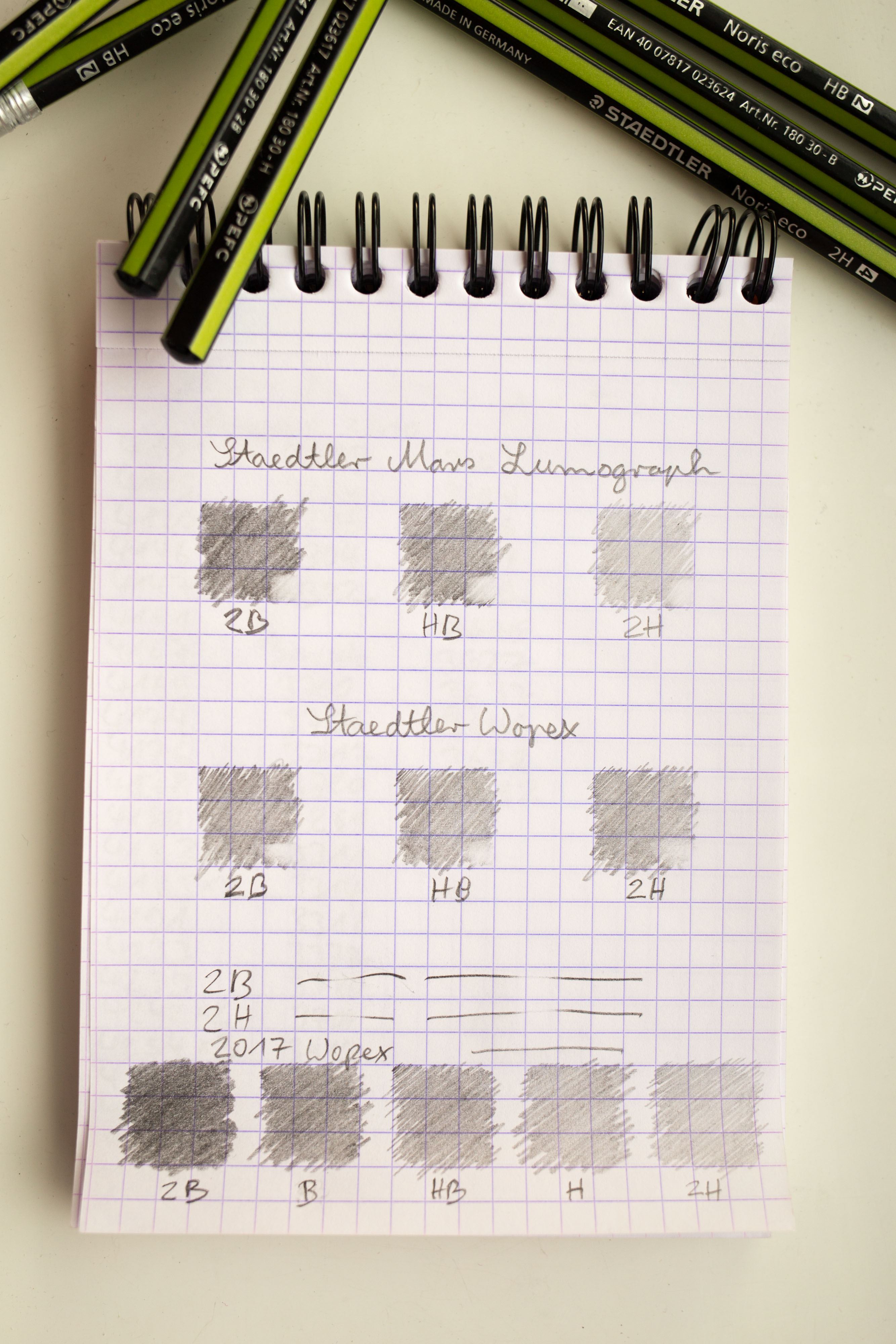
I got the sheet from the 2010 blog post out and added the new 2017 grades.
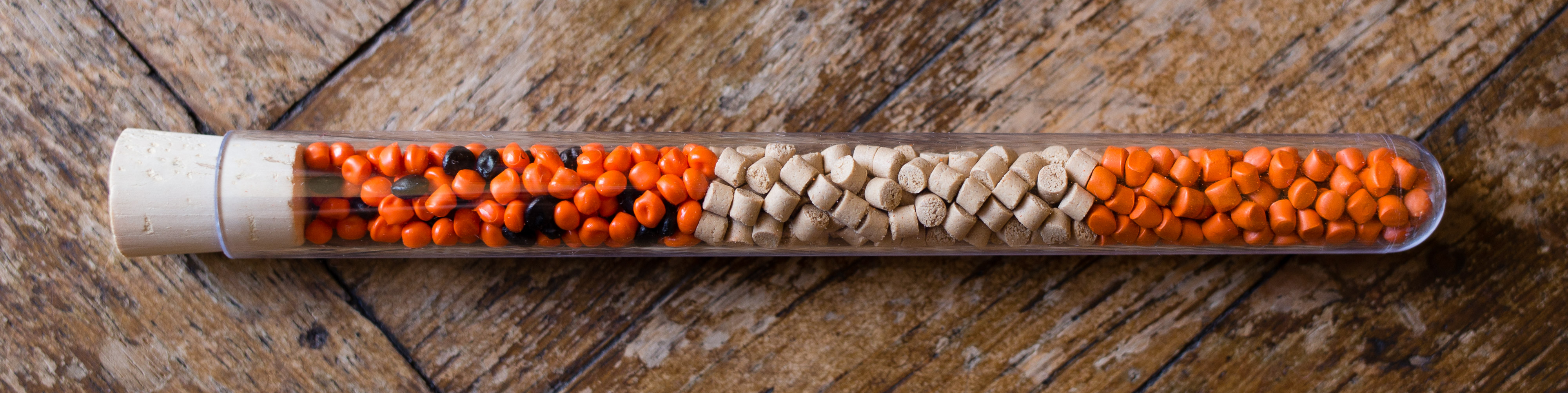
Just a quick reminder. Staedtler introduced the Wopex (pencil) in 2009 – it’s an extruded pencil and its body is made from a wood-plastic-composite (which consists of more wood than plastic). In 2010 Staedtler introduced the Wopex in 2B and 2H. I had a closer look at the 2B and 2H version in a 2010 blog post and couldn’t find much difference between the 2B, HB and 2H version. Fast forward to 2016. By now Staedtler is using the term Wopex only to describe the material used to make these pencils. Wopex is not used anymore as a name for the pencil itself – at least not by Staedtler. At the Insights X 2016, they had a few prototypes of the new ‘Wopex material’ Noris eco in 2H, H, HB, B and 2B. At the Insights X 2017, they showed the final product.
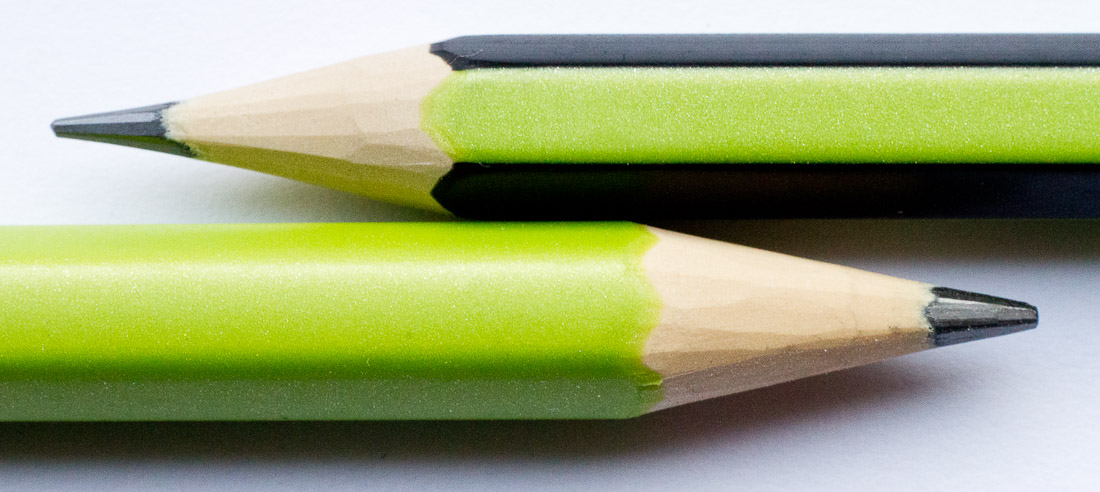
Close up of the 2010 vs. 2017 comparison
The new 2017 Noris eco
Looks
The design of the Noris eco is clearly inspired by Staedtler’s European staple pencil, the Noris, but like other Wopex material pencils, the surface of the extruded Noris eco feels rubberised. It is also eco-green, but has the same black stripe pattern as the yellow Noris or the red Tradition: The two opposing, labelled sides (let’s call them top and bottom) of this hexagonal pencil are black. The four sides (let’s call them the two right and the two left sides) are green with a think black stripe in between. I am mentioning this because some of the prototypes had a different pattern.
Unlike previous Wopex material pencils, the new Noris eco has a cap. It’s cool, man.
Great news. There’s a proper difference between the different grades in the new 2017 version. In terms of darkness and in terms of point retention. Compared to the Mars Lumograph in 2B, which is a very easy to erase pencil, the new Noris eco in 2B is more difficult to erase.
Eraser test – the bottom right square has been erased
If you see them in a shop I urge you to give them a try.
Last month Tombow released a new eraser (Japanese announcement, Google translation). It’s quite similar to an old, familiar friend, the Staedtler Mars plastic, but with a Tombow Mono inside. The eraser stick has a diameter of 6.7 mm and a length of 100 mm.
Tombow’s new Mono Stick and Staedtler’s Mars plastic
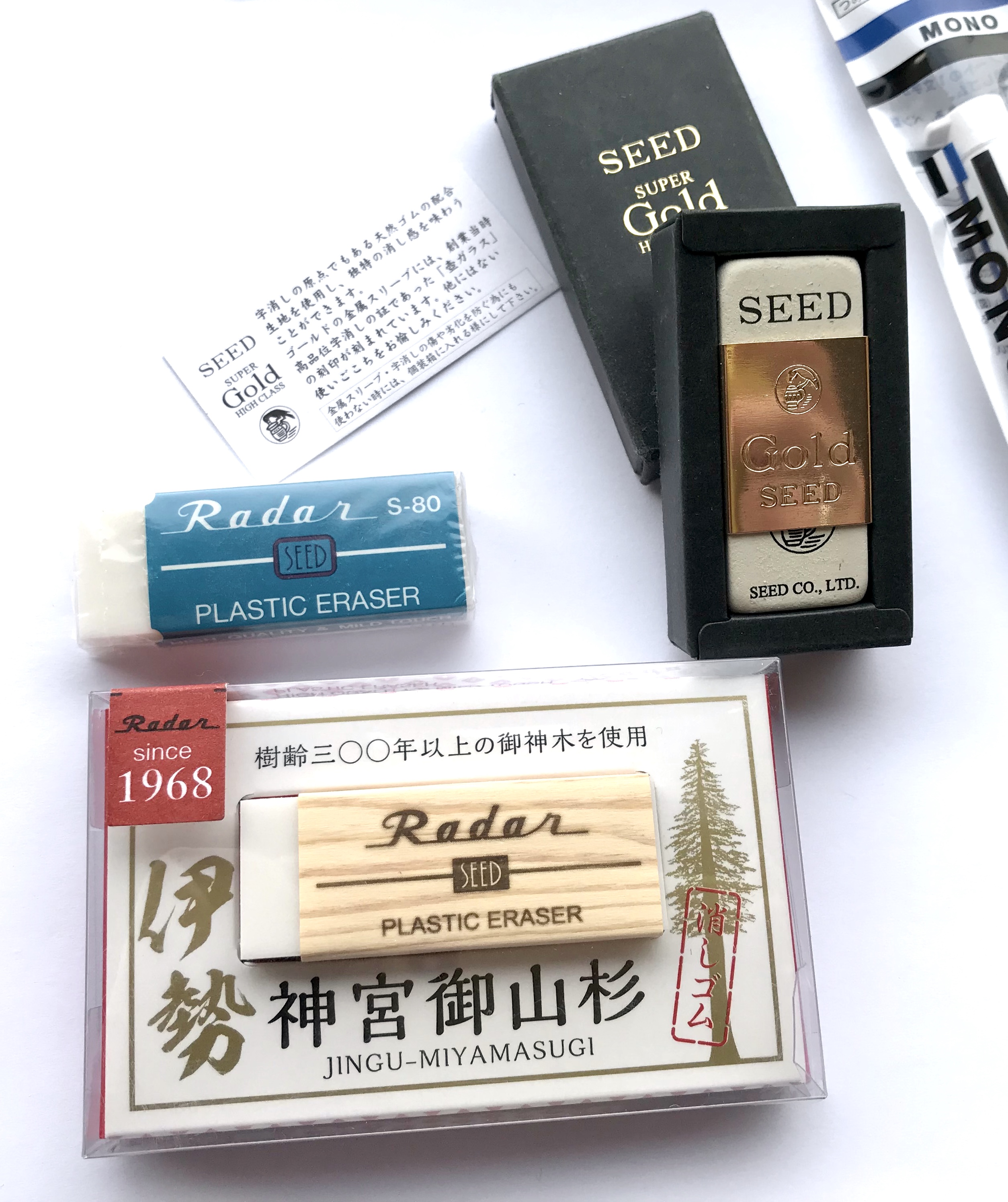
Tombow isn’t the only company with new erasers. Look at this special eraser from Seed. Seed’s Radar is one of their famous erasers. This version has a sleeve made from 300 year old cedar wood.
Cedar Seed
Here it is again, next to some other Seed erasers.
..as well as a nice sharpener and organiser from Nakabayashi. There’s an automatic (~£28; $39, €31) and a manual version (~£9; $13; €10) of the Pacatto sharpener.
The Stationery King [1]Sean rightly wonders whether he shouldn’t be the emperor of stationery. did of course have several appearances, too).
…and now for something completely different. I dare to include it because it has hexagonal in the title: Hexagonal Phase.
The computer animations from the TV series were actually hand drawn.
I would like to thank Yumiko for the nice parcel and Gunther and Sola for the additional information.
The Hitchhiker’s Guide to the Galaxy images in this blog post are from the BBC series of the same name. I believe that the use of the image shown in this blog post falls under “fair dealing” as described by the UK Copyright service.