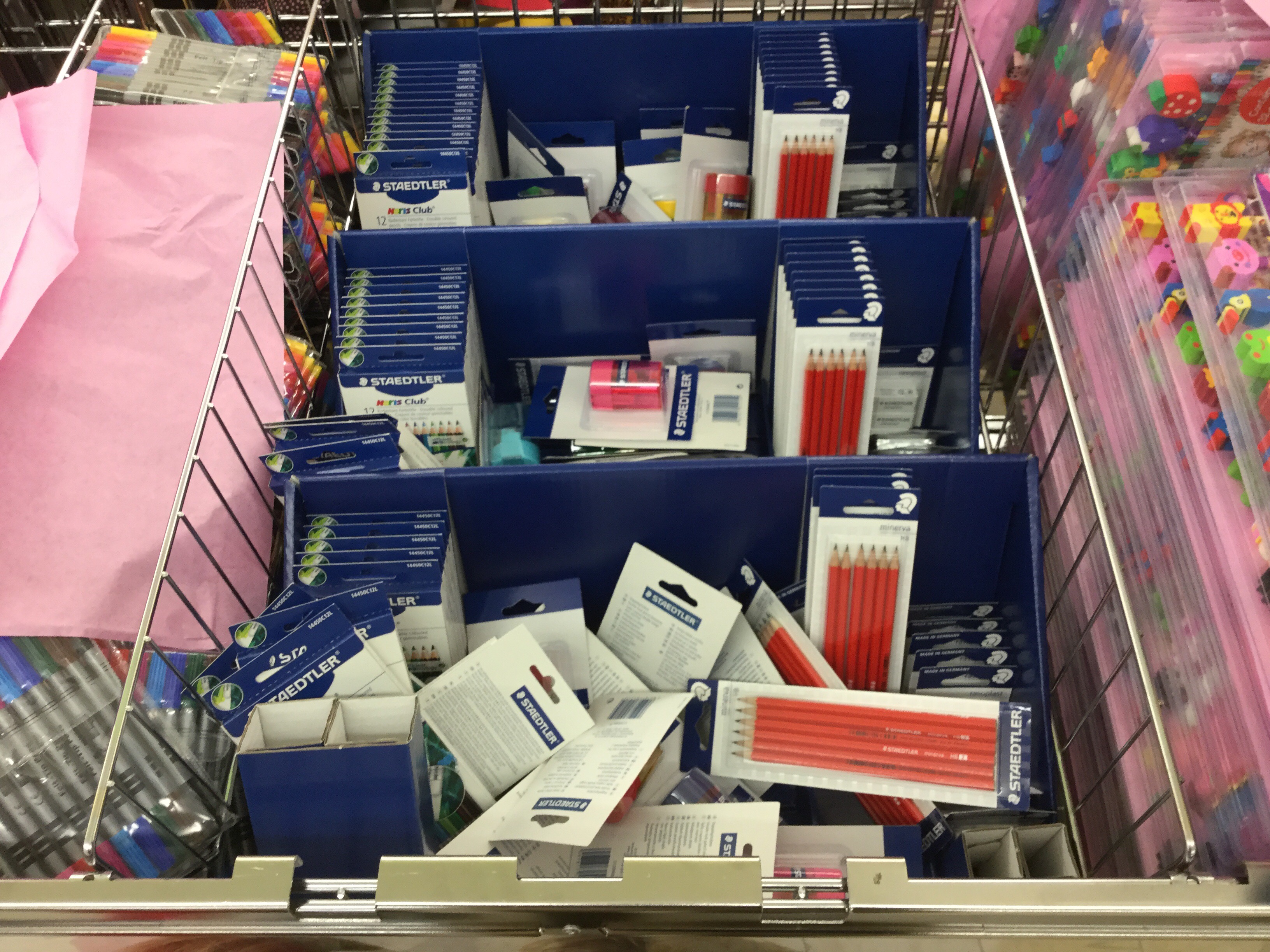
What a nice surprise. Yesterday I got this Staedtler pencilmaker set. Christoph, a blog reader bought it in Staedtler’s shop in Nuremberg and sent it to me (and postage was quite expensive). Thank you very much.
The pencilmaker set came out in 2011, you might have seen this blog post at the time, and at that time you could also buy it online in the UK. I assume what is being sold in Nuremberg is stock left from that time.
I made a little video showing the set and how it is being assembled. I suggest you watch it on YouTube for a better resolution. I also suggest watching it with an increased playback speed (I like 1.5x).
ISOT 2016
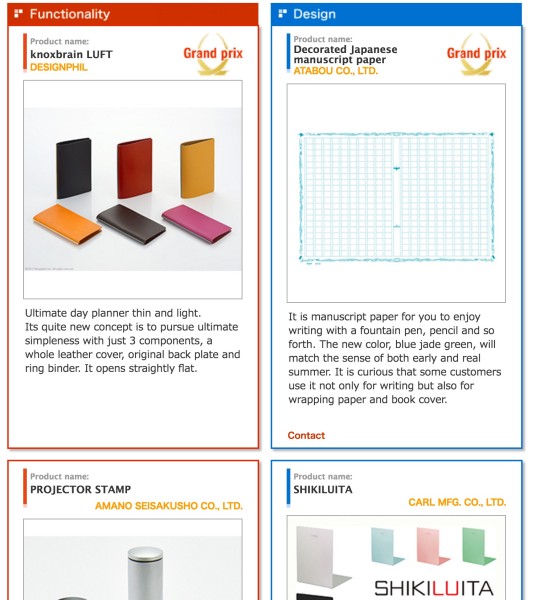
ISOT is the International Stationery & Office Products Fair Tokyo. Yumiko has made me aware that their Stationery Of The Year product list is out. Thank you. Have a look at the web site. It’s in English.
There were a few great blog posts about Faber-Castell’s Perfect Pencil on Sean’s (retired) Pencils and Music blog and the (also retired) Pencil Talk blog had a whole series of blog posts about the different versions.
I have used Faber-Castell’s Perfect Pencil for quite a few years now and have mentioned it a few times on this blog, but I thought the blog posts I have don’t pay adequate tribute to this great pencil, so here is a closer look (I don’t dare to call it a review) at the cheapest version available.
The Perfect Pencil II
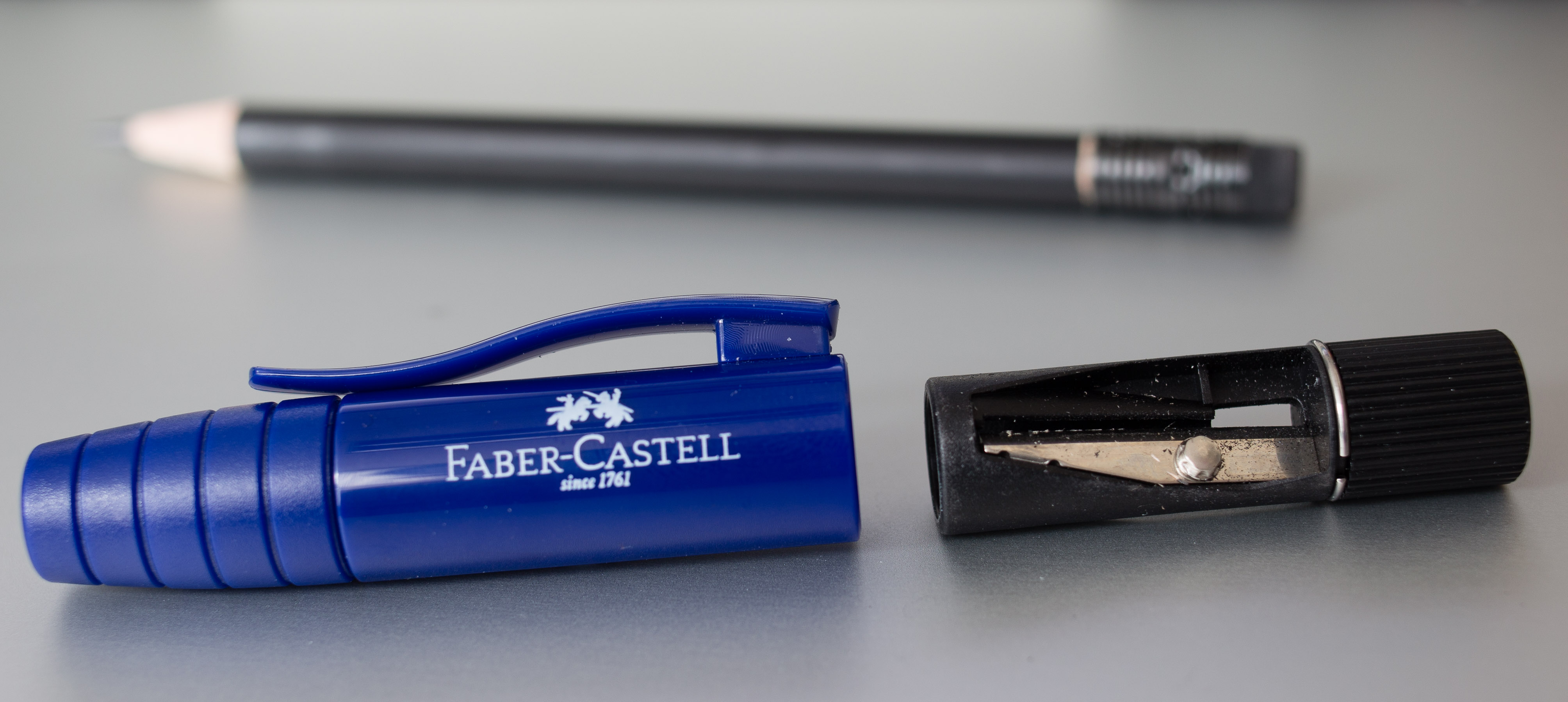
Officially called the Perfect Pencil II, but sometimes called the Perfect Pencil junior (for example at Cult Pens while The Journal Shop calls it Perfect Pencil II) this pencil was released in 2007. There are different colours available (blue, red, black, blackberry – the article number starts with 18 29, followed by another number for the colour) and this pencil can be bought for £3 (~$3.95; €3.55) or less. I bought mine in Shanghai and I think I paid the equivalent of £2 or less.
Like the more expensive perfect pencils it can be used as
a cap to protect the pencil point, making the pencil pocket safe
as an extender to write more comfortable with short pencils
and it features a built-in sharpener.
It is best to be used with eraser tipped pencils and official refills are shorter than normal so that the perfect pencil fits in shirt pockets etc.
It’s not bad looking, but for my taste the Castell version is much better looking ..and less bulky, but also a few times more expensive, so more of a problem when you lose it (I lost mine after a few years of use).
The Perfect Pencil’s history
The first perfect pencil, the brainchild of Anton-Wolfgang Graf von Faber-Castell, was part of the Graf von Faber-Castell line and came out in 1993. Back then the eraser was in the extender.
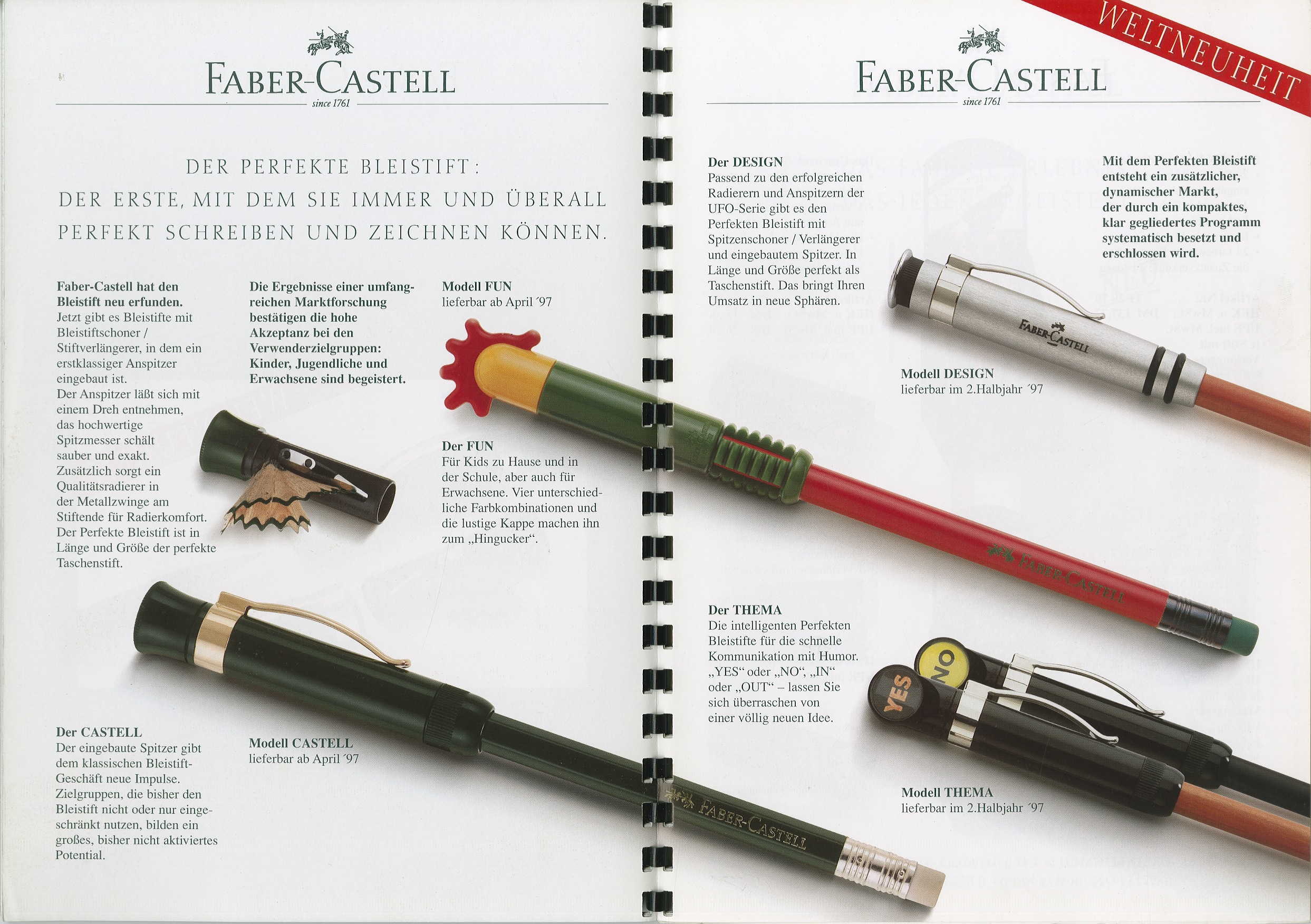
1997 Faber-Castell released more affordable perfect pencils (the Castell and Design versions are still available) and a year later the posh Graf von Faber-Castell perfect pencil changed to the more familiar version with the eraser under a small cap.
The perfect pencil line in 1997A very simple perfect pencil time line
Here’s a video where I look at the Perfect Pencil II.
I suggest you click on it to open it in YouTube, you then get a higher resolution and you can play it with a higher speed on most devices (I like 1.5x). This video also looks at how products in China are marked (origin and date) and shows Shangching‘s Tomoe River notebook I use for diagrams in this blog.
Other manufacturers have released similar products.
If you want to move up to a more expensive version I recommend the Castell version, which can be bought for under £10 (~$13.15; €11.80). I have previously looked at the black edition of the Castell Perfect Pencil.
There is also the more direct successor available, the Perfect Pencil III, bulkier, but with a built-in waste box. The cheapest seller I found in the UK so far is the Journal Shop where it sells for £3.95.
If you like to read more about the perfect pencil: Here are more Perfect Pencils at other blogs
What an exciting day. I got two deliveries, one from Japan and one from Germany.
Both seem to be XL… (Japan in green, Europe in yellow)
The parcel from Japan was sent from Yumiko, a friend of Sean, who helped me get a few things I couldn’t order myself …including Uniqlo’s Tombow t-shirts. I was able to get the Pelikan version here in Europe, but the Tombow version is not being sold here.
I was hoping that the Japanese XL will be similar in size to the European XL, especially since the t-shirts being sold here come with English/Japanese tags, but unfortunately it turned out that the Japanese XL is at least one size smaller than the European version – so the t-shirts won’t fit unless I lose a lot of weight. I guess I should see this as my incentive to lose more weight ..but I don’t think it’s achievable for me to fit into these anytime soon.
…the tags are different though
There was also something else in the parcel. Something very special.
The other parcel did contain a replacement Pollux. You might remember that had problems with my first Pollux. Thanks to Lexikaliker, without whom I wouldn’t have any Pollux, I got a replacement
Here’s a quick look at the replacement Pollux.
As a comparison: the second video features a knife sharpened pencil. You can also see Staedtler’s sand paper in the second video.
Well, here’s a short version of my diary experience. In the 1990s I used to use the Apple Newton’s calendar (there was a point when the old model was sold very cheap in 1994 or 1995, so I couldn’t resist and bought one. Later there was a point when Apple offered you the later model for a very small fee if you returned your old Newton, I did that, too.).
Well, after Apple decided to drop the Newton I bought a used Nokia Communicator and used it as my diary.
Later, in 2001, when I moved to England, I bought a Filofax. My Communicator was pretty slow by then, maybe because all the memory was used up. In the 1990s Filofax wasn’t very well known in Germany. I think I only knew about it because of the 1990 movie Taking care of business – the German title of the movie translates as “Filofax – I am you and you are nothing”.
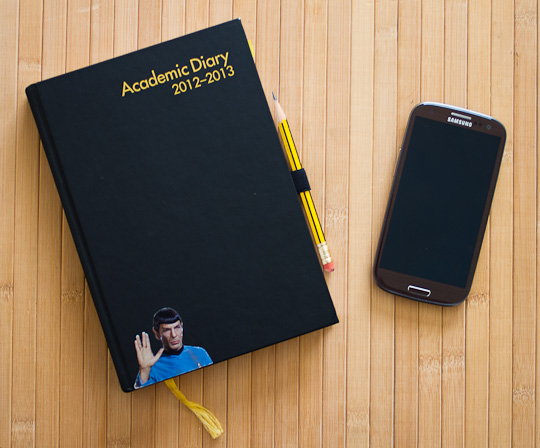
My old and new paper diary
Size comparison old and new diary
Well, let’s fast forward fifteen years. I used to like the Lyreco diaries my employer provided, but this time they ordered a slightly different one and it seems so much worse, so I decided to buy my own diary. I didn’t really consider a Filofax because I remember that I found flipping pages in the ring bound Filofax annoying …so I thought I try a Hobonichi Techo. Lexikaliker, as usual one of the early adopters of new trends, has mentioned the Hobonichi Techo in 2013[1]I wonder how many items would me much less known in the stationery fandom if it wasn’t for him. The Swiss Wood pencil, the Pollux, the Janus, the Greande, … this will be a very long … Continue reading.
The kind of work I do means that I need a diary from summer to summer, rather than January to December, so I bought the Hobinchi Techo avec, July – December in A6, just to try out whether this is for me. My previous diary used to be A5 and Susan M. Pigott’s excellent review at The Pen Addict indicates that A6 might be a bit small, but I thought I try ‘portable’ for now, I can then still switch to A5 in January if this one turns out to be too small.
First observations
Thickness
My first observations: the diary is not as thin as I thought it would be. According to Nanami Tomoe River paper has nearly half the thickness of copy paper, but this six months diary seems about half as thick as my twelve months diary (if you deduct the thick lids), even though my old diary has lots of extra pages before and after the ‘page a day’ section.
The Techo isn’t as thin as expected – The diary on the right has twice as many pages
Pencil leads
The Orenz is a great pencil for this diary, the 0.2mm lead helps to write small so that you can get more on a page. I did also try to use my Color Eno leads, but these coloured leads don’t like to ‘stick’ to the paper and the colours are very difficult to read. Have a look at the image below. W15 and W14 (in graphite) are easy to read, but the word in orange (Assessment) and the squiggly line in green (both Color Eno leads) are not.
Graphite is easy to read, coloured leads are not
Erasing
Erasing on this paper is great. The ink on some printed documents can rub off if you use an eraser, but when I use an eraser [2]The Faber-Castell dust-free. on the Hobonichi Techo the graphite gets removed but the print on the pages stays, just as it should.
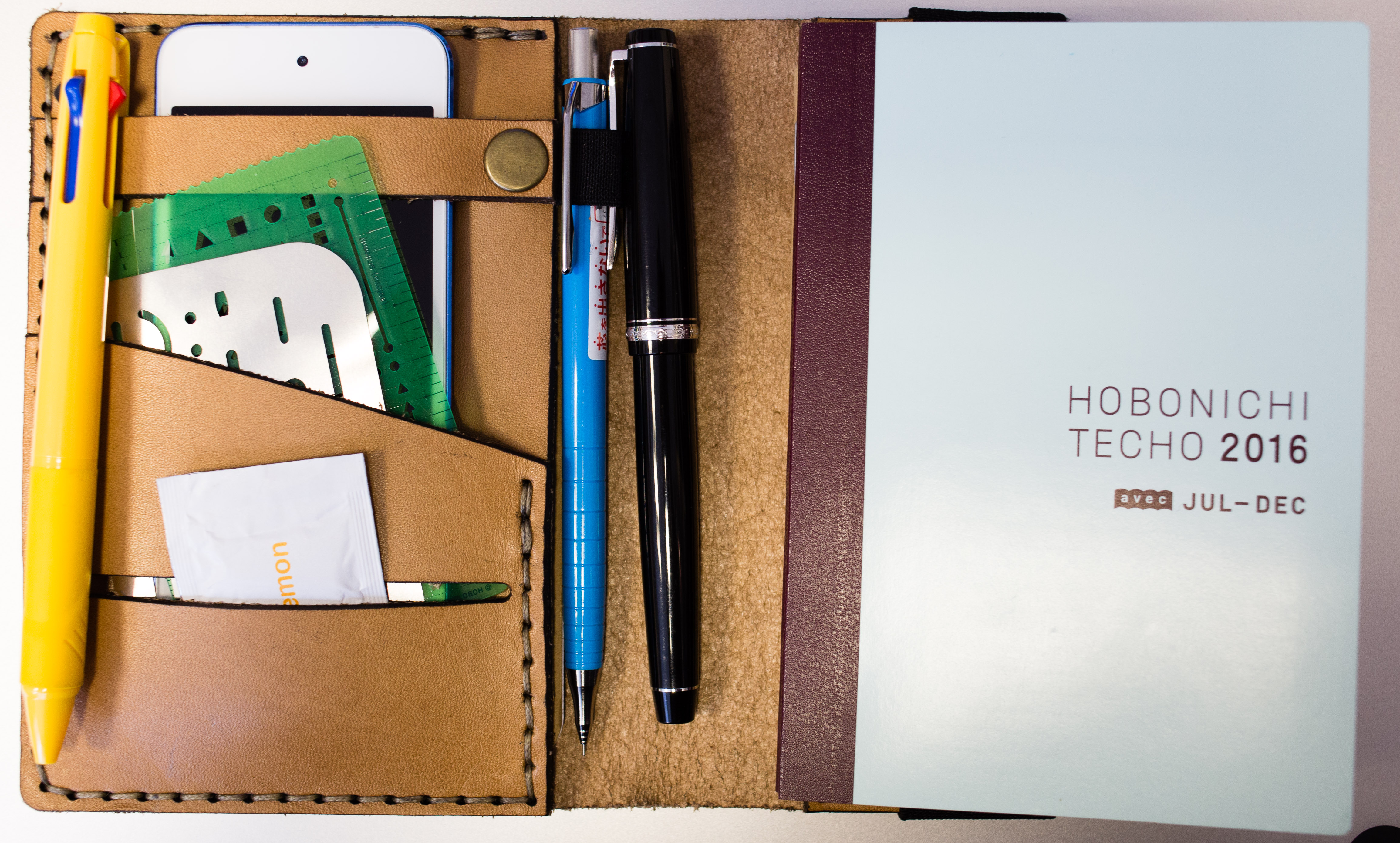
I have recently started using an eraser shield, in this case Staedtler’s eraser shield [3]Made in Taiwan, Shangching helped me get it, together with the Orenz I use in the Hobonichi. and it is a great addition to the Hobonichi (you can see it on the left in the image below), especially if you use very fine leads and write small.
I wonder how many items would me much less known in the stationery fandom if it wasn’t for him. The Swiss Wood pencil, the Pollux, the Janus, the Greande, … this will be a very long list.