Pac-Man
How cool is this.. Pac-Man pencil case and pencil cup from Quo Vadis.

… but where to get them and how much are they? I’ve only found the notebooks when I was looking…
How cool is this.. Pac-Man pencil case and pencil cup from Quo Vadis.
… but where to get them and how much are they? I’ve only found the notebooks when I was looking…
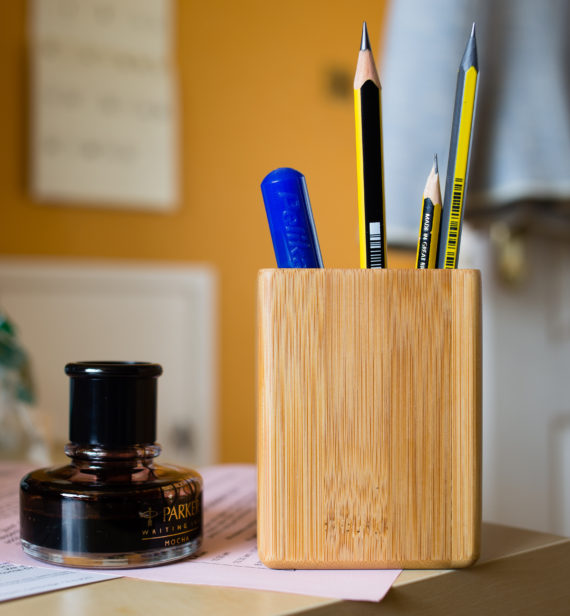

Description: A bamboo pencil pot from John Lewis
Price: £5 (~$6.75; €6.05)
Material: Bamboo
Further information: A bamboo pencil pot. The rounded corners are really nice. If you like bamboo: a 2011 blog post included a similar pencil pot, but this month’s pencil pot’s simplicity makes it the nicer of the two pencil pots.
|
|
|
Price and exchange rates: June 2016 (These are post-Brexit vote exchange rates)
Pencil Pot Of The Month – June 2016 Read More »
I recently got the Rotring 800+ in black and 0.5mm, a mechanical pencil I was very excited about. Unfortunately, the 0.5 mm version in black was slightly more expensive than the silver or 0.7mm version.

According to Rotring’s website, the Rotring 800 was introduced in 1993. It features a retractable sleeve and lead [1]It is not a sliding sleeve, so it is either fully retracted or fully extended. When retracted the sleeve will disappear in the body of the pen.. The Rotring 800+, introduced in 2014, is a very similar pencil that features a stylus tip at the front of the pencil, so when the sleeve is retracted you can use the front of the pencil for writing. In that respect, the 800+ is different as most ‘combination pens’ with a stylus tip have it at the end, for example instead of an eraser.

When including postage cost Amazon was the cheapest, selling this version for just under £49 (~$65; €59). Reichelt was cheaper, but unless you buy other products from them to get free shipping the postage cost would have ended making this order more expensive than on Amazon.
Well, suddenly, a few days later, this pen got £10 cheaper, despite the falling post-Brexit vote Pound and it now sells for under £39 (~ $52; €47). It was a gift from my wife, so I didn’t pay for it, but still, £10 cheaper now – not happy. Nevertheless, when it was bought £49 incl. postage was the cheapest price, as far as I know.
Do you remember my Scraping pencils post where I programmed an R script to track price developments on the Cultpens web site? Camelcamel does something similar, but automated, for Amazon products – and when you look the 800+ price is just crazy – according to Camelcamel this pen sold for nearly £60 in December 2014 but was less than £25 in December 2015.
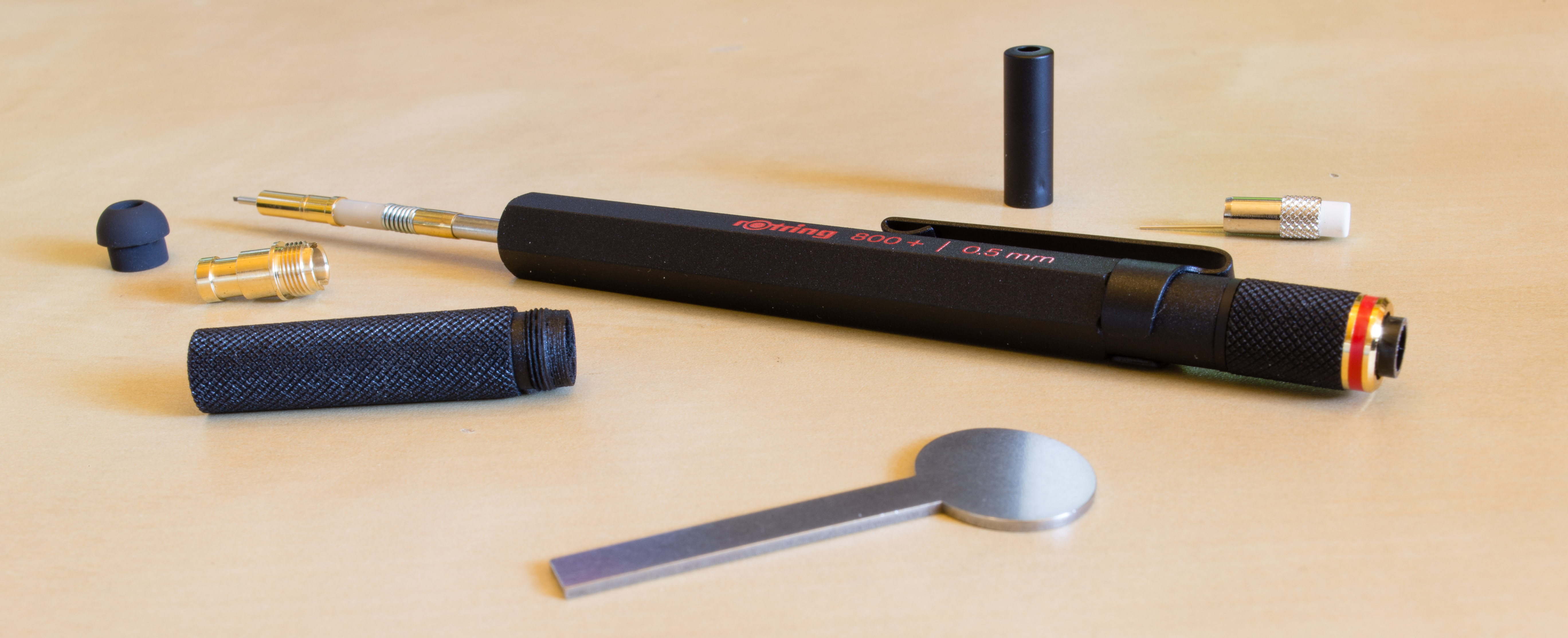
Have a look at this video where I have a look at the performance (if that is the right word here) of the stylus. It is quite disappointing. The Staedtler’s Noris Stylus is much cheaper, but performance is similar.
The video should display the force needed in Newton, but this doesn’t seem to display on all mobile devices. It should however work if you watch the video on a computer.
When I asked Rotring about the poor performance of the stylus tip their reply included these statements.
There is no difference of sensitivity between
different rubber. We also found that you do have to press a little more than with a finger.
Well, as you can see in my (unscientific) test there was a difference between different rubber tips. The second rubber tip that came with the pen needed a force of between 1.2 N and 1.5 N, but the third rubber tip only needed between 0.1 N and 0.8 N.

You need to press quite a bit for the stylus to work. Just a quick back of the envelope calculation that will not be very precise: if I take the Axial Pen Force mentioned in this paper [2]Van Den Heuvela, van Galenb, Teulingsc, van Gemmertc: Axial pen force increases with processing demands in handwriting, see http://www.sciencedirect.com/science/article/pii/S0001691898000316 and put them into the equation from this paper [3]
Schomaker, Plamondon: The relation between pen force and pen-point kinematics in handwriting, see http://link.springer.com/article/10.1007%2FBF00203451, assuming an angle of 45°, you get a normal pen force of less than 0.9 N. So I some users, on some devices, only have to press a little more than compared to normal writing, but I doubt these people use the same force when they use their fingers on their smartphone. In my case, because I don’t press very hard when writing, the normal pen force used is much lower than the 0.9 N from the back of the envelope calculation. I need to press harder than to get the 800+ to work on my devices, compared to writing on paper and I =most definitely= need to press harder to get the 800+ stylus tip to work compared to using my fingers.
I noticed that the force needed is different for different devices, so the Rotring 800+ might work better on your device, but in any case, you will need much more force than you would if you used your fingers.
I disagree with Rotring’s statements. As far as I can tell there seems to be a difference between different rubber tips and you need to press much more, not just ‘a little more than with your finger’ to get the stylus tip to work.

The Rotring 800+ brought a few disappointments:
Price and exchange rates: June 2016 (These are post-Brexit vote exchange rates)
If you found the bit about the axial pen force interesting, I have previously mentioned this, including in the Del Guard post.
You can find reviews of the 800+ at the Pen Addict and at Clicky Post. There is also a YouTube review of this pencil.
As usual, please open the images in a new tab to see them in high resolution.

References
| ↑1 | It is not a sliding sleeve, so it is either fully retracted or fully extended. When retracted the sleeve will disappear in the body of the pen. |
|---|---|
| ↑2 | Van Den Heuvela, van Galenb, Teulingsc, van Gemmertc: Axial pen force increases with processing demands in handwriting, see http://www.sciencedirect.com/science/article/pii/S0001691898000316 |
| ↑3 | Schomaker, Plamondon: The relation between pen force and pen-point kinematics in handwriting, see http://link.springer.com/article/10.1007%2FBF00203451 |
| ↑4 | I use one of those swipe keyboard inputs |
Disappointed with the Rotring 800+’s stylus tip Read More »

A few months ago I was able to get a Mascot for a good price. The Mascot is a propelling pencil made from sterling silver. A few years ago Dave showed it on his blog.
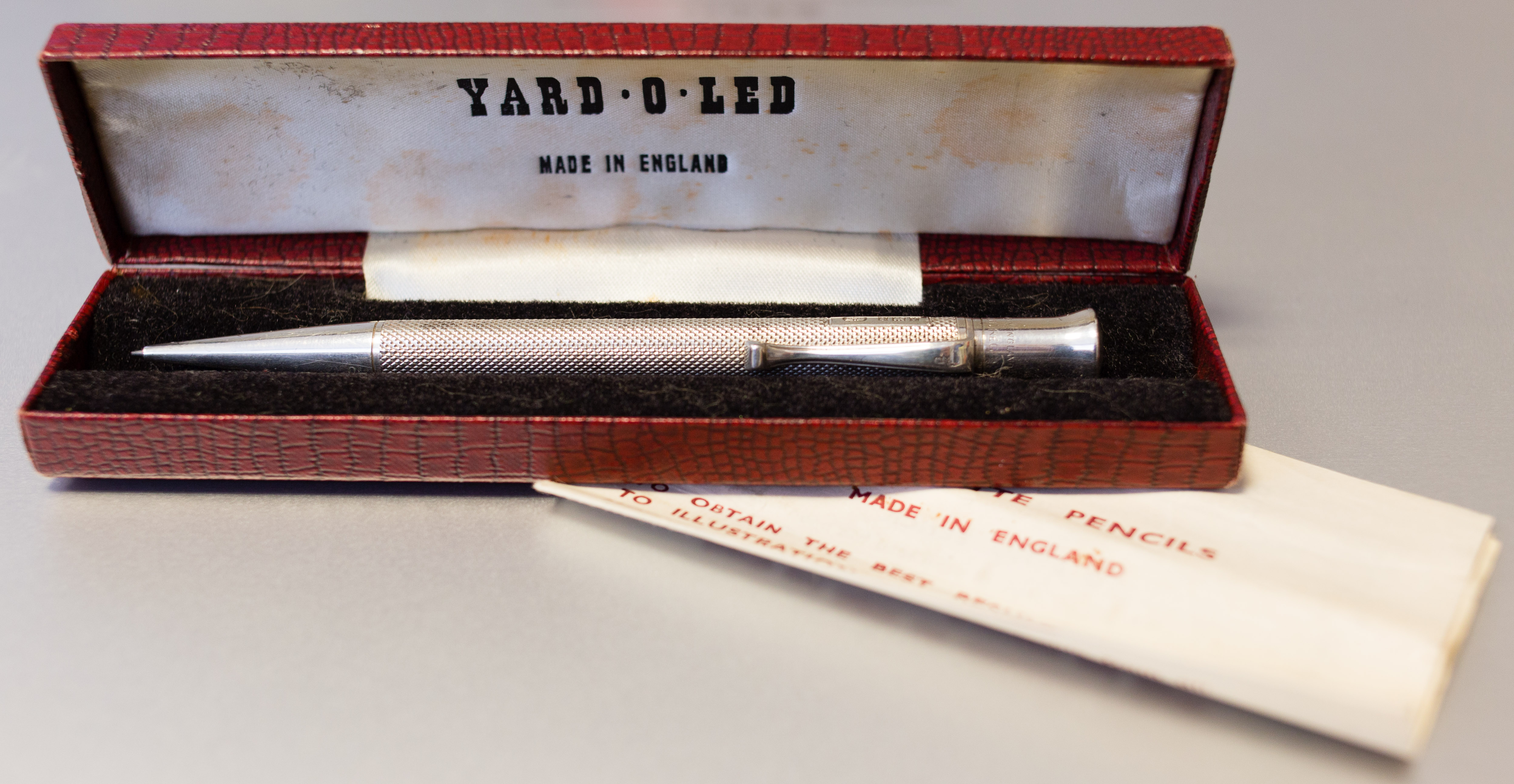
Mine is stamped with the date letter G, so it must be from 1956 or 1957 [1]see https://theassayoffice.co.uk/send-us-your-hallmarking/date-letters , a time when the maker, Edward Baker, was already part of Yard-O-Led (In 1952 Frank Tuffnell became the majority shareholder of Yard-O-Led and acquired Edward Baker [2]see http://www.yard-o-led.com/#our-story . In 1955 Yard-O-Led took over Edward Baker [3]see http://www.gracesguide.co.uk/Yard-o-led_Pencil_Co ). Despite having been part of Yard-O-Led the pen doesn’t seen to have been marketed as a Yard-O-Led pencil. This could be down to the fact that the internal mechanism works in a different way.

According to The Writing Desk all Yard-O-Led pencils ever made accept 3″ leads [4]see http://www.thewritingdesk.co.uk/showproduct.php?brand=Yard-O-Led&range=pencil+refills , but I can’t see how these could fit into the Mascot – so maybe the different mechanisms in Yard-O-Led and Edward Baker pencils and the resulting difference in leads used was part of the reason why the pen was not officially sold as a Yar-O-Led. My pencil came in a Yard-O-Led box and with Yard-O-Led instructions, but as the pen is 60 years old these might not be the original box and instructions that came with the pen.

Including leads the Mascot weighs about 28g and has a diameter of just over 8mm – round pencils tend to have a diameter of about 7.5mm and hexagonal ones have about 7mm between opposing sides. The pen a bit more than 12cm long.

Despite it being thicker and certainly heavier than a wood cased pencil it does feel small in your hands …modern pens are usually bigger, but the heavy weight of the Mascot, for its size, makes it feel solid and expensive.

The leads have a diameter of 1.18mm [5]Dave talked about the fact that 1.18mm, 1.1mm, 1.15mm and 1.2mm leads are usually the same. and are nearly an inch long.
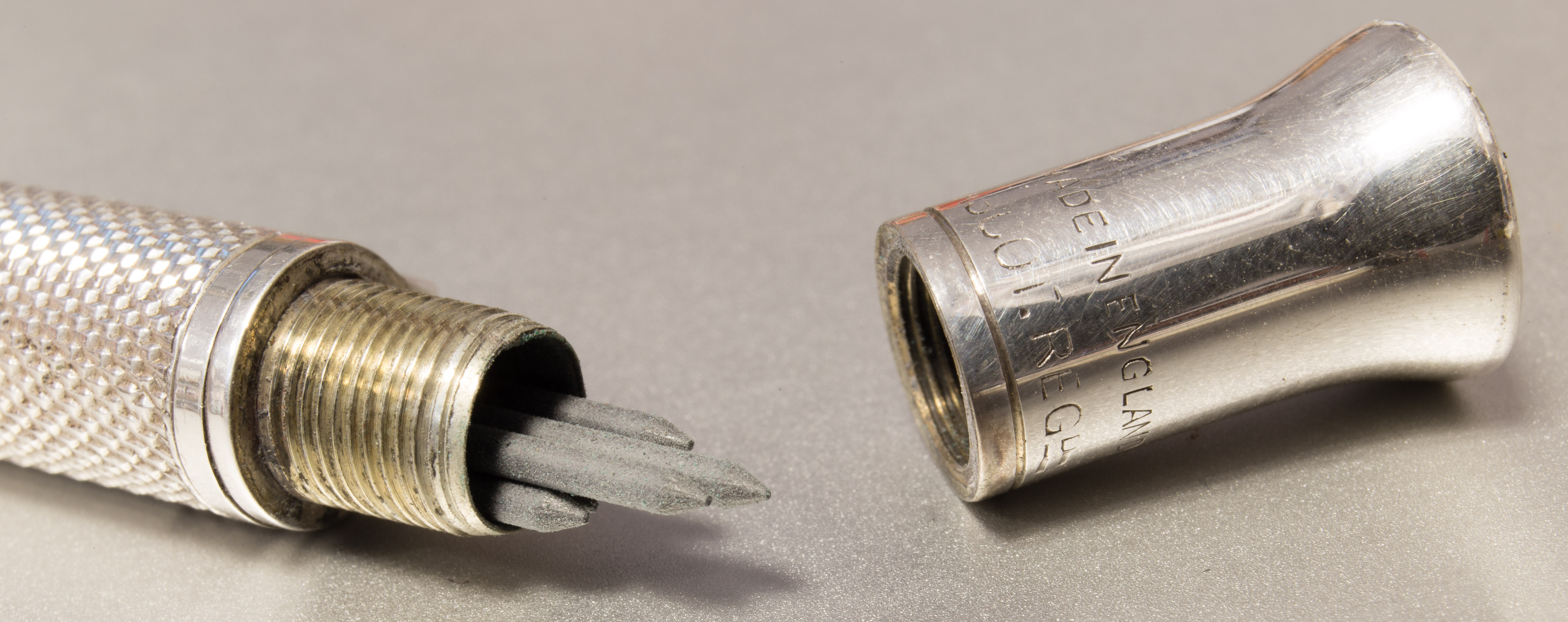
Yard-O-Led’s name came from the fact that their pencils could hold a whole yard of lead in refills. If you are of the metric persuasion: 1 yard has 36 inches, so you would need 36 of these inch long refills for a yard. My Mascot came with 6 leads, but it could probably hold around 12 leads. 12 inches are one foot, so I guess Foot-O-Led would be more suitable as a name for the Mascot than Yard-O-Led.

I assume slightly longer 1.18mm leads from Kaweco or Wörther would fit, I have’t tried it out yet, though. These slightly longer leads are 30mm long.

I like a fine point, so I sharpen the leads with Faber-Castell’s lead pointer sharpener box (what a name) 18 41 00. These sharpeners usually cost around €0.60. They are for leads with a diameter of 2mm, but work with 1.18mm.

It’s a great looking pencils, even though it is a bit small for today’s standard. I love the wider top/end of this pencil. It is similar to other pens from the past. These days similar tops can be found on Graf von Faber-Castell pens or the Castell 9000 Perfect Pencil (you can see them in this blog post).

You can find more Yard-O-Led related goodness at United Inkdom, Scribble’s Too Many Pencils and Dot Cross Dot.
References
Neil Gaiman, a famous British author, has just posted this on his Instagram account.
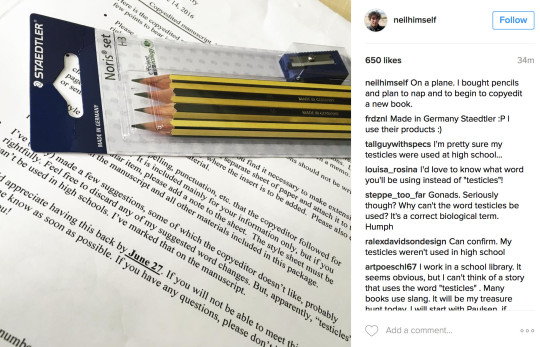
Nice to see celebrities using the Noris, too.
Thanks to Johnny for letting me know about this.
I have added this to the Noris in the wild page.
Neil Gaiman’s Noris pencils Read More »

