Post offices in the UK sell all sorts of things and the things they sell are often quite reasonably priced. This can include things like cakes, hand bags or kitchen foil, but naturally there is also a selection of stationery available. In July I bought the Factis 60 RP eraser at the Cinnamon Hill post office in Walton-le-Dale for 25p (~39¢; 32c). I have seen Factis erasers in Germany, too [1]I would even go as far as saying that there has also been a surge in Spanish made erasers in Germany, but it could just be that the few shops I have seen just happened to stock more or display them … Continue reading. It is often not possible to identify the manufacturer of these erasers, but I assume many of them are made by Factis. I assume the company is named after one of the components needed to make natural rubber erasers.
The Staedtler 1810 KP72 and the two erasers
Another eraser I bought in July is the Ty Beanie Puzzle Eraser Peepers. When I saw a selection of the Beanie Puzzle Erasers on the MS Pride of Rotterdam I remembered Shangching’s positive review and bought one for £1.19 (~$1.87; €1.50). There were many erasers to choose from, so I picked Peepers, the duck, one of the erasers with a more complex looking surface structure.
The Factis 60 RP and the Ty Peepers taken apart
Performance-wise both erasers perform similarly well, with the more rubbery 60 RP needing a little bit less effort to eraser graphite than the Peepers. Both erasers perform worse than a good eraser, like my favourite non-dust erasers or the Mars plastic stick 528 55, but better than the typical non-name eraser or the most erasers you’ll find at the end of an eraser-tipped pencil.
I bought the Staedtler pencil with the mathematical formulas, the 1810 KP72, used in the photos and for the comparison in Nuremberg’s Staedtler Welt for 95 cents (~$1.18; 75p).
I would even go as far as saying that there has also been a surge in Spanish made erasers in Germany, but it could just be that the few shops I have seen just happened to stock more or display them more prominently.
As a complement to Lexikaliker’s yellow Wopex, here a photo of the yellow Wopex blister pack available in the UK. I bought this pack of five Wopex plus eraser and sharpener this April for £2.99 [1]plus 90p shipping (~$4.69; €3.70). Unfortnately I haven’t seen the eraser-tipped version from Lexikaliker’s blog post yet, but I will definitely buy it if I ever see it.
East…West…Everywhere wrote a blog post about the green version, available in the USA, that comes with Staedtler-made eraser caps. These eraser caps are basically a white version of the eraser caps that are quite common in North-America [2]Some pencils in North America come with these erasers attached to them, the Magic Writer for example. You can also spot them fairly often in American TV shows, e.g. in Two And A Half Men..
Some pencils in North America come with these erasers attached to them, the Magic Writer for example. You can also spot them fairly often in American TV shows, e.g. in Two And A Half Men.
In a previous blog post I compared three Staedtler tradition 110 pencils, made in three different factories – the one in Wales, the one in Australia and the one in Germany. Today I want to look at three different Staedtler Noris 120 pencils – made in Malaysia, Wales and Germany. I bought a dozen of the Malaysian Noris in March 2010 for £2.24 (~ $3.40; €2.78) from a Malaysian seller on eBay.
Noris presharpened, top to bottom: Malaysia, Great Britain, Germany
The only pencil from this comparison that is still in production is the Nuremberg-made Noris. The factory in Malaysia closed down two years ago and the factory in Wales closed down four years ago. You can still find Welsh-made pencils in the UK, but there are very few shops left that still have stock. I am not sure about the situation in Malaysia, but I assume most of the Malaysian Noris are also sold by now. In a previous blog post I mentioned that 2B is the most common pencil grade in Malaysia. It is so popular in Malaysia that the Malaysian Noris is only available in 2B, therefore I’ll compare it with the Welsh and German Noris in 2B.
Different caps – Top to bottom: Malaysian 2B, Welsh 2B, Welsh B, German 2B
The colour of the Noris cap normally indicates the pencil grade. The HB Noris has a red cap. Strangely enough the cap colour is not consistent. The older Welsh and Malaysian 2B Noris have black caps, while the newer German Noris, bought in April 2012 at Müller in Volkach, Germany for €0.59 (~ $0.73; £0.47), has an orange cap, similar, but a slightly lighter in colour than the orange cap of a Welsh Noris B.
Noris sharpener (511 004) and two wedge sharpeners (510 10 and 510 50)
Which eraser could be most suitable to sharpen a Noris? None other than the Staedtler Noris sharpener, of course. Bought at Currys / PC World in Preston, when they tried to get rid of their stationery in December 2011 this sharpener was part of a ‘study set’ that came with 2 Noris HB, one Staedtler Mars plastic eraser and the Staedtler Noris sharpener for £1.17 (~ $1.79; €1.45). The blister pack says “Made in Germany”, but the wedge sharpener in the Noris sharpener is made in China, or at least the the metal body of the sharpener inside is. I wonder why Staedtler put a metal sharpener in there. Most people probably wouldn’t notice and Staedtler sells plastic sharpeners with the same form factor that could have been used in the Noris sharpener to keep the price down…
The W wedge sharpener in the Noris sharpener
The bottom of the metal sharpener 510 10 in the Noris sharpener features a ‘W’, which indicates that this sharpener is one of Staedtler’s newer sharpeners, optimised for use with the Wopex. It has a sharpening angle of 23°. The thickness of the shavings produced by the Wopex-optimised sharpener is the same as the one by the older model, usually just under 0.3 mm. I assume the difference is in the way the blade has been sharpened.
The older 510 10 wedge sharpener
I used a notepad from Brunnen [1]bought in August 2011 at McPaper in Schweinfurt, Germany for €1.19 (~ $1.46; £0.96) to compare the different leads in terms of smoothness, reflectiveness, darkness, erasability, graphite transfer to another page and how long they keep the point. As far as I can tell the three different Noris perform very similar. The graphite from the Malaysian Noris might transfer a bit easier to another page, e.g. in a diary, but it’s only every so slightly worse than the other two Noris pencils.
No bar code on the Malaysian Noris
In terms of exterior appearance the Welsh and German Noris are nearly on par, with the paint on the Noris from Nuremberg being slightly more even. The paint of the Malaysian Noris is however much worse, but still better than the no name or own brand pencils you usually get in super markets. The Welsh Noris has a diameter of 7mm, which is slightly more than the 6.9mm the Malaysian and German pencils have.
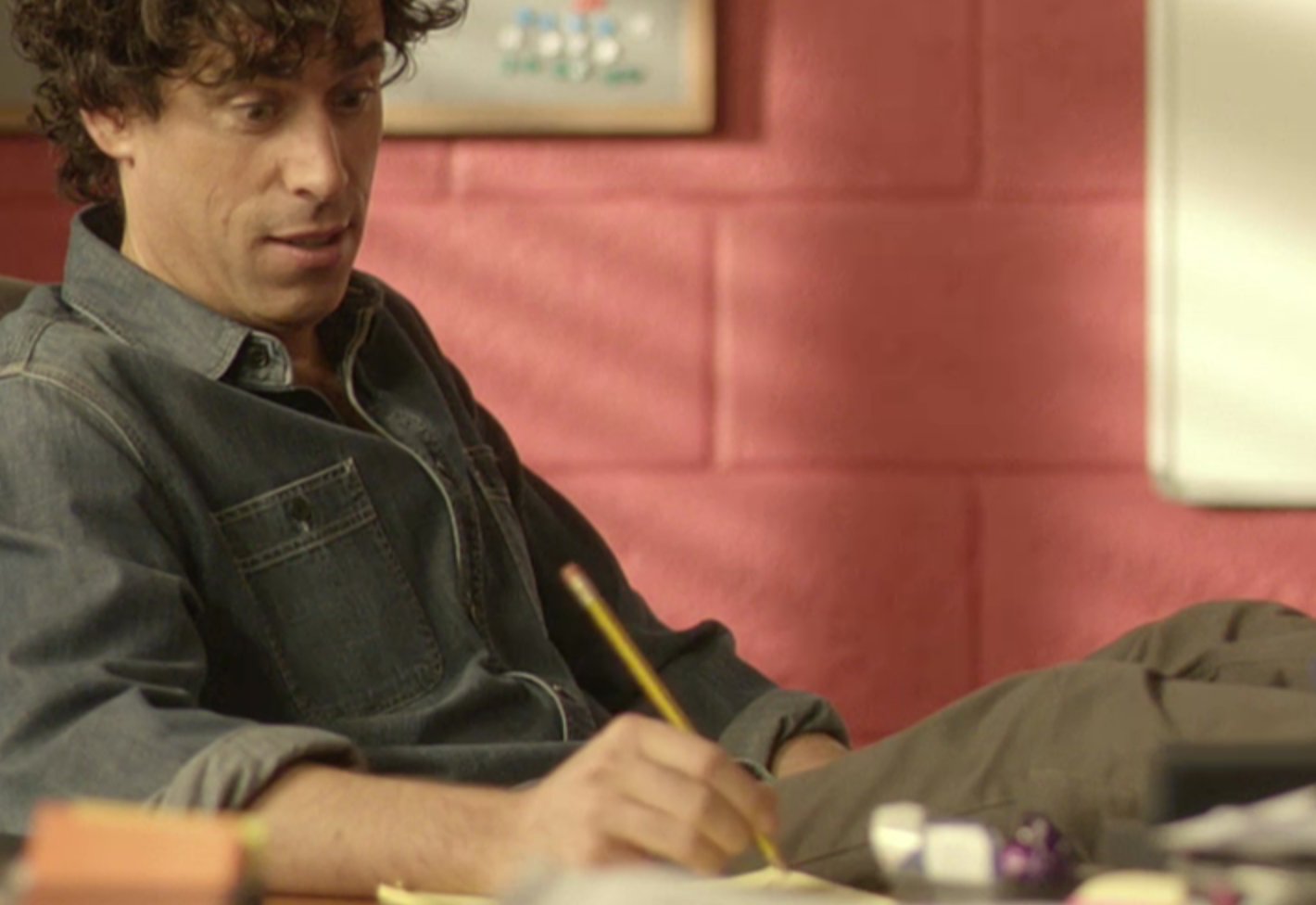
For me the Noris is THE typical pencil. Previous blog posts showed the Noris being featured on TV. Today I want to add two more screen shots. One from Episodes, where Sean Lincoln (played by Stephen Mangan [2]…who recently, as Dirk Gently, used a Faber-Castell Grip 2001 ) is using a Stadtler Noris in the USA, even though it isn’t officially on sale in the USA. The character must have brought it from the UK, the desk is full of Noris pencils ..or, in the real world, this scene might have been filmed in the UK.
The other screen shot is from episode 705 “Liebeswirren” of German/Austrian/Swiss crime TV series Tatort. One of the actors in this episode from Munich was Christoph Waltz of Inglourious Basterds fame.
One of my favourite type of computer games were always adventure games. Even though I knew about the adventure games from Sierra On-Line, I played the games from Lucasfilm Games much earlier, as I didn’t have a 16-bit machine at the time [1]There were of course also other companies making great adventure games, e.g. ICOM, Infogrames, Software 2000, …. When finally did have a 16-bit machine (an Amiga) I played all their games I could get my hands on, including the remakes – and I then did the same again when I switched to a PC (which was quite late, in 1996).
The Two Guys From Andromeda, the creators of the Space Quest series, recently started a Kickstarter project and the first prototype they released shows the Staedtler Mars technico (see picture) next to a sheet of paper within which the protoype is running. Nice to know that they, or someone from Q42, is using this lead holder.
You can find a review of the Staedtler Mars technico at Lung Sketching Scrolls and some nice, vintage technico photos at Lexikaliker.
The screenshot of the Staedtler Mars technico has been taken from the The Two Guys From Andromeda SpaceVenture Prototype. I believe that the use of this image falls under “fair dealing” as described by the UK Copyright service.
Today: another blog post about one of the items I have received from Office Hero, the Staedtler Wopex. You might remember my previous two blog posts about the Wopex, one was looking at the Wopex 2B and 2H and one was comparing different eco pencils. Office Hero sent me a pack of twelve Wopex as a free sample. Their normal price is £4.01 (~ $6.35; €4.60) plus VAT.
Why another blog post about the Wopex? The Wopex has one property I really like, even though there are actually also a few things wrong with the Wopex. Back to the characteristic I like, which is why I pick this pencil more and more often when making entries in my diary. The reason is simple and has been mentioned by Koralatov in a recent comment: there’s hardly any graphite transfer between different pages when writing on the reverse. I use my diary to keep track of appointments and to record things that need doing. Graphite from soft pencils will transfer easily after something has been written on the reverse or on the next page, which will in then look very unsightly. Even though you can get graphite from the Wopex to transfer to another page if you want to, as seen on the photos, this transfer is usually not happing under normal circumstance and is therefore not a problem.
Graphite comparison in a Castelli Academic Diary
I think the Wopex has great potential, but it also has a few flaws which I want to mention.
The “fibre Wopex material” is too hard, so I use dedicated sharpeners in my office and at home, just for the Wopex. The “fibre Wopex material” is also too hard for rotary blade sharpeners.
If you sharpen the Wopex to a very fine point the point will break easily.
Small bits of the “fibre Wopex material”, close to the lead, can crumble off when sharpening.
There doesn’t seem to be a difference between the Wopex 2B, HB and 2H.
There are quite a few other issues, but mentioning them all would distract from the main issue I want to address here: Wopex‘s great lead that is a very good choice for diaries.
Top-bottom: Mars Lumograph HB, F, Castell 9000 HB, 2B, Technograph B, Wopex HB, Mono HB, Ticonderoga HB
Let’s look at the results from my (unrepresentative) graphite transfer test, conducted by writing on one page, putting the next page on top and applying pressure to the reverse of the next page [1]The effects can be stronger when applying pressure directly to the reverse of the page you wrote on.. Harder and lighter leads do better than softer and darker leads – no surprise here. The best pencil in my comparison was the Staedtler Wopex HB, followed by the Caran d’Ache Technograph 777 B, which has previously been reviewed by penciltalk. The worst pencils in this test were the Tombow Mono 100 HB and the Amos Dixon Ticonderoga HB. This was obviously due to their softness which does however bring other advantages, e.g. better pressure/darkness ratio – I do however prefer a tidy diary and do tend to use the Tombow and Dixon only when smearing, smudging and graphite transfer don’t matter.
Price and exchange rates: October 2011.
I would like to thank
David from Office Hero and Oliver Carding from Sagittarius Digital for the free samples
The comparison has been conducted in a Castelli Academic Diary my wife got from her employer. I use a no name academic diary from my employer, which has very different paper. My initial impressions are that graphite-transer-wise good pencils behave better in my diary, but bad pencils behave worse.