Made in Germany

Lamy scribble

This is my second blog post about pencils that The Pen Company sent to me [1]They send pens to several bloggers. You don’t have to pay for the pens, but are expected to write a blog post about the pens.. The original blog post can be found on their blog.


Me and Lamy, Lamy and I

You might not have guessed, because of the lack of Lamy posts on Bleistift, but Lamy is one if the stationery brands I feel strongly connected to. It all started about 1985 when I got my first Lamy Safari fountain pen. From that point onwards I only used Safari fountain pens in school. After I left school I didn’t use fountain pens on a daily basis any more and temporarily lost my link to Lamy. I did buy the occasional Lamy pen, though, until finally, in 2008, I rediscovered Lamy as one of my favourite brands after I got a Lamy 2000 fountain pen.

Lamy scribbles
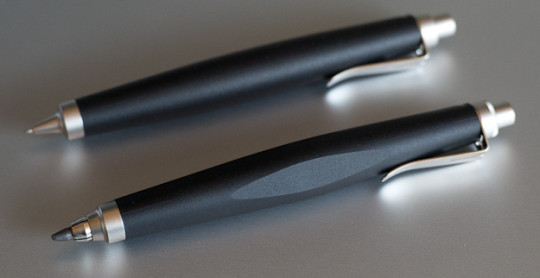
The 0.7 mm version (top) and the 3.15 mm version (bottom) of the Lamy scribble.


Volker Albus, architect and designer: Just think of his Scribble writing set for Lamy. Seldom have the central functions and haptic requirements of such a twist action pen been translated so precisely and at the same time unmistakably into an aesthetic vocabulary.
Studio Hannes Wettstein (2011, p. 151)

Lamy and pencils

I was quite excited when Lamy’s wood cased pencils came out in 2010, even though, for my taste, they are a bit too soft for daily use. I have also bought a few of their mechanical pencils and I have been tempted on several occasions to buy a Lamy 2000 or  Lamy scribble mechanical pencil. So, naturally, I was very excited when I received two Lamy scribble pencils from The Pen Company, the Lamy scribble 0,7  [2]Germany, like most European, African and South American countries, adopted the comma as their decimal mark. Mechanical pencil and the Lamy scribble 3,15 Mechanical pencil. Because of its width I’d actually call the 3.15 mm version a lead holder, but I’ll go with the official name here, according to which it is a mechanical pencil.


The design – the process

First computer designs and prototypes of the scribble were created in 1997 by Swiss designer Hannes Wettstein, one of Switzerland’s most important designers [3]see NZZ: Suche nach den Archetypen von morgen, 7 July 2008. This was followed by two more prototype series in 1998 that lead to the final drawings in 1999. I’ll write more about the design later in this blog post. Overall, the development time of the scribble took less than two years.

Scribble 0.7
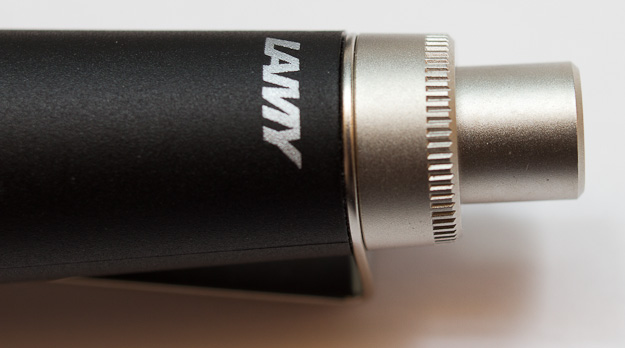
Lamy scribble 0.7 mm cap


The design – the colours

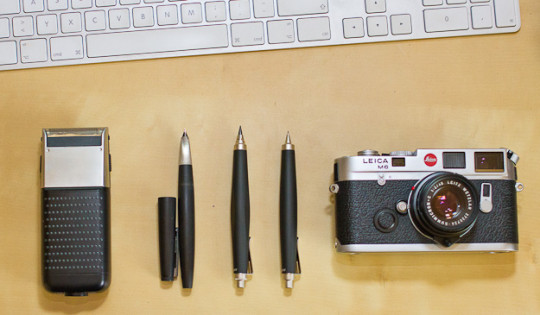
The current version of the scribble features what I tend to see as a classic colour combination: black and silver. It is a colour combination that I associate with simple design that follows functionality. Interestingly enough many of the great black and silver products I can think of feature a similar distribution between the two colours: lots of black and a bit of silver – and they also try to avoid unnecessary design elements that don’t contribute to the products function.
Black and Silver
Black and Silver (Braun, Lamy 2000, 2x Lamy scribble, Leica – unfortunately I couldn’t fit an iMac into this picture as well)

Another version of the scribble was available until 2010. Instead of fittings with a palladium finish it featured fittings in black chrome [4]I’d like to thank Lamy’s Marco Achenbach for this information..
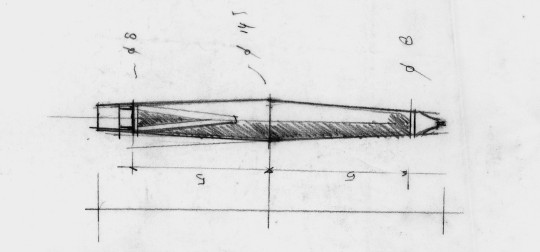
 

Hannes Wettstein's early sketch of the scribble
Hannes Wettstein’s early sketch of the scribble


The design – the shape

The bulge in the middle of the short shaft makes SCRIBBLE a highly ergonomic tool. Its ergonomic quality is further enhanced by the flat surfaces, which are cut into the shaft. These flats also prevent the pen from rolling away.
Studio Hannes Wettstein (2011, p. 222)

With 10 mm – 13 mm [5]depending on where you hold this pen diameter the grip section of the scribble certainly has a wider than average diameter. I read in the past that wider grips on pens relieve writing stress and fatigue. I have to emphasise that I didn’t see any such claim from Lamy or Studio Hannes Wettstein, but after having used the scribble for a while I found that writing with another mechanical pencil with a much narrower grip felt much less comfortable, compared to the scribble. Even though the grip section is quite wide the tip is rather slim. This makes it possible to write using with a more acute angle.


Lamy scribble 0.7
Lamy scribble 0.7


The design – awards

It doesn’t come as a big surprise that such an excellent pencil won several awards.

In 2001 the scribble won the Design Plus award in Frankfurt and in 2002it won the  if award in Hanover.


Lamy scibble 0.7
Lamy scibble 0.7


The 0.7 mm version

The 0.7 mm version can hold up to 6 leads (if you wiggle the pen a bit to get them all in). It also features a small eraser under the cap that comes with a pin / clean out rod. Each click will advance the lead by about 0.9mm, which is suitable for a 0.7 mm lead.
 

One of the grooves on the body of the 3.15 mm version


The 3.15 mm version

The 3.15 mm version has three grooves along the body of the pen. I first thought they are there to support rotating the pen to use up the lead evenly, but they are not close enough to the tip for this, so I assume the grooves are there to visually distinguish the 3.15 mm version from the 0.7 mm version version of the pen. The pen comes with a 4B lead. a bit soft for my taste and unfortunately Lamy only sells refills in 4B, but you can get harder leads from other manufacturers. I assume that slightly thinner leads, like Caran d’Ache’s 3 mm leads will also fit. As far as I know Lamy does not offer a suitable sharpener. So far I have sharpened the lead using a KUM Automatic Long Point sharpener.
 

Scribble 3.15
Lamy scribble 3.15


Clip and mechanism

Both pens feature a sheet metal clip that can be removed. With 0.65 mm the sheet metal clip is thicker than that of your average pen. Most clips are bent on the corners to give the illusion of volume, but the scribble‘s clip is really that thick. According to Simon Husslein from Studio Hannes Wettstein designing and producing this clip was quite a challenge. I certainly believe that as I was not able to find another pen in my collection with such a thick sheet metal clip.

The lead holding mechanism seems to come from Schmidt. It is featured on page 12 of their catalogue – it’s the second mechanism from the left. The mechanism works very well, but my exposure to lead holders is limited, so I can’t really compare it.

There is also a ball point version available. This seems to be an afterthought that was designed in December 2000. The body is based on the 0.7 mm version body, the one without the grooves.

Lamy scribble 3.15
Lamy scribble 3.15

Hannes Wettstein post scribble

Hannes Wettstein and his studio later also went on to develop the studio for Lamy, which makes him one of the few select designers who designed more than one pen for Lamy. Hannes Wettstein died in 2008, but his design lives on. Current products by Studio Hannes Wettstein are created by Simon Husslein and Stephan Hürlemann and are very close to Wettstein’s design DNA. Look at this Braun watch for example.


Lamy scribble 3.15 mm and 0.7 mm version

Conclusion

It didn’t take long for these two mechanical pencils to become my current favourites. There are other pencils that I like for their design, but I love the scribble because it’s so comfortable to hold (the grip diameter is surprisingly comfortable and the weight distribution is very good, too) and looks so good. It’s just a shame there’s no 0.5 mm version available, but my understanding is that as users of the scribble Hannes Wettstein had architects and designers in mind who want to liberally put their drawing lines on a blank canvas. A thin line just isn’t suitable for that purpose.


I’s like to thank Simon Husslein from Studio Hannes Wettstein for answering all my questions about the scribble patiently. All the information about the design process came from Mr Husslein.

You can find more information about the Lamy scribble at Pencil Revolution, Jack the Scribbler (ballpoint version) and Dave’s Mechanical Pencils.

Only slightly related: There’s a great article on the Fountain Pen Network: Lamy 2000 and the Origins of “Lamy Design”

The quotes in this blog post have been taken from the following book:
Studio Hannes Wettstein. Seeking Archetypes. 2011. Lars Müller Publishers, Zürich.

References

References
1 They send pens to several bloggers. You don’t have to pay for the pens, but are expected to write a blog post about the pens.
2 Germany, like most European, African and South American countries, adopted the comma as their decimal mark.
3 see NZZ: Suche nach den Archetypen von morgen, 7 July 2008
4 I’d like to thank Lamy’s Marco Achenbach for this information.
5 depending on where you hold this pen

Lamy scribble Read More »

The Lyra Temagraph and the Eisen 480

I guess I should stick to pencils, the clam clips blog post really wasn’t popular, so here’s a new blog posts about a pencil and a sharpener/eraser combo. The pencil side of today’s post is, to some extent, linked to an earlier blog post about the Amos Dixon Ticonderoga and to pencil talk’s blog post about Fila’s global pencils. I’ll be writing about Lyra’s Temagraph. The sharpener side of the post is linked to an earlier post about the Eisen 402.

A Temagraph next to a Ticonderoga


The Lyra Temagraph

Temagraph

Assumed origin: from Greek thema + -graph: An instrument for writing about a topic, theme or proposition

The Temagraph has been available for some time now, but in the past it was only available under the Fila brand name. You can see pictures of the old Fila Temagraph at Lápis and Pencils and at pencil talk. After Fila (Italy) bought Dixon (USA) and Lyra (Germany) they started ‘adjusting’ their products, including the Temagraph. The Temagraph suddenly started to look pretty much like the Dixon Ticonderoga (metallic green font on a yellow pencil) and is now marketed [1]It’s advertising includes promises such as “The best designers choose the excellent lines of Temagraph pencils.” and “The best illustrators choose the clean line left by … Continue reading as a Lyra pencil, rather than as a Fila pencil.

Look

Two sides of the pencil are a labelled. The Temagraph side is labelled in metallic green. Opposite is the barcode side, labelled in black. The Temagraph has a end cap similar to the Noris, indicating lead hardness, but with a straight line around the corners.

Material

The FSC code on the packaging doesn’t leave any doubt about the Temagraph being linked to the Ticonderoga. The certificate is linked to the Beijing Fila Dixon Stationery Co., Ltd [2]Timberlines has further information about the Chinese manufacturer of these pencils. and shows that the pencil is made using Tilia spp., which includes many species of linden trees (also called lime trees or basswood).

The barcode side of the Temagraph and the Eisen 480

Availability

Even though it is officially a Lyra pencil (and Lyra is/was a German brand) I have never seen this pencil in any shop in Germany. It dos however seem to be more popular in Fila’s home country Italy. When looking for the Temagraph on Amazon UK I could only find Italian sellers offering this pencil. Mine are from a local shop in Germany. They didn’t stock any, but a few years ago I asked them to order a few for me.

Performance

The Temagraph feels fairly smooth and puts down a very dark line. As you might have guessed from the fact that it’s a dark line – the lead rather soft, which means that point retention is not as good as it is with a normal pencil. In my case that means that I’m happy to use the Temagraph for writing the occaional sentence (think calendar entries), but I wouldn’t want to use it write a lot as it would need sharpening too often.

The Eisen 480 taken apart

The Eisen 480

I sharpened the Temagraph with Eisen’s model 480. The Eisen 480 sharpens with an angle of approx. 21°. It’s a container sharpener that comes with an eraser, to some extent similar to the Faber-Castell Sharpener-eraser pen 18 44 01. The container for the shavings can be rotated and will lock in one of two positions: sharpener accessible and sharpener closed, to prevent shavings from falling out.

What an excellent point

The eraser comes with a lid and fits exactly under the lid. Eraser performance is good. It’s a TPR (thermoplastic rubber) eraser that produces strands that roll together, to some extent similar to a dust-free eraser, but not as extreme, but eraser performance overall is no match for the excellent performance of the sharpener, which produces a nice, continuous strand of shavings with a thickness of about 0.2 mm. The blade is made in Baiersdorf, the container is made in Taicang, where assembly takes place, and the eraser is bought in.


You can find out more about the Temagraph at Lexikaliker.

The grey background in the photos (except the last photo) is from Atoma’s Alain Bertreau notebook. I placed the items in the A4 version of this notebook.

I bought the Temagraph in Germany, but can’t remember how much I paid for them.

I have received the Eisen 480 as a free sample from Eisen. Mr. Leistner provided further information. I don’t believe that, when I received the sample, Eisen was aware that I have a blog. I also don’t believe that not having paid for this sharpener has influenced my opinion of the sharpener in any way.

References

References
1 It’s advertising includes promises such as “The best designers choose the excellent lines of Temagraph pencils.” and “The best illustrators choose the clean line left by Temagraph pencils! Superior quality, gold series, fine graphite for clean-cut lines, Temagraph pencils come with an extra-resistant and easy to sharpen and original green metal band indicating the grade.” Despite this promise the green band isn’t made from metal. I’m also not sure though what the green band is resistant to, why you would want to sharpen it. The green band doesn’t indicate the grade either. I’m not sure whether the best illustrators really choose the Temagraph, so like with a lot of advertising I choose not to believe this until I see proof supporting this statement.
2 Timberlines has further information about the Chinese manufacturer of these pencils.

The Lyra Temagraph and the Eisen 480 Read More »

Wanted Down Under: the Castell 9000

Here in the UK there are several TV shows about buying holiday homes abroad or emigrating. One of those shows is “Wanted Down Under”. The format is usually the same and involves showing how much more people would earn down under and showing what to expect in terms of costs, facilities etc. I’ve never seen a whole episode, but over the years I’ve seen different bits from several episodes and (suspenseful music) they have never talked about the stationery situation down under!

Time to remedy this. Let’s look at the Castell 9000 down under.

Castell 9000 Germany Indonesia
The Castell 9000‘s main markings. Top: Germany, Bottom: Indonesia
Please enlarge by clicking, so that the differences are more obvious.

For the last three to four years Faber-Castell Australia [1]Their boss is our other favourite Count, Count Andreas Wilhelm Eberhard von Faber-Castell, who has been mentioned previously. has been buying the Castell 9000 pencils from their sister company in Indonesia [2]Made in Bekasi in one of several Faber-Castell plants in Indonesia. Here’s a photo of the impressive entrance.. They said that prior to this they bought them from Germany, but if Faber-Castell Indonesia is out of stock Faber-Castell Australia will request replenishment from Faber-Castell Germany.

castell9000-indonesia2
The Castell 9000‘s bar codes. Top: Germany, Bottom: Indonesia

In reality this situation seems to be a bit more complicated than that. You might remember Kevin from New South Wales because of his guest review of the Dahle 133 sharpener. Kevin reports that for the last eight to ten years he usually only came across Indonesian Castell 9000 pencils, the exception being some mixed grade tins, which are from Germany.

Sarab from Western Australia also struggles to find the German Castell 9000, which he prefers, and reports that its not easy finding a stationery shop in Europe that will ship small orders internationally. In his experience the differences in grade of the Indonesian Castell 9000 are very subtle or non-existent. In the past he managed to get Bavarian made Castell 9000 pencils in some branches of Jacksons Drawing Supplies, but now they also only stock Indonesian made Castell 9000 pencils.

Castell 9000 Germany Indonesia
Only the German Castell 9000 (top) has markings on three sides. The Indonesian Castell 9000 (bottom) only has markings on two sides.

There seem to be so many unused numbers after 9000. I can see that Castell 9000 is an established brand, but I wonder whether life wouldn’t be easier if the Indonesian pencil had another model number – what about 9001? It’s easy to distinguish the different 9000s anyway. In terms of colour and feel the paint of the Indonesian 9000, which doesn’t seem to be water-based, seems to be more similar to the paint used for the Mitsubishi 9800 and less similar to the one used for the Castell 9000 from Stein. The bar code, lead hardness font and print on only two sides of the hexagonal pencil also give the game away anyway…


The 'town' of Castell
The ‘town’ of Castell. The Castell 9000 is (indirectly) named after this town, through the Counts of Castell.
Nearby, on Schwanberg, you can even find pencil cedars. The first seeds to plant these trees in Bavaria were imported by Lothar von Faber (Faber, 1873, p.44) [3]Faber, 1873. Die Bleistift-Fabrik von A. W. Faber zu Stein bei Nürnberg. Nürnberg : Sebald’sche Buchdruckerei.

I would like to thank Sarab, who brought this issue to my attention, Faber-Castell Australia for further information, Kevin for further information and for the Indonesian Castell 9000 he sent me in October 2011 and Sean for telling me about the book referenced in the third footnote.

More Castell 9000 related posts can be found at Contrapuntalism, Pencil Talk and Bleistift.

References

References
1 Their boss is our other favourite Count, Count Andreas Wilhelm Eberhard von Faber-Castell, who has been mentioned previously.
2 Made in Bekasi in one of several Faber-Castell plants in Indonesia. Here’s a photo of the impressive entrance.
3 Faber, 1873. Die Bleistift-Fabrik von A. W. Faber zu Stein bei Nürnberg. Nürnberg : Sebald’sche Buchdruckerei

Wanted Down Under: the Castell 9000 Read More »

Handicraft with Bleistift IV – epic fail

A fake Noris. They didn't try very hard, but I'm sure many customers who are not so familir with pencils will buy this pencil because of the familiar colours and patterns.
A fake Noris. The company behind it didn’t try very hard, but I’m sure many customers who are not so familiar with pencils will buy this pencil because of the familiar colours and patterns. It even features a black strip between two yellow sides.

Long time readers might remember my blog post about the Reynolds 432 and the Nataraj 621, both of which look pretty much like a Staedtler Tradition. There are also countless Staedtler Noris copies – previously I’ve mentioned the Fox Essentials. Recently, I’ve come across a quite cheeky copy of the Noris, when one of my students was using it in class. I call it a cheeky copy, because it features a red cap, just like the original Noris …but the copied pencil’s cap is rather ugly in compared to the original.

Noris eco in a Leuchtturm Loop
The Noris eco is my daily pencil. The Leuchtturm Loop has been reused from a previous diary, thanks to a paper riveter.

A few weeks later I also finally got my hand on a Noris eco. I planned to get one from Cult Pens when I order from them again, but then I saw the Noris eco in WH Smith, where they sell for 85p (~$1.40; €1.05) each. I also had a look at my local Ryman, but they didn’t sell them there, even though they sell them in their official eBay outlet [1]It’s difficult to find there, though – they spell Staedtler wrong, even though they do sometimes get the spelling right, e.g. for the Staedtler Traditional [sic] pencil..

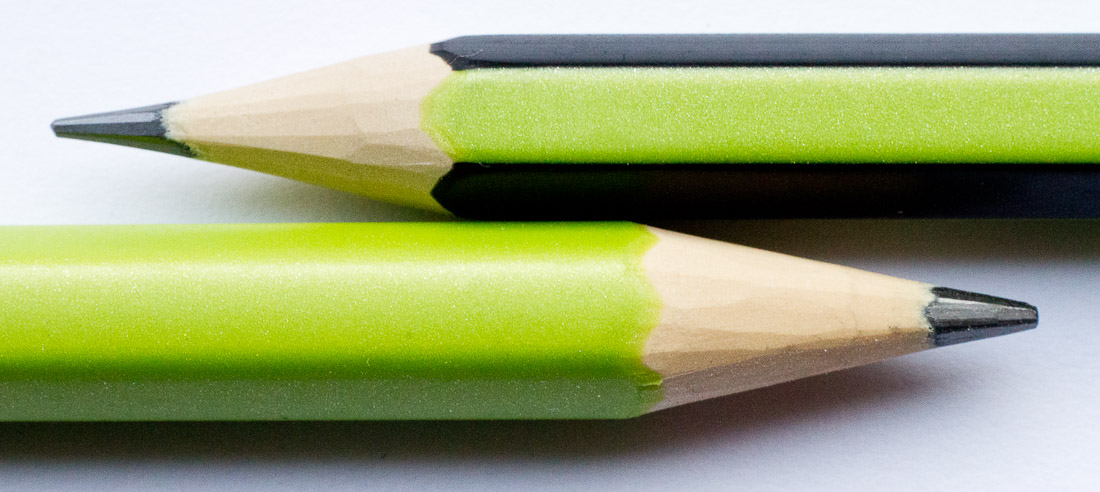
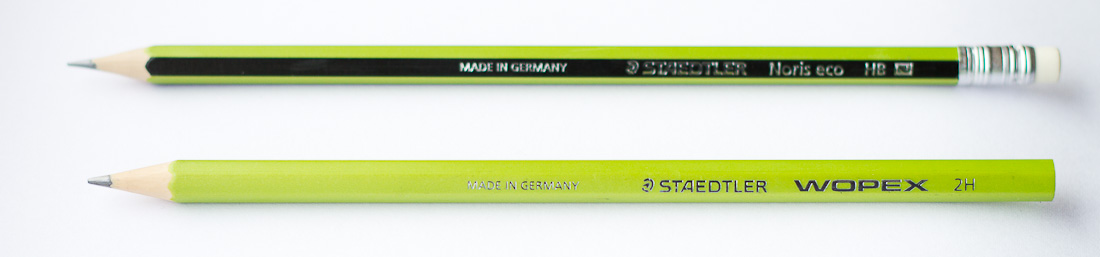
Top: Noris eco – Bottom: Wopex 2H

The lovely Noris eco is now my daily pen in my diary’s loop.

One thing I noticed: the green colour of the Noris eco seems virtually identical to the Wopex in 2H.

Top: Noris eco - Bottom: Wopex 2H
Top: Noris eco – Bottom: Wopex 2H

While the Noris has a more complicated pattern [2]The six sides of the hexagonal Noris are painted like this:
black, yellow (thin black strip) yellow, black, yellow (thin black strip) yellow.
, the Noris eco has a simpler pattern [3]The six sides of the Noris eco are painted like this:
black, green, black, green, black, green.
. I assume this is because it’s not so easy to extrude a thin black strip precisely over a corner.

Now, if the Noris eco is just a green Wopex with black strips and if there are fake Noris (plural: Norises?) anyway, why not make your own (fake?) version from a yellow Wopex?

Yellow Wopex and a Noris
I’ve only ever seen the yellow Wopex in Asda and on Ebay. I assume the ones on eBay were bought in Asda, where they are very cheap.

To increase my chances of getting acceptable looking black strips on the pencil I decided to cover the areas not to be painted with a tape.

The taped Wopex
The taped Wopex. The tape dispenser in the background is an old Bakelite model.

I then used a permanent marker to paint the Wopex. As you can see it all went belly up. Somehow the tape didn’t stick well and the lines from the black marker were not very straight …so I didn’t bother to do the thin strips carefully either. If you want to try it and are successful: Try to do the red cap using nail polish. Pencil Revolution has further instructions.

Epic fail!
Epic fail!


Price and exchange rates: January 2014

I’d like to thank Kamil Musial for showing me the “Stationery” Staedtler Noris copy.

References

References
1 It’s difficult to find there, though – they spell Staedtler wrong, even though they do sometimes get the spelling right, e.g. for the Staedtler Traditional [sic] pencil.
2 The six sides of the hexagonal Noris are painted like this:
black, yellow (thin black strip) yellow, black, yellow (thin black strip) yellow.
3 The six sides of the Noris eco are painted like this:
black, green, black, green, black, green.

Handicraft with Bleistift IV – epic fail Read More »

Old drawing pins

Today: a blog post that is suspiciously similar to some of Lexikaliker’s blog posts.

But I just cannot resist showing these drawing pins I found in a shelf my father used to use.

Old drawing pinsSorry, no close ups. The camera I have with me has a fairly wide lens and the minimum focus distance is rather large. This picture has already been heavily cropped.

Kaufhof is a department store chain in Germany.

The Express box contains drawing pins marked “Gloria 44”. I’m not sure whether these are the drawing pins that were originally sold in this box, as I don’t see the word Gloria anywhere on the box.

Old drawing pins Read More »