Faber-Castell

Quick on the Draw

What a nice surprise. I was just just driving home from work when I turned the radio on and heard the end of “Quick on the Draw“, a programme from Radio 4’s In Business series of programmes. This programme picked up two topics that The Economist covered over the last few months: Staedtler vs. Faber-Castell and the Mittelstand. Today’s Radio 4 programme featured an interview with Axel Marx, Managing Director of Staedtler, and Count Anton-Wolfgang von Faber-Castell. Axel Marx talked about the Wopex and Count Anton-Wolfgang von Faber-Castell talked about the perfect pencil and the luxurious Graf von Faber-Castell collection. I only heard the second half, but hope to listen to the whole programme on the BBC iPlayer soon [1]According the the information currently displayed on the BBC iPlayer page the programme will be available online until 2099, if I access the programme with my phone the programme is said to be online … Continue reading. I am not sure whether the content can be accessed outside the UK, though. If not: the programme will be repeated on Sunday, 17th May 2011, at 21:30 on BBC Radio 4. Even if you are outside the UK you should be able to listen to Radio 4 live over the Internet.

You can also read comments about this programme from the presenter Peter Day on his In Business page.

Two more comments:

  • It was nice to hear people speaking with a Franconian accent on the radio, even though the accent was not very strong.
  • I was not surprised to hear Count Anton-Wolfgang von Faber-Castell in this programme. He is the one who is often representing Faber-Castell in the media. Last month there was a rare chance to see his brother – in a children’s programme on the TV channel of the public broadcasting authority for the German Freistaat (Republic) of Bavaria. The programme (“Ralphi”) explained how pens and brushes are manufactured and Faber-Castell was represented by …not Count Anton, but Count Andreas von Faber-Castell, who settled in Australia in the 1970s.

References

References
1 According the the information currently displayed on the BBC iPlayer page the programme will be available online until 2099, if I access the programme with my phone the programme is said to be online for about 300 more days …but usually programmes are only available for a week, so I would not be surprised if this programme will disappear from the iPlayer

Quick on the Draw Read More »

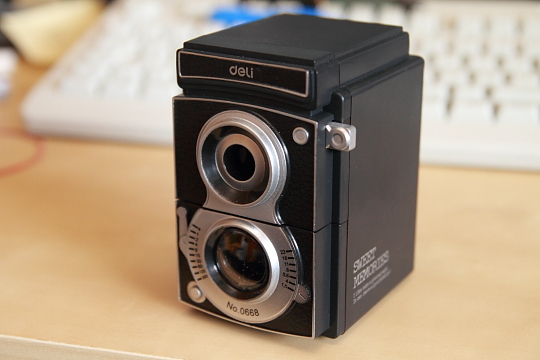
Deli pencil sharpener 0668

When you visit a university in Shanghai you will usually find at least two types of shops nearby: Snack shops (lots of them) and stationery shops. I have not yet seen another city where this phenomenon is as obvious as in Shanghai. The stationery shops can be split into two groups: stationery shops with functional stationery and stationery shops that sell girly stationery as well as other things like make-up, charms, etc – but you can also find shops that are somewhere in-between these two groups.

After my good experience with another Deli sharpener I could not resist and bought this TLR shaped sharpener, the Deli 0668, in December 2010 when I saw it in it in Shanghai – in a stationery shops outside a university. Deli’s headquarters are near Shanghai, so I it is not surprising that this sharpener was inspired by a Shanghainese-made Seagull TLR [1]Seagull TLRs were basically Rolleiflex copies. Outside China Quelle rebranded Seagull TLRs and distributed them as Revue cameras (40 years ago). There are still companies out there that distribute … Continue reading.

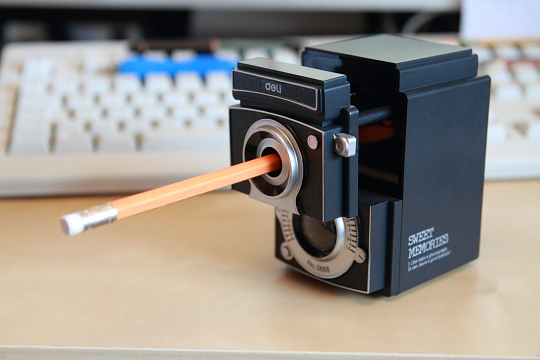
The 0668's single rotary blade cylinder

I paid about ¥ 30 (£ 2.80, € 3.30, $ 4.50) for this sharpener, a bit more than what I paid for the Deli 0635. You can get this sharpener cheaper if you look around or if you buy online, e.g. from Taobao. Outside China you can get this sharpener from Kikkerland for $15 (£ 9.30, € 10.80) or from Urban Outfitters for £ 15 ($ 24.20 , € 17.50) [2]Urban Outfitters buy it from Kikkerland and in the end after shipping it over, everyone adding some profit and after adding tax, it is more than five times as expensive than what I paid in a little … Continue reading. It is currently on offer and can be bought for £ 8 online and in the Urban Outfitter shops .

The 0668 has a single rotary blade cylinder, similar to the one in the 0635. There is also a removable tray for the shavings. The clamps that hold the pencil during sharpening have a rubber surface so they won’t damage the pencil’s surface. Additionally, there is an automatic stop mechanism that will prevent you from over-sharpening a pencil. The main difference between the two Deli sharpeners is that the 0668 produces a shorter (and blunter) point. It also features a point adjuster switch similar to the one seen in the Carl Bungu Ryodo BR-05 pencil sharpener, reviewed at pencil talk and in the Dahle 133 / M+R 0981, reviewed at Lexikaliker. The blunt setting at the extreme end will result in a “point” diameter of about 2mm is only suitable for colour pencils with a wide core. Normal graphite pencils do not have a wide enough core for this setting.


On the left a Faber-Castell 1117 sharpened with the Deli 0668 (sharp setting), in the middle a Faber-Castell 1117 and a Mitsubishi Arterase Color 0668 sharpened with the Deli 0668 (blunt setting), on the right a Faber-Castell 1117 sharpened with the Deli 0635

Conclusion: A great sharpener for a great price. I will not use the blunt setting and, to be honest, I do prefer the longer point I get from the Deli 0635 much more. It is nevertheless a sharpener I will enjoy using. It is currently in my office where I use it for all kinds of wooden pencils, but not for pencils that use difficult to sharpen material, like the Wopex, as my experience with the Deli 0635 has shown that the Deli’s automatic stop mechanism does not work with these pencils and that the harder material seems to be detrimental to the blade cylinder.


A Faber-Castell 1117 sharpened using the sharp setting and a Uni Mitsubishi Arterase Color Vermilion sharpened using the blunt setting.

The pencils used in this blog post are Faber-Castell’s 1117 B and Uni Mitsubishi’s Arterase Color Vermilion 310. The 1117 feels like an unpainted pencil. It is not really painted but features a water-based varnish. It also has a breakage-resistant lead and an eraser. It does performs well for a budget pencil. It is made in Germany and sells for around € 0.30 each (~42¢, ~25p). You can find a review of the Faber-Castell 1117 at pencil talk. The Uni Mitsubishi’s Arterase Color Vermilion 310 is made in Japan. I do not have more information about this pencil, but you can find a review at Lexikaliker and at pencil talk. I would like to thank Lexikaliker for the Arterase Color pencil used in this blog post.

Prices: December 2010

Exchange rates: March 2011

The Deli in Urban Outfitters (Manchester)

References

References
1 Seagull TLRs were basically Rolleiflex copies. Outside China Quelle rebranded Seagull TLRs and distributed them as Revue cameras (40 years ago). There are still companies out there that distribute Seagull cameras outside China, one of the most famous ones is Lomography. Another interesting point: Whoever designed this sharpener changed the markings compared to the real camera, from f/3.5 to f/1.5
2 Urban Outfitters buy it from Kikkerland and in the end after shipping it over, everyone adding some profit and after adding tax, it is more than five times as expensive than what I paid in a little shop that wasn’t cheap in the first place.

Deli pencil sharpener 0668 Read More »

Anniversaries

2011 is the year Faber-Castell celebrates its 250 year anniversary (1761 – 2011). Stephen from penciltalk told me about an anniversary set of 6 Castell 9000 pencils that was for sale on eBay. Faber-Castell gave these away at this year’s Paperworld trade fair. Unlike the centennial tins with 12 and 72 pencils, this tin does not contain the normal Castell 9000 pencils you can buy in shops, but Castell 9000 pencils with 1761 – 2011 * 250 years printed on them. They are not available in shops (yet), but according to comments on Faber-Castell’s facebook page Faber-Castell seems to consider producing them for sale. Let’s keep our fingers crossed!

Stabilo celebrates the 40th anniversary of their Boss Highlighters. As part of this anniversary there is a giveaway from Tiger Pens, where you can win Boss mugs, and a game from Stabilo where you can win Boss mugs, USB sticks and other prizes (there are different prizes for different countries).

Stephen Wiltshire, using a Staedtler tradition, on BBC's Top Gear (Image © BBC)

Staedtler‘s  historic pencil construction kit will unfortunately not be available in shops. The good news: you can order these kits directly from Staedtler for € 5 each. You can also get Staedtler’s historic Lumograph tin (100 M12H: € 16.20), the historic Tradition tin (Nr. 110 M12H: € 14.40) and the historic Noris tin (Nr. 120 M12H: €  9.60) directly from Staedtler. All of these special items are only available while stocks last. The historic pencil construction kit is not available yet, but can already be ordered.

Staedtler also managed to get the support of Stephen Wiltshire for their pigment liner. Lexikaliker mentioned him in his report about the Paperworld 2011 and I mentioned him previously in this blog post.


The photo of Stephen Wiltshire using a Staedtler Tradition has been taken from Top Gear Episode 5 of Series 14 and has been used previously in a blog post from March 2010 about the Staedtler tradition. I believe that the use of this image falls under “fair dealing” as described by the UK Copyright service.


Anniversaries Read More »

Faber-Castell TK-Fine

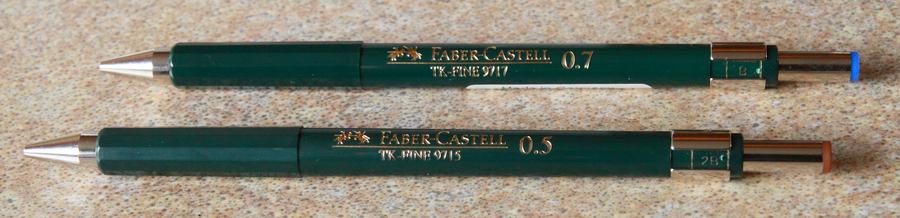
Today: a mechanical pencil – The Faber-Castell TK-Fine, which is – despite the similar name – quite different to the TK-Fine Vario L, discussed by Dave. or the TK-Fine Executive, also reviewed by Dave.

Price-wise the TK-Fine is only about a third of the price of the TK-Fine Vario L. The TK-Fine is also slighlty cheaper than the Executive version, but this price difference is not that big.

All of the different TK-Fine pencils come in Faber-Castell’s famous dark green colour you know from the Castell 9000, but the TK-Fine version does not have the twist eraser, nor does it have (adjustable) lead cushioning. Another difference is that the Vario has a grooved metal grip area and that the Executive has a similar plastic grip while the TK-Fine‘s grip area is very much like the Apollo‘s. The Apollo has unfortunately disappeared, but a few weeks ago Lexikaliker had a post about the Apollo (Google translation of Lexikaliker’s Apollo post) and he was even kind enough to give his Apollo to an artist whose Apollo broke after 15 years of intense use.

…but the grip is not the only similarity between the Apollo and the TK-Fine. Let’s have a closer look at the similarities and differences between the Apollo and the TK-Fine.

The Apollo was available from 1983 until 2000. Different version can be seen in Lexikaliker’s post and in my opinion the Apollo XL looks just beautiful!

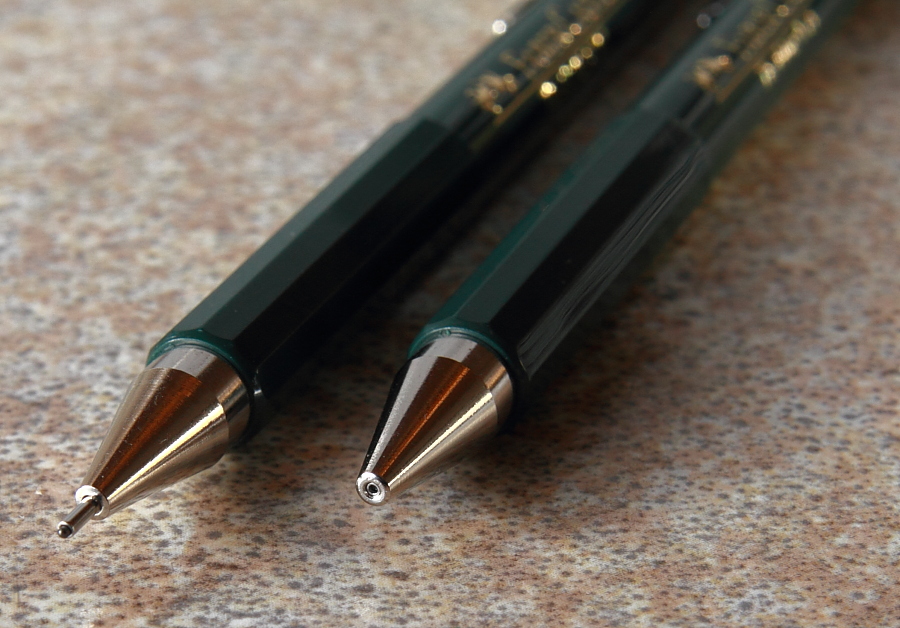
The TK-Fine has been available for over ten years and looks very similar, the main difference in appearance being the different top cap. It is actually being manufactured using the same tools that were used to make the Apollo, but the TK-Fine is made for technical drawings with a rigid, but fully-retractable lead sleeve, similar to the one you might know from Staedtler’s Mars micro. The Apollo on the other hand was made for writing and had a sliding sleeve that retracts as the pencil is used.

The TK-Fine is being produced in Geroldsgrün in Upper Franconia (Germany) available in 0.35mm (TK-Fine 9713), 0.5mm (9715), 0.7mm (9717) and 1.0mm (9719) and has an according top cap marked according to the ISO norm for technical drawing.

I bought the TK-Fine 9717 in April 2010 in Müller in Volkach (Germany) for €4,39 (~$5.80; £3.70) and the TK-Fine 9715 from Schule-Uni-Shop.de, who also ship internationally, for € 2,67 (~$3.50; £2.25). The price in the UK is comparatively high: At CultPens TK-Fine sells for £4.16 (~$6.50; €4.90).

Conclusion:

The TK-Fine offers great value for money if you find a shop that sells it for a reasonable price, but since it is not a common pencil you might have problems getting hold of one.It comes with 3 super-polymer leads in HB, offers a pocket-safe lead sleeve (fully-retractable), it is colour coded according to ISO for lead width, it has an adjustable lead-grade indicator (2B – 4H, plus one neutral setting) and the eraser comes with a cleaning pin.


Prices: April 2010 and November 2010

Exchange Rates: December 2010

I would like to thank Ms Schaklies from Faber-Castell Customer Care for the additional information about the TK-Fine.

By the way… Faber-Castel made it into the Economist again. This time into the Economist’s Schumpeter column, which was introduced about a year ago.

Faber-Castell TK-Fine Read More »

Writing slates

When I started school and we learned how to write we were using writing slates, probably because you can practise again and again without wasting paper. They were not really made of slate, instead they were a bit like a laminated piece of paper, just that the plastic used is much harder and that the surface was not smooth. A few months ago I found my old writing slate again, together with the sponge to clean it and the pencil to write on it.

The sponge came in a container that could be closed – nice when you want to transport it, but not nice if you do not let the sponge dry out from time to time, as the old water will get smelly. The pencil was a “Heft und Tafel” (exercise book and chalkboard) pencil from A.W. Faber-Castell. As the name suggests they can be used on slate and on paper. You can still get the “Heft and Tafel” pencils today. I bought the white Goldfaber pencil you can see in the photo in April 2010 from Bürobedarf Jäcklein in Volkach for € 1 (~$ 1.38; ~85p). Even the writing slate Scolaflex is still available from Brunnen. Mine is from the late Seventies, just like the blue pencil. It has lines on one side to help getting the cap height and baseline right and is plain dark green on the other side.

Writing slates from proper slate are still available for a reasonable price. I just bought this school writing slate (see photo) from Inigo Jones for £ 3.25 (~$ 5.25; ~€ 3.80). It even comes with a slate pencil. Unfortunately I was not able to find out whether the slate is real Welsh slate.


Price: April 2010, Exchange rates: November 2010

Lexikaliker has a nice photo of a writing slate (Google translation) .

Writing slates Read More »