Pencils

Traces of graphite – Massimo Fecchi

Time for another traces of graphite post.

As I kid I spent most of my pocket money on buying comics. Just to point it out though: in Europe the common comics at that time were not superhero comics, like in the USA. Instead the popular comics were Disney and Franco-Belgian comics.

I read a lot of comics, but despite there being so many artists there’s probably no other single person that has influenced my ‘visual taste’ as much as the Italian comic artist this blog post is about. I love his way of rounding off corners. Things he draws just always seem to have perfect proportions and shapes.

In the past this artist’s drawing could be admired in the Fix and Foxi comics or in Knax, a free comic magazine provided by some banks. Back then printing the name of the artists who were working on a comic story wasn’t common, that only became common many years later – but when it became common I figured out that the style of drawing I liked most was from Massimo Fecchi.

Today he is working on Disney comics (Duck and Mouse) for Egmont. I think that might make him the only Italian comic artist drawing Disney comics for Egmont (in Denmark) instead of for Topolino / Panini Comics (in Italy).

Ten years ago I was lucky enough to get a drawing from him, which has first been hanging in my living room and after I moved it is on the wall, just where you enter the house.

Fecchi's drawing
Fecchi’s drawing

I have recently asked him by email what tools he is using to create his comics.

He told me that he is using these four steps to create a page.

  1. He is drawing a rough outline of the page with a blue pencil. For this he is using Pilot’s 0.7 mm Color Eno leads in a Caran d’Ache 844, a pencil which he describes as the best.
  2. He then draws the lines with 0.5 mm Koh-I-Noor leads in B, in a Rotring Tikky (the  older, German made Tikky II with the wavy grip section).
  3. Before inking with a brush we will draw fine details with Staedtler’s pigment liner (0.1 mm, 0.2 mm or 0.5 mm)
  4. In the end he will ink the drawings with a Winsor & Newton #2 brush from the 7 series.

Here’s a magnification where you can see the blue lines from the rough outline

You can see the blue a graphite pencil lines in Fecchi's drawing
You can see the blue a graphite pencil lines in Fecchi’s drawing

He was kind enough to let me have a look at the comic he is currently working on, so here’s a chance to compare how a page looks like after the second and after the fourth step – please open the images in a new tab so that you can see all the details.
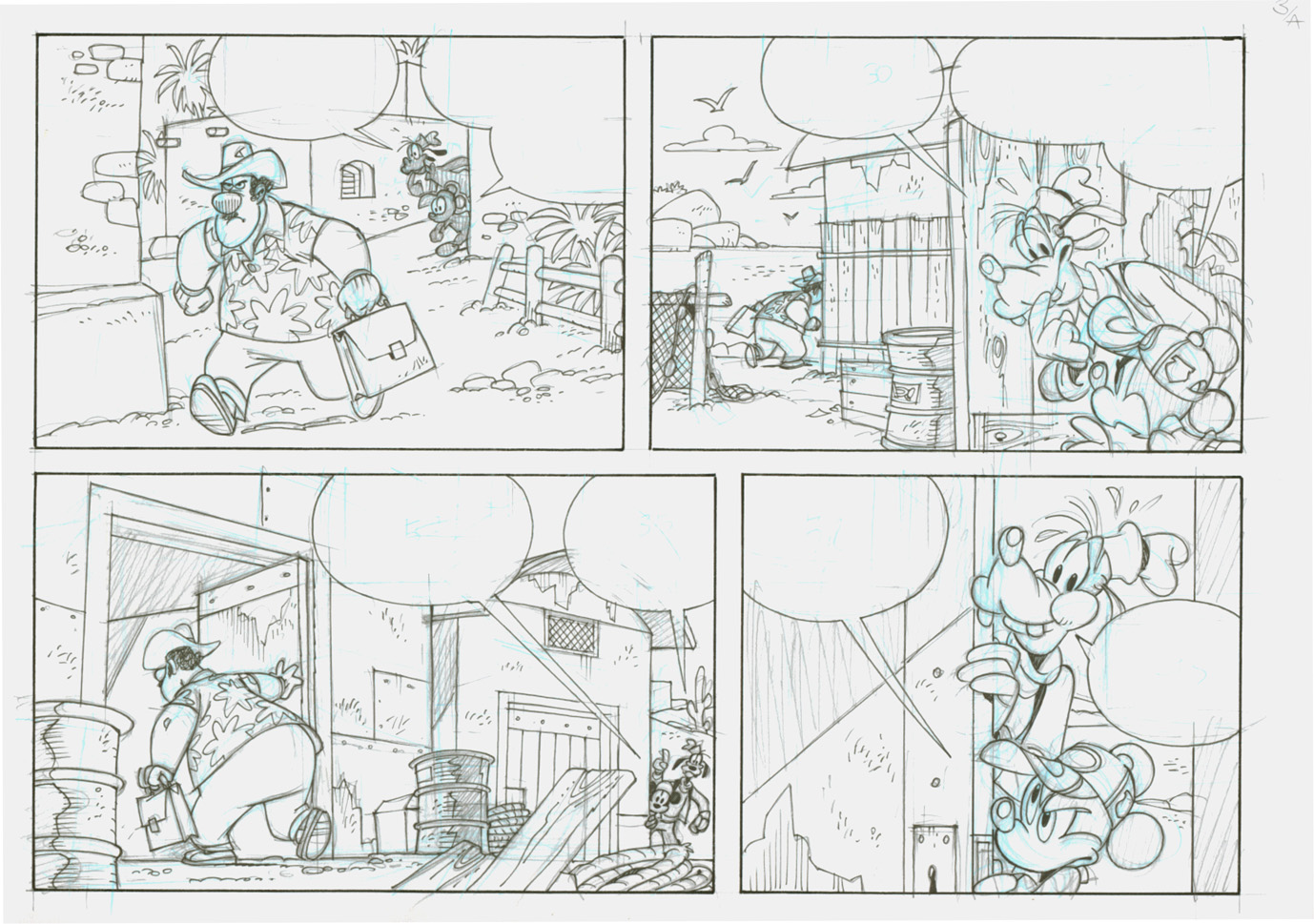
Pencil drawing (© Disney/Egmont)
Inked (© Disney/Egmont)

Traces of graphite – Massimo Fecchi Read More »
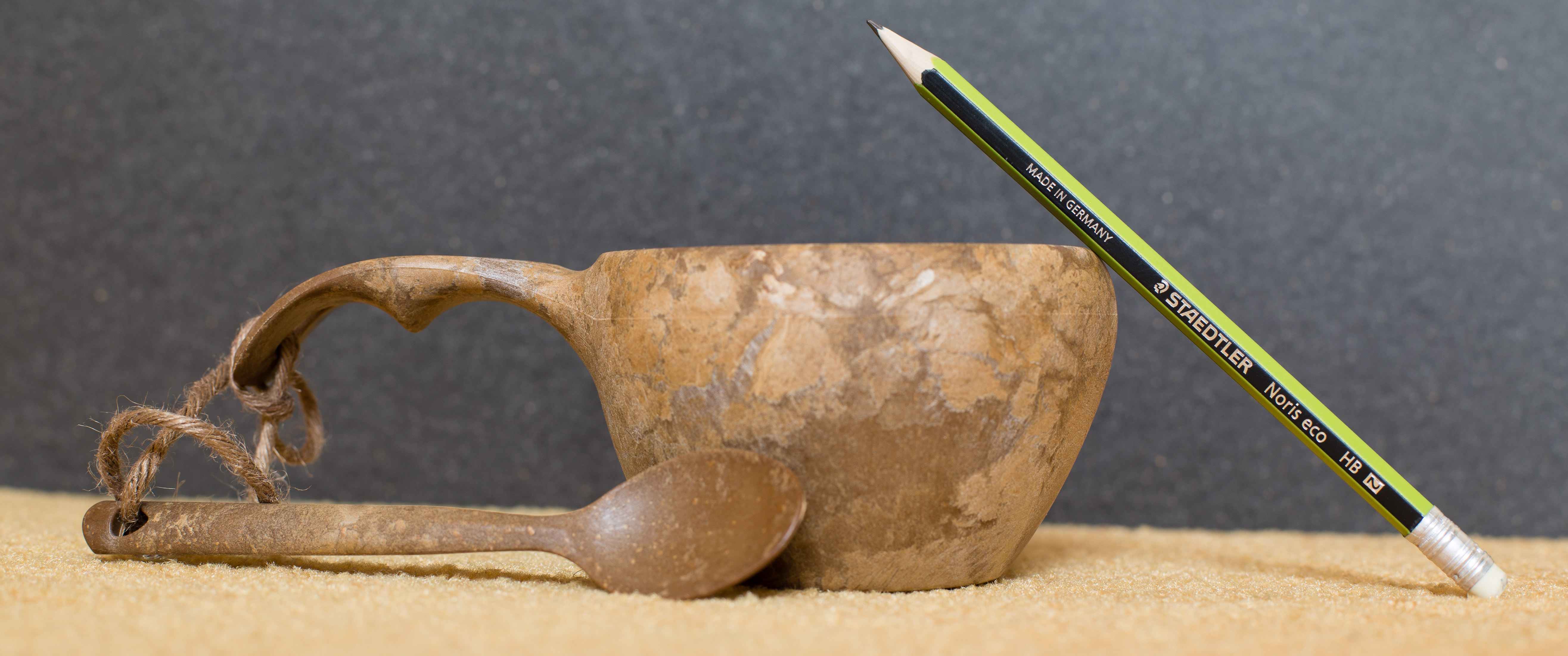
Kupilka and Wopex

These items have something in common. Both are wood plastic composites.

The Wopex doesn’t need an introduction on a pencil blog. According to Staedtler’s website it contains more wood than plastic.

Kupilka and Wopex

The cup is a Kupilka, a kind of modern Kuksa. The Kuksa is a traditional cup from northern Scandinavia, carved from birch burr. I was very tempted to buy one when I transferred in Helsinki airport a few years ago, but you’re only supposed to carve them yourself or get them as a gift, plus I mainly drink tea with milk and they’re not so good with milk I heard, so I skipped buying one. Well, this is a modern version and like the Wopex it’s a wood plastic composite. According to the manufacturer it’s 50% pine and 50% thermoplastic.

I bought mine in March 2016 for £16.93 (~$23.90; €20.90), including postage, from an Amazon Marketplace seller. I was quite surprise when it turned out that the company that sold the Kupilka is from the city where I live. They even have a Kuksa carving course this autumn. I’m very tempted!

Kupilka and Wopex

I was quite surprised that my cup came with a spoon. I didn’t expect that as no spoon was pictured on Amazon.

Massdrop sold these recently, too, and you could even choose between different colours, but I already have my Kupilka so wasn’t tempted by their offer.


Price: March 2016

Exchange rates: April 2016

To see the high-res version of the photos please open in a new tab.

You can find reviews of the Kupilka at Hiking in Finland, Black Scout Survival and Sticks Blog.

You can find reviews of the Wopex at East.. West.. Everywhere, Stationery Traffic and at Pencil Revolution.

The godfather of all Wopex posts can be found at Lexikaliker and there’s a comparison of the different Wopex leads here at Bleistift.

The Massdrop link contains a friend invitation code.


Kupilka and Wopex Read More »

More Mongols

Eberhard Faber Mongol pencils at the surrender in Reims (Image © probably Pathé News)

Well, there are not many blog posts about vintage pencils here, but thanks to Henrik’s comments here’s a quick follow up on the previous blog post and the Mongol.

Eberhard Faber Mongol pencils at the surrender in Reims (Image © probably Pathé News)

The Mongol is the pencil that was used for taking notes at the surrender in Reims (ending WWII in Europe), while the Parker 51 was used to sign the actual documents.

Eberhard Faber Mongol pencils at the surrender in Reims (Image © probably Pathé News)

If you want to have a closer look at these pencils: Sean has a blog post about the Mongols made in 1944, near the height of U.S. production for the Second World War.

Eberhard Faber Mongol pencils at the surrender in Reims (Image © probably Pathé News)
Preparing the Eberhard Faber Mongol pencils for the surrender in Reims (Image © probably Pathé News)

I believe that the use of the image shown in this blog post, falls under “fair dealing” as described by the UK Copyright service.

More Mongols:

Lexikaliker has a nice Mongol ad from the 1920s and on Sola’s blog you can admire some of the Mongol’s great packaging.

…and just earlier this week Jinnie had a look at the Mongol 482

There also more Mongol spotting going on at Orange Crate Art, actually so much that I only picked one to link to. Michael has some great Mongol ads, too. This one is on my wall in the office.


More Mongols Read More »

Faber-Castell Columbus

Faber-Castell Columbus

Faber-Castell Columbus

Today: Faber-Castell’s Columbus pencil, which you might remember from Contrapuntalism’s blog post about the Columbus’ catalogue number.

Last October [1]A fitting month to buy a Columbus pencil. I bought a dozen Columbus in HB for £6.98 including postage from eBay (~$10.10; €9). I like pencils with a theme, and with the Columbus theme and the little ship printed on the pen this pencil doesn’t disappoint [2]…but using the article bumber 1492 instead of 2103 would make it even better.

Faber-Castell Columbus


The Columbus did have many different article numbers since it was first released. It’s current number is 2103 (the six digit number is 113100) and even though it survived it is only officially available in Ireland where it is actually distributed by Tom Martin and Company Limited, the Irish agents for Faber-Castell, not by Faber-Castell directly.

Faber-Castell Columbus

Faber-Castell in Ireland

(Image © Irish Examiner)

In 1954 Roland Graf von Faber-Castell [3]The father of Anton-Wolfgang Graf von Faber-Castell ..and nine other children. set up a factory in Fermoy in Ireland [4]see p.42, Faber-Castell anniversary magazine 1761-2011; p. 110 Das Bleistiftschloss. In the 1960s the factory was expanded further. This factory is where the Faber-Castell Columbus was being made until the factory closed down in 1990. Similar pencils where made there, too, like the (pre-)Bonanza seen at Contrapuntalism. It looks as if Ireland got so used to the Columbus pencil and as if there was still a demand for this pencil, so after the factory in Fermoy closed down Faber-Castell started making the pencil elsewhere. Tom Martin is now distributing it to satisfy national demand.

Faber-Castell Columbus

In its life the Columbus has been made in many different places: the USA, Ireland, Franconia (Bavaria). I am not sure where the current Columbus is made, the box and the pencil don’t have a “Made in” imprint, but if I was a betting man I would say they’re from Indonesia, where the Bonanza and the Goldfaber are being made.

Faber-Castell Columbus

EcoPencil

The packaging features an EcoPencil sign, something Faber-Castell is using to highlight some of their environmentally friendly pencils, but there doesn’t seem to be a definite criteria needed to get this Faber-Castell stamp of eco approval. Some Brazilian pencils with this stamp are FSC certified, but the Columbus isn’t . Instead the Columbus has PEFC certification (Programme for the Endorsement of Forest Certification schemes). Another  reason why the Columbus got the EcoPencil sign is its more eco friendly varnish.

Faber-Castell Columbus

Performance

The Columbus delivers solid performance, as expected from Faber-Castell. The line is very similar to what you would get from a Bonanza and from a Goldfaber. This pencil is nice and pleasant to write with. Like many Faber-Castell pencils it feels a bit harder and lighter than the same grade from other manufacturers like Staedtler, so depending on your taste you might want to buy this pencils in a slightly softer grade.

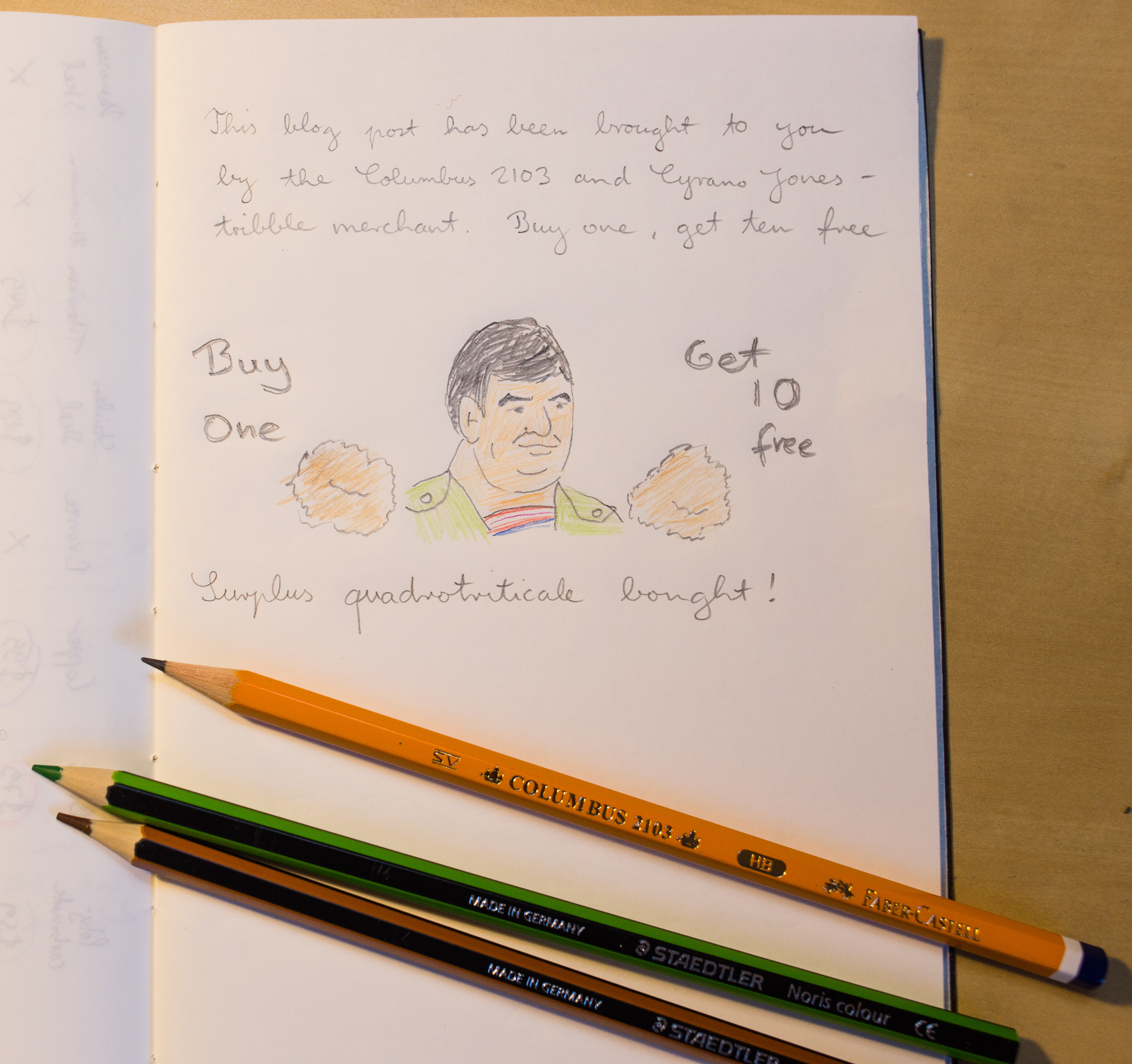
This blog post has been brought to you by the Columbus 2103 and Cyrano Jones - tribble merchant. Buy one, get ten free. Surplus quadrotriticale bought.


Price: October 2015

Exchange rates: February 2016

I’d like to thank Róisín Fleming from Tom Martin and Company Limited for the information about the EcoPencil label.

You can find more photos from Faber-Castell in Fermoy (including photos of Roland Graf von Faber-Castell)  at the Faber-Castell album on the Fermoy Facebook page.

I believe that the use of the image from from the Irish Examiner, shown in this blog post, falls under “fair dealing” as described by the UK Copyright service.


References

References
1 A fitting month to buy a Columbus pencil.
2 …but using the article bumber 1492 instead of 2103 would make it even better
3 The father of Anton-Wolfgang Graf von Faber-Castell ..and nine other children.
4 see p.42, Faber-Castell anniversary magazine 1761-2011; p. 110 Das Bleistiftschloss

Faber-Castell Columbus Read More »

Graf von Faber-Castell Journal and Paper

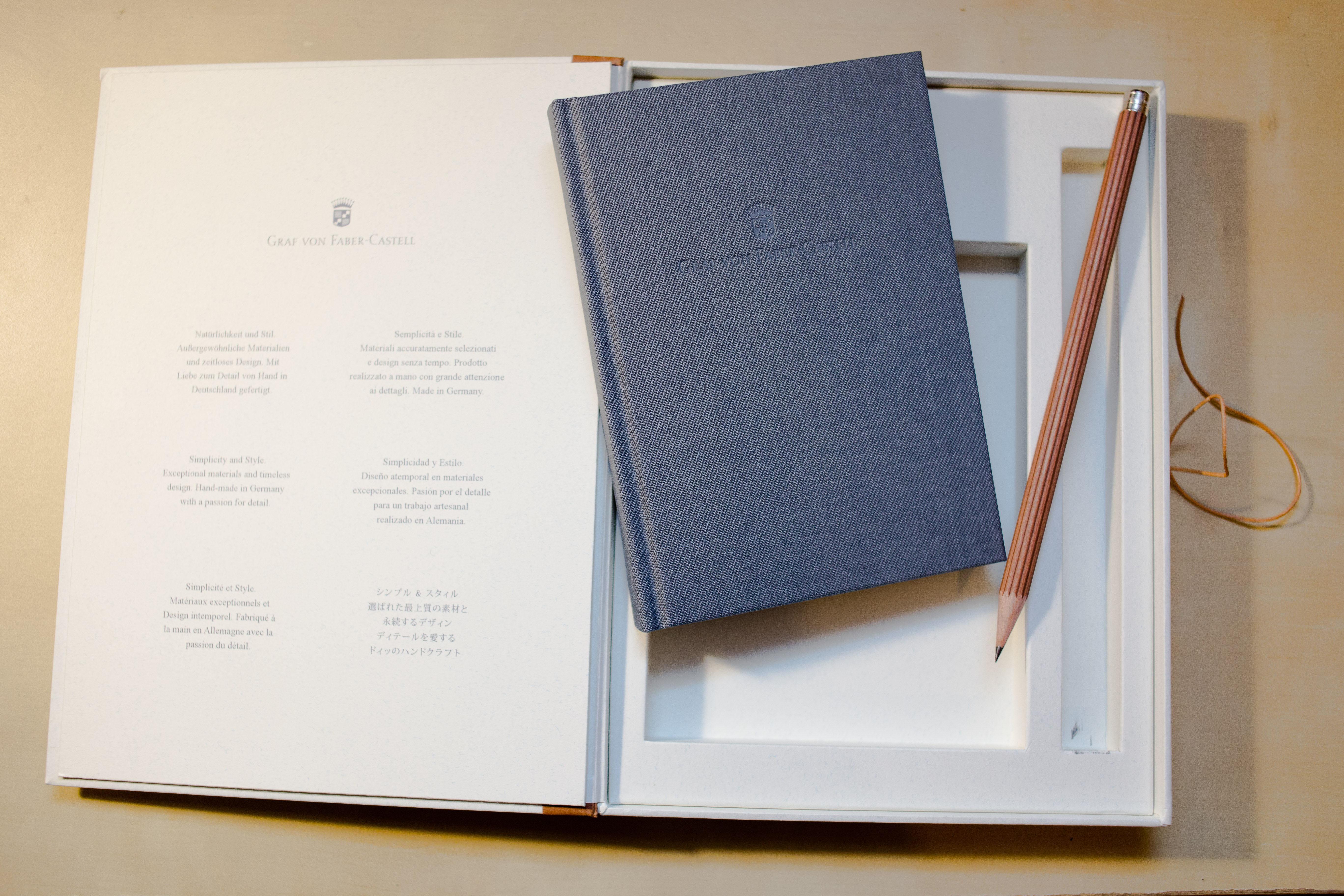
gvfc-journal1Today: a noble notebook and pencil.

Graf von Faber-Castell, that’s Faber-Castell’s posh product line started in 1993. Back then our favourite count, Anton-Wolfgang Graf von Faber-Castell, introduced this line as part of Faber-Castell’s reorientation. As a pencil enthusiast, I am quite happy that the Graf von Faber-Castell line has not neglected the humble pencil. There was a Graf von Faber-Castell version with only an eraser cap, a pencil extender and the perfect pencil and there were some other pencils along the way, like the fluorescent Graf von Faber-Castells.

This Graf von Faber-Castell Journal and Pencil set is available for free with most purchases from The Pen Company’s Graf von Faber-Castell line. I got it free of charge when I recently placed an order with them.

gvfc-journal-open2


The pencil included in this set is one of their fluted pencils with a silver plated end cap. I assume it is silver plated, not solid silver but I am not 100% sure. These pencils are a bit harder than the very old Graf von Faber-Castell pencils, but certainly softer than a Faber-Castell HB pencil. In any case, they are a pleasure to write with while keeping the point fairly well.


gvfc-journal-inside
gvfc-pencilThe notebook you get is clothbound and has thick, creamy paper in a kind of slightly yellow shade of light beige. It feels quite different to the ordinary white from most notebooks. Despite the smooth surface, the paper is taking the graphite on very well. I am spelling this out because some smooth paper, like the one found in the original Field Notes, is very smooth and doesn’t work well with pencils – as if the paper is too smooth and not abrasive enough to get the graphite off the pencil and onto the paper. This Graf von Faber-Castell paper does, however, feel very smooth to the touch but is ‘abrasive’ enough for use with HB pencils. The writing experience on this paper is just excellent. It’s a shame you can’t buy these individually, but since they’ve been around for at least five years I hope that we will still see this notebook as part of some special offers in the future.


This blog post has been published on The Pen Company’s Blog, too. Just to spell it out, I have not received any money for writing this blog post.

Graf von Faber-Castell Journal and Paper Read More »