A few weeks ago I wrote about the Eco Bridge Paper Pencils. I want to mention a few other things that are being sold in the same shop sell. The items are not exactly cheap, so it is unlikely that I will buy them. This means I cannot write a proper review, but it would be a shame to leave these items unmentioned, as they are unusual and, for lack of a better word, interesting.
If I had to describe the shop I would say it is a shop full of random quirky things aimed at arty, Apple using yuppies. Things are not cheap, but it will be difficult to find them somewhere else. It is a kind of hip and cool version of Manufactum.
Continuing from the Eco Bridge Paper Pencils, along the Korean stationery theme, they also sell Korean ‘notebooks’ (actually what I would call exercise books). They look nice and are labelled in French. Unfortunately importing them from Korea made them cost five to ten times the price of a similar (plain looking) notebook from Europe. If you want a really nice, thin notebook this might be it.
Another product imported from East Asia is a set of 36 squary, coloured pencils from Japan. It retails for £60 and is part of the Düller range. The Düller range also includes a pen designed by Dietrich Lubs, who is featured in New York’s Museum of Modern Art. The coloured pencil set is designed by Naori Miyazaki. Unfortunately I was not able to find out more about her [1]I assume it is a female name, except that she is not featured in the Museum of Modern Art. The MoMA online shop does however sell a clock designed by her. Back to the pencil set. There is some rather strange text in German written on this pencil box about combining German taste and Japanese handiness, which looks instantly East Asian because of the character spacing. In different online stores in the UK and Australia the price of this pencil set can vary dramatically. I thought I saw it in an American online store for $96, but I was not able to find it any more to confirm this price.
I have been looking forward to receiving Staedtler’s Wopex in 2B and in 2H since I started using the Wopex HB a few weeks ago. Even though writing with this pencil is somehow strange, it is also quite nice at the same time. If the Wopex is not over-sharpened and if you write on the right kind of surface it will perform really well. Another thing I should mention is that the Wopex does not smudge, something I find quite important (others might not care).
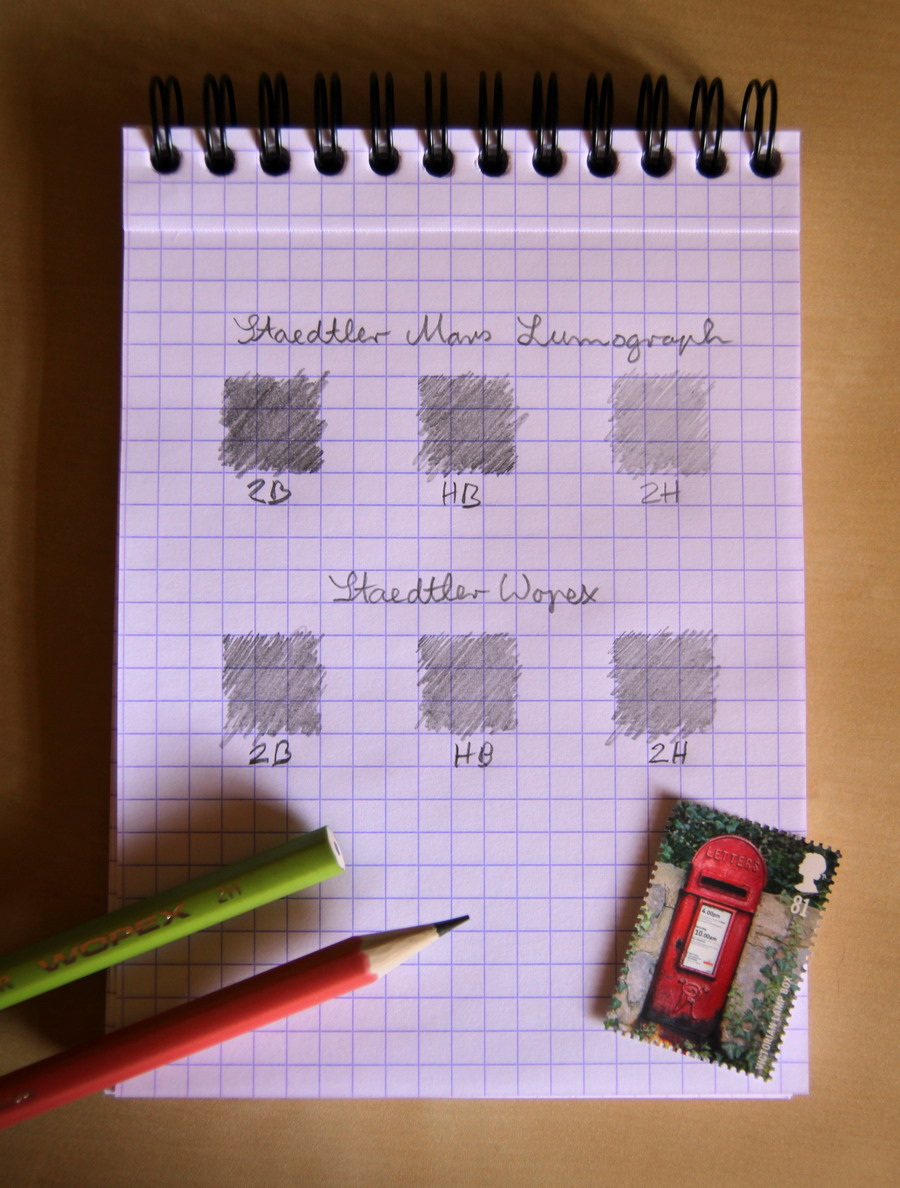
Back to the main topic: I received the Wopex in 2B and in 2H and after trying the new pencils for a few seconds I was quite disappointed. Not because they do not perform well (they are nice writers), but because I really struggle to find a difference between the 2B, the HB and the 2H. They lay down a line of the same intensity, they ‘shade’ paper the same way, erasing them is virtually the same and they all do not smudge either.
Is selling the same pencil under different grades some sort of marketing trick?
Did I get a bad bunch?
…or does the production process mean that the different grades of lead are the same at the ‘start’ of the pencil and the real lead will appear after more sharpening?
I would be very interested to hear whether other Wopex users have the same problem.
My mother bought the Staedtler Wopex 2B and 2H from Bürobedarf Jäcklein in Volkach and sent them to me. At about €1 each they were rather dear, but you can find them cheaper online.
Before I start talking about the eco pencils I want to emphasise that I call them eco pencils because they are marketed in this or in a similar way. Why are they marketed like this? Because they do not use wood, but alternative materials. While I do believe that they could be more ecologically friendly than wooden pencils I have no proof and in the same way that for example biofuel or hybrid cars bring new problems, there might be hidden problem I do not know of when it comes to the production of the eco pencils.
The six eco pencils. Paper left, other materials right.
When it comes to wooden pencils there are also big differences, e.g. between pencils using wood from certified [1]e.g. FSC, PEFC, well-managed forests and pencils with wood from unknown and more dubious sources. It certainly would not be a problem to produce pencils without wood that are actually less environmentally friendly than traditional wooden pencils. In absence of any incriminating evidence I will however give the six eco pencils tested in this article the benefits of the doubt and will refer to them as eco pencils, as intended by their manufacturers.
First I will have a closer look at the extruded pencils.
CD case pencil
Let’s start with the red pencil, made from recycled CD cases. I found this pencil a few weeks ago, somebody must have lost it …or forgotten it …or more likely: did not want to use it any more because it is so horrible (more on this later). When I first found it I was quite excited. The pencil point was broken off, so I could not use it and had to sharpened it in my Deli pencil sharpener 0635, which I soon regretted. You had to use considerably more force compared to sharpening a wooden pencil in the Deli and to be honest, the Deli has not been the same since. The red plastic is much harder than wood and must have somehow blunted the burr cylinder. The Deli 0635 still works, but does not operate as smoothly as in the past. Writing with this pencil is not very nice. The line is not particularly black and the pencil manages to give you a waxy and scratchy feeling the same time. The writing on the pencil reads “Pencil made from recycled CD cases”. I wish it stayed a CD case.
Ticonderoga Renew HB Soft
On to the next pencil. The Ticonderoga Renew, made from recycled tyres. I was quite excited when I received my pack of ten.This excitement started to disappear when I tried to sharpen these pencils. They are even harder to sharpen than the red CD case pencil. Rotating the pencil in any sharpener will make you fear for the sharpener. I fear the pencil will manage to blunt every blade it touches. Once I started using the pencil any last bit of enthusiasm I had left for this pencil was gone completely. It was scratchy and the line is certainly not dark at all. Sometimes it seems to perform better, so I suspect that the lead is of different quality in different parts …or maybe the difference in performance has to do with the writing angle or the degree of sharpening. Sometimes writing with this pencil is nearly acceptable, but only nearly. Overall it is even worse than the CD case pencil. BTW, there is a warning, printed on the box “Not for use with electric sharpeners”.
Staedtler Wopex HB
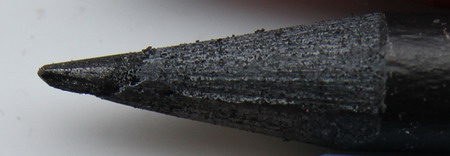
Last in the category of extruded pencils is the Staedtler Wopex. According to Staedtler the fibre material is made from 70% wood. The pencil is much easier to sharpen then the previous two pencils, but it is still not anywhere near a wooden pencil. As the lead is extruded, not made the traditional way, writing with it is more similar to writing with the previous two pencils than it is to writing with a pencil that has a traditional lead. Luckily there is no scratchiness, instead the lead is quite waxy. The line of the Wopex is also much darker, more like a line from a traditional pencil. Having used the Wopex for a few weeks now I have to say that depending on the paper and writing surface used, writing with the Wopex can be a very pleasant experience. Its lines are a bit more difficult to erase than those of most traditional pencils and it is about twice as heavy as a traditional pencil, which is quite nice. Another nice feature is its nice, “grippy” surface.
Top – bottom: CD case, Ticonderoga Renew, Staedtler Wopex, Eco Bridge, O’Bon Newsprint, Tesco
Next I will have a look at the pencils that use rolled paper instead of wood.
Eco Bridge
Recently I had a closer look at the Eco Bridge pencils, so I will not go into too much detail again. It is a nice pencil, but one thing I noticed is that, compared to other paper pencils, the rolled paper is more likely to get ripped away during sharpening, presumably because of no, less or different glue applied to the paper before rolling.
O’Bon Newsprint 2B
Next is the O’Bon Newsprint pencil. Mine seems to be made from paper that might have been part of a financial newspaper from mainland China. The pencil is made in China, but the newspaper you can see on the packaging of the pencils seems to be from Malaysia, which is where O’Bon seems to have its origins (don’t quote me on this, I am only 99% sure). Malaysia seems to be the new El Dorado for stationery lovers. If you like pens from the higher end of the market you might have come across Pen Gallery, an online shop from Malaysia. Pelikan is kind of Malaysian too. Pelikan, and recently Herlitz, were bought by a Malaysian business man and stationery aficionado who, according to some newspaper articles I read, fulfilled his lifelong dream when he bought this stationery giant. A lot of Faber-Castell products are made in Malaysia, too …so now it turns out O’Bon is from Malaysia as well. I wonder whether this is more than a coincidence. On the other hand Staedtler closed its factory in Malaysia this year. OK, one last Malaysia pencil fact: The most common pencil grade in Malaysia is 2B. Getting other grades is even quite difficult. Back to the O’Bon pencils: they are actually very good. Even though they are 2B they hardly smudge and the line is nice and dark. Unlike the Eco Bridge pencils the O’Bon pencils can be sharpened and still look good, as the paper does not rip away.
Tesco pencil
Now to the last paper pencil. The Tesco paper pencil is quite similar to the O’Bon as it is also made from real newspaper, while the Eco Bridge seems to use paper specially made for the pencils, which reduces the eco-ness considerably. The Tesco pencil is also slightly slimmer than the other two paper pencils and much cheaper. The surface is smooth like the O’Bon’s surface while the Eco Bridge pencil has a rough paper surface. By far the biggest drawback of the Tesco pencil is that it smells horribly for several days after taking it out of the package. Something that makes me think that the glues being used cannot be too healthy. On the plus side the Tesco pencil is one of the cheapest pencils around, but my local Tesco stopped stocking them so I fear they might be difficult to come by in the future.
Conclusion:
Unfortunately most of the pencils are only available in some markets. The Ticonderoga Renew box has a UK address printed on the reverse, but I have never seen this pencil in the UK. Staedtler has a worlwide distribution network, but the Wopex does not seem to be available in all markets.
The Staedtler Wopex is, without a shadow of a doubt, the winner of the extruded pencils tested here. There are of course also other extruded pencils, like the ones from BIC, but they were not included as I have never used them. Last time I used other extruded pencils they were horrible writers, similar to the CD case pencil and the Ticonderoga Renew, so I assume that there are not many nice extruded pencils available. One problem with the Wopex that I should point out is that the last millimetre of the point can break easily if you have over-sharpened it.
The winner of the rolled paper pencils is the O’Bon Newsprint. It can be sharpened without problems, the surface finish is really nice and it does not have the horrible smell the Tesco pencil has in th ebeginning.
One interesting point I should mention is that some of the eco pencils (Wopex & O’Bon) claim that they last longer than normal pencils. I have not looked into this yet and cannot comment on it. If you think you noticed that they last longer please let me know.
Eraser test with Mars plastic pen on Bloc Rhodia No 13
I would like to thank Kevin from O’Bon for sending me the Newsprint pencils free of charge. Even though I received them free of charge I tried to be objective and believe that this article was not influence by the fact that I received the O’Bon pencils without having to pay for them. You can find a review of O’Bon pencils at pencil talk.
Last time I visited Selfridges, they had the Robot Pencil Sharpener from Kikkerland on a shelf. I recognised it from Dave’s Mechnical Pencils, but I am sure I have also seen it in other blogs. Of course I could not resist and was drawn to it. Next to it there were also some other novelty pencils and eraser, including big dinosaur shaped erasers, Penguin Book pencils and paper pencils. This being Selfridges the items were not cheap, but I still bought the robot sharpener and the paper pencils.
The paper pencils are from a company called Eco Bridge and are made in Korea. I paid £3.95 (~ $ 5.95, ~ € 4.40) for three pencils. The price in Korea is 2300 Won (~ £ 1.35, ~ $ 2.00, ~ € 1.50). Not cheap, especially when keeping in mind that until recently Tesco sold similar pencils made from rolled Chinese newspaper for less than 5p (~ 8¢, ~6ct) each. O’Bon’s newsprint pencils, reviewed at pencil talk, cost $5 (~ £ 3.30, ~ € 3.70) for a pack of 10.
The Eco Bridge pencils is definitely softer than the Tesco pencil or the average European HB pencil, its softness is comparable to a Staedtler Mars Lumograph B, Faber-Castell 9000 2B or Palomino HB. Smudging is similar to other pencils of this softness. To my surprise the Eco Bridge is a very good pencil. It is much smoother than a Dong-A Fable HB, one of the few pencils from a Korean company that is, as far as I know, produced in Korea. I normally prefer pencils where the point stays sharp for longer, but softer pencils like the Eco Bridge have the advantage of delivering a nicer, darker black when writing.
Eco Bridge Pencil (front) & Tesco Pencil (back)
When it comes to sharpening the pencils the Tesco pencil performs better than the Eco Bridge. The blade of the sharpener (in this case the Eisen 402) seems to cut the Tesco paper much better, while the paper in the Eco Bridge is more likely to get ripped away. While the paper used for the Tesco pencil is rolled paper with Chinese characters on it, probably from a newspaper or something similar, all three Eco Bridge pencils have a similar colour distribution on the paper, red in the middle, near the lead, and recycling beige on the outside. I suspect that the paper used for the Eco Bridge has been recycled and printed on specifically for this pencil, in order to produce this pattern on the paper. This would also explain the higher price tag. This recycling process might be responsible for the rougher paper, compared to the Tesco pencil, which results in the paper ripping easier.
Eco Bridge & Tesco on Bloc Rhodia No 13, eraser test with Mars plastic pen, smudge test on the right
Conclusion:
The Eco Bridge is not cheap, but it is a nice pencil. It might not be able to compete with really good pencils, but it is better than most “average” pencils. If you like B or 2B pencils and happen to see the Eco Bridge pencils in a shop you could give it a try. On the other hand this money would (nearly) buy you one of the good pencils (9000, Lumograph, Palomino, Mono).
Price and exchange rates: March 2010.
I would like to thank Kent from Pencilog for the Dong-A Fable used for the comparison.
When it comes to the recognition value of their pencils there is one company that – in my opinion – does by far the best job: Staedtler. Compared to other companies in this industry Staedtler is quite unusual as the company belongs to the Staedtler foundation whose main purpose is the promotion of scientific research… but I digress. Let’s get back to the pencils: As much as I like to use pencils from other companies, the Faber-Castell 9000 for example, for me the archetype of a pencil is the Staedtler Noris, available in two versions: as the 120 (without eraser) and as the 122 (with eraser).
The Noris is a pencil that is very common in Europe, but I would not say that it dominates the market. Noris as a brand name for pencils has been registered in 1901 and the name Noris itself is closely related to Staedtler: the nymph Noris is the personification of Nuremberg, the city where Staedtler has its headquarters. The Noris pencil is definitely quite popular in Germany. In UK it is also quite popular: in supermarkets you can usually find at least two types of pencils, often more, but a no name pencil and the Staedtler Noris seem to be the common denominator.
Somehow the look of the Noris is easy to remember, but this is not a feature unique to the Noris: Staedtler also did a great job in that respect with some of their other pencils: the tradition and the Mars Lumograph. These three models are instantly recognisable and unless you count the yellow Koh-I-Noor [1]which was not the first yellow pencil, but seemed to have sparked the popularity of yellow pencils in America they seem to be the most copied pencils in the world.
The Staedtler Noris was the antetype for the Chunghwa 6181, reviewed at oh! super tooth, but even though the Noris has probably been less often copied than the tradition and the Mars Lumograph, it can be seen on TV more often, usually used by somebody who is probably not even aware what make or model it is.
In one episode of Black Books the main character is using a Noris to control who is allowed to talk. I just saw the Noris again last week in a BBC documentary unrelated to pencils, and I see an icon that looks like the Noris on a daily basis in Okular, the document viewer in KDE 4.
Slightly younger than the Noris, with Mars being registered as a pencil brand in 1900, but with the Lumograph being released about 30 years later, the Mars Lumographwould probably have to top the list when it comes to how often the look of a pencil has been copied by no name pencils. I have seen no name pencils with the look of the Mars Lumograph, but without any writing on it countless times. Sometimes you can also see copies of this pencil with the name of the manufacturer on it, e.g. the Chunghwa Drawing pencil, reviewed at Blyantsiden (Google translation) or the Medicise Drawing pencil 9002. Of course the Mars Lumograph also got its fair share of TV presence. Just to name one example, there is a Derrick episode from the Seventies where a secretary is using a pencil, unmistakably a Mars Lumograph.
Top to bottom: Great Britain, Australia, Germany
The distinct look of the Staetdler pencils makes recognising them so easy. This must surely be an important factor that influences the decision of customers when they are in front of a shelf of pencils and need to decide which pencil to buy.
Unfortunately Staedtler stopped producing pencils in Australia and Great Britain, but some shops still have stock left that was produced in these two countries. You might know where this is going… After this really long-winded introduction I will now compare Staedtler pencils from different countries, to be more precise: I will be comparing the Staedtler tradition 110 from Australia, Germany and Great Britain. For this comparison I used recently produced pencils from the three different factories. It would be wrong to assume that there is no variation in the production, so please do not take this comparison too seriously.
Top to bottom: Great Britain, Australia, Germany
When comparing the different HB versions [2]Even though I have most grades of the British (actually Welsh to be precise) and of the Australian tradition I only have the HB version of the German tradition. you can see that the Australian version has the thinnest layer of paint. I have to say that I actually like it, because you can see the texture of the wood through the paint. On a negative note I also have to add that the Australian pencils (all grades) have the paint applied less consistently. All pencils came pre-sharpened, but the pencil from the German factory has been pre-sharpened using a different method than the other pencils. The pencil from Great Britain is definitely softer than the other two. It also smudges a bit more. When I tried to erase all three using the Mars plastic eraser pen (528 50) there was no real difference between the different pencils.
Different tradtitions on Brunnen Kompagnon Anno 1877 paper
Comparing the Australian 4B and the British 4B I also thought that the British pencil was a tick softer, but this was definitely not as noticeable as it was for the HB pencils. Using the Mars plastic eraser pen the Australian 4B was maybe a bit easier to erase than the British 4B, but again there was not a big difference.
Different tradtitions on Brunnen Kompagnon Anno 1877 paper
Conclusion: The tradition is a really good pencil. I am not sure why, but the German Staedtler web site lists the tradition in the artist category, not in the category for pencils used for writing. Nevertheless the tradition is very suitable for writing. Stock of Australian and British tradition pencils will be exhausted soon, so get some while you can …not that the performance of the German tradition is worse, but if you just spent a few minutes reading this post you must be pencil-crazy enough to want the Australian and British version as well.
I would like to thank David from Dave’s Mechanical Pencils for the selection of Australian pencils, including the Staedtler tradition, he sent me.
The photo of Stephen Wiltshire using a Staedtler Tradition has been taken from Top Gear Episode 5 of Series 14. I believe that the use of this image falls under “fair dealing” as described by the UK Copyright service.
The pencil icon has been taken from Okular, the document viewer in KDE 4.
Even though I have most grades of the British (actually Welsh to be precise) and of the Australian tradition I only have the HB version of the German tradition.