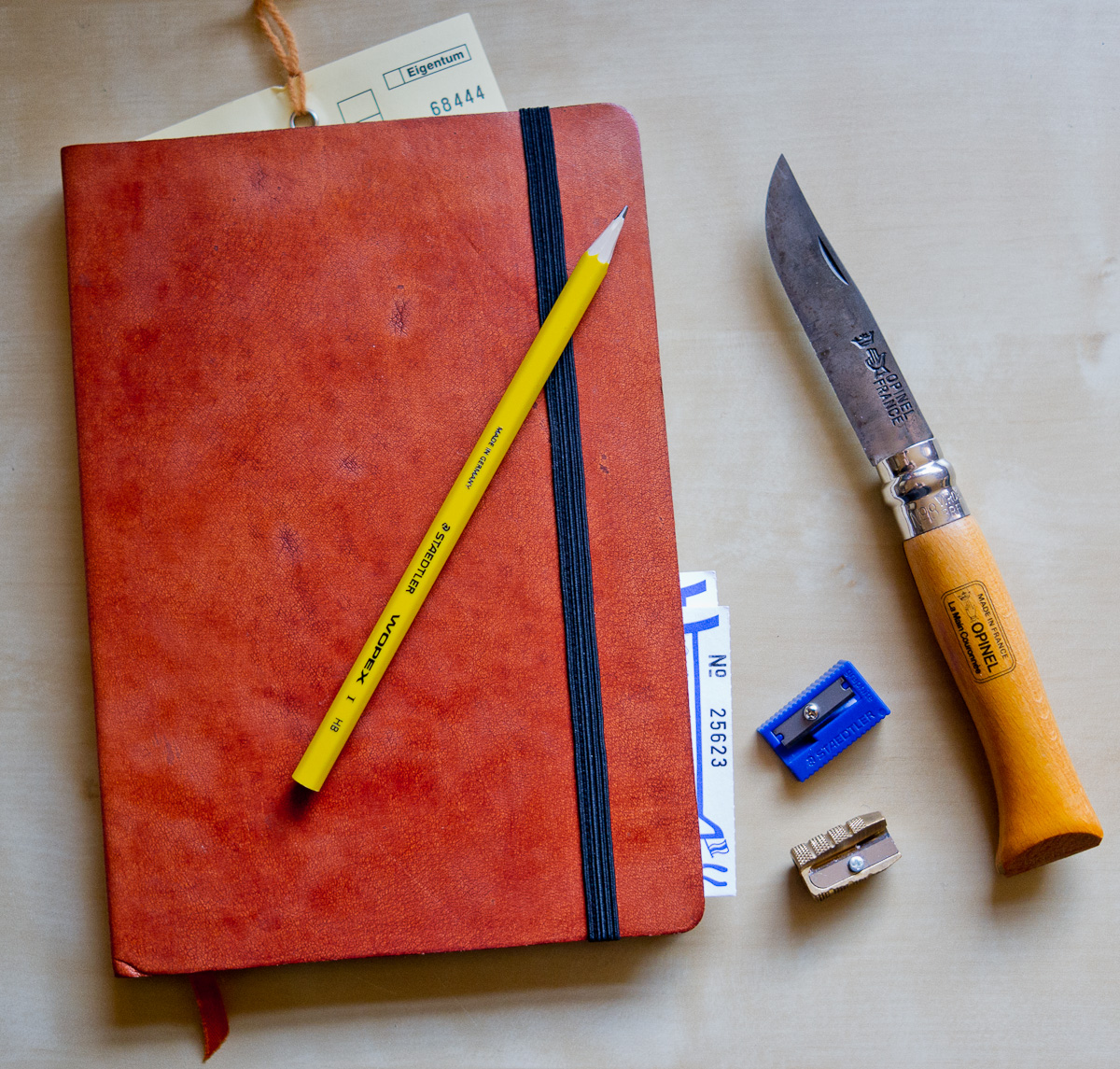
You might have already noticed that the Wopex is one of my favourite pencils. It is the pencil I use most often when writing on paper where ghosting/graphite transfer might be a problem. There is however one problem that makes using a Wopex an experience less exciting than it could be: sharpening this pencil.
Wopex, presharpened
Desktop sharpeners are not good at sharpening pencils with such a hard casing. They won’t stop automatically, too, which means that you might shorten the pencil too much when using a desktop sharpener and you’ll got a less than exciting finish where the blade cylinder stopped.
Wopex, prism sharpener sharpenedClick to enlarge
A normal prism sharpener does a better job when it comes to sharpening a Wopex, but the lead tends to look rather porous after sharpening and the fine point created will break much easier on a Wopex than on a pencil with a traditional lead.The special Wopex sharpeners don’t seem to do a better job than any other prism sharpeners. At least they don’t do for me, maybe I don’t use them the way they should be used. One example is shown here, but the point doesn’t always look that bad. A better looking point, made using a prism sharpener, has been shown in a previous blog post.
Wopex, knife sharpened
The presharpened Wopexes[1]Wopeges, Wopeces? or whatever the plural may be are looking and performing best. They are sharpened on an abrasive surface, something that is not necessarily practical for home use because of the time and dust involved. Searching for an alternative, better than a normal prism sharpener, I thought of using a knife to achieve a point similar to the one of presharpened Wopexes.
“Unlike most other sharpening techniques, in which blades engage the pencil’s wood (and later, graphite) at an angle more or less parallel to the shaft, the pocketknife’s blade is applied perpendicular to the pencil’s shaft.” (Rees 2012, p.46) [2]Rees, D., 2012. How to sharpen pencils. Brooklyn, New York: Melville House.
There is a special pencil knife for sharpening and erasing, but I used a normal knife. In this case one with a high carbon steel blade, but stainless steel blades work just as well. The results are good, better than what I get from a prism sharpener, including the Wopex sharpener, but are slightly worse when compared to a presharpened Wopex.
To celebrate 350 years of Bleiweißsteftmacherhandwerk [1]the craft of making pencils – Bleiweißsteft is what the Bleistift (German for pencil) was called during the 17th century the Franconian and Bavarian regional news reported live from Staedtler’s factory on 25 September 2012. The reports were only a few minutes long.
Dr. Konstantin Czeschka, Chief Technology & Production Officer, and Axel Marx, Managing Director, talked about the history of the pencil and included these interesting details:
The graphite used for pencil leads is ground to particles whose size is in the range of a micrometer, one millionth of a metre.
In 1900 there where 23 companies manufacturing pencils in Nuremberg. They employed 10,000 employees.
One machine, shown on TV, can produce 1000 leads per minute.
The pencil leads are heated to 1000°C
The leads seem to be made in Nuremberg, but the pencils seem to be assembled in their factory in Neumarkt.
I thought Staedtler’s mechanical pencils are made there, but didn’t expect their pencils to be made there, too. I mentioned Neumarkt in a previous blog post when I wrote about the ONLINE All Wood Marone. ONLINE is based in Neumarkt, too, as is e+m Holzprodukte.
Producing a pencil is a fairly automated process. You only need about 1-2 seconds of human labour time. 100 years ago about one minute was needed, 200 years ago it was about an hour.
The price of graphite is expected to rise. One of the reasons is that it is needed for manufacturing batteries for electric cars.
The images in this blog post have been taken from Frankenschau and Abendschau. I believe that the use of the images shown in this blog post falls under “fair dealing” as described by the UK Copyright service.
End of July I visited Staedtler Welt, Staedtler’s shop in the centre of Nuremberg.
Mechnical pencils
The weather on the day was great, around 35°C (~95°F), and I even passed Staedtler’s headquarters when I drove into Nuremberg. This was because my wife, I and two friends went to Herzogenaurach first, the city where Adidas and Puma are from, and when you drive from there to the centre of Nuremberg on the Bundesstraße (B road / national highway) you pass Staedtler’s headquarters, a nice surprise and something I didn’t know or expect.
Nuremberg Souvenirs
Staedtler Welt opened in November 2010 and offers a great selection of Staedtler products – obviously the best I have seen so far in a shop, but I was slightly disappointed because there were many current Staedtler products I am aware of that I couldn’t find in this shop. To be honest I was expecting to see more products, but nevertheless, the products available include some items you don’t usually see in shops, like the Mars rasor and even products that are not made any more, like the Mars stenofix.
The Mars stenofix was still being sold
Most of the space in the shop is used to display stationery, but there is also an area in the back of the shop dedicated to FIMO and related products, like FIMO accessories. In this part of the shop you can even find ovens and an area that is probably being used for FIMO workshops.
The employees were extremely friendly. One of the employees is originally from the UK and started to talk to our British friends who went there with me and my wife. The prices in the shop were similar to what you would pay on the high street or in a typical department store.
The FIMO area is on the left. You can also see an oven.
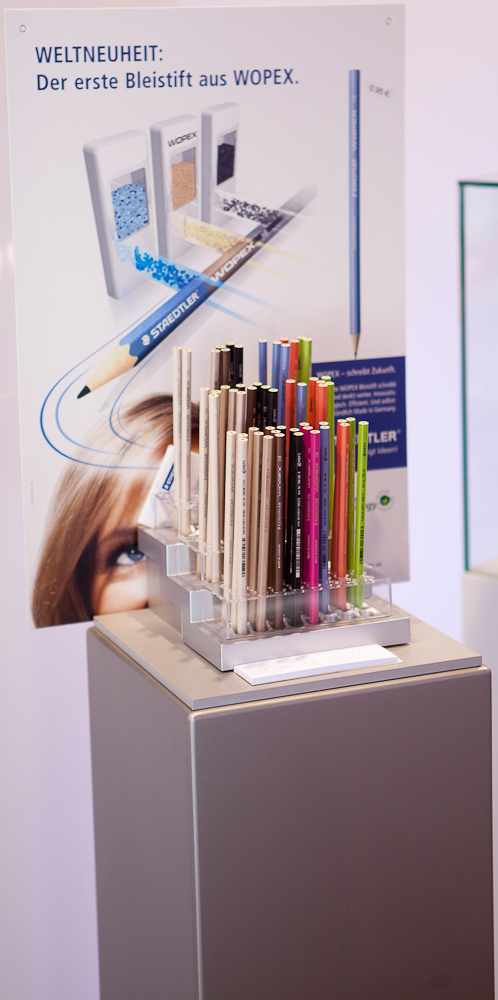
Wopex and the trend line colours are also on display in the shop. These trend line colours, many are different shades of brown, were first released about a year ago. I thought that they were originally colours exclusive to the Wopex range, but I couldn’t find any evidence for this. In any case, you can now find non-Wopex products in trend line colours, too. When they were first released the trend line products were only available in the Staedtler Welt shop, but during my trip to Germany this July I saw trend line products in department stores, too.
Most items were reasonably priced. This leather(?) mouse pad was nice, but expensive.
I would like to thank Vernon Antcliff for letting me know his camera when we were in Staedtler Welt.
As a complement to Lexikaliker’s yellow Wopex, here a photo of the yellow Wopex blister pack available in the UK. I bought this pack of five Wopex plus eraser and sharpener this April for £2.99 [1]plus 90p shipping (~$4.69; €3.70). Unfortnately I haven’t seen the eraser-tipped version from Lexikaliker’s blog post yet, but I will definitely buy it if I ever see it.
East…West…Everywhere wrote a blog post about the green version, available in the USA, that comes with Staedtler-made eraser caps. These eraser caps are basically a white version of the eraser caps that are quite common in North-America [2]Some pencils in North America come with these erasers attached to them, the Magic Writer for example. You can also spot them fairly often in American TV shows, e.g. in Two And A Half Men..
Some pencils in North America come with these erasers attached to them, the Magic Writer for example. You can also spot them fairly often in American TV shows, e.g. in Two And A Half Men.
In a previous blog post I compared three Staedtler tradition 110 pencils, made in three different factories – the one in Wales, the one in Australia and the one in Germany. Today I want to look at three different Staedtler Noris 120 pencils – made in Malaysia, Wales and Germany. I bought a dozen of the Malaysian Noris in March 2010 for £2.24 (~ $3.40; €2.78) from a Malaysian seller on eBay.
Noris presharpened, top to bottom: Malaysia, Great Britain, Germany
The only pencil from this comparison that is still in production is the Nuremberg-made Noris. The factory in Malaysia closed down two years ago and the factory in Wales closed down four years ago. You can still find Welsh-made pencils in the UK, but there are very few shops left that still have stock. I am not sure about the situation in Malaysia, but I assume most of the Malaysian Noris are also sold by now. In a previous blog post I mentioned that 2B is the most common pencil grade in Malaysia. It is so popular in Malaysia that the Malaysian Noris is only available in 2B, therefore I’ll compare it with the Welsh and German Noris in 2B.
Different caps – Top to bottom: Malaysian 2B, Welsh 2B, Welsh B, German 2B
The colour of the Noris cap normally indicates the pencil grade. The HB Noris has a red cap. Strangely enough the cap colour is not consistent. The older Welsh and Malaysian 2B Noris have black caps, while the newer German Noris, bought in April 2012 at Müller in Volkach, Germany for €0.59 (~ $0.73; £0.47), has an orange cap, similar, but a slightly lighter in colour than the orange cap of a Welsh Noris B.
Noris sharpener (511 004) and two wedge sharpeners (510 10 and 510 50)
Which eraser could be most suitable to sharpen a Noris? None other than the Staedtler Noris sharpener, of course. Bought at Currys / PC World in Preston, when they tried to get rid of their stationery in December 2011 this sharpener was part of a ‘study set’ that came with 2 Noris HB, one Staedtler Mars plastic eraser and the Staedtler Noris sharpener for £1.17 (~ $1.79; €1.45). The blister pack says “Made in Germany”, but the wedge sharpener in the Noris sharpener is made in China, or at least the the metal body of the sharpener inside is. I wonder why Staedtler put a metal sharpener in there. Most people probably wouldn’t notice and Staedtler sells plastic sharpeners with the same form factor that could have been used in the Noris sharpener to keep the price down…
The W wedge sharpener in the Noris sharpener
The bottom of the metal sharpener 510 10 in the Noris sharpener features a ‘W’, which indicates that this sharpener is one of Staedtler’s newer sharpeners, optimised for use with the Wopex. It has a sharpening angle of 23°. The thickness of the shavings produced by the Wopex-optimised sharpener is the same as the one by the older model, usually just under 0.3 mm. I assume the difference is in the way the blade has been sharpened.
The older 510 10 wedge sharpener
I used a notepad from Brunnen [1]bought in August 2011 at McPaper in Schweinfurt, Germany for €1.19 (~ $1.46; £0.96) to compare the different leads in terms of smoothness, reflectiveness, darkness, erasability, graphite transfer to another page and how long they keep the point. As far as I can tell the three different Noris perform very similar. The graphite from the Malaysian Noris might transfer a bit easier to another page, e.g. in a diary, but it’s only every so slightly worse than the other two Noris pencils.
No bar code on the Malaysian Noris
In terms of exterior appearance the Welsh and German Noris are nearly on par, with the paint on the Noris from Nuremberg being slightly more even. The paint of the Malaysian Noris is however much worse, but still better than the no name or own brand pencils you usually get in super markets. The Welsh Noris has a diameter of 7mm, which is slightly more than the 6.9mm the Malaysian and German pencils have.
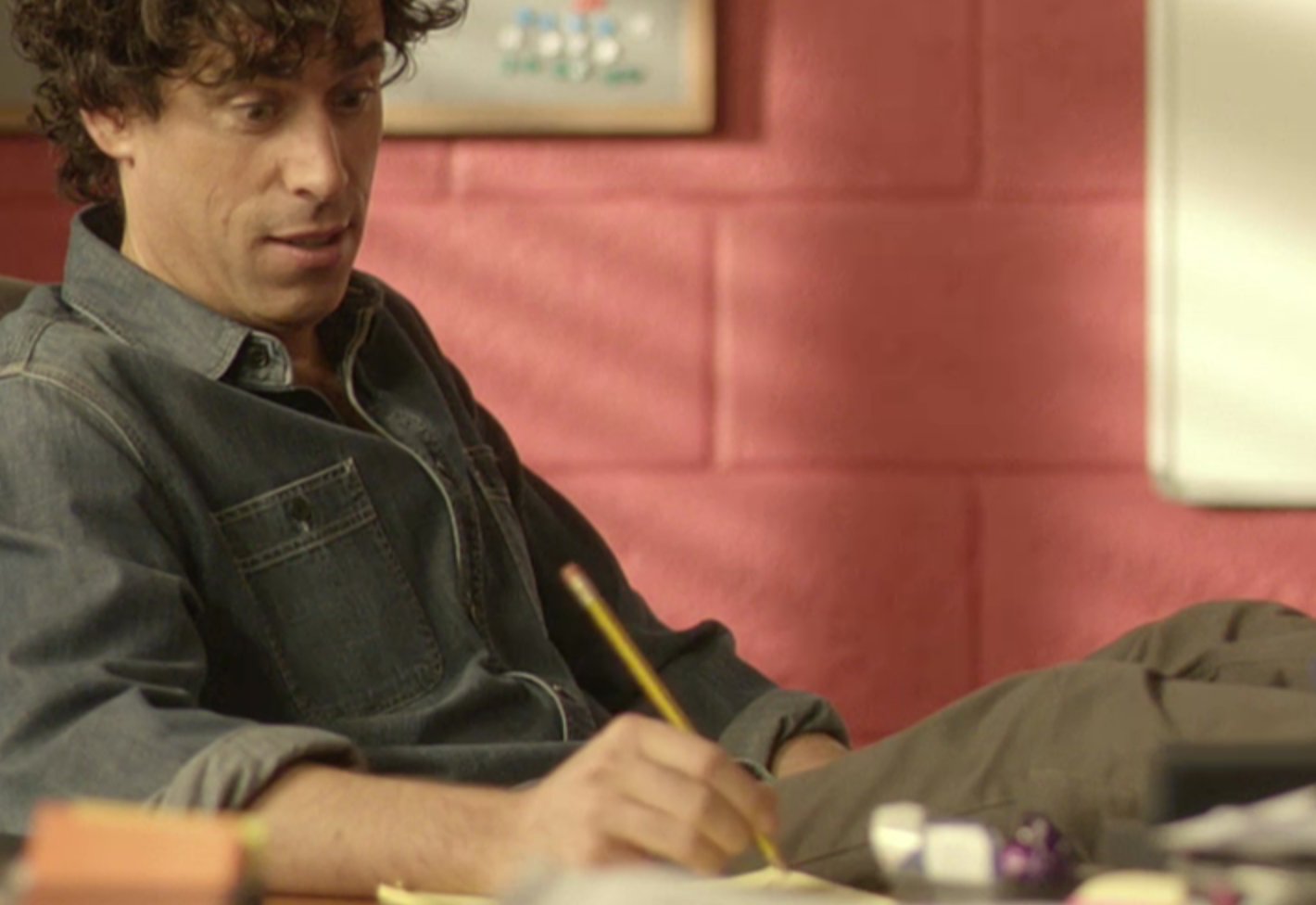
For me the Noris is THE typical pencil. Previous blog posts showed the Noris being featured on TV. Today I want to add two more screen shots. One from Episodes, where Sean Lincoln (played by Stephen Mangan [2]…who recently, as Dirk Gently, used a Faber-Castell Grip 2001 ) is using a Stadtler Noris in the USA, even though it isn’t officially on sale in the USA. The character must have brought it from the UK, the desk is full of Noris pencils ..or, in the real world, this scene might have been filmed in the UK.
The other screen shot is from episode 705 “Liebeswirren” of German/Austrian/Swiss crime TV series Tatort. One of the actors in this episode from Munich was Christoph Waltz of Inglourious Basterds fame.