I was lucky enough to spot several Staedtler Noris pencils in the BBC’s national and regional news in the last couple of days. One of the regional news clips was even filmed just around the corner.
…but Sean has sent me an even more exciting Noris spotting:
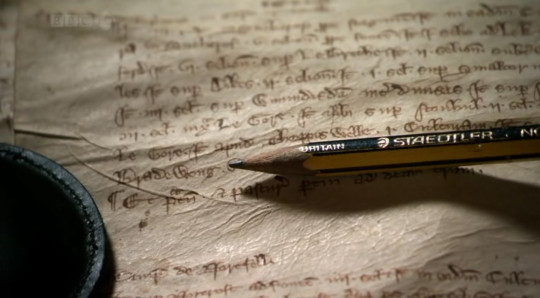
The 6-part series from the BBC called The Story of England by Michael Wood features Staedtler pencils in several shots. Here’s a photo from this series, featuring a Welsh-made Noris.
I believe that the use of the the screen shot of the Noris pencil, taken from Michael Wood’s Story of England falls under “fair dealing” as described by the UK Copyright service.
As you might have guessed after reading The Noris, then and now or any of the other Seen in the wild posts: I’m always happy when I see the Staedtler Noris on somebody’s desk or in a shop (not really worth a blog post: “Did you know, my local bank is using Noris pencils”) or on telly (probably more interesting for you, so maybe worth a blog post).
Last time I spotted a Noris was in Episode 3 of Uncle. This episode gives you the opportunity to admire the Noris in Nick Helm’s right and left hand and in his mouth (maybe the production company shouldn’t have picked the bacon flavoured Noris).
I believe that the use of the screen shot of the Noris pencil, taken from episode three of the first season of the TV series Uncle falls under “fair dealing” as described by the UK Copyright service.
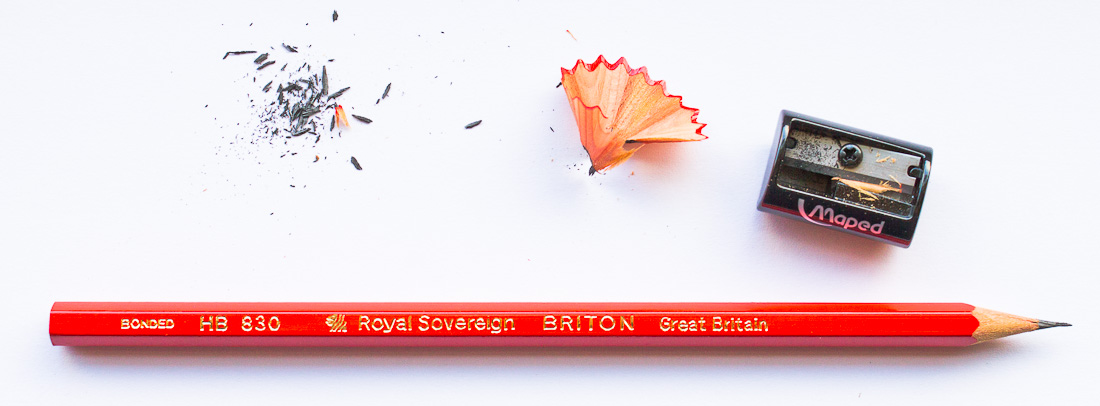
I have touched on the complicated history of the Royal Sovereign Pencil Co in a previous blog post. Today I want to show another pencil made by Royal Sovereign: the Briton.
To put this pencil into context: it was made in the early 1970s, i.e. after Staedtler’s partnership with the British Royal Sovereign Pencil Company started in 1960 and after the owner or Royal Sovereign, the Charnaud family, offered Staedtler their shares in 1966. I guess there’s a chance these pencils were made on the same machines as the early Staedtler Tradition pencils shown here.
The Briton pencil was available in five different degrees: 2H (yellow), H (green), HB (red), B (light blue) and 2B (dark blue), but towards the end of the Briton line, before it was replaced by the Staedtler Tradition, only the HB and B pencils were still in production.
Just like the earliest Staedtler Tradition pencils, it has golden lettering and was pre-sharpened on the right side. This means that the text is upside down if you hold the pencil (the normal way) in your right hand.
The Briton is easy to sharpen and erase. Sharpening was tested using a Maped Metal sharpener, made in Suzhou [1]That’s one of the nice things in Chinese supermarkets: the label on the product or shelf will tell you which city a product is made in., near Shanghai. In terms of darkness, the lead produces a line similar to modern Staedtler pencils but feels a bit scratchier. It is definitely a good all-round and everyday pencil.
I would like to thank mrsnuffles for telling me which other Briton degrees were available at the time.
After Pencil Revolution’s Wopex post and the following discussion on how to sharpen a Wopex: a photo of a Deli 0668 sharpened Wopex.
Typical pattern created when sharpening a Wopex with a cylindrical sharpener. Click to enlarge.
For many months now I have hardly ever sharpened my Wopeces with anything other than a Deli 0668. For that purpose I have one Deli 0668 at home and one in the office. The 0668’s angle of 20° is more suitable for the Wopex than the more acute angle of ~17°-18° the Deli 0635 will produce.
One warning though, the hardness of the Wopex can make the auto-stop fail. If you notice that the sharpener doesn’t stop, release the pencil holder (back to it’s original position) to avoid more of the pencil being fed further towards the burr cylinder. To finish the sharpening process just keep turning the handle until there is no more resistance .
A fake Noris. The company behind it didn’t try very hard, but I’m sure many customers who are not so familiar with pencils will buy this pencil because of the familiar colours and patterns. It even features a black strip between two yellow sides.
Long time readers might remember my blog post about the Reynolds 432 and the Nataraj 621, both of which look pretty much like a Staedtler Tradition. There are also countless Staedtler Noris copies – previously I’ve mentioned the Fox Essentials. Recently, I’ve come across a quite cheeky copy of the Noris, when one of my students was using it in class. I call it a cheeky copy, because it features a red cap, just like the original Noris …but the copied pencil’s cap is rather ugly in compared to the original.
The Noris eco is my daily pencil. The Leuchtturm Loop has been reused from a previous diary, thanks to a paper riveter.
A few weeks later I also finally got my hand on a Noris eco. I planned to get one from Cult Pens when I order from them again, but then I saw the Noris eco in WH Smith, where they sell for 85p (~$1.40; €1.05) each. I also had a look at my local Ryman, but they didn’t sell them there, even though they sell them in their official eBay outlet [1]It’s difficult to find there, though – they spell Staedtler wrong, even though they do sometimes get the spelling right, e.g. for the Staedtler Traditional [sic] pencil..
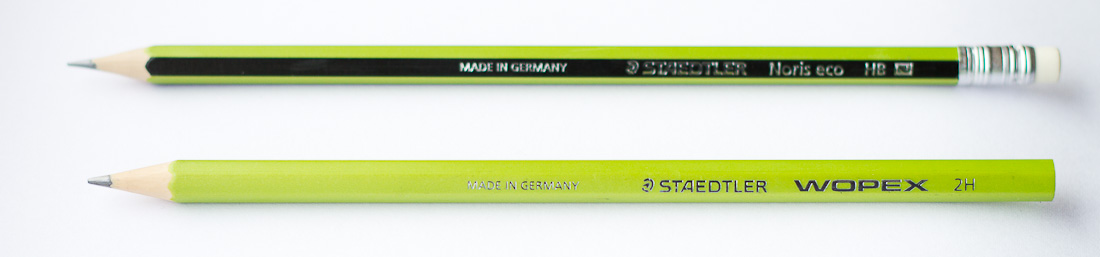
Top: Noris eco – Bottom: Wopex 2H
The lovely Noris eco is now my daily pen in my diary’s loop.
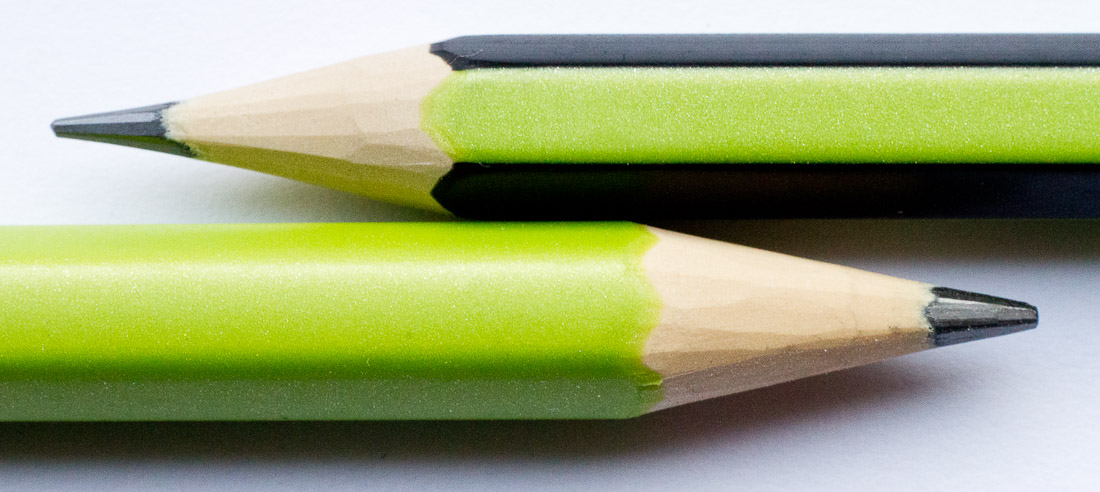
One thing I noticed: the green colour of the Noris eco seems virtually identical to the Wopex in 2H.
Top: Noris eco – Bottom: Wopex 2H
While the Noris has a more complicated pattern [2]The six sides of the hexagonal Noris are painted like this:
black, yellow (thin black strip) yellow, black, yellow (thin black strip) yellow., the Noris eco has a simpler pattern [3]The six sides of the Noris eco are painted like this:
black, green, black, green, black, green.. I assume this is because it’s not so easy to extrude a thin black strip precisely over a corner.
Now, if the Noris eco is just a green Wopex with black strips and if there are fake Noris (plural: Norises?) anyway, why not make your own (fake?) version from a yellow Wopex?
I’ve only ever seen the yellow Wopex in Asda and on Ebay. I assume the ones on eBay were bought in Asda, where they are very cheap.
To increase my chances of getting acceptable looking black strips on the pencil I decided to cover the areas not to be painted with a tape.
The taped Wopex. The tape dispenser in the background is an old Bakelite model.
I then used a permanent marker to paint the Wopex. As you can see it all went belly up. Somehow the tape didn’t stick well and the lines from the black marker were not very straight …so I didn’t bother to do the thin strips carefully either. If you want to try it and are successful: Try to do the red cap using nail polish. Pencil Revolution has further instructions.
Epic fail!
Price and exchange rates: January 2014
I’d like to thank Kamil Musial for showing me the “Stationery” Staedtler Noris copy.
It’s difficult to find there, though – they spell Staedtler wrong, even though they do sometimes get the spelling right, e.g. for the Staedtler Traditional [sic] pencil.