I spent Christmas and New Year in Shanghai and saw our old friend, the green Chung Hwa 101, again …on many occasions. I even think that there were more 101s and fewer unidentifiable No Name pencils than in the past. I did however see one specific pencil replacing the 101 in several places were the 101 was previously the only dominant pencil.
The contender that took over some restaurant tables and cashier desks was the Chung Hwa 6151, previously reviewed at pencil talk. The fact that the 6151 comes with an eraser must make it more desirable in many situations – like the one on the photo, where it is used by patrons to order dim sum by marking the desired types and quantities on a menu.
Einszweidrei! im Sauseschritt
Läuft die Zeit, wir laufen mit. (from Julchen by Wilhelm Busch, 1877)
It’s incredible how fast time is flying by. This blog started last November with a blog post about the Kuru Toga and now it is already more than a year old. In the first year there were altogether 65 blog posts. Now for some statistics: during the first year most visitor came from the USA, followed by the UK, then Germany, then Canada. In terms of numbers the visitors from these four countries, where more than 65% of all visitors came from, were followed by visitors from 106 other countries.
…but enough about statistics. Let’s talk about pencils!
Today I want to write about a pack of “graphic pencils” from Taiwan’s Lion Pencil Co., Ltd., better known as Simbalion. I bought this pack of pencils in December 2009 at Keyroad a shop on Shanghai’s FuZhou Road. If the name rings a bell, I mentioned it in my previous blog post about the Deli sharpener 0635. I never saw this brand in the West before. Have you seen Simbalion pencils in your country?
The pack contains twelve pencils with the grades 4H-H, F, HB, B-6B. My pencil came in an “easy to use easel box”, but this box has since been replaced and these pencil are now available in a new polypropylene case.
The Lion Pencil Company was established in 1956 and is one of Taiwan’s oldest stationery manufacturers. The Lion Pencil Company is proud of having invented the “art set”, but I am sure some other companies will lay claim to having invented the art set in the stationery context, too. Their Taiwanese factory is in Taipei county, but they also have a factory in Kunshan (Jiangsu province), very close to Shanghai and just next to Taicang, where Eisen has a factory.
In Taiwan the normal price for the new set of these pencils in a PP case is 120 NT$ ($ 3.95, £ 2.50, € 2.95). I paid much more for my old “easel box”, maybe because these pencils were imported into the Chinese mainland or maybe, this is only speculation and probably not the case, because the new set is from the factory in Kunshan. According to the labels and stamps on my pack it was produced in the factory in Taipei county on 7th May 2009 – nice to get so much information 🙂
The pencils are nice, certainly not scratchy, but I do wonder about Simbalion’s grading. The H pencil from this pack is certainly the softest H pencil I have ever used and does feel softer than the HB pencil from the same pack. The print on the pencils is uneven in places and the end of the pencil has too much paint that is not evenly distributed.
Altogether a nice set of pencils for this price. The pencils are not scratchy or bad in any other way. My main criticism would be the unpredictable hardness or softness of the lead that does not seem to be consistent with the printing on the pencil.
Conclusion
Nothing too fancy, nothing too bad – you get what you paid for as long as you pay not more than the official price.
Price and exchange rates: November 2010
I would like to thank Kevin Davis from O’Bon for the sugarcane paper used in these photos.
For me the Staedtler Noris has always been the archetype of a pencil. The Mars Lumograph might come close and these days I might also consider the Castell 9000, but somehow I never really saw the Castell 9000 being used around me when I was younger. My father was a joiner, so he used carpenter pencils and normal pencils …and because he used a lot of them he would not buy the more expensive ones. There was a point, I think it was the early nineties, when Herlitz Scolair pencils became quite cheap. So he usually used those …and he used a lot of them. Even though I also used to use them I never thought of them as nice pencils, they were always just cheap pencils to me. In the eighties there were of course Japanese pencils in Germany, too, but they were usually novelty pencils, not branded pencils. Their selling point would be the unusual look, e.g. unusual patterns or colours printed on them, often metallic. Unfortunately they usually suffered from lead breakage, probably because the manufacturers did not have to try hard: Everybody who bought them did so because of how nice they looked, not because of their reputation – and since they were not branded you could not really know which ones to avoid in the future .
Shanghai's Chung Hwa Drawing Pencil 101
Back to my original topic: I think the Staedtler Noris can be seen as the archetype of a pencil in the UK and in Germany. In the UK the Staedtler tradition can also be seen quite often, but in both countries the Noris seems to be the pencil that is most ‘common’ and recognisable the same time.
Shanghai’s popular pencil
Last time I was in Shanghai I was trying find the Shanghainese equivalent by looking for the most common pencil in everyday life. I expected it would be the Chung Hwa 6151, just because it was a Shanghainese pencil you come across in stationery blogs or web sites, but I never really saw the 6151 in the wild. Instead I came across the Chung Hwa Drawing Pencil 101 again and again. Employees in supermarkets used it to make notes. Waiters in restaurants used it to take orders. It just seemed to be the most common pencil in Shanghai. If there are any reader who know or live in Shanghai and disagree please let me know. I would like to know what your experience is.
China First Pencil Company Ltd.
Before I go into more detail about this pencil I would like to talk about the manufacturer, Chung Hwa, first. There are many Chinese companies and products in different and unrelated industry sectors that are called Chung Hwa: there are Chung Hwa cigarettes, cars, there is Chung Hwa cognac, ink, etc. As far as I can tell these companies have usually no connection except the common name. Chung Hwa (PinYin: ZhongHua) does translate as ‘China’ but not in the normal sense, i.e. when you talk about the country, but in a cultural or literary sense.
The Chung Hwa pencil company traces it roots back to 1935. It changed the name a few times and today’s official name is China First Pencil Company Ltd. They manufacture graphite, colour and cosmetic pencils as well as pencil related stationery and machines for the pencil industry.
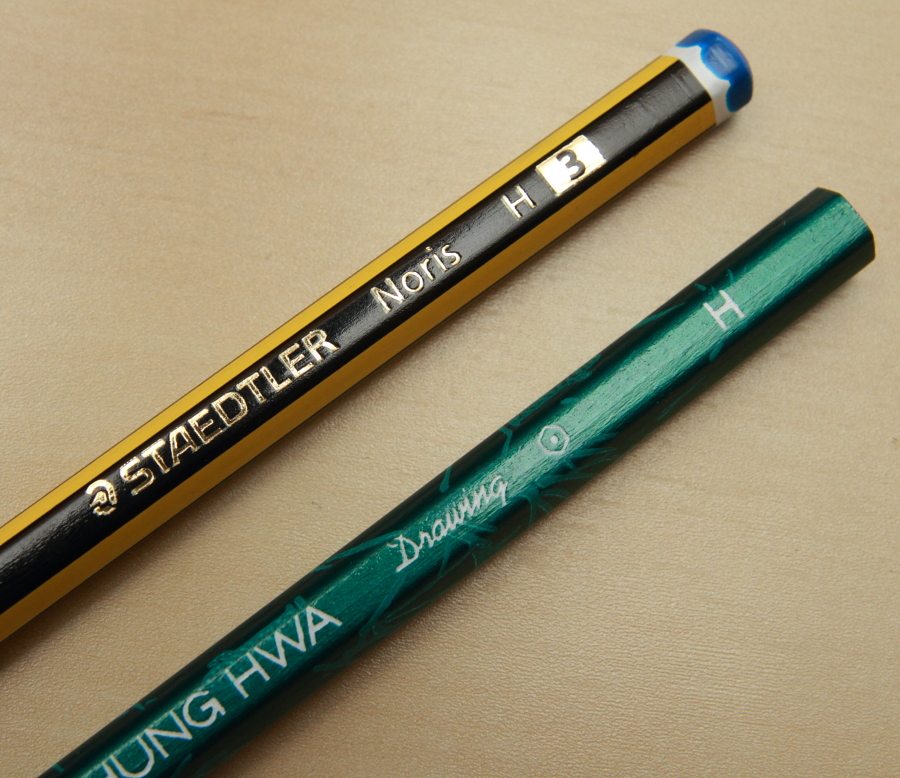
Today the Chung Hwa Drawing pencil‘s body has a dark green body colour with a light green pattern of bamboo leaves and totems printed over it. The pencil is hexagonal without a painted cap and is labelled on three sides. The wood used is rather red, but does not seem to be the Vatta wood (Macaranga Peltata) mention in a previous blog post. Two sides are labelled in white, one in white and gold. As far as I know the Chung Hwa 101 should be available 6H – H, F, HB, H – 6H. Despite my best efforts I was however unable to find this pencil in F, so I bought one pack in HB and one in H.
…compared to the Staedtler Noris
Since this pencil seems to be Shanghai’s everyday pencil I thought it would be a good idea to compare it to what I think is the UK’s and Germany’s everyday pencil, the Staedtler Noris, as explained earlier. Let’s start by looking at the finish. I like the fact that you can see the wood grain through the paint, but on the 101 the paint has not been applied as well as on the Noris. This applies to both the dark green base and the light green pattern. The Chung Hwa Drawing Pencil 101 in HB is also not as soft and smooth as a Noris HB. It is not yet scratchy and certainly not worse than an average pencil. The graphite is not too reflective and does not smudge, so keeping the price in mind the 101 HB is very good value for money. The 101 in H is also very good for the price, but compared to the Noris in H it is much softer, more like an F grade pencil.
Conclusion
The Chun Hwa Drawing Pencil 101 offers very good value for money. It is not really a great pencil that can compete with good pencils, but it is definitely better than the average no name pencil and better than many cheap branded pencils.
As usual: the paper that can be seen in the comparison photo of this blog post is the Bloc Rhodia Nº 13.
If you ever go to Shanghai you should visit FuZhou Road. This road is famous for its book stores (including the Shanghai Foreign Language Bookstore), but you will also find many stationery shops there. After seeing the sheer number of different stationery shops, focussing mainly on calenders, note books, diaries, tools used for Chinese calligraphy (like brushes, paper, inkstones) and stationery, you might be disappointed when you actually want to buy stationery: the choice is smaller than expected because many of the shops sell exactly the same items. Other places in Shanghai that sell stationery are big supermarkets (Carrefour, E-mart) or small stationery shops you can normally find near universities.
Keyroad, a relatively new shop on FuZhou Road, is offering items quite different to those offered in the more old-fashioned stationery shops nearby. Targeting Japanophile students, only about half of the space is used for stationery, the other half is used for things like mugs, gloves, toys, etc. Most of these other items are for girls, quite expensive, cute and conjure up associations with Japan, Korea or Taiwan.
There is even a prism sharpener for oil and wax based pencils
The selection of sharpeners was not overwhelming, with the focus on cute looking sharpeners, but to my delight I found a rotary sharpener for only ¥ 25 (£ 2.40, € 2.70, $ 3.70). It is model 0635 from Deli, a stationery manufacturer established in 1988 and employing more than 2000 staff. The sharpener has one burr cylinder and even includes a spring-driven holder for the pencil. There is no desk clamp and no regulator for sharpness or point, but I do not think anybody would mind at this price.
Faber-Castell Bonanza 1320 B
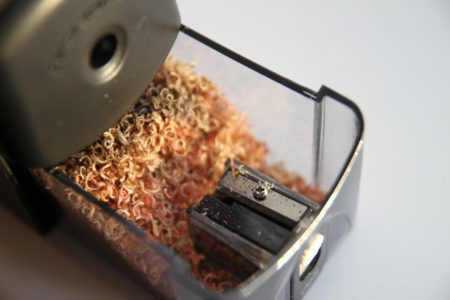
The waste container even includes a prism sharpener in case you need to sharpen oil or wax based pencils as they are not suitable for rotary sharpeners. The manual of the sharpener is in Chinese and English, but the English is rather poor and difficult to understand.
The 0635 has one burr cylinder
Performance:
Performance-wise the Deli 0635 is excellent. The point is very long, even longer than one from a KUM Automatic Long Point. This is a problem for pencils with very soft graphite leads, for colour pencils or for pencil users who use a lot of pressure when writing or drawing, as the point might brake easily. I have not yet had any problems with the point of graphite leads braking, but I stopped using the Deli 0635 with colour pencils. Even the ones with harder leads, like the Mitsubishi Vermilion and Prussian Blue will brake easily when writing if you are not very careful.
Conclusion:
This is an excellent sharpener at such a low price. As it is a cylindrical cutter it should last quite a while without getting blunt. More expensive sharpeners have a desk clamp and let you adjust whether you want a long or short point, but if you like a sharp point and do not want to clamp your sharpener (I assume most people don’t) the Deli 0635 offers fantastic value for money.
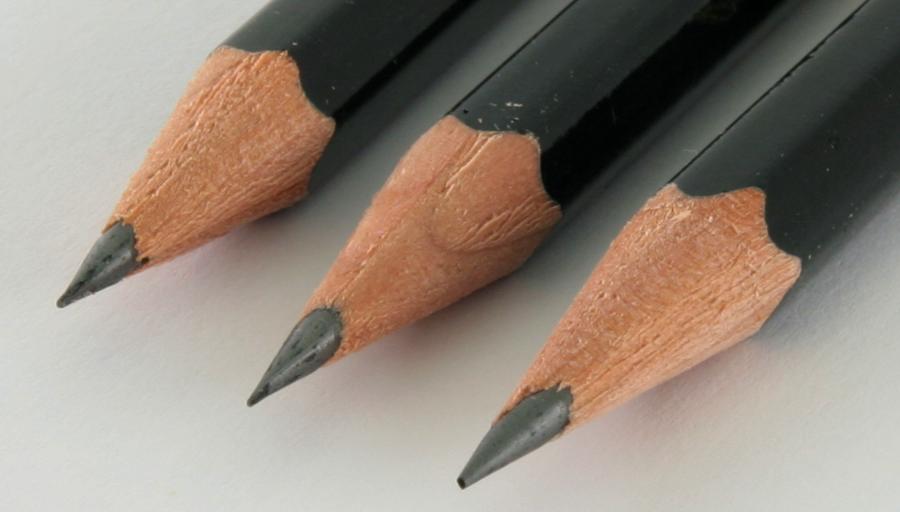
Point comparison (l-r): M+R grenade, Eisen 402, KUM Automatic Long Point, Deli 0635
The stationery cupboard, where my colleagues and I get our stationery supplies from, did have pencil sharpeners in the past. I am not sure why there are none left, but I assume it is because most colleagues, especially most support staff, use Paper Mate Non-Stop pencils.
Paper Mate Non-Stop:
The Non-Stop is basically a SharpWriter with tip and eraser in black for the European market, or possibly for all markets outside North America. First released in 1984 the SharpWriter / Non-Stop is a disposable mechanical pencil, made in USA. You can even refill it, if you want. Unlike some other disposable mechanical pencils it is possible to refill leads when you remove the eraser. To advance the lead you twist the tip and – very positive for a cheap pencil – the lead is cushioned which should be good news for users who use more pressure when writing than I do.
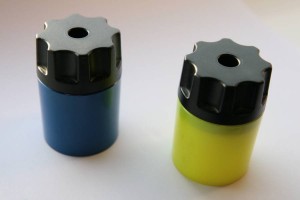
The Eisen Model 402 in blue and yellow
Eisen:
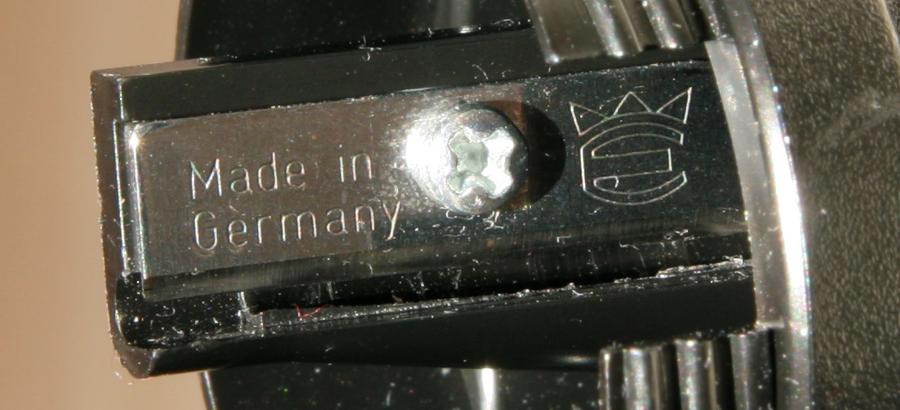
But back to the pencil sharpeners… They were all the same type, had a cylinder shaped plastic container and were available in many colours. At the bottom of the plastic container you could see the wording “Made in Germany”. Some of the sharpeners had plain blades without any writing on them, some [1]I assume the older ones had “Made in Germany” and a lower case e with a crown on top written on the blade. After looking at different manufacturers’ web sites I found that this sharpener is Model 402 from Eisen[2]pronounced like iron with an s sound between the two syllables, a company manufacturing pencil sharpeners since 1921. Like nearly all other German manufacturers in the pencil and sharpener industry (e.g. Faber-Castell, Staedtler, Schwan Stabilo, Lyra, KUM or Möbius+Ruppert) Eisen is from Franconia, an area slightly smaller than Massachusetts. Other information and figures I found about Eisen is sometimes contradicting, but apparently they have 60 employees in their Franconian factory and produce 200 million steel blades annually. In 2003 Eisen established its own factory in Taicang [3]Taicang is very popluar with companies from America, Europe, Taiwan and Japan. About 100 German SMEs settled there. near Shanghai, and production of the cheaper sharpeners was moved there while the production of more expensive sharpeners for cosmetic pencils is still taking place in the original factory in Baiersdorf. The factory in Baiersdorf is managed by Christian Eisen and the factory in Taicang by Stephan Eisen, both descendants of Christian Eisen, the founder of Eisen Metallwarenfabrik. Altogether, there are 150 employees in both factories, producing 60 – 80 million sharpeners annually.
Lyra, recently acquired by the FILA group, just started distributing Eisen sharpeners in the German-speaking countries, but I am not sure about the distribution of Eisen sharpeners in the rest of the world. They were available in the UK, probably through Impega [4]Impega became Lyreco in 2009, a supplier of stationery for companies.
Dong-A Fable, sharpened with (left - right) M+R grenade, Eisen 402, KUM Automatic Long Point
Model 402:
What is so special about the Model 402, you might ask. The answer is that it is a fantastic sharpener, somewhere between a traditional sharpener and a long point . Sharpening with the Eisen 402 produces a point as smooth as one produced by Möbius+Ruppert’s grenade or by KUM’s Automatic Long Point 2M. Even sharpening “difficult” pencils, like the Dong-A Fable, is no problem with the 402. When I tried to sharpen the Fable with a hardly used KUM 400-5L the lead broke every single time, with the Eisen 402 I managed to produce a great point first time trying, even though I have been using it irregularly for years and with the same blade.
Eisen 402 blade
I noticed that my yellow 402, which has an unmarked blade, is not as smooth as the blue one, which has the Eisen logo and Made in Germany written on the blade. It could be that the unmarked blades are worse, but the yellow 402 was in my office and saw much more use than its blue colleague, so I blame the slightly worse performance of the unmarked blade on the fact that the marked blade had not been used so often.
The Eisen 402 is certainly a great sharpener. It outperforms my KUM Streamline Chrome Canister Sharpener 460S and my KUM Long Point 400-5L. The only shame is that it seems to be difficult to get hold of an Eisen 402.
—
I would like to thank Kent for the Dong-A Fable pencils used in the comparison of different sharpeners. Kent explained me that Dong-A is one of the oldest pencil manufacturers in Korea and that Fable is a relatively new model from Dong-A.
There is a video, produced for local TV stations, with more information about Eisen at Wirtschaftstreff Bayern. Unfortunately it is only available in German and the exact link is changing every month. The video with information about Eisen is from 23 October 2009.
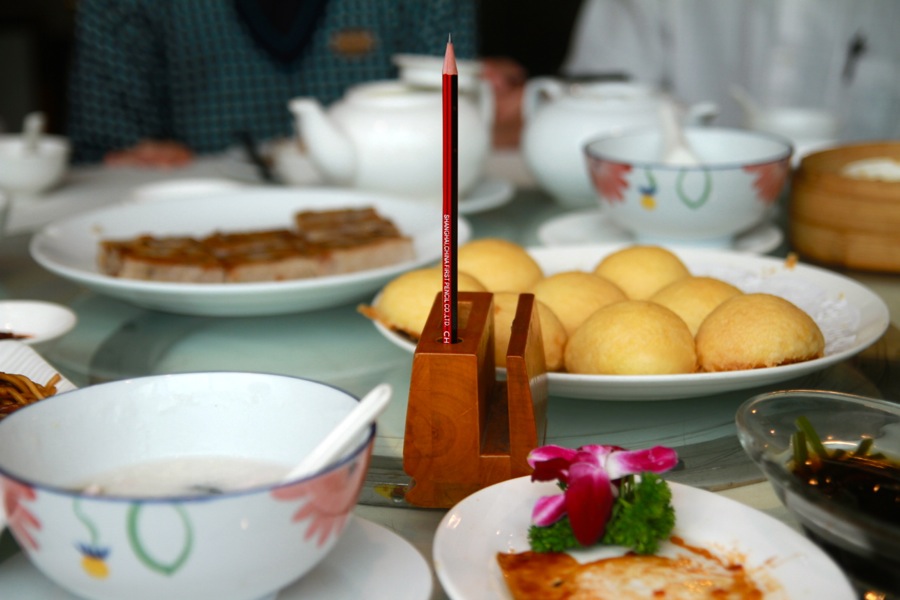 The contender that took over some restaurant tables and cashier desks was the Chung Hwa 6151, previously reviewed at pencil talk. The fact that the 6151 comes with an eraser must make it more desirable in many situations – like the one on the photo, where it is used by patrons to order dim sum by marking the desired types and quantities on a menu.