Made in China

Deli pencil sharpener 0668
When you visit a university in Shanghai you will usually find at least two types of shops nearby: Snack shops (lots of them) and stationery shops. I have not yet seen another city where this phenomenon is as obvious as in Shanghai. The stationery shops can be split into two groups: stationery shops with functional stationery and stationery shops that sell girly stationery as well as other things like make-up, charms, etc – but you can also find shops that are somewhere in-between these two groups.
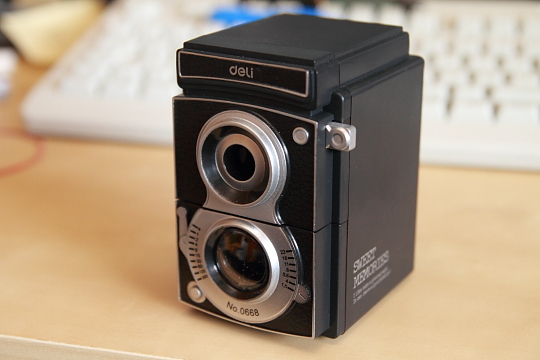
After my good experience with another Deli sharpener I could not resist and bought this TLR shaped sharpener, the Deli 0668, in December 2010 when I saw it in it in Shanghai – in a stationery shops outside a university. Deli’s headquarters are near Shanghai, so I it is not surprising that this sharpener was inspired by a Shanghainese-made Seagull TLR [1]Seagull TLRs were basically Rolleiflex copies. Outside China Quelle rebranded Seagull TLRs and distributed them as Revue cameras (40 years ago). There are still companies out there that distribute … Continue reading.

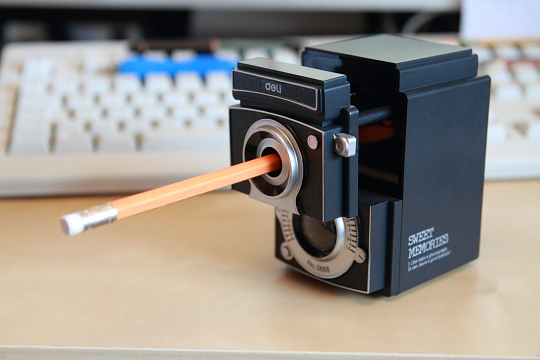
The 0668's single rotary blade cylinder

I paid about ¥ 30 (£ 2.80, € 3.30, $ 4.50) for this sharpener, a bit more than what I paid for the Deli 0635. You can get this sharpener cheaper if you look around or if you buy online, e.g. from Taobao. Outside China you can get this sharpener from Kikkerland for $15 (£ 9.30, € 10.80) or from Urban Outfitters for £ 15 ($ 24.20 , € 17.50) [2]Urban Outfitters buy it from Kikkerland and in the end after shipping it over, everyone adding some profit and after adding tax, it is more than five times as expensive than what I paid in a little … Continue reading. It is currently on offer and can be bought for £ 8 online and in the Urban Outfitter shops .

The 0668 has a single rotary blade cylinder, similar to the one in the 0635. There is also a removable tray for the shavings. The clamps that hold the pencil during sharpening have a rubber surface so they won’t damage the pencil’s surface. Additionally, there is an automatic stop mechanism that will prevent you from over-sharpening a pencil. The main difference between the two Deli sharpeners is that the 0668 produces a shorter (and blunter) point. It also features a point adjuster switch similar to the one seen in the Carl Bungu Ryodo BR-05 pencil sharpener, reviewed at pencil talk and in the Dahle 133 / M+R 0981, reviewed at Lexikaliker. The blunt setting at the extreme end will result in a “point” diameter of about 2mm is only suitable for colour pencils with a wide core. Normal graphite pencils do not have a wide enough core for this setting.


On the left a Faber-Castell 1117 sharpened with the Deli 0668 (sharp setting), in the middle a Faber-Castell 1117 and a Mitsubishi Arterase Color 0668 sharpened with the Deli 0668 (blunt setting), on the right a Faber-Castell 1117 sharpened with the Deli 0635

Conclusion: A great sharpener for a great price. I will not use the blunt setting and, to be honest, I do prefer the longer point I get from the Deli 0635 much more. It is nevertheless a sharpener I will enjoy using. It is currently in my office where I use it for all kinds of wooden pencils, but not for pencils that use difficult to sharpen material, like the Wopex, as my experience with the Deli 0635 has shown that the Deli’s automatic stop mechanism does not work with these pencils and that the harder material seems to be detrimental to the blade cylinder.


A Faber-Castell 1117 sharpened using the sharp setting and a Uni Mitsubishi Arterase Color Vermilion sharpened using the blunt setting.

The pencils used in this blog post are Faber-Castell’s 1117 B and Uni Mitsubishi’s Arterase Color Vermilion 310. The 1117 feels like an unpainted pencil. It is not really painted but features a water-based varnish. It also has a breakage-resistant lead and an eraser. It does performs well for a budget pencil. It is made in Germany and sells for around € 0.30 each (~42¢, ~25p). You can find a review of the Faber-Castell 1117 at pencil talk. The Uni Mitsubishi’s Arterase Color Vermilion 310 is made in Japan. I do not have more information about this pencil, but you can find a review at Lexikaliker and at pencil talk. I would like to thank Lexikaliker for the Arterase Color pencil used in this blog post.

Prices: December 2010

Exchange rates: March 2011

The Deli in Urban Outfitters (Manchester)

References

References
1 Seagull TLRs were basically Rolleiflex copies. Outside China Quelle rebranded Seagull TLRs and distributed them as Revue cameras (40 years ago). There are still companies out there that distribute Seagull cameras outside China, one of the most famous ones is Lomography. Another interesting point: Whoever designed this sharpener changed the markings compared to the real camera, from f/3.5 to f/1.5
2 Urban Outfitters buy it from Kikkerland and in the end after shipping it over, everyone adding some profit and after adding tax, it is more than five times as expensive than what I paid in a little shop that wasn’t cheap in the first place.

Deli pencil sharpener 0668 Read More »

AMOS DIXON Ticonderoga

Today: a tie-in with pencil talk’s blog post about FILA’s global pencil. I want to add the Korean version of the Ticonderoga to Fila’s global pencils series. According to the information from the packaging it is manufactured by Beijing Fila Dixon. One sentence printed on the packaging is very interesting: “R&D in Korea”.

Has the current Ticonderoga been developed in Korea?

Pencil talk mentioned that the different version of this pencil have different cores. This could also mean that not the whole pencil, but that only the core for the Korean version has been developed there – to fit local preferences.

Other Fila pencils I have at my disposal do not emphasise where they have been developed. A pack of Lyra pencils has this sentence printed on the packaging: “Made in China under LYRA-Germany quality standards”, while Dixon pencil packaging only states where the pencils have been produced: Triconderoga: “Made in Mexico”, Ticonderoga Renew: “Made in USA”.

FILA’s global pencil


The Triconderoga blister pack comes with a fantastic sharpener from Eisen.


I would like to thank Kent for the AMOS DIXON Ticonderoga.

I would like to thank Sean for the Triconderoga and the Ticonderoga Renew.

AMOS DIXON Ticonderoga Read More »

My favourite eraser

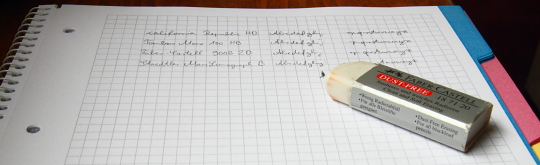
My favourite eraser is, without a shadow of a doubt, the Faber-Castell 18 71 20 Dust-Free eraser …or its little brother, the 18 71 30. There are many good erasers. I like Sanford’s Artgum eraser, I sometimes use the Staedtler Mars plastic stick eraser and also cannot really complain about some of the high end erasers I use, like the Graf von Faber-Castell Ersatzradiergummi

…but none of them matches the comfort and softness of the 18 71 20 / 18 71 30. It does not smear and it does erase like a dream. It is made in Malaysia, like many of Faber-Castell’s erasers, and is suppossed to be dust-free, which refers to the fact that the eraser waste twists up into strands. There are similar erasers out there, for example Flomo’s Non-Dust eraser from Shanghai, but they are usually not as soft and do not erase as well.

Faber-Castell’s dust-free eraser is relatively new, it has only been introduced in 2004.The retail price in the UK is around the £ 1 ($ 1.62; € 1.14) mark, often a little bit higher.

I would be happy to hear what you think of this eraser. Is it only me or do others also think that this eraser is so much better than any other eraser? If you have a chance to try this eraser out, please give it a go.

Flomo Non-Dust (left), 18 71 30C (middle) and 18 71 20 (right)

In case you wonder about the notebook you can see in the photos. It’s a A4 spiral divider notebook with coloured index tabs, made from FSC paper (70 g/m²). It was sold in the UK through Lidl stores and is, as far as I know, made by Zebra Papierverarbeitungs GmbH. It should be available from ProNa.


Price and exchange rates: November 2010

My favourite eraser Read More »

Peanuts 60th Anniversary Moleskine

As I mentioned earlier there are new limited edition Moleskines available to celebrate the 60th Anniversary of Schulz’s Peanuts. I first read about the Pac-Man edition in Office Supply Geek’s newsletter which in turn lead me to the Peanuts edition.

This is my first Moleskine. I have used similar notebooks in the past, but somehow I have never bought one from Moleskine Srl / Modo & Modo Spa. My first surprise came when I saw that Moleskines are made in China. I assumed they are made in Italy, but (as Lexikaliker would write it) a quick google search extensive research has shown that they are made in China since 2006. Contrary to the popular believe, I come across quite often, made in China does not equal inferior quality: I have seen many items of extremely high quality that are made in China …but without going into too much details about currency exchange rates etc, I would like to say that I was quite surprised to see Moleskines are made there because similar notebooks made in “high wage countries” are not more expensive than Moleskines (limited edition or not) – I just assumed Moleskines were made in Italy because of the high price …but of course I cannot blame Moleskine Srl or its parent company for trying to milk the cash cow by increasing their profit margin. In the end they are a company and want to make profit.

I ordered this Moleskine from WHSmith’s online store – they were the cheapest shop I could find. This A6 Moleskine was £7.43 ($11.93; €8.56). I have not yet been able to find the limited editions on the high street or in shopping centres (Paperchase, WHSmith, John Lewis, …). It feels nice and well made, though I have seen similar notebooks where the workmanship seems to be better. The coating above the spine feels a bit loose but should be able to cope with daily use.

The notebook comes with Peanuts stickers


Price: October 2010

Exchange rates: November 2010

Peanuts 60th Anniversary Moleskine Read More »

Chung Hwa Drawing Pencil 101

Popular Pencils in the UK and Germany

For me the Staedtler Noris has always been the archetype of a pencil. The Mars Lumograph might come close and these days I might also consider the Castell 9000, but somehow I never really saw the Castell 9000 being used around me when I was younger. My father was a joiner, so he used carpenter pencils and normal pencils …and because he used a lot of them he would not buy the more expensive ones. There was a point, I think it was the early nineties, when Herlitz Scolair pencils became quite cheap. So he usually used those …and he used a lot of them. Even though I also used to use them I never thought of them as nice pencils, they were always just cheap pencils to me. In the eighties there were of course  Japanese pencils in Germany, too,  but they were usually novelty pencils, not branded pencils. Their selling point would be the unusual look, e.g. unusual patterns or colours printed on them, often metallic. Unfortunately they usually suffered from lead breakage, probably because the manufacturers did not have to try hard: Everybody who bought them did so because of how nice they looked, not because of their reputation – and since they were not branded you could not really know which ones to avoid in the future .

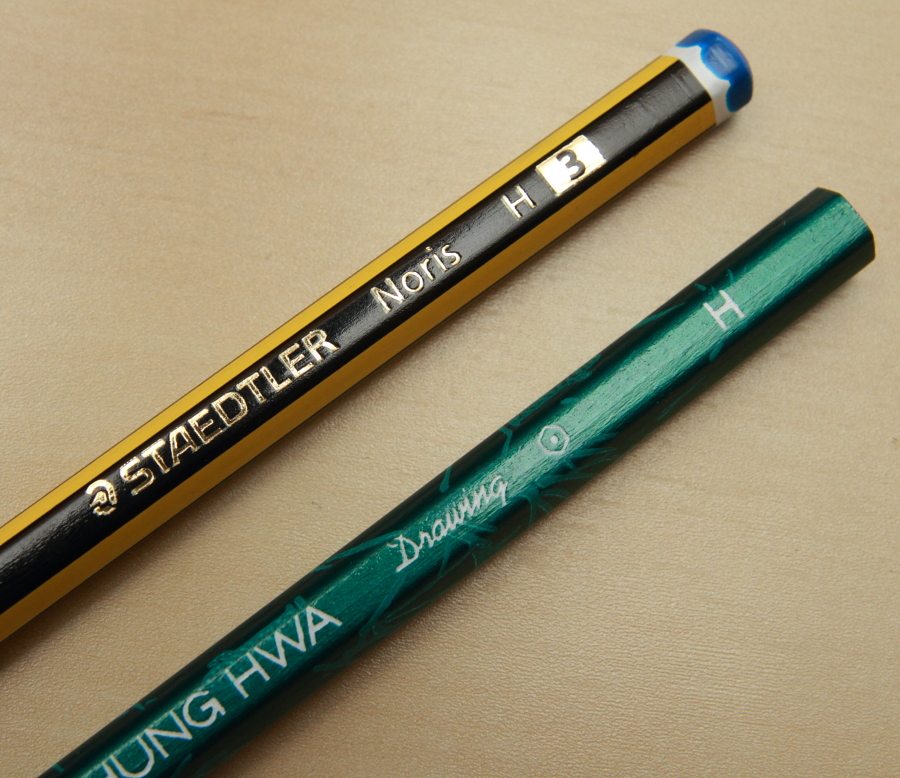
Shanghai's Chung Hwa Drawing Pencil 101

Back to my original topic: I think the Staedtler Noris can be seen as the archetype of a pencil in the UK and in Germany. In the UK the Staedtler tradition can also be seen quite often, but in both countries the Noris seems to be the pencil that is most ‘common’ and recognisable the same time.

Shanghai’s popular pencil

Last time I was in Shanghai I was trying find the Shanghainese equivalent by looking for the most common pencil in everyday life. I expected it would be the Chung Hwa 6151, just because it was a Shanghainese pencil you come across in stationery blogs or web sites, but I never really saw the 6151 in the wild. Instead I came across the Chung Hwa Drawing Pencil 101 again and again. Employees in supermarkets used it to make notes. Waiters in restaurants used it to take orders. It just seemed to be the most common pencil in Shanghai. If there are any reader who know or live in Shanghai and disagree please let me know. I would like to know what your experience is.

China First Pencil Company Ltd.

Before I go into more detail about this pencil I would like to talk about the manufacturer, Chung Hwa, first. There are many Chinese companies and products in different and unrelated industry sectors that are called Chung Hwa: there are Chung Hwa cigarettes, cars, there is Chung Hwa cognac, ink, etc. As far as I can tell these companies have usually no connection except the common name. Chung Hwa (PinYin: ZhongHua) does translate as ‘China’ but not in the normal sense, i.e. when you talk about the country, but in a cultural or literary sense.

The Chung Hwa pencil company traces it roots back to 1935. It changed the name a few times and today’s official name is China First Pencil Company Ltd. They manufacture graphite, colour and cosmetic pencils as well as pencil related stationery and machines for the pencil industry.

Chung Hwa Drawing Pencil 101

Prices for a pack of 10 Chung Hwa 101 Drawing pencils start at 6.50 RMB (97¢, 61p, 70c) but usually they are quite a bit higher. The look of this pencil seems to have changed dramatically over time: In the past there was one version of this pencil (i.e. same name and model number) that  looked like a typical Mars Lumograph copy. The article number of Chung Hwa’s pencil with the Mars Lumograph look (Google translation of the linked page) has however changed from 101 to 111, and you can sometimes even find this pencil in supermarkets in the West.

Today the Chung Hwa Drawing pencil‘s body has a dark green body colour with a light green pattern of bamboo leaves and totems printed over it. The pencil is hexagonal without a painted cap and is labelled on three sides. The wood used is rather red, but does not seem to be the Vatta wood (Macaranga Peltata) mention in a previous blog post. Two sides are labelled in white, one in white and gold. As far as I know the Chung Hwa 101 should be available 6H – H, F, HB, H – 6H. Despite my best efforts I was however unable to find this pencil in F, so I bought one pack in HB and one in H.

…compared to the Staedtler Noris

Since this pencil seems to be Shanghai’s everyday pencil I thought it would be a good idea to compare it to what I think is the UK’s and Germany’s everyday pencil, the Staedtler Noris, as explained earlier. Let’s start by looking at the finish. I like the fact that you can see the wood grain through the paint, but on the 101 the paint has not been applied as well as on the Noris. This applies to both the dark green base and the light green pattern. The Chung Hwa Drawing Pencil 101 in HB is also not as soft and smooth as a Noris HB. It is not yet scratchy and certainly  not worse than an average pencil. The graphite is not too reflective and does not smudge, so keeping the price in mind the 101 HB is very good value for money. The 101 in H is also very good for the price, but compared to the Noris in H it is much softer, more like an F grade pencil.

Conclusion

The Chun Hwa Drawing Pencil 101 offers very good value for money. It is not really a great pencil that can compete with good pencils, but it is definitely better than the average no name pencil and better than many cheap branded pencils.


As usual: the paper that can be seen in the comparison photo of this blog post is the Bloc Rhodia Nº 13.

Chung Hwa Drawing Pencil 101 Read More »