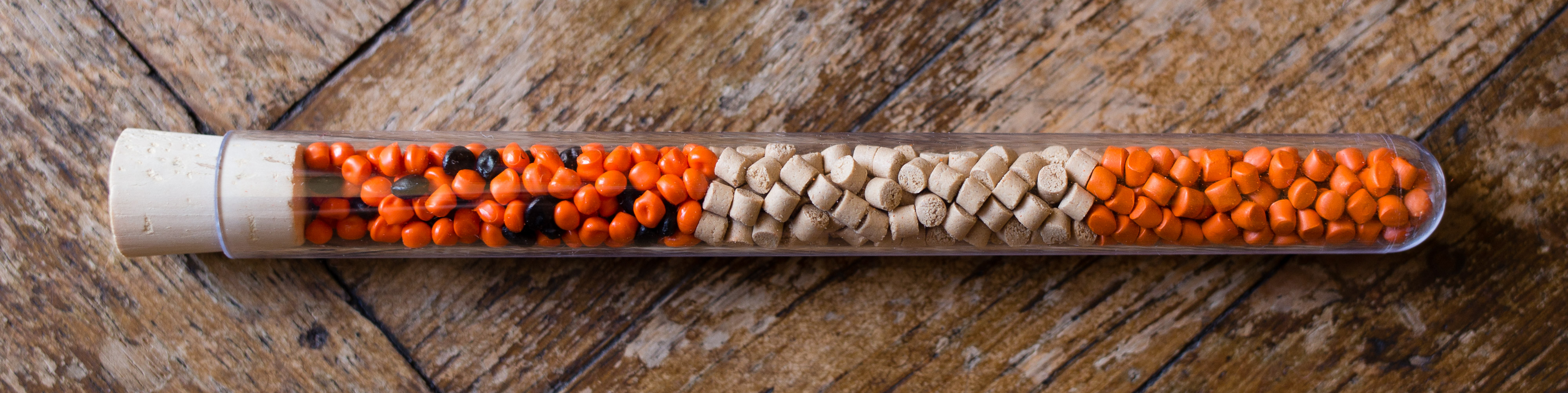
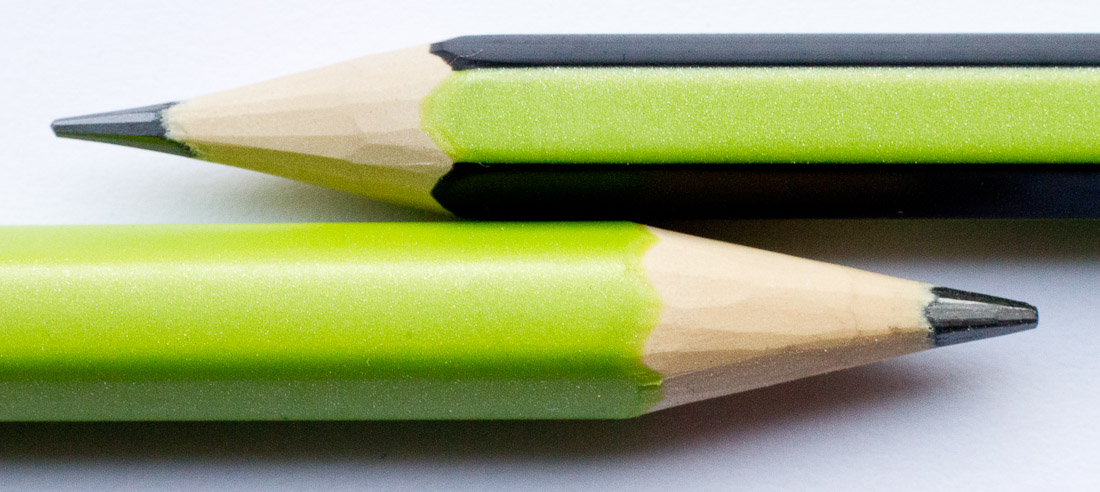
Another Noris in the Wild. This time from the cover of a single by indie-pop band Von Wegen Lisbeth. I got to know the band because of their song on the Crucchi Gang album and noticed that their latest single features what is unmistakably a Staedtler Noris.
I believe that the use of the cover of this single falls under “fair dealing” as described by the UK Copyright service.
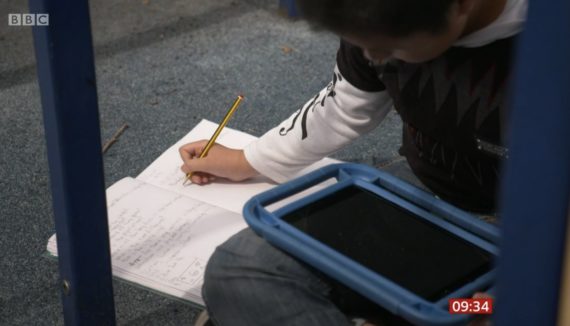
The Staedtler Noris can regularly be seen in news reports here in the UK (stock footage of school kids often include scenes of children writing with a Noris because of its popularity in schools) …so normally a Noris in the news (BBC or otherwise) wouldn’t be worth mentioning. Today is different though: because of a football (soccer) game between England and Denmark this evening the BBC News at Six viewers got a rare glimpse of what is going on on the streets in Copenhagen.
Unlike here in the UK, where the ‘normal’ hexagonal Staedtler Noris is most popular, this unrepresentative sample of one from Denmark seems to suggest that the Noris Triplus Jumbo, which is not a common sight in the UK, is more common in the land of Hygge.
The screenshot has been taken from BBC News at Six on 7 July 2021. I believe that the use of this image falls under “fair dealing” as described by the UK Copyright service.
I was told that the 511 120 is already available in shops, but here in the UK we are just coming out of lockdown so I have not had a chance yet to see this sharpener in the wild [2]Mine was sent from Germany..
The 511 120 is a nice addition to the Noris line in the Noris anniversary year. You can see it in action in the video below.
In Europe, you mainly associate the Noris name with the yellow and black hexagonal pencil, but the Noris didn’t start with that look and even though the yellow and black Noris, the 120, must be the most popular Noris it is by no means the only Noris product. There are also Noris pencils available in a triangular shape, as coloured pencils, sharpeners, erasers and in some markets, you get different colours than in others. Look for example at these nice Noris colours from Iran, the erasable red version (14450-2PP2) from Japan, the learner’s stylus 119 20 that comes with a free app.
Helmut Hufnagl
There are also some news in the Noris anniversary year that are good [3]for Helmut and bad [4]for stationery fans at the same time. Helmut Hufnagl, the designer of the 511 120 and many other exciting Staedtler products, is starting his well-deserved retirement at the end of this month. If you are interested in functional and affordable stationery have a look at this list of blog posts that mentions some of the products he designed.
To celebrate the 120th anniversary of the Noris Staedtler has created a special page for our [1]..certainly my and maybe also your favourite pencil favourite pencil. You can find it in the ‘Highlights’ section of Staedtler’s website (it’s part of the the ‘Discover’ menu item).
I wish this important brand and pencil could have been in the limelight a bit longer – by Staedtler featuring the Noris anniversary article on their landing page for a few weeks – especially in countries like the UK where the Noris is very popular and people might appreciate this special anniversary [2]The 120th anniversary of the pencil with then umber 120.. Addendum: I have been told that that the Noris anniversary pages will be expanded throughout the year.
The special Noris web page is a great read with lots of historic details plus some quirky titbits thrown in, like the record-breaking Noris color pencil that is more than 450 meters long or the giant Noris Obelisk in Barcelona. Unfortunately the translation into English seems to have been done by a computer, which resulted in the occasional information hiccup, but that doesn’t detract from the enjoyment you get from all the details. Addendum: My understanding is that Staedtler will get the translation issues fixed.
The anniversary details from this page are great, so I couldn’t resist and added some of them to the Noris page on Stationery.wiki.
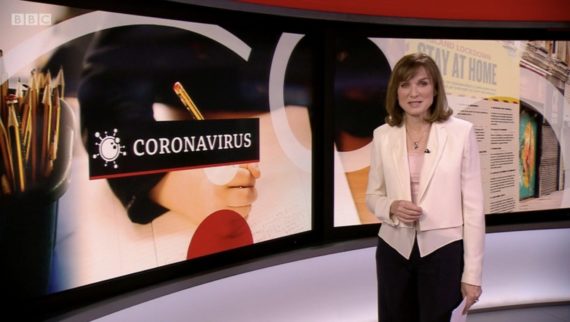
The screenshots have been taken from BBC News. I believe that the use of these images falls under “fair dealing” as described by the UK Copyright service.
When I saw the Noris 511 120 Sharpener, mentioned in the previous blog post, my first thought was that Helmut Hufnagl was probably involved in the development of this sharpener. Two reasons: like the 562 300 PB ruler it is suitable for left-handed users [1]no wonder Staedtler won an award for non-discriminatory corporate culture and like the 512 60C sharpener the 511 120 tries to provide a mess-free experience, thanks to the cap. The similarity to the Sonic Ratchetta is another thing to notice. The 511 120 , like the Ratchetta, has a ratchet mechanism. This also means you can sharpen without having to ‘regrab’ the pencil and it makes the sharpener easier to use for left-handed users. In the West, the Sonic Ratchetta seems to be more commonly available than other sharpeners of a similar design. Similar sharpeners are being sold under other names (Bostitch, Paperpro and more), but as far as I can tell the original version was not the Sonic Ratchetta but was the SDI Buggy, first released in 2013. (You have to watch that video!)
The maestro did it again
I feel lucky and privileged to have been able to not only get answers to my questions about this sharpener but to even some additional information, directly from Mr Hufnagl. As suspected this sharpener is really his brainchild and even though it is being produced at one of the two factories were Sonic Ratchettas/SDI Buggies, etc, are being made, the Noris 511 120 is a different product, i.e. has different specs.
Super 5 (top) vs Dex (bottom) the photo doesn’t help in understanding the differences
Super sharpener, Super 5
The whole ‘looks similar but is different’ situation reminds me a bit of the Super 5. The fantastic Super 5 fountain pen looks quite similar to Kingsley’s Dex and thanks to Scribble I found out that both of these, and also the Manuscript Master, use Helit bodies. These pens are however quite different in terms of ‘feel quality’ and even function: while the Dex feels cheap and plasticky the Super 5 is a great pen to use and has a very special nib. They are quite different even though both use Helit bodies. As mentioned previously, Helit is actually owned by Maped which brings us back to the topic of sharpeners: The 511 120 isn’t out yet, but I am looking forward to finding out how it will perform.
Testing
Mr Hufnagl asked different kinds of users to test the new sharpener. Doctors / GP practices and hairdressers were particularly impressed with this sharpener. Different employees were sharing pencils, e.g. to write down appointments, and ratchet mechanism made sharpening easy for left-handed users while the shape made the sharpener easy to clean (think Covid). Pupils from secondary schools also loved this sharpener.
I’m really looking forward to the 511 120. It certainly seems worthy of sporting the Noris’ colours and is a great addition to the Noris line in the Noris anniversary year.
It’s 2021 and the Staedtler Noris, Staedtler’s pencil with the article number 120, is 120 years old this year.
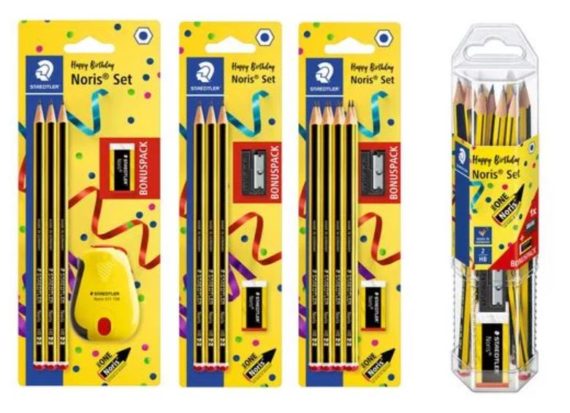
One of the new anniversary sets from Staedtler’s web site, released for this occasion, looks extremely desirable: it contains a new sharpener that will be available soon. The article number will be 511 120, a nice nod to the Noris’ number.
Staedtler’s keeps trying to allow your pencil case to stay mess-free: Similar to the 512 60C from 2017, the new sharpener can be closed to prevent graphite and wood shavings from falling out.
Are you sitting comfortably? Good: the 511 120 will display when the pencil is sufficiently sharpened and will have a ratchet function to make it suitable for left-handed users. I am not left-handed but like how Staedtler cares for all users – like they did when they introduced the 562 300 PB ruler. The sharpener will be suitable for pencils with a diameter of up to 8.2 mm. I can’t wait for the 511 120 to hit the shelves in the UK …finally some good news in these sad times.
As established in many previous blog posts the Staedtler Noris is THE common pencil in British schools. It’s no surprise then that (stock) photos used by British newspapers heavily feature the Noris.
It’s nice to know that British schools recognise a good pencil when they see one and that Staedtler’s Noris is, as far as I can tell, by far the most common pencil in British schools. If I could only have one pencil for the rest of my life it would be the Noris, without a shadow of a doubt.
In this school scene from the British TV series Catastrophe (Season 4 Episode 2) you can see ten Staedtler Noris in nine seconds
https://gph.is/2CGEDx4
(It’s an animated gif, so you might depending on the browser you use you might have to click on it first.)
Since we’re on the topic of Staedtler anyway: have a look at this drawing tube (to transport drawings, etc.) in a Mars Lumograph look. Cool.
The school scene in this blog post has been added to the Noris in the Wild page and is from the Channel 4 series Catastrophe. I believe that the use of the animated GIF shown in this blog post falls under “fair dealing” as described by the UK Copyright service.
This blog had quite a few Wopex related blog posts over the years – and here’s the latest one: about the new generation of Wopex pencils. This is the third generation I know of, but there might have been more.
Previously… on Bleistift.blog
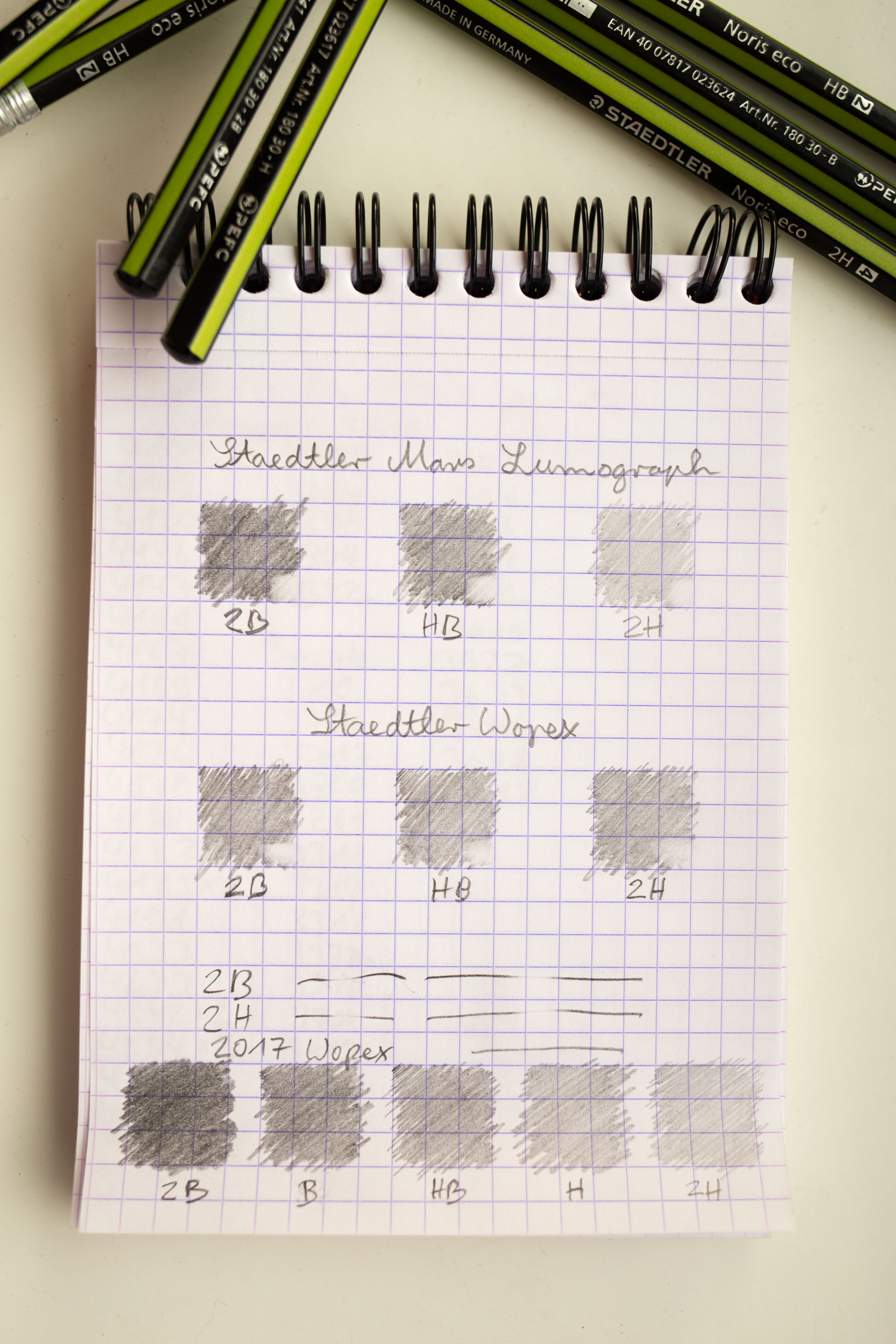
I got the sheet from the 2010 blog post out and added the new 2017 grades.
Just a quick reminder. Staedtler introduced the Wopex (pencil) in 2009 – it’s an extruded pencil and its body is made from a wood-plastic-composite (which consists of more wood than plastic). In 2010 Staedtler introduced the Wopex in 2B and 2H. I had a closer look at the 2B and 2H version in a 2010 blog post and couldn’t find much difference between the 2B, HB and 2H version. Fast forward to 2016. By now Staedtler is using the term Wopex only to describe the material used to make these pencils. Wopex is not used anymore as a name for the pencil itself – at least not by Staedtler. At the Insights X 2016, they had a few prototypes of the new ‘Wopex material’ Noris eco in 2H, H, HB, B and 2B. At the Insights X 2017, they showed the final product.
Close up of the 2010 vs. 2017 comparison
The new 2017 Noris eco
Looks
The design of the Noris eco is clearly inspired by Staedtler’s European staple pencil, the Noris, but like other Wopex material pencils, the surface of the extruded Noris eco feels rubberised. It is also eco-green, but has the same black stripe pattern as the yellow Noris or the red Tradition: The two opposing, labelled sides (let’s call them top and bottom) of this hexagonal pencil are black. The four sides (let’s call them the two right and the two left sides) are green with a think black stripe in between. I am mentioning this because some of the prototypes had a different pattern.
Unlike previous Wopex material pencils, the new Noris eco has a cap. It’s cool, man.
Great news. There’s a proper difference between the different grades in the new 2017 version. In terms of darkness and in terms of point retention. Compared to the Mars Lumograph in 2B, which is a very easy to erase pencil, the new Noris eco in 2B is more difficult to erase.
Eraser test – the bottom right square has been erased
If you see them in a shop I urge you to give them a try.
By the way, Daan De Winter’s Noris in the Belgian TV series Professor T. is visible in many episodes. It is also used to remove the seal of a crime scene and for other tasks. Nice.
The screenshot/animated GIF in this blog post has been taken from Episode One of Season One of the original Professor T. TV series. I believe that the use of Staedtler’s image shown in this blog post and the use of the animated GIF from Professor T. falls under “fair dealing” as described by the UK Copyright service.