Let’s be honest. People have really been struggling to remember how to spell Bleistift.
What was that address again for that pencil blog? Not the good one, the one with the brown/black logo at the top? bliestitf.mmem.de or something like that?
Well, there’s an easy solution to that problem now.
Welcome to pencil.land[1]“.land” is one of those fancy new domains. – where smooth pencils are plentiful and scratchy ones are banned. Erasers are dust-free and sharpener produce a perfect point every time.
I don’t intend to rename the blog, but I hope things are easier next time when you struggle to remember how to get here. The tagline under the blog’s name will therefore change. It used to be “don’t like scratchy pencils”, then it was “any old pencil won’t do” [2]Think Tina Turner’s Private Dancer, now I’ll have to add pencil land.
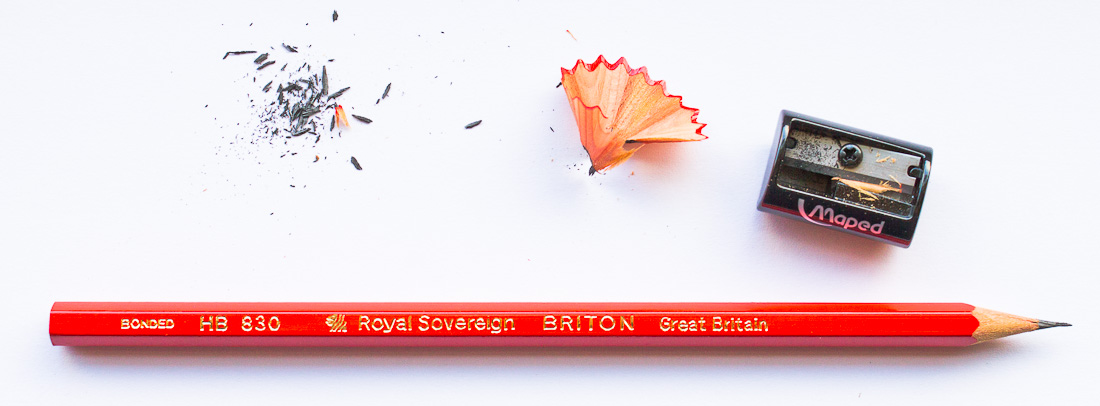
I have touched on the complicated history of the Royal Sovereign Pencil Co in a previous blog post. Today I want to show another pencil made by Royal Sovereign: the Briton.
To put this pencil into context: it was made in the early 1970s, i.e. after Staedtler’s partnership with the British Royal Sovereign Pencil Company started in 1960 and after the owner or Royal Sovereign, the Charnaud family, offered Staedtler their shares in 1966. I guess there’s a chance these pencils were made on the same machines as the early Staedtler Tradition pencils shown here.
The Briton pencil was available in five different degrees: 2H (yellow), H (green), HB (red), B (light blue) and 2B (dark blue), but towards the end of the Briton line, before it was replaced by the Staedtler Tradition, only the HB and B pencils were still in production.
Just like the earliest Staedtler Tradition pencils, it has golden lettering and was pre-sharpened on the right side. This means that the text is upside down if you hold the pencil (the normal way) in your right hand.
The Briton is easy to sharpen and erase. Sharpening was tested using a Maped Metal sharpener, made in Suzhou [1]That’s one of the nice things in Chinese supermarkets: the label on the product or shelf will tell you which city a product is made in., near Shanghai. In terms of darkness, the lead produces a line similar to modern Staedtler pencils but feels a bit scratchier. It is definitely a good all-round and everyday pencil.
I would like to thank mrsnuffles for telling me which other Briton degrees were available at the time.
You might have noticed that I’m trying hard not to have too many fountain pen related blog posts here on Bleistift. One of the reasons why the pencil theme and the name of the blog (the German word for pencil) were chosen was because it feels as if there are orders of magnitude more blogs and resources about fountain pens on the web than there are about the humble pencil. This time, however, I can’t resist focussing on inks and fountain pens …because I have received Pelikan’s Wanderlust ink.
The Wanderlust ink bottle in Preston
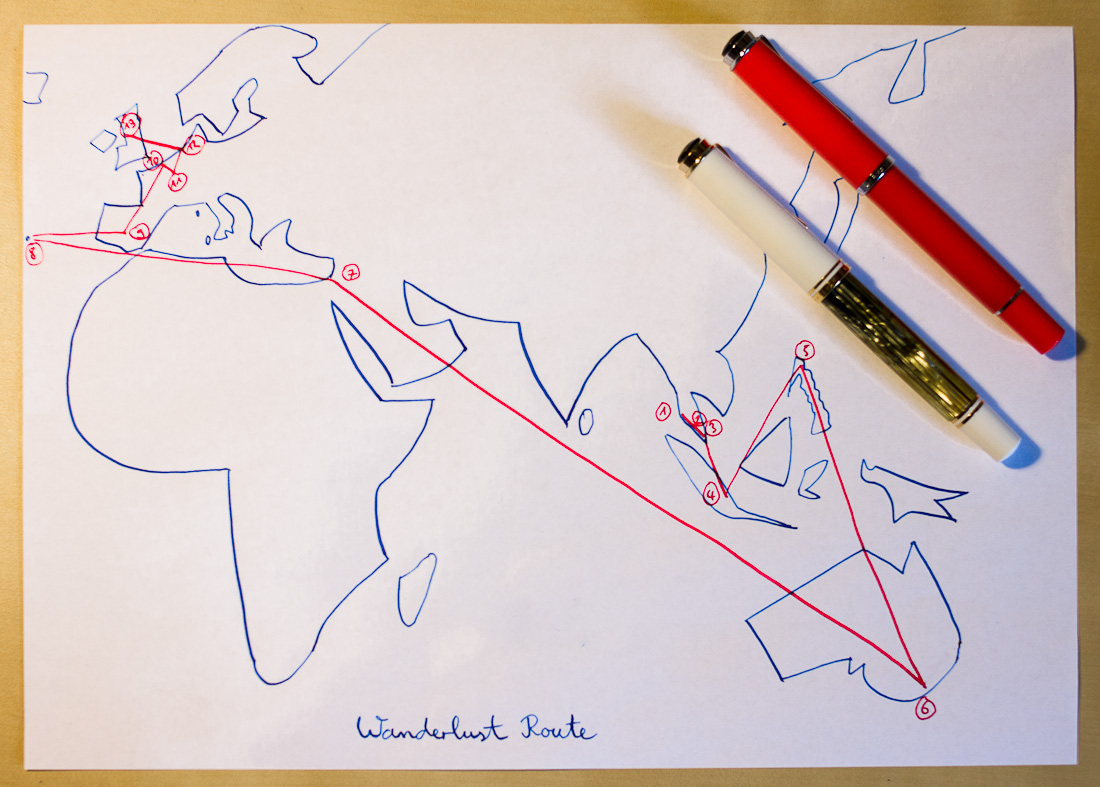
For the Wanderlust project an ink bottle [1]Actually, there are three ink bottles, travelling at the same time but on different routes. is travelling around the world I was lucky enough to keep it for a few days while it was on it’s way from from Asia, through Europe, to South America. Before arriving in England it travelled from Malaysia to Singapore toIndonesia to the Philippines to Australia to Israel to the Azores to Spain to Belgium to Luxembourg to the Netherlands.
The Wanderlust route so far
Looking at the twelve letters written by previous participants, I was admiring the different writing styles, as well as the different kinds of paper that were being used. I was surprised to see that many participants share common attributes and could identify with many of them. Other participants were roughly my age and work-wise from many were from a similar background: there were many participants in academia or with an engineering background. Also: half of the participants don’t live in the country they were born in.
The twelve Wanderlust letters so far
When I first heard about the Wanderlust project I thought the ink in this box would be an ink created especially for this project. It turned out that the ink in the box was a standard ink from Pelikan’s Edelstein range. My box did contain their Topaz ink, but earlier participants on my route had a different ink in their box.
The Wanderlust ink bottleMy Wanderlust letter
I did plan to use my favourite fountain pen, a white tortoiseshell M400 [2]Recently fixed free of charge by Pelikan after the piston came out, like all previous issues I had with other pens over the years. Their service is really excellent., but when I read the letters from the previous participants, which included nice postcards from Granada and an olive branch from Israel I thought I should also theme my letter according to my country. I wrote on British paper (Imperial Parchment, White Wove, made in Scotland and recently bought on offer in Tafford Centre’s Pen Shop) and used a Pelikan 100N fountain pen, which as far as I can tell has been produced for the British market in the 1930s or 1940s. It features a G.W. (Günther Wagner, the plant manager who took over Pelikan in the 1870s) stamped nib [3]which is so rare that it wasn’t even featured on Ruettinger-web where you can normally find information about all things Pelikan. I’m quite proud that a photo of my nib is now featured on … Continue reading.
Details on some of the envelopes
Click to admire fine details
One of the reasons why I love Pelikan fountain pens is their performance. They always start (unlike all my Cross fountain pens), they don’t skip, I never got my hand dirty because of ink in the cap (unlike my Noodlers and TWSBI fountain pens) and even if they even been unused for many months they don’t dry out or have problems starting (unlike my Cross, Noodlers, Hero fountain pens – some of them don’t even survive a few days of non-use without drying out too much to start easily). The only other fountain pen brand I know that performs well in all these areas is Lamy.
The GW nib used to write my letter
The only shame is that Pelikan doesn’t make flexible nibs any more [4]Some of their recent nibs are however slightly flexible, as shown in this blog post from nearly exactly one year ago.. If you want one you need to get an old and flexible nib or get a nib custom ground one. Pelikan started a nib grinding service recently, but unfortunately they don’t do flex nibs.
The Wanderlust box will now make its way to South America. I hope the next participants enjoy it as much as I did.
Recently fixed free of charge by Pelikan after the piston came out, like all previous issues I had with other pens over the years. Their service is really excellent.
which is so rare that it wasn’t even featured on Ruettinger-web where you can normally find information about all things Pelikan. I’m quite proud that a photo of my nib is now featured on Ruettinger-web.
Then… I got the Pelikan Wanderlust box (pictures to follow). It’s a box with Pelikan ink travelling the world. I was supposed to get mine in December, but the box seems to be travelling to some remote islands and I was told it was held up in customs [2]It’s too late now to join Wanderlust, but Justanotherpen started a similar project..
Danske blyanter
Then… I got the Denmark booster pack I won in Rad and Hungry‘s hunt. Nice!
Here in the UK there are several TV shows about buying holiday homes abroad or emigrating. One of those shows is “Wanted Down Under”. The format is usually the same and involves showing how much more people would earn down under and showing what to expect in terms of costs, facilities etc. I’ve never seen a whole episode, but over the years I’ve seen different bits from several episodes and (suspenseful music) they have never talked about the stationery situation down under!
Time to remedy this. Let’s look at the Castell 9000 down under.
The Castell 9000‘s main markings. Top: Germany, Bottom: Indonesia Please enlarge by clicking, so that the differences are more obvious.
For the last three to four years Faber-Castell Australia [1]Their boss is our other favourite Count, Count Andreas Wilhelm Eberhard von Faber-Castell, who has been mentioned previously. has been buying the Castell 9000 pencils from their sister company in Indonesia [2]Made in Bekasi in one of several Faber-Castell plants in Indonesia. Here’s a photo of the impressive entrance.. They said that prior to this they bought them from Germany, but if Faber-Castell Indonesia is out of stock Faber-Castell Australia will request replenishment from Faber-Castell Germany.
The Castell 9000‘s bar codes. Top: Germany, Bottom: Indonesia
In reality this situation seems to be a bit more complicated than that. You might remember Kevin from New South Wales because of his guest review of the Dahle 133 sharpener. Kevin reports that for the last eight to ten years he usually only came across Indonesian Castell 9000 pencils, the exception being some mixed grade tins, which are from Germany.
Sarab from Western Australia also struggles to find the German Castell 9000, which he prefers, and reports that its not easy finding a stationery shop in Europe that will ship small orders internationally. In his experience the differences in grade of the Indonesian Castell 9000 are very subtle or non-existent. In the past he managed to get Bavarian made Castell 9000 pencils in some branches of Jacksons Drawing Supplies, but now they also only stock Indonesian made Castell 9000 pencils.
Only the German Castell 9000 (top) has markings on three sides. The Indonesian Castell 9000 (bottom) only has markings on two sides.
There seem to be so many unused numbers after 9000. I can see that Castell 9000 is an established brand, but I wonder whether life wouldn’t be easier if the Indonesian pencil had another model number – what about 9001? It’s easy to distinguish the different 9000s anyway. In terms of colour and feel the paint of the Indonesian 9000, which doesn’t seem to be water-based, seems to be more similar to the paint used for the Mitsubishi 9800 and less similar to the one used for the Castell 9000 from Stein. The bar code, lead hardness font and print on only two sides of the hexagonal pencil also give the game away anyway…
The ‘town’ of Castell. The Castell 9000 is (indirectly) named after this town, through the Counts of Castell. Nearby, on Schwanberg, you can even find pencil cedars. The first seeds to plant these trees in Bavaria were imported by Lothar von Faber (Faber, 1873, p.44) [3]Faber, 1873. Die Bleistift-Fabrik von A. W. Faber zu Stein bei Nürnberg. Nürnberg : Sebald’sche Buchdruckerei.
I would like to thank Sarab, who brought this issue to my attention, Faber-Castell Australia for further information, Kevin for further information and for the Indonesian Castell 9000 he sent me in October 2011 and Sean for telling me about the book referenced in the third footnote.