If the pen is mightier than the sword, how mighty must a bullet-pen be? Have a look this unusual bullet-shaped pencil, made of beechwood, at Ortie Design.
…and if you feel less like Sledge Hammer and more like world peace you can destroy the bullet in a pencil sharpener.
Einszweidrei! im Sauseschritt
Läuft die Zeit, wir laufen mit. (from Julchen by Wilhelm Busch, 1877)
It’s incredible how fast time is flying by. This blog started last November with a blog post about the Kuru Toga and now it is already more than a year old. In the first year there were altogether 65 blog posts. Now for some statistics: during the first year most visitor came from the USA, followed by the UK, then Germany, then Canada. In terms of numbers the visitors from these four countries, where more than 65% of all visitors came from, were followed by visitors from 106 other countries.
…but enough about statistics. Let’s talk about pencils!
Today I want to write about a pack of “graphic pencils” from Taiwan’s Lion Pencil Co., Ltd., better known as Simbalion. I bought this pack of pencils in December 2009 at Keyroad a shop on Shanghai’s FuZhou Road. If the name rings a bell, I mentioned it in my previous blog post about the Deli sharpener 0635. I never saw this brand in the West before. Have you seen Simbalion pencils in your country?
The pack contains twelve pencils with the grades 4H-H, F, HB, B-6B. My pencil came in an “easy to use easel box”, but this box has since been replaced and these pencil are now available in a new polypropylene case.
The Lion Pencil Company was established in 1956 and is one of Taiwan’s oldest stationery manufacturers. The Lion Pencil Company is proud of having invented the “art set”, but I am sure some other companies will lay claim to having invented the art set in the stationery context, too. Their Taiwanese factory is in Taipei county, but they also have a factory in Kunshan (Jiangsu province), very close to Shanghai and just next to Taicang, where Eisen has a factory.
In Taiwan the normal price for the new set of these pencils in a PP case is 120 NT$ ($ 3.95, £ 2.50, € 2.95). I paid much more for my old “easel box”, maybe because these pencils were imported into the Chinese mainland or maybe, this is only speculation and probably not the case, because the new set is from the factory in Kunshan. According to the labels and stamps on my pack it was produced in the factory in Taipei county on 7th May 2009 – nice to get so much information 🙂
The pencils are nice, certainly not scratchy, but I do wonder about Simbalion’s grading. The H pencil from this pack is certainly the softest H pencil I have ever used and does feel softer than the HB pencil from the same pack. The print on the pencils is uneven in places and the end of the pencil has too much paint that is not evenly distributed.
Altogether a nice set of pencils for this price. The pencils are not scratchy or bad in any other way. My main criticism would be the unpredictable hardness or softness of the lead that does not seem to be consistent with the printing on the pencil.
Conclusion
Nothing too fancy, nothing too bad – you get what you paid for as long as you pay not more than the official price.
Price and exchange rates: November 2010
I would like to thank Kevin Davis from O’Bon for the sugarcane paper used in these photos.
Today: a tie-in with pencil talk’s blog post about FILA’s global pencil. I want to add the Korean version of the Ticonderoga to Fila’s global pencils series. According to the information from the packaging it is manufactured by Beijing Fila Dixon. One sentence printed on the packaging is very interesting: “R&D in Korea”.
Has the current Ticonderoga been developed in Korea?
Pencil talk mentioned that the different version of this pencil have different cores. This could also mean that not the whole pencil, but that only the core for the Korean version has been developed there – to fit local preferences.
Other Fila pencils I have at my disposal do not emphasise where they have been developed. A pack of Lyra pencils has this sentence printed on the packaging: “Made in China under LYRA-Germany quality standards”, while Dixon pencil packaging only states where the pencils have been produced: Triconderoga: “Made in Mexico”, Ticonderoga Renew: “Made in USA”.
FILA’s global pencil
The Triconderoga blister pack comes with a fantastic sharpener from Eisen.
I would like to thank Kent for the AMOS DIXON Ticonderoga.
I would like to thank Sean for the Triconderoga and the Ticonderoga Renew.
Next year Staetdler will release “nostalgic metal tins” as a limited edition. There will be tins for the Mars Lumograph, the Noris and the Tradition (yes, this time with an upper case “T”).
I assume that that only the tins have the nostalgic look and that the pencils inside will have the modern look.
Fantastic! I hope I will be able to buy some before they are gone. Getting this years 1835-2010 set was difficult enough.
For me the Staedtler Noris has always been the archetype of a pencil. The Mars Lumograph might come close and these days I might also consider the Castell 9000, but somehow I never really saw the Castell 9000 being used around me when I was younger. My father was a joiner, so he used carpenter pencils and normal pencils …and because he used a lot of them he would not buy the more expensive ones. There was a point, I think it was the early nineties, when Herlitz Scolair pencils became quite cheap. So he usually used those …and he used a lot of them. Even though I also used to use them I never thought of them as nice pencils, they were always just cheap pencils to me. In the eighties there were of course Japanese pencils in Germany, too, but they were usually novelty pencils, not branded pencils. Their selling point would be the unusual look, e.g. unusual patterns or colours printed on them, often metallic. Unfortunately they usually suffered from lead breakage, probably because the manufacturers did not have to try hard: Everybody who bought them did so because of how nice they looked, not because of their reputation – and since they were not branded you could not really know which ones to avoid in the future .
Shanghai's Chung Hwa Drawing Pencil 101
Back to my original topic: I think the Staedtler Noris can be seen as the archetype of a pencil in the UK and in Germany. In the UK the Staedtler tradition can also be seen quite often, but in both countries the Noris seems to be the pencil that is most ‘common’ and recognisable the same time.
Shanghai’s popular pencil
Last time I was in Shanghai I was trying find the Shanghainese equivalent by looking for the most common pencil in everyday life. I expected it would be the Chung Hwa 6151, just because it was a Shanghainese pencil you come across in stationery blogs or web sites, but I never really saw the 6151 in the wild. Instead I came across the Chung Hwa Drawing Pencil 101 again and again. Employees in supermarkets used it to make notes. Waiters in restaurants used it to take orders. It just seemed to be the most common pencil in Shanghai. If there are any reader who know or live in Shanghai and disagree please let me know. I would like to know what your experience is.
China First Pencil Company Ltd.
Before I go into more detail about this pencil I would like to talk about the manufacturer, Chung Hwa, first. There are many Chinese companies and products in different and unrelated industry sectors that are called Chung Hwa: there are Chung Hwa cigarettes, cars, there is Chung Hwa cognac, ink, etc. As far as I can tell these companies have usually no connection except the common name. Chung Hwa (PinYin: ZhongHua) does translate as ‘China’ but not in the normal sense, i.e. when you talk about the country, but in a cultural or literary sense.
The Chung Hwa pencil company traces it roots back to 1935. It changed the name a few times and today’s official name is China First Pencil Company Ltd. They manufacture graphite, colour and cosmetic pencils as well as pencil related stationery and machines for the pencil industry.
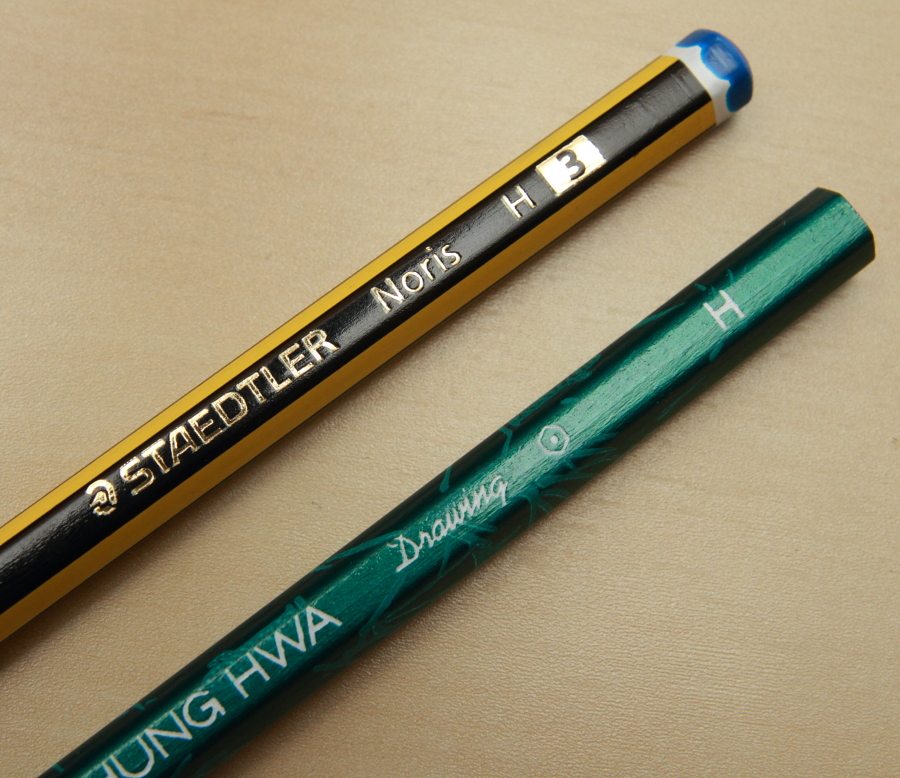
Today the Chung Hwa Drawing pencil‘s body has a dark green body colour with a light green pattern of bamboo leaves and totems printed over it. The pencil is hexagonal without a painted cap and is labelled on three sides. The wood used is rather red, but does not seem to be the Vatta wood (Macaranga Peltata) mention in a previous blog post. Two sides are labelled in white, one in white and gold. As far as I know the Chung Hwa 101 should be available 6H – H, F, HB, H – 6H. Despite my best efforts I was however unable to find this pencil in F, so I bought one pack in HB and one in H.
…compared to the Staedtler Noris
Since this pencil seems to be Shanghai’s everyday pencil I thought it would be a good idea to compare it to what I think is the UK’s and Germany’s everyday pencil, the Staedtler Noris, as explained earlier. Let’s start by looking at the finish. I like the fact that you can see the wood grain through the paint, but on the 101 the paint has not been applied as well as on the Noris. This applies to both the dark green base and the light green pattern. The Chung Hwa Drawing Pencil 101 in HB is also not as soft and smooth as a Noris HB. It is not yet scratchy and certainly not worse than an average pencil. The graphite is not too reflective and does not smudge, so keeping the price in mind the 101 HB is very good value for money. The 101 in H is also very good for the price, but compared to the Noris in H it is much softer, more like an F grade pencil.
Conclusion
The Chun Hwa Drawing Pencil 101 offers very good value for money. It is not really a great pencil that can compete with good pencils, but it is definitely better than the average no name pencil and better than many cheap branded pencils.
As usual: the paper that can be seen in the comparison photo of this blog post is the Bloc Rhodia Nº 13.