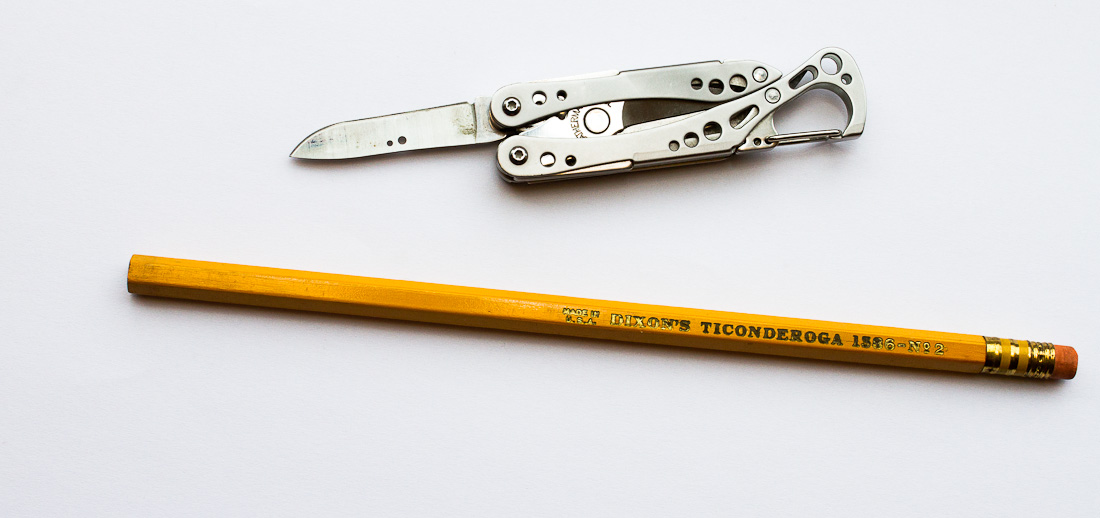
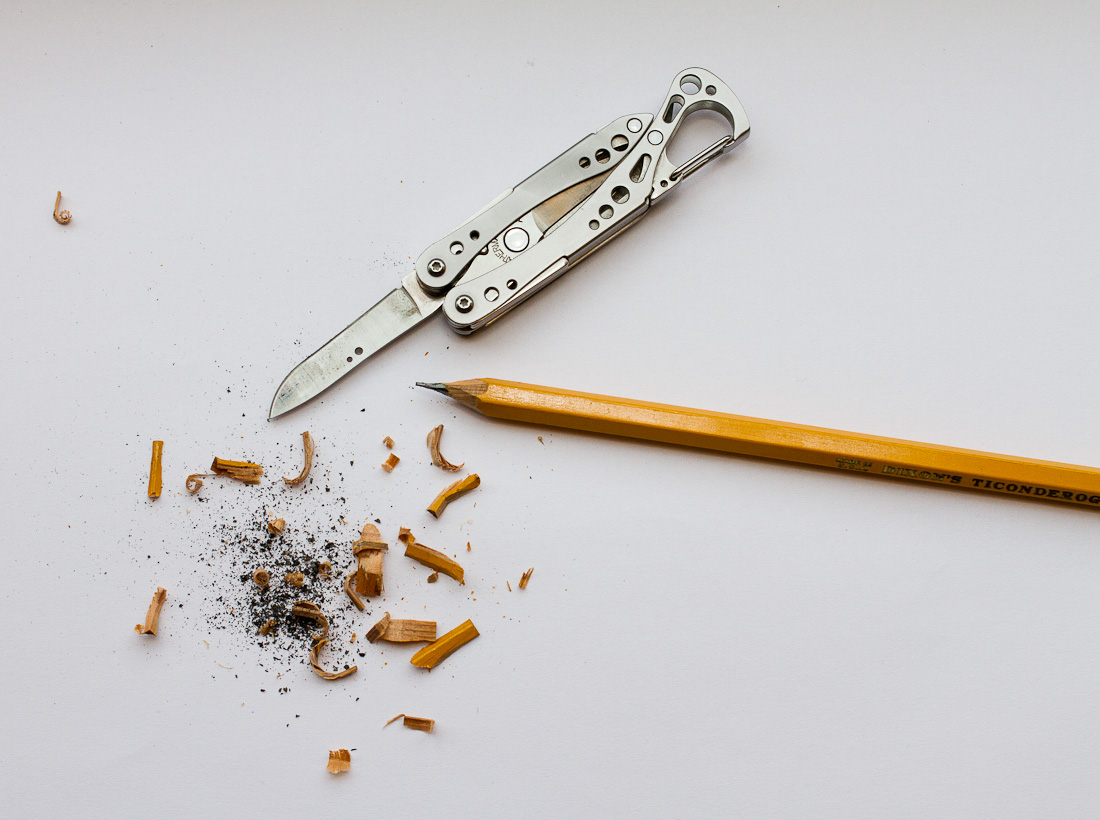
As a pencileer, molyvophile and molyvologue [1]See explanation in this blog post. I couldn’t think of a better way to celebrate Independence Day than to sharpen an American pencil with an American blade.
…but which pencil to choose? In the end I narrowed it down to the Mongol and the Ticonderoga. As these pencils where also made in other countries I obviously only put the American made versions on the short list.
In the end I did go with the Ticonderoga, just because I thought Faber-Castell takes some of the emphasis on the USA away. So, the chosen pencil is the Dixon’s American Ticonderoga. I did have a few of them in stock, but haven’t actually used them yet. My Ticonderoga experience so far was limited to the ‘Korean’ Ticonderogas, the awful Ticonderoga Renew and the Microban Ticonderogas.
The knife was easy to choose, my Leatherman Style CS …just because it is the only knife I own that is, as far as I know, made in the United States of America.
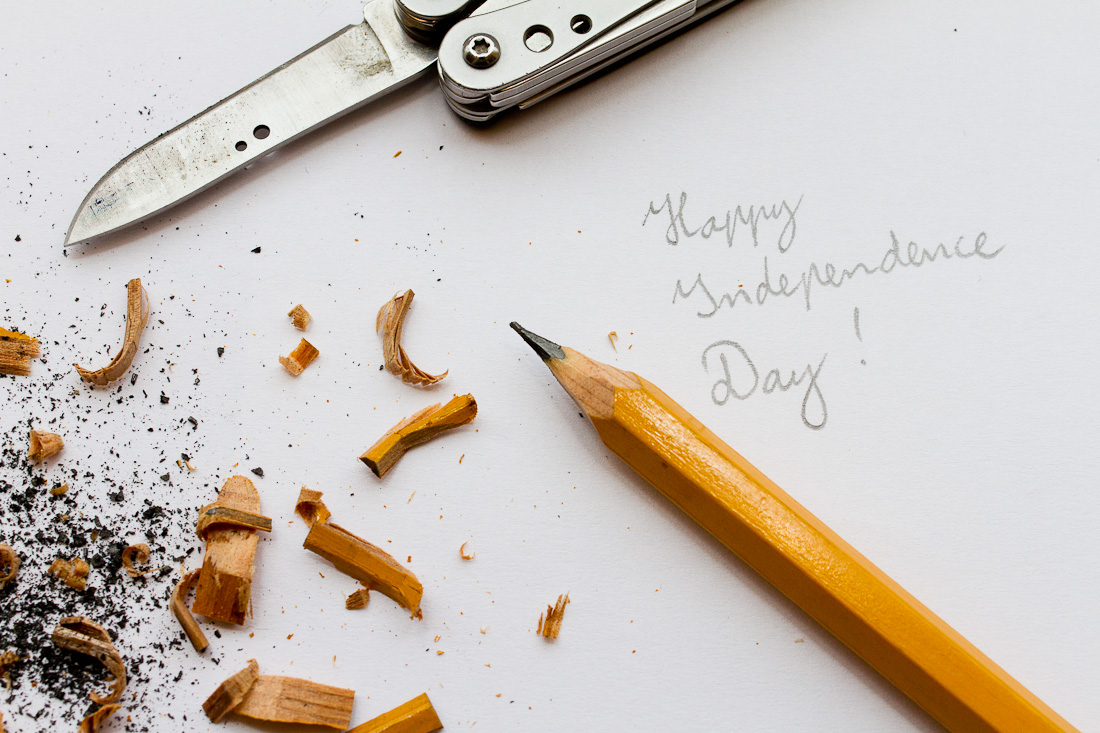
OK, let’s start sharpening. Because I only have a few of these American made Ticonderogas I want a less acute angle than usual – I just don’t want to waste too much of the nice pencil.
I don’t want to go for a proper obtuse angle either, as that would probably be a very strange writing experience.
Here way are. By the way, the American blade was sharpened with something American, too: The Spyderco Tri-Angle Sharpmaker, which could also be used to sharpen blades of pencil sharpeners.
Happy Independence Day!
As usual, please click on the pictures to see them in a higher resolution.
As you might have guessed after reading The Noris, then and now or any of the other Seen in the wild posts: I’m always happy when I see the Staedtler Noris on somebody’s desk or in a shop (not really worth a blog post: “Did you know, my local bank is using Noris pencils”) or on telly (probably more interesting for you, so maybe worth a blog post).
Last time I spotted a Noris was in Episode 3 of Uncle. This episode gives you the opportunity to admire the Noris in Nick Helm’s right and left hand and in his mouth (maybe the production company shouldn’t have picked the bacon flavoured Noris).
I believe that the use of the screen shot of the Noris pencil, taken from episode three of the first season of the TV series Uncle falls under “fair dealing” as described by the UK Copyright service.
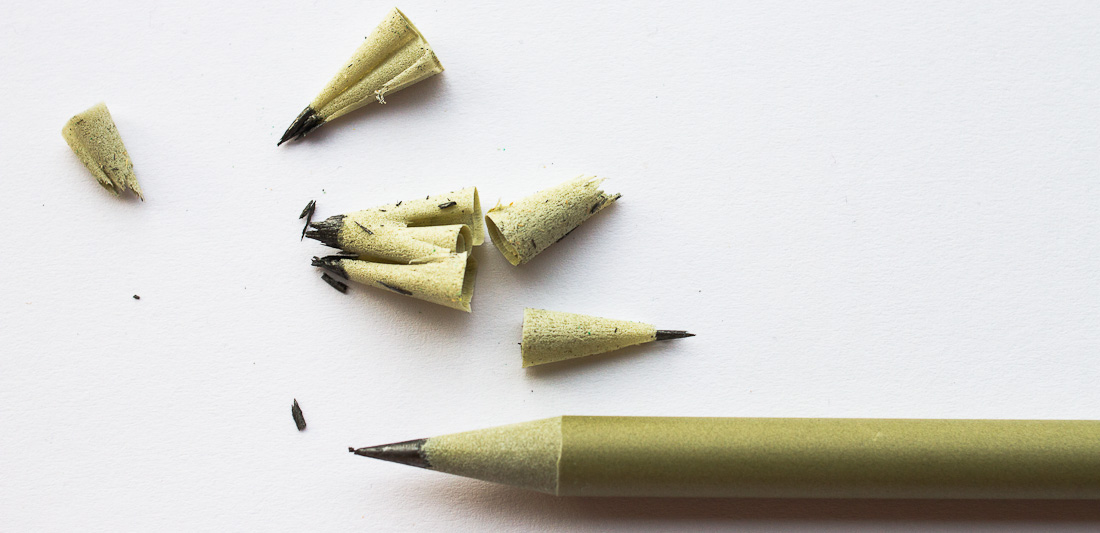
This time: a pencil made from recycled money. My colleague Dr. Mitchell Larson saw this pencil while visiting another university and brought one back.
Recycled money
A quick search on the Internet shows that many British suppliers of promotional pencils stock this green, recycled pencil. I am not sure whether it’s made from recycled Pound notes (less likely) or whether the colour is supposed to indicate that it is made from recycled Dollar bills (more likely). This is probably the same pencil as the one seen on Pencil Revolution in 2006. In any case, the pencil doesn’t feel as if it’s made from pure, recycled cotton paper. It’s much too hard and dense for that. I’d speculate that it’s made from plastic banknotes if I wouldn’t think it’s made from Dollar bills. Another explanation for the plasticy consistency, one which seems more likely, might be that the consistency of the recycled notes is just not right to be made into a pencil – so the recycled material might have had to be mixed with another material. Maybe there’s an even more exciting explanation: maybe the recycled notes had to be mixed with another material to make it impossible to use this pencil to forge money. Lots of speculation, but in the end it doesn’t matter why: this pencil is much more similar to a Staedtler Wopex or to a BIC ecolutions evolution than to a pencil made from rolled paper, like the ones shown in the battle of the eco pencils.
The pencil itself is round. I mention this because there is an older, hexagonal version – the one made from $7.33 of recycled Dollars.
Factory sharpened
The lead
The lead behaves and feels similar to the BIC ecolutions evolution, it’s just a bit less waxy. It’s definitely worse than a Staedtler Wopex, it’s not as dark and more plasticy, but much better than the catastrophic pencils made from recycled CD cases, which are widely used as promotional pencils. I’m not even looking for the CD case pencils on purpose, but have already come across four different ones. Two of them were left by students in different rooms in our university. I can’t blame them for not wanting to write with these pencils.
Sharpened using a DUX 9207-N
Sharpening
The Dux 9207-N
In a good sharpener, in this case the DUX 9207-N, sharpening the recycled money pencil is effortless. Despite being made from a material that seems quite a bit harder than wood the sharpener didn’t struggle at all. When sharpening the recycled money pencil in a ‘not so good’ sharpener or one where use has resulted in a blunt blade sharpening needs more effort than your average wood cased pencil.
Since we’re just talking about the sharpener anyway, the DUX 9207-N is a very nice sharpener, made from black Bakelite. As far as I know this sharpener has been first produced in the 1940s. You can sometimes see people on eBay trying to sell new versions of this sharpener as antiques. The DUX sharpens with an angle of ~20°. Please take the time to click on the picture of the sharpener to see the delicate, sophisticated pattern on the lid of the sharpener in higher resolution.
Overall
Some pencils made from recycled materials are truly awful. This pencil isn’t one of them. The fact that it’s made from recycled money makes it an interesting novelty. The lead is usable, even though it’S not as good as the best pencils made from recycled materials.
Tested on Banditapple 3G paper
I’d like to thank Lexikaliker for getting me the Dux 9207-N sharpener. I couldn’t find it in any local shops.
I’d like to thank Dr. Mitchell Larson for the recycled money pencil.
A recycled money pencil has been recently mentioned in the Erasable podcast, probably in Episode 5.
I’ve been luck enough to have been chosen by The Pen Company, together with several other bloggers, to receive stationery to try out. Here’s my blog post about the Tombow mechanical pencil they sent me, originally posted on The Pen Company’s blog.
Introduction
Do you remember what you did in 1987?
If you were living in the USA you were lucky enough to be able to watch Star Trek: The Next Generation. The UK and Germany got TNG a few years later, in 1990. If you’re more into computers: the Amiga 500 was also released in this year.
..and in the world of pencils 1987 was the year the Tombow Zoom 707 mechanical pencil, designed by Mr Tsuyoshi Hasegawa, was launched in Japan, one year after the ballpoint pen of the same series came out.
Awards
It only took another year before the Zoom 707 was released in Europe – in 1988. Over the next years it won three design award in Germany: the Red Dot Design Award in 1988, the Design Plus Award in 1989 and the Baden-Württemberg International Design Award in 1990.
Despite this pencil being so long on the market I didn’t know about it until recently. I got my Zoom 707 from The Pen Company as part of their programme where they send pens to stationery blogs for review. I even got the de Luxe version, which was launched in 1994. Tombow describes the de Luxe version, which sells for £28.60, around £10 more than the standard version, as being “glossy silver”.
Size comparison: Tombow Mono 100, Tombow Zoom 707 de Luxe, Staedtler Mars micro
Expectations and reality
I’ve got to be honest here, I would have never ordered this pen. The slim design doesn’t look very uncomfortable to me, so I didn’t have particularly high expectation when I started using this pen. To my surprise it was much more comfortable than expected. The rubber grip section of the pen has a diameter of 6.5mm and is not too far off a Tombow pencil’s diameter: the Tombow Mono 100 wood-cased pencil has a diameter of 7.2mm.
The grip is only slightly narrower than a wood-cased pencil
Build quality is excellent, but the red ball at the end of the clip and the rubber at the end of the pen show parting lines, and except the look the pencil behaves very similar to your typical mechanical pencil: with around 10g the weight is similar to other mechanical pencils. One click will advance the by about 0.6mm, which is also pretty standard and it also uses a ratchet mechanism like many other mechanical pencils.
One click will advance the lead by ~0.6mm
The pen comes in a nice presentation tin and with a lifelong warranty. It doesn’t come with instructions, though, and since I’ve used mechanical pencils in that past that have to be refilled through the tip I wasn’t sure how to refill this pen. It’s size and the fact that my careful attempt to remove the push top (I didn’t want to damage the pen) were not successful didn’t help either. The push top can however be removed, to be refilled. My pen came with three leads, but despite is slim design I managed to squeeze eight leads into the pen.
Overall
The Zoom 707 is one of those pens that ages well. Despite being more than 25 years old it doesn’t look old fashioned.
As far as I know this pencil is selling well. I wonder how most people are using this pencil. Its two main attributes, the slim size and the sturdiness (thanks to its metal body), make it a pencil that is probably more suitable than others to be a diary pencil, the kind of pencil you clip to your diary and leave it there to fulfil this specific purpose.
I would like to thank The Pen Company for this pencil and Mrs. Balsewicz from Tombow Europe for the information she has provided about the Zoom 707.