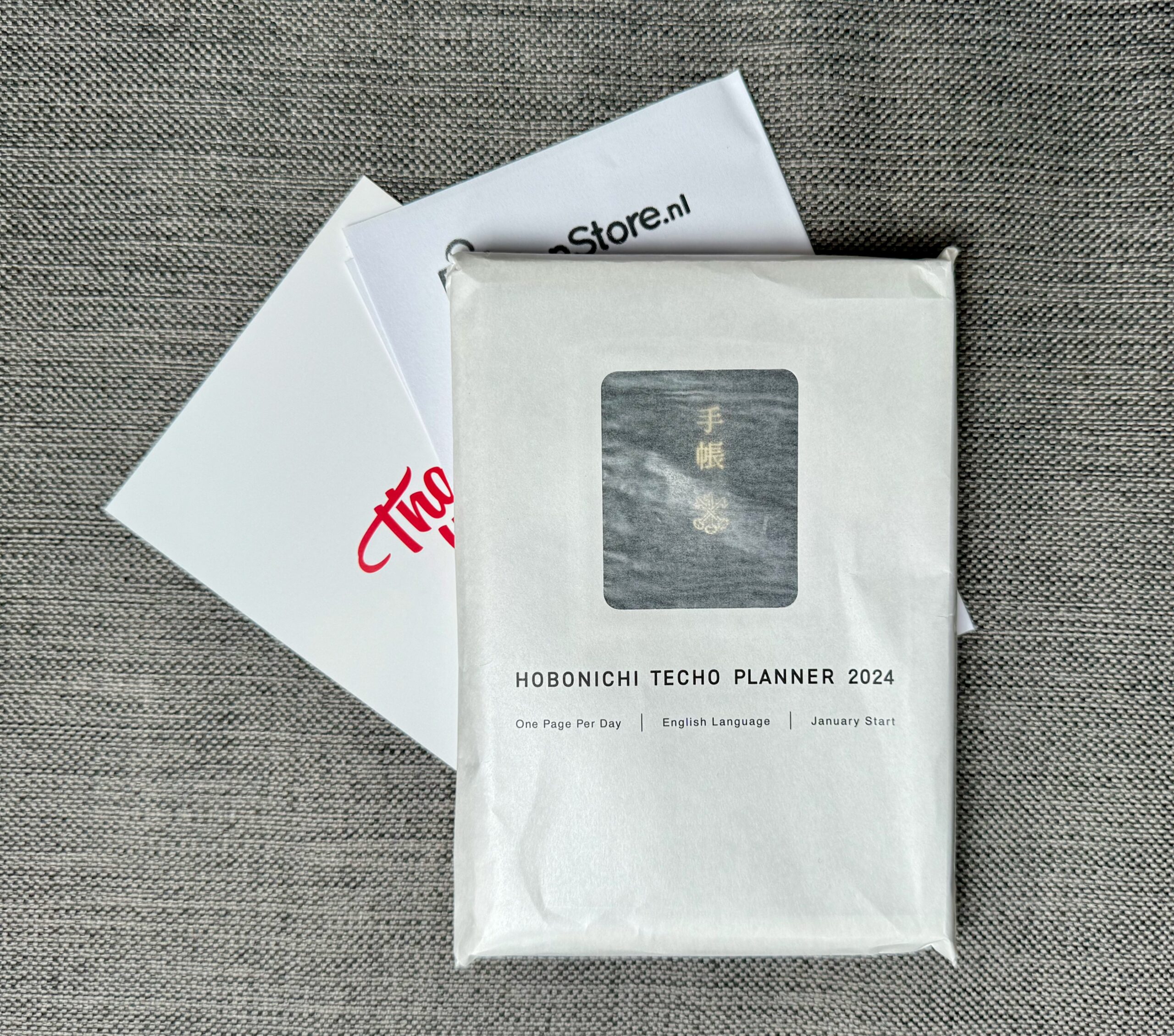
I used to order my Techos from the Hobonichi store in Japan, but now that I live in Germany and only need the notebook itself, it turned out much cheaper to order it from PenStore.nl. Of course you don’t get the gimmicks that come with the Techo: a 3-colour uni Jetstream pen and this year also a little bag, but postage from Japan would have been about as much as the Techo itself.
It’s nice to be able to easily order from continental Europe again. Since Brexit I missed out on a few nice stationery items that were either too expensive to get into the UK or were not available in the UK.
I wonder what other stores I’ll discover that I missed out on so far. Unfortunately it’s now more expensive to order from nice UK shops like The Pen Company, Pen Heaven, Write Here and CultPens. Some of them pay duties and taxes for you, for others you have to pay via the delivery company, so you don’t know in advance how much it will cost…
How to use a lead pointer tub might not be that obvious. That must certainly a factor contributing to the video’s popularity, but it still doesn’t explain why the video remains popular to this day.
Many of the comments show that buyers of the lead pointer often don’t know how to use it properly and that they wish they had known about the video earlier.
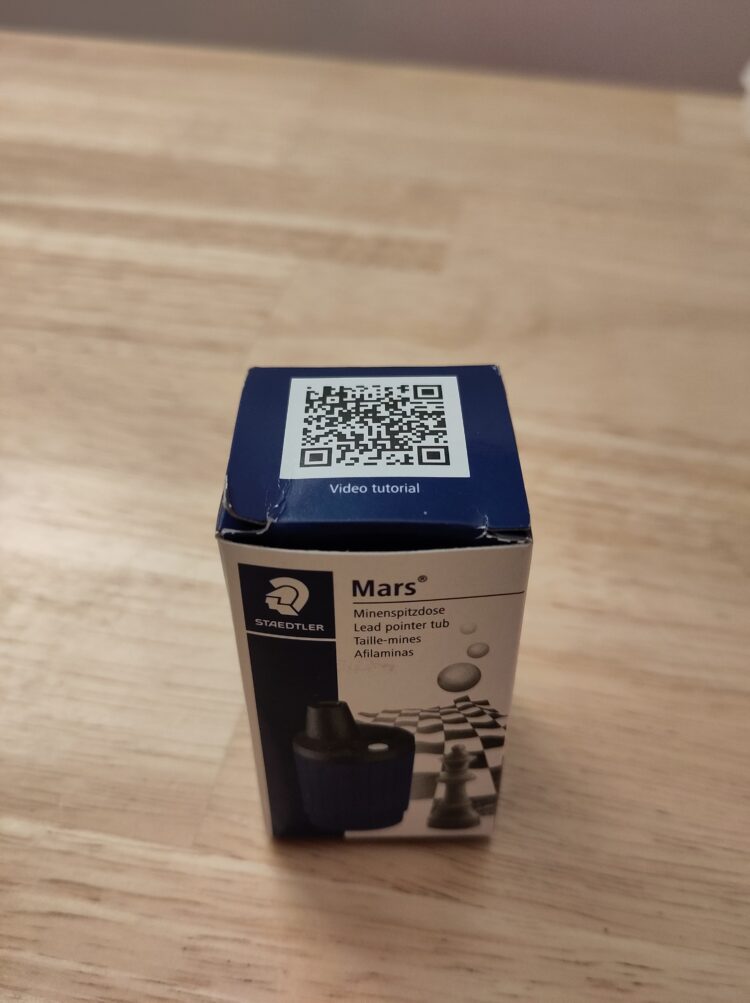
Three years ago, one of the comments (see above) posted under the video said that Staedtler should point to this video. Well, a few days ago a follow up comment was posted (see below). It came from Bleistift viewer Björn who found the video because Staedtler is now printing a QR point on the lead pointer box, pointing to the Bleistift video explaining how to use the lead pointer!
What a surprise that was!! Björn also sent some photos of the new box with the QR code.
Thank you Björn for letting me know and thank you Staedtler for linking to the video.
Almost unimaginable today, but: Yes, there was a time when employees spent their entire working lives, from training to retirement, with just one employer. A time when companies lasted and sometimes outlasted whole generations. Corporations and conglomerates with which people associated a degree of identification that went beyond the purely professional.
There is no doubt that Duisburg DEMAG was one of these companies, which lasted from 1910 to 1973, with roots going back to 1819. DEMAG – a name that still means something to many people on the Rhine and Ruhr.
Those who had been associated with such a company for a long time were given a gift, a token of appreciation, on their work anniversary – after 25 and 40 years with the company – in addition to an extra month’s salary.
A famous example of this is SIEMENS; to this day, a very high-quality wristwatch from a German manufacturer is given to mark the anniversary: the Ludwig from NOMOS in the corresponding SIEMENS edition (one of the few companies in the present day that still has such long ties).
What is the exception today was the rule in post-war West Germany: high-quality gifts on anniversaries.
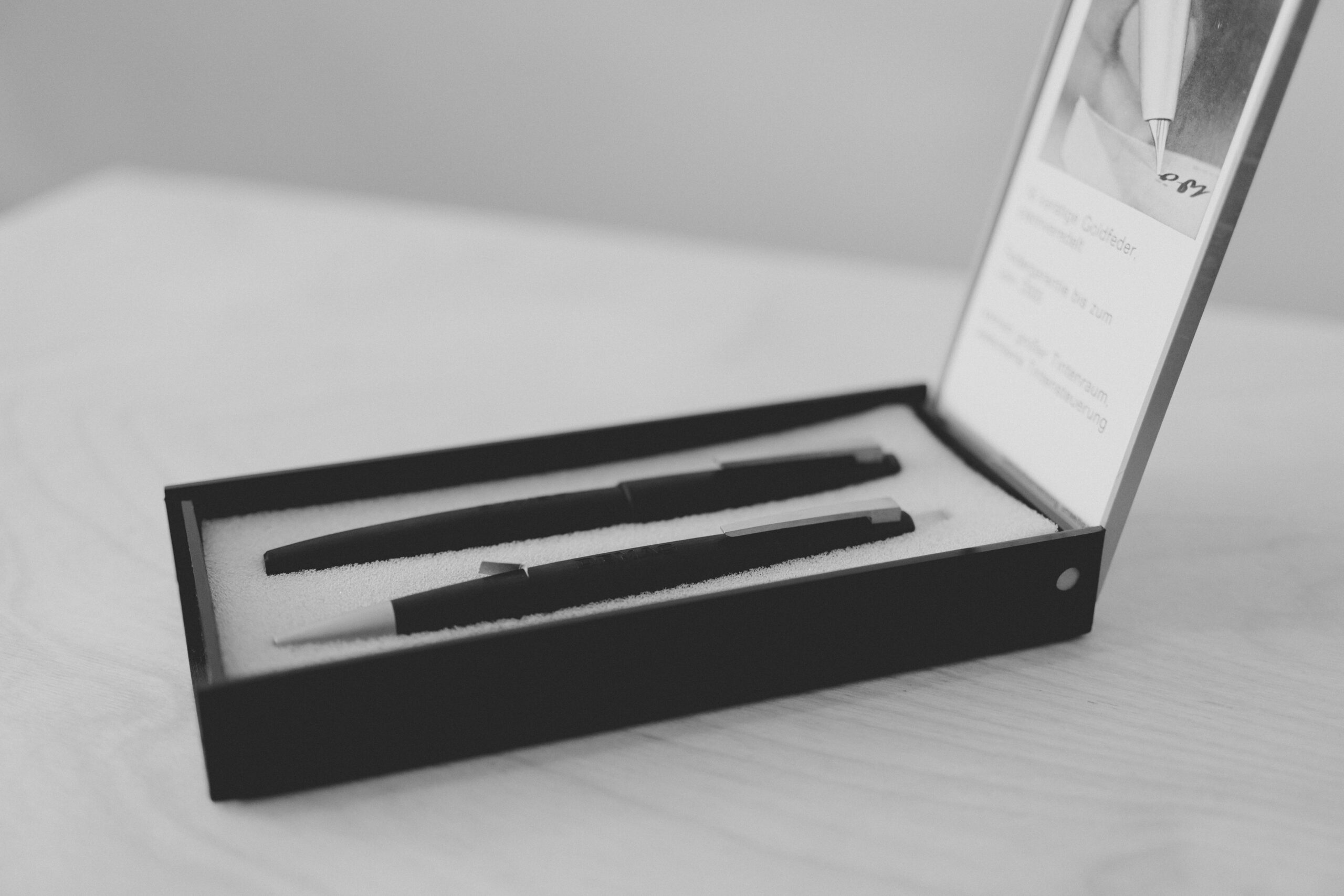
Recently, while walking through a flea market in Duisburg, I discovered just such an anniversary present: a beautiful, originally packaged, actually never used LAMY 2000 gift set, consisting of a piston fountain pen and a biro, both engraved with the DEMAG logo.My father spent his working life in the ThyssenKrupp Group. I remember that when I was a child – the 1990s! – writing instruments, often from LAMY, and also pocket knives (Victorinox) were often given away in a professional context. Whole drawers were filled with LAMY pens and miniature pocket knives. These “normal” promotional gifts often had an equivalent value of € 5.00-10.00; something like a LAMY 2000 was only given on very special occasions.
Back to the flea market in question: The seller himself was not the youngest – but too young to have worked at DEMAG himself. An heirloom from his father? Probably. Written on the box in sharpie: Black fountain pen, black biros” – the beautiful set, it ended up in some cupboard, a drawer, maybe even in the attic, as soon as it was received. A package with obvious contents, after all, the writing instruments are clearly pictured on it, and yet the previous owner felt called upon to note the contents again in full.
In the cupboard, in the drawer or in the attic, this box must have lain for decades until it was sold to me. Why were the writing instruments never used? Perhaps they were “too bad” (although one might argue that it was too bad just NOT to use them). Or maybe they were simply not appreciated and only “archived” because that was the way official gifts were made at that time.
DEMAG existed until 1973, after which some former subsidiaries continued to bear the name – but it is unlikely that the gift was made after 1973. The iconic LAMY 2000, designed by Gerd A. Müller, came onto the market in 1966. The guarantee on the nib until the year 2000 is noted in the set .
Also based on the old LAMY branding, I assume that this beauty falls exactly into that period – i.e. 1966-1973. A wonderful set. And – in more ways than one – a piece of German history.
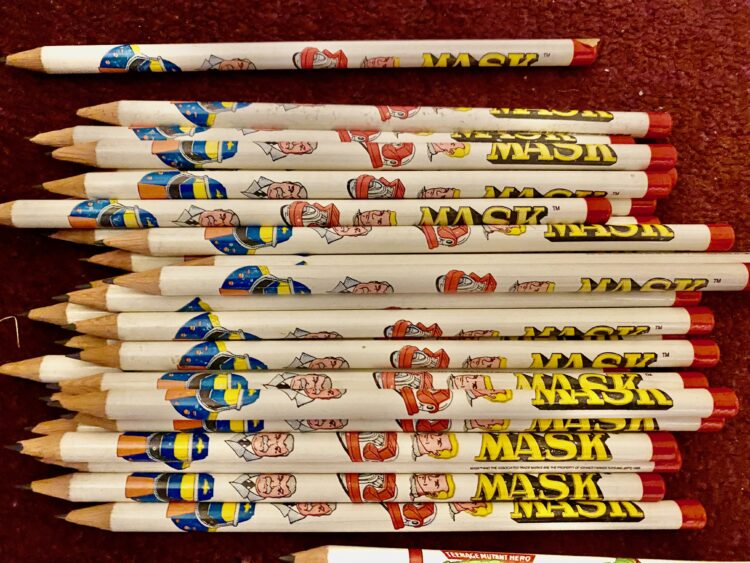
After reading the previous Staedtler x Star Wars blog post, Bleistift reader Matthew asked for pictures of the licensed pencils made in Staedtler’s Welsh factory, so I dug some out:
Mask pencilsBravestarr pencilsCapers pencilsDavid The Gnome pencilsDogtanian and Spot’s pencils Mickey Mouse pencils
Merchandise from TV series and movies is all around us and is also pretty common in the stationery world, but a lot of the licensed stationery doesn’t actually show the manufacturer and quality is sometimes dubious.
In the Eighties and Nineties Staedtler used to produce quite a lot of licensed pencils with designs linked to TV series and movies. Most of these were unbranded, i.e. as a consumer you weren’t able to see these were actually made by Staedtler. It seems that this is down to the fact that in most cases Staedtler didn’t purchase the licence but produced the pencils according the customer specifications. This seems to be still common: the manufacturer is not the licence holder which might also explain the poor quality of a lot of licensed stationery as the company holding the licence might just get the cheapest factory to produce the pencils as the products get bought because of the licensed characters, not because of the quality.
I had a big collection of licensed pencils made in Staedtler’s Pontyclun factory in Wales but decided to let them find a new home as I just have too many pencils.
The printing on the pencils included some globally well known trademarks, like Lion King and Teenage Mutant Ninja Turtles, but also a lot of UK specific brands that are not well known outside the UK and Ireland, e.g. Beano and David the Gnome. To my surprise one type of pencil was particularly popular, the MASK pencil, based on an animation from the mid-Eighties. Even though I watched a lot of children animations in the mid-Eighties I was not familiar with this series and rather surprised by the popularity. The same is true for another series I wasn’t familiar with and that seemed to be very popular: Bravestarr.
The collector who took these pencils made me aware of Star Wars stationery that Staedtler used to produce and that I want to share with you today.