What percentage of kids are right and what percentage are left handed?
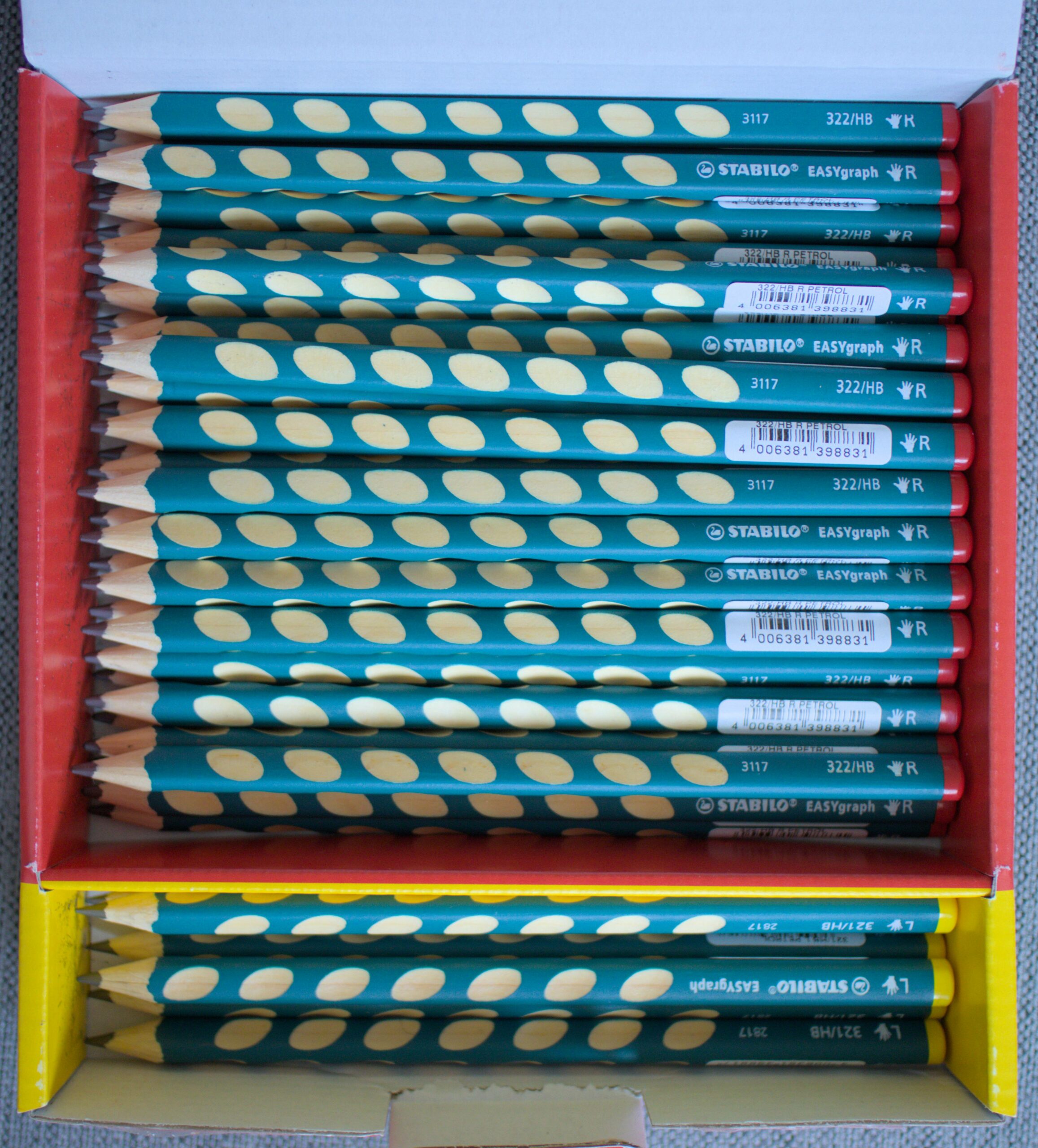
Based on the distribution of pens in their class pack, Stabilo seems to work with the assumption that about eight out of 48 children (~17%) are left handed.
Statistics seem to indicate that the actual number of left handed people is lower, but exact numbers depend on which statistic you look at – and which country that statistic covers.
I wonder if the discrepancy in this class pack means that teachers using this pack usually have a few spare left handed pencils at the end of the year…
My favourite iron gall ink is the one made by Bach’s Tinten. Unfortunately, it is quite difficult to get hold of it …and I fear by now it is not being made any more.
I have two ink bottles from them. One was bought in 2009 as a set with a quill and instructions. The other ink bottle was bought just by itself, i.e. without a quill and instructions.
You might have seen the ink bottle with the crimson ink before as it made an appearance in previous blog posts here at Bleistift.
When cleaning up this weekend, I came across the instruction sheet that came with the ink set. It’s rather nice, so I thought I share a translation with you here:
Fine Historical Stationery Writing like in old times At a time when new writing instruments are being introduced to the market by the industry almost every day, the desire for the original arises more and more often in many people. This desire is to be fulfilled by the historical stationery, individually handcrafted as in the old days, taking us back to a time when writing was a very personal way of expression. The inks The inks are made according to old recipes, some of which were thought to have been forgotten. Among others, the following natural colour materials are used: Black inks are made from an acidic tannin-iron compound. Coloured inks contain, for example, green walnut shells (brown), redwood and chochal lice (red), indigo (blue), turmeric with indigo (green), and various other ingredients, especially gum arabic as a binder. The iron gall ink is a valuable document ink; its blue ink strokes turn black on the paper and cannot be decomposed – neither by acids, alkalis nor by constant sunlight. The historic inks are bottled in jars faithfully reproduced from a 19th century model. As in those days, the ink jars are corked and sealed. To open the jar, you clasp it tightly with your hand and press your thumb against the cork. The sealing wax then pops open. The jars should not be left open for any length of time. The quills Since time immemorial, people have written with the goose quill, which was replaced at the beginning of the 19th century by the steel pen. At the beginning of the 19th century, it was replaced by the steel nib and later by the fountain pen. Raven, eagle and swan feathers were also used for writing. The bird feather must not be left in the ink glass, because otherwise it will soften, since it is made of horn. It can be re-cut with a very fine knife. Keel and steel nibs are best for writing on smooth, well-glued paper. Letter, bank mail, and butt papers are preferred, or for special work, genuine skin parchments.
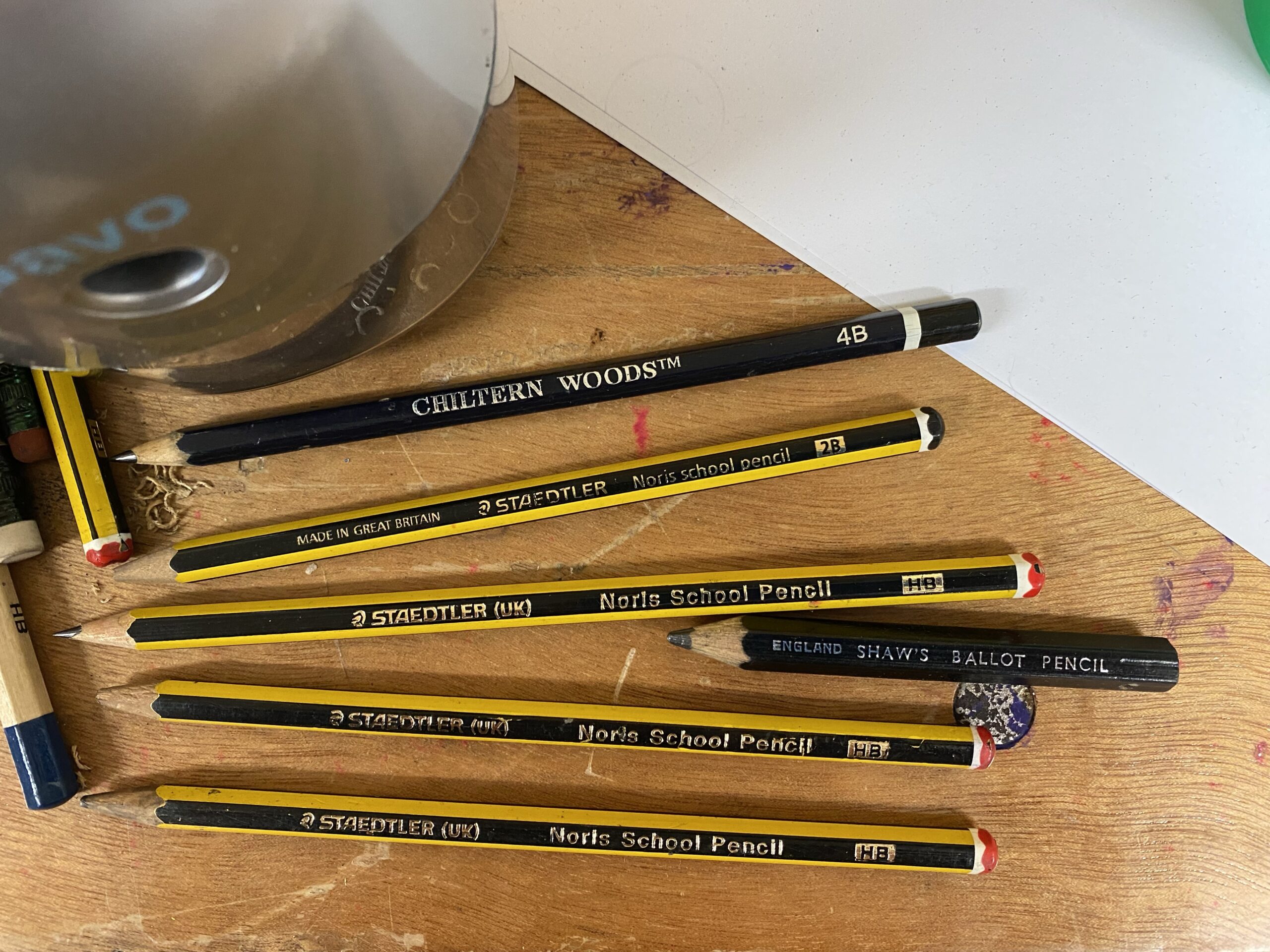
Seen in our scout hut – when sharpening the pencils there with the Rolls Royce of pencil sharpeners: old Noris school pencils, with several attributes that the new Noris school pencils don’t have any more:
the label, including the fonts used, has changed quite a bit
the factory in Pontyclun, where these pencils were made, does not exist any more
It was nice to come across these in the wild. If you like to see more Noris pencils in the wild have a look the the Noris in the wild page.
PS: It was a surprise to also find the UK’s official ballot pencil, used in election, in the scout hut’s collection of pencils. It’s not the first time I came across unexpected pencils in a scout hut.
In a recent blog post I talked about the new upcycled Noris in the UK. The upcycled version is extruded using a composite wood/plastic material instead of wood. The lead is also extruded and quite different to traditional pencil leads. Glenn, who is a Bleistift blog reader, told me that down South, in London where he lives, the change to the upcycled version of the Noris started last Summer. I guess there’s a higher Noris turnover over there. Around here there are still supermarkets that have not even started stocking the upcycled Noris and only sell the older wood-cased version.
We then also talked about how to recognise if the pencil is upcycled or not. There can be some confusion as I have seen upcycled Noris in the old packaging and Glenn told me that he has seen upcycled Noris pencils that don’t have “Upcycled Wood” written on the barrel.
Here’s a little video that spells out how to recognise which version you are seeing (based on wood grain and lacquer near the cap).