I am still quite busy at work, so no new blog post at the moment…
…but I thought I amuse you with with this video from Pelikan’s youtube channel.
Montblanc fountain pen failed – Pelikan M800 to the rescue
Pelikan’s description of the video reads as follows:
“During the inauguration of Japanese minister Kensaku Morita on April 6th, 2009 the fine writing instrument failed. The former Minister Akiko Domoto spontaneously offered her Pelikan Souverän M800 to her successor and the documents could be signed without further delays…”
Usually, I do not display images from other web sites for copyright reasons – one of the reasons why my blog posts with news look quite bare. If I do include images not taken/created by myself I mark them accordingly (e.g. a screen shot from a TV series). Since youtube provides the code to embed videos on your own web pages I decided to embed this video directly. Last year, I did something similar for a Staedtler video. I will keep my restrictive policy regarding images and will mark all images taken from other sources explicitly.
Unfortunately bad news keep coming from Japan. Let’s hope for the best, which (currently) is probably a hope that things don’t get even worse.
When you visit a university in Shanghai you will usually find at least two types of shops nearby: Snack shops (lots of them) and stationery shops. I have not yet seen another city where this phenomenon is as obvious as in Shanghai. The stationery shops can be split into two groups: stationery shops with functional stationery and stationery shops that sell girly stationery as well as other things like make-up, charms, etc – but you can also find shops that are somewhere in-between these two groups.
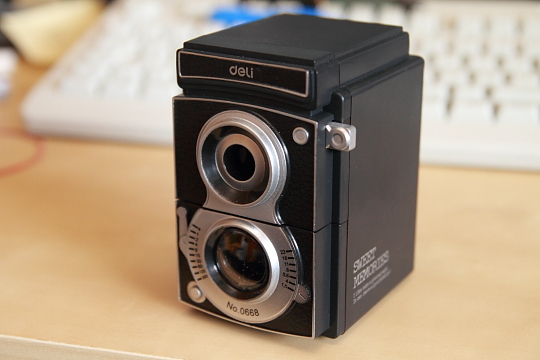
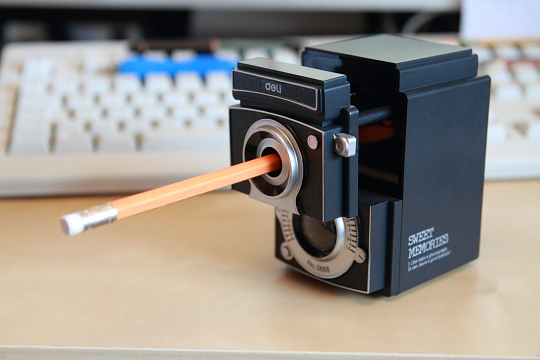
After my good experience with another Deli sharpener I could not resist and bought this TLR shaped sharpener, the Deli 0668, in December 2010 when I saw it in it in Shanghai – in a stationery shops outside a university. Deli’s headquarters are near Shanghai, so I it is not surprising that this sharpener was inspired by a Shanghainese-made Seagull TLR [1]Seagull TLRs were basically Rolleiflex copies. Outside China Quelle rebranded Seagull TLRs and distributed them as Revue cameras (40 years ago). There are still companies out there that distribute … Continue reading.
The 0668's single rotary blade cylinder
I paid about ¥ 30 (£ 2.80, € 3.30, $ 4.50) for this sharpener, a bit more than what I paid for the Deli 0635. You can get this sharpener cheaper if you look around or if you buy online, e.g. from Taobao. Outside China you can get this sharpener from Kikkerland for $15 (£ 9.30, € 10.80) or from Urban Outfitters for £ 15 ($ 24.20 , € 17.50) [2]Urban Outfitters buy it from Kikkerland and in the end after shipping it over, everyone adding some profit and after adding tax, it is more than five times as expensive than what I paid in a little … Continue reading. It is currently on offer and can be bought for £ 8 online and in the Urban Outfitter shops .
The 0668 has a single rotary blade cylinder, similar to the one in the 0635. There is also a removable tray for the shavings. The clamps that hold the pencil during sharpening have a rubber surface so they won’t damage the pencil’s surface. Additionally, there is an automatic stop mechanism that will prevent you from over-sharpening a pencil. The main difference between the two Deli sharpeners is that the 0668 produces a shorter (and blunter) point. It also features a point adjuster switch similar to the one seen in the Carl Bungu Ryodo BR-05 pencil sharpener, reviewed at pencil talk and in the Dahle 133 / M+R 0981, reviewed at Lexikaliker. The blunt setting at the extreme end will result in a “point” diameter of about 2mm is only suitable for colour pencils with a wide core. Normal graphite pencils do not have a wide enough core for this setting.
On the left a Faber-Castell 1117 sharpened with the Deli 0668 (sharp setting), in the middle a Faber-Castell 1117 and a Mitsubishi Arterase Color 0668 sharpened with the Deli 0668 (blunt setting), on the right a Faber-Castell 1117 sharpened with the Deli 0635
Conclusion: A great sharpener for a great price. I will not use the blunt setting and, to be honest, I do prefer the longer point I get from the Deli 0635 much more. It is nevertheless a sharpener I will enjoy using. It is currently in my office where I use it for all kinds of wooden pencils, but not for pencils that use difficult to sharpen material, like the Wopex, as my experience with the Deli 0635 has shown that the Deli’s automatic stop mechanism does not work with these pencils and that the harder material seems to be detrimental to the blade cylinder.
A Faber-Castell 1117 sharpened using the sharp setting and a Uni Mitsubishi Arterase Color Vermilion sharpened using the blunt setting.
The pencils used in this blog post are Faber-Castell’s 1117 B and Uni Mitsubishi’s Arterase Color Vermilion 310. The 1117 feels like an unpainted pencil. It is not really painted but features a water-based varnish. It also has a breakage-resistant lead and an eraser. It does performs well for a budget pencil. It is made in Germany and sells for around € 0.30 each (~42¢, ~25p). You can find a review of the Faber-Castell 1117 at pencil talk. The Uni Mitsubishi’s Arterase Color Vermilion 310 is made in Japan. I do not have more information about this pencil, but you can find a review at Lexikaliker and at pencil talk. I would like to thank Lexikaliker for the Arterase Color pencil used in this blog post.
Seagull TLRs were basically Rolleiflex copies. Outside China Quelle rebranded Seagull TLRs and distributed them as Revue cameras (40 years ago). There are still companies out there that distribute Seagull cameras outside China, one of the most famous ones is Lomography. Another interesting point: Whoever designed this sharpener changed the markings compared to the real camera, from f/3.5 to f/1.5
Urban Outfitters buy it from Kikkerland and in the end after shipping it over, everyone adding some profit and after adding tax, it is more than five times as expensive than what I paid in a little shop that wasn’t cheap in the first place.
2011 is the year Faber-Castell celebrates its 250 year anniversary (1761 – 2011). Stephen from penciltalk told me about an anniversary set of 6 Castell 9000 pencils that was for sale on eBay. Faber-Castell gave these away at this year’s Paperworld trade fair. Unlike the centennial tins with 12 and 72 pencils, this tin does not contain the normal Castell 9000 pencils you can buy in shops, but Castell 9000 pencils with 1761 – 2011 * 250 years printed on them. They are not available in shops (yet), but according to comments on Faber-Castell’s facebook page Faber-Castell seems to consider producing them for sale. Let’s keep our fingers crossed!
Stabilo celebrates the 40th anniversary of their Boss Highlighters. As part of this anniversary there is a giveaway from Tiger Pens, where you can win Boss mugs, and a game from Stabilo where you can win Boss mugs, USB sticks and other prizes (there are different prizes for different countries).
Staedtler‘s historic pencil construction kit will unfortunately not be available in shops. The good news: you can order these kits directly from Staedtler for € 5 each. You can also get Staedtler’s historic Lumograph tin (100 M12H: € 16.20), the historic Tradition tin (Nr. 110 M12H: € 14.40) and the historic Noris tin (Nr. 120 M12H: € 9.60) directly from Staedtler. All of these special items are only available while stocks last. The historic pencil construction kit is not available yet, but can already be ordered.
The photo of Stephen Wiltshire using a Staedtler Tradition has been taken from Top Gear Episode 5 of Series 14 and has been used previously in a blog post from March 2010 about the Staedtler tradition. I believe that the use of this image falls under “fair dealing” as described by the UK Copyright service.
You might have noticed that new blog posts at Bleistift were mainly announcements, there were no new review-style blog posts with images since last December. The reason behind this is simple: I have been quite busy at work (some colleagues left, but this is only part of the story) and I will be quite busy for some time to come.
Therefore, I am quite happy that I finally managed to put together some photos and a few words about two pencil stands I bought last November. They are from Wedo (Werner Dorsch) [1]Using this type of acronym to create a company name is quite common in Germany. Other company names created using a similar mechanism are Haribo (Hans Riegel Bonn) or Adidas (Adi Dassler)., a company established 1933 and located just south of Frankfurt. In the first years Wedo’s main business was repairing fountain pens. Later they started manufacturing nibs for fountain pens. These days Wedo’s main business seems to be the distribution of office products, school supplies and gifts.
Before I start talking about these pencil stands I want to emphasise first that I love products made from bamboo and I am quite happy that products made from bamboo have become more and more common. Ten years ago there were not many products made from bamboo available in non-specialist shops in Europe. The only “solid” bamboo products I can remember from that time are tea sets and tools used for tea ceremonies. Even earlier, in the 90s, only “thin” bamboo products, e.g. bamboo steamers, could be found in shops …at least as far as I know, but please let me know if this was different where you live or whether there are some products I left out. Luckily today you can get lots of products made from bamboo: chopping boards, trolleys, laundry baskets, pencil sharpeners, … I assume that part of the reason of the increased number of bamboo products must be that the gluing process involved improved dramatically over the last years.
Wedo Desktop Butler
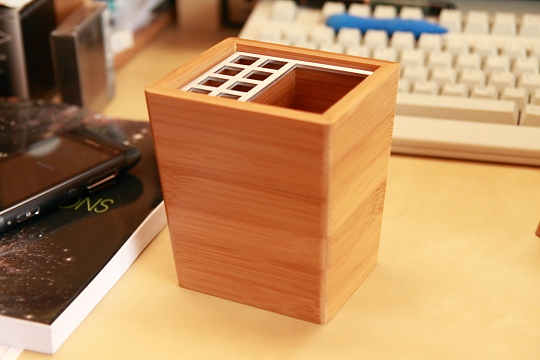
When I saw Wedo’s bamboo products online I could not resist and ordered their desktop butler and pencil pot, the fact that the price is very reasonable did not help resisting either. The desktop butler was € 9.40 ($ 12.85; £ 7.90) and the pencil pot was € 8.50 ($ 11.60; £ 7.15). Both products are extremely well made and look fantastic. I really like them. The strips of bamboo glued together are about 2 cm wide (nearly an inch), must bamboo products seem to be made from much narrower strips of bamboo. The walls of the desktop butler are 5mm thick, the walls of the pencil pot 7mm. This gives both products are very solid feel. My only concern with these pencil stands is the aluminium insert at the top. I fear they might scratch the surface of the pens out inside. This problem is however more perceived than real, at least in my case. I use these pencil stands for everyday pencils and if I store pens with polished surfaces in them I put them in and take them out carefully. The aluminium insert might not make any scratches, but I just don’t want to risk it…
Wedo Pencil Pot
Prices: November 2010
Exchange rates: February 2011
I bought both products in November 2010 from Schule-Uni-Shop.
Using this type of acronym to create a company name is quite common in Germany. Other company names created using a similar mechanism are Haribo (Hans Riegel Bonn) or Adidas (Adi Dassler).
If you are interested in fountain pens you probably came across Montblanc’s Mahatma Gandhi fountain pen. Keeping in mind that Gandhi led a simple lifestyle, gave up unnecessary expenditure and promoted Indian-made goods there is a huge discrepancy between what he represented and what Montblanc’s Mahatma Gandhi pen stands for. No wonder this pen made headlines in several newspapers, including USA Today and The Guardian.
More affordable was Montblanc’s saffron coloured Mahatma Gandhi ink, which was released around the same time but sold out very soon. De Atramentis started selling an ink with the same colour and the same name. Even though there is a chance that Montblanc’s Gandhi ink was manufactured by De Atramentis I wouldn’t bet on it. Old Montblanc ink and De Atramentis inks are made in Germany, but as far as I know Montblanc’s old inks were made by Gutenberg [1]previously mentioned in this article – not by De Atramentis. Montblanc’s new inks are made in Austria.
De Atramentis’ Mahatma Gandhi ink is probably a copy of Montblanc’s ink, but it might be worth a try if you were keen on getting Montblanc’s Gandhi ink and missed your chance when it was first released. Unfortunately, De Atramentis’ shipping costs outside Germany are quite steep.