Over the last three days the first Lancashire Science Festival took place on the premises of my employer. There were some really exciting shows – and there were souvenirs.
Titan, the robot, was one of the attractions
I couldn’t resist and bought two pencils made from recycled CD cases, for 50p each (~ 78¢; 62c). When I saw them I knew they were the same kind of pencils as the red pencil, made from recycled CD cases, discussed in the Battle of the eco pencils, but I was hoping these pencils had improved over the last two years.
The recycled pencils
This hope was unfortunately misplaced. The pencil is as bad as the red one I looked at two years ago. The lead is not very dark and writing with this pencils feels rubbery, but also a bit scratchy at the same time. After my bad experience last time I didn’t use my Deli pencil sharpener 0635 for this pencil. Instead I used the Dux 9207-N sharpener, which is so sharp that it can easily cope with the hard plastic that makes up the casing, but that only makes me happy about the good sharpener and doesn’t help at all with this horrible pencil. I only know one pencil that is worse: the Ticonderoga Renew HB.
Sharpened with a Dux 9207-N
Conclusion:
A fantastic science festival, but horrible souvenir pencils.
Price: June 2012
Exchange rates: July 2012
I would like to thank Lexikaliker for the fantastic DUX 9207-N sharpener that has been used to sharpen the pencil for the photo.
As a complement to Lexikaliker’s yellow Wopex, here a photo of the yellow Wopex blister pack available in the UK. I bought this pack of five Wopex plus eraser and sharpener this April for £2.99 [1]plus 90p shipping (~$4.69; €3.70). Unfortnately I haven’t seen the eraser-tipped version from Lexikaliker’s blog post yet, but I will definitely buy it if I ever see it.
East…West…Everywhere wrote a blog post about the green version, available in the USA, that comes with Staedtler-made eraser caps. These eraser caps are basically a white version of the eraser caps that are quite common in North-America [2]Some pencils in North America come with these erasers attached to them, the Magic Writer for example. You can also spot them fairly often in American TV shows, e.g. in Two And A Half Men..
Some pencils in North America come with these erasers attached to them, the Magic Writer for example. You can also spot them fairly often in American TV shows, e.g. in Two And A Half Men.
Hi Matthias/readers:- today after a lot of searching through Japanese sites, I received the above sharpener from a store (AT-N) on rakuten.com (English version here). The store in this link, I’m showing because it has a close up of the rotary unit, showing the stamping “CARL” and “MADE IN JAPAN”. The standard Carl Angel-5 sharpener is now made in China. The following comments may be useful:
Design Differences to the standard CARL ANGEL-5:
1. Rubber padded pencil grippers
2. Chrome handles (pincers) in place of plastic pincers.
3. Crank handle has a nicer triangular plastic holding part in place of the ribbed plastic handle on the CA-5.
4. The milled rotary unit is stamped “CARL”, “MADE IN JAPAN”.
Usage Differences: – Now comes the disappointing part:
The rotary unit is not the same as the original CARL ANGEL – the point it produces is similar to the Mitsubishi KH-20, a somewhat dull point, and shorter, fatter cone – although I gather this is more preferred by “writers”. As I use this sharpener for sketching/drawing in a small A6 size sketchbook, my needs are for a “as sharp as reasonably possible” point. Even with the standard CARL ANGEL-5 I invariably touch up the point to serious needle sharpness with a OLFA cutting knife.
There was, however, a pot of gold at the end of the rainbow….but it means owning the two sharpeners – the Original and the Premium. Solution:
I swapped the rotary unit including the crank handles ( the premium crank handle fits the standard Carl, but unfortunately the standard Carl crank handle doesn’t fit the Premium rotary unit – weird, I know) between each sharpener…(twenty seconds) and now I have my perfect (for me) sharpener, albeit using the “cheaper Chinese” but “better” rotary mechanism from the Standard Carl Angel-5. Now I can sharpen (and already have) my premium pencils in a truly “premium” sharpener, giving me what I always wanted:
– the long cone and sharp point of the standard Carl Angel-5 AND just as importantly to me
– rubber padded pencil grippers to keep the pencil surface pristine… very necessary when sketching, where visual distractions can be a problem to the creative process.
FC 9000, Staedtler Mars, Palomino Blackwing 602, and some vintage American drawing pencils now look much prettier when I’m sketching.
The important bits:
I paid net Y2000 (they deduct Japanese tax) and Y1860 shipping EMS. Total cost – just over AUD50.00. The process of ordering on Rakuten is quite simple and there is no need to become a member. I mucked up my credit card expiry and Rakuten admin simply cancelled the transaction with the store (AT-N) – I received a cancellation email, and I placed a new order without problem. The English translations of the numerous emails (shipping, cancellation, order, new order, etc) are quite amusing, but sufficient to get the message across.
Matthias and fellow readers, I hope this is of some help.
In a previous blog post I compared three Staedtler tradition 110 pencils, made in three different factories – the one in Wales, the one in Australia and the one in Germany. Today I want to look at three different Staedtler Noris 120 pencils – made in Malaysia, Wales and Germany. I bought a dozen of the Malaysian Noris in March 2010 for £2.24 (~ $3.40; €2.78) from a Malaysian seller on eBay.
Noris presharpened, top to bottom: Malaysia, Great Britain, Germany
The only pencil from this comparison that is still in production is the Nuremberg-made Noris. The factory in Malaysia closed down two years ago and the factory in Wales closed down four years ago. You can still find Welsh-made pencils in the UK, but there are very few shops left that still have stock. I am not sure about the situation in Malaysia, but I assume most of the Malaysian Noris are also sold by now. In a previous blog post I mentioned that 2B is the most common pencil grade in Malaysia. It is so popular in Malaysia that the Malaysian Noris is only available in 2B, therefore I’ll compare it with the Welsh and German Noris in 2B.
Different caps – Top to bottom: Malaysian 2B, Welsh 2B, Welsh B, German 2B
The colour of the Noris cap normally indicates the pencil grade. The HB Noris has a red cap. Strangely enough the cap colour is not consistent. The older Welsh and Malaysian 2B Noris have black caps, while the newer German Noris, bought in April 2012 at Müller in Volkach, Germany for €0.59 (~ $0.73; £0.47), has an orange cap, similar, but a slightly lighter in colour than the orange cap of a Welsh Noris B.
Noris sharpener (511 004) and two wedge sharpeners (510 10 and 510 50)
Which eraser could be most suitable to sharpen a Noris? None other than the Staedtler Noris sharpener, of course. Bought at Currys / PC World in Preston, when they tried to get rid of their stationery in December 2011 this sharpener was part of a ‘study set’ that came with 2 Noris HB, one Staedtler Mars plastic eraser and the Staedtler Noris sharpener for £1.17 (~ $1.79; €1.45). The blister pack says “Made in Germany”, but the wedge sharpener in the Noris sharpener is made in China, or at least the the metal body of the sharpener inside is. I wonder why Staedtler put a metal sharpener in there. Most people probably wouldn’t notice and Staedtler sells plastic sharpeners with the same form factor that could have been used in the Noris sharpener to keep the price down…
The W wedge sharpener in the Noris sharpener
The bottom of the metal sharpener 510 10 in the Noris sharpener features a ‘W’, which indicates that this sharpener is one of Staedtler’s newer sharpeners, optimised for use with the Wopex. It has a sharpening angle of 23°. The thickness of the shavings produced by the Wopex-optimised sharpener is the same as the one by the older model, usually just under 0.3 mm. I assume the difference is in the way the blade has been sharpened.
The older 510 10 wedge sharpener
I used a notepad from Brunnen [1]bought in August 2011 at McPaper in Schweinfurt, Germany for €1.19 (~ $1.46; £0.96) to compare the different leads in terms of smoothness, reflectiveness, darkness, erasability, graphite transfer to another page and how long they keep the point. As far as I can tell the three different Noris perform very similar. The graphite from the Malaysian Noris might transfer a bit easier to another page, e.g. in a diary, but it’s only every so slightly worse than the other two Noris pencils.
No bar code on the Malaysian Noris
In terms of exterior appearance the Welsh and German Noris are nearly on par, with the paint on the Noris from Nuremberg being slightly more even. The paint of the Malaysian Noris is however much worse, but still better than the no name or own brand pencils you usually get in super markets. The Welsh Noris has a diameter of 7mm, which is slightly more than the 6.9mm the Malaysian and German pencils have.
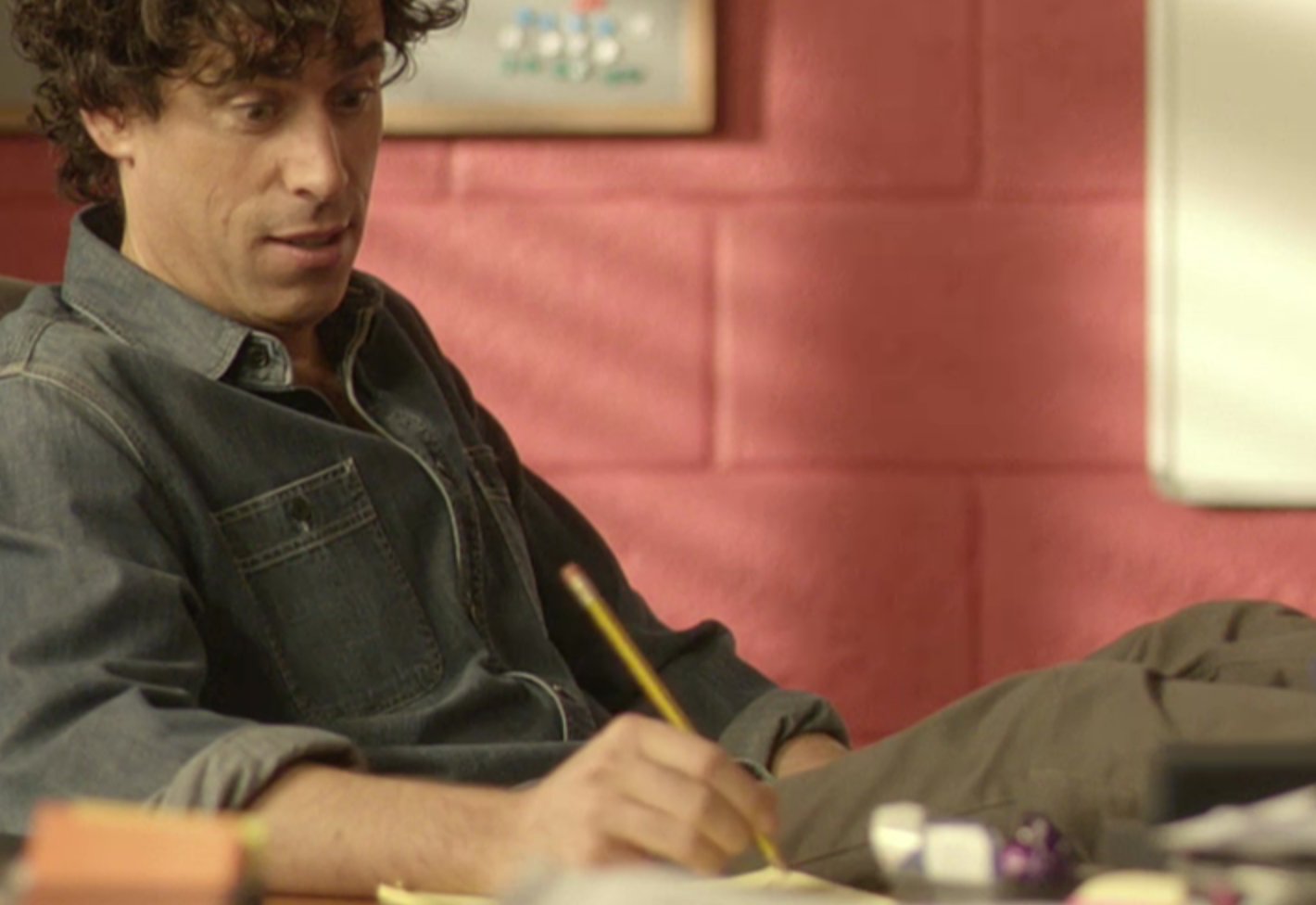
For me the Noris is THE typical pencil. Previous blog posts showed the Noris being featured on TV. Today I want to add two more screen shots. One from Episodes, where Sean Lincoln (played by Stephen Mangan [2]…who recently, as Dirk Gently, used a Faber-Castell Grip 2001 ) is using a Stadtler Noris in the USA, even though it isn’t officially on sale in the USA. The character must have brought it from the UK, the desk is full of Noris pencils ..or, in the real world, this scene might have been filmed in the UK.
The other screen shot is from episode 705 “Liebeswirren” of German/Austrian/Swiss crime TV series Tatort. One of the actors in this episode from Munich was Christoph Waltz of Inglourious Basterds fame.
Today an interesting article appeared on the BBC News web site: “Why are fountain pen sales rising?“. You might remember that Nick Hewer from the Apprentice is using Lamy fountain pens (see my blog post from last summer where you can see him using a Lamy Joy). He is being mentioned, too, and there are also links to other fountain pen related articles.
The photos of Nick Hewer using a Lamy Safari have been taken from series 8 episode 2 and 6 of The Apprentice UK. I believe that the use of these images falls under “fair dealing” as described by the UK Copyright service.