Staedtler

Black n’ Red polynote A7 plain

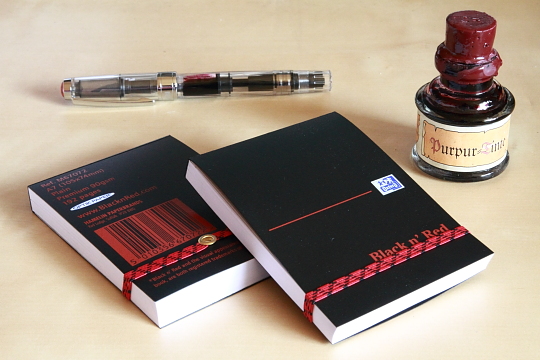
Last week I bought Black n’ Red’s pocket-sized, i.e. A7, polynote in my local Tesco’s. The polynote is a reporter notebook that flips open at the top and features a polypropylene cover and an elastic band. I bought it because it was half prize, only 60p (97¢; 68c), and because I was quite happy with my previous Black n’ Red purchase, a hard cover Black n’ Red recycled notebook.
Black n’ Red recycled hard cover notebook

My previous Red n’ Black purchase, the recycled notebook is really nice. Unlike the US version reviewed at Office Supply Geek it features British and European maps and information. I only paid £ 3.50 in my university’s library, but the price is probably either subsidised or they do not earn any money from this notebook as I have never seen anywhere else for a similar price. I have used this notebook for several months, but have only used pencils in this notebook, so I cannot comment on the suitability of the paper for fountain pens. It does however feel like good quality paper. I did contact Hamelin / Oxford brands with some questions about the paper, probably about a year ago, but unfortunately I never received a reply.

Back to the polynote

There seems to be a ruled version, too, but I bought the plain version. It contains 192 pages of 90 g/m² Optik Paper. The polypropylene cover seems durable and robust and can be wiped easily if dirty. The polynote does also contain a page with reference information, similar to the one found in the recycled notebook, but this time restricted to metric / imperial conversion tables. There is no danger that pages would fall out by mistake, but they can be removed easily if you wish to do so. The paper has a high quality feel to it and is more opaque than other 90 g/m² paper I have used in the past.

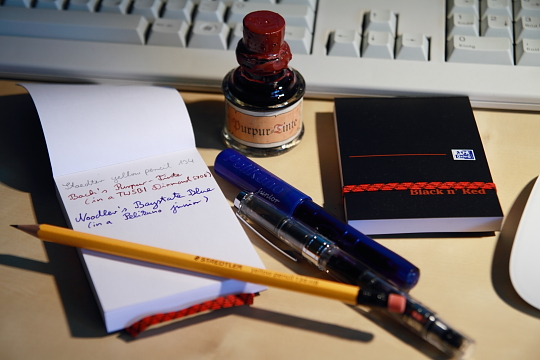
As you can see in the first photo I tried a pencil and two fountain pen inks on the paper.Erasing the graphite works well. The paper feels extremely smooth when erasing, but seems to retain more of a dent where the graphite was than other paper. This means you can see or guess the writing because of the slight indentation. Both inks worked well on the paper and did not bleed through the page.

Bach’s Purpur-Tinte

I bought the ink used with the TWSBI Diamond 530 at Eberbach Abbey, where some scenes of the film “The Name of the Rose” were filmed. This ink is from a small ink manufacturer called “Bach’s Tinten” (Bach’s inks). I have an iron gall ink from the same manufacturer, which is absolutely fantastic when used with a dip pen. Unfortunately, I was not able to find out more about the manufacturer of this ink. All I know is that it seems to be sold in some German museums and other tourist attractions. If you know more about this ink, please let me know.

TWSBI Diamond 530

I used Bach’s Purpur (purple) ink in my brand new TWSBI Diamond 530, which I bought from The Writing Desk for £36.79 (~$59.35; €41.75). TWSBI, originally an OEM manufacturer, make mechanical pencils, too. You can read more about their history and the meaning of their name at Okami Whatever. I first thought about buying this pen from the TWSBI ebay store, where it is slightly cheaper than in the UK, but the price is just above the threshold for VAT and customs (and therefore handling) charges, so buying it from The Writing Desk was the better option. The pen is quite big and made for fountain pen geeks: it is a demonstrator that can be disassembled and even comes with sililcon grease and the wrench needed for disassembly. As far as I know it is using a Schmidt nib, but a limited edition pen with a Bock nib will be released if there are enough orders. The pen is great and offers fantastic value for money. When it comes to fountain pens I am a fan of Pelikan, a Malaysian owned writing instrument manufacturer headquartered in Switzerland with manufacturing facilities on several continents, so – naturally – I compare the diamond 530 with Pelikan fountain pens and I have to say that the Diamond 530 is very big in comparison – much bigger than, for example, a Pelikan Souverän M600.  I do own a few fountain pens from manufacturers other than Pelikan and quality-wise the TWSBI is certainly one of the better ones, especially for this price.

Noodler’s Baystate Blue

Noodler’s, from Massachusetts, “the smallest ink company in the world with the largest color selection” is, without a shadow of a doubt, my favourite ink company. I do like inks from other companies too, but Noodler’s is my overall favourite. Baystate Blue is a very unusual ink, unusual in its rebellious colour and the high, i.e. alkaline, pH value. You can read more about it on Noodler’s web site. The first time I saw this intense ink on paper it reminded me of a pen I got in the late 1970s / early 1980s. At that time Pepsi ran a big marketing campaign worldwide – and in Germany, too: “Mach den Pepsi Test” (Take the Pepsi Challenge) [1]At that time RC Cola and Afri Cola were still commonly available in Germany. Afterwards you got a “I took the Pepsi Challenge” pen. As far as I remember it was a Staedtler pen and looked like a Lumocolor with a yellow body and with a Pepsi logo and reference to the Pepsi test printed on it. As far as I remember it  had a colour very close to Noodler’s Baystate Blue …and I completely forgot about this pen until Baystate Blue reminded me of this pen and this unusual colour. It’s not really my favourite colour, maybe because it is a bit too unconventional, but it might actually look quite good with a fine nib. I will try that out after I used up the Baystate Blue in my Pelikano junior.
Conclusion

The Black n’ Red polynote is a great little reporter notebook. I think I might carry one with me in the future. There is a plain and a ruled version, both probably ref. number M67072. The robust covers makes it a notebook you can carry around with you all the time and the current half price offer is really good, but even if you pay the full price it offers good value for money and nice smooth and unusually soft (maybe even a bit too soft) paper.


Prices and exchange rates: March 2011

You can find a review of Noodler’s Baystate Blue at Without ink.

Office Supply Geek has a great review of the TWSBI DIamond 530.

References

References
1 At that time RC Cola and Afri Cola were still commonly available in Germany

Black n’ Red polynote A7 plain Read More »

Anniversaries

2011 is the year Faber-Castell celebrates its 250 year anniversary (1761 – 2011). Stephen from penciltalk told me about an anniversary set of 6 Castell 9000 pencils that was for sale on eBay. Faber-Castell gave these away at this year’s Paperworld trade fair. Unlike the centennial tins with 12 and 72 pencils, this tin does not contain the normal Castell 9000 pencils you can buy in shops, but Castell 9000 pencils with 1761 – 2011 * 250 years printed on them. They are not available in shops (yet), but according to comments on Faber-Castell’s facebook page Faber-Castell seems to consider producing them for sale. Let’s keep our fingers crossed!

Stabilo celebrates the 40th anniversary of their Boss Highlighters. As part of this anniversary there is a giveaway from Tiger Pens, where you can win Boss mugs, and a game from Stabilo where you can win Boss mugs, USB sticks and other prizes (there are different prizes for different countries).

Stephen Wiltshire, using a Staedtler tradition, on BBC's Top Gear (Image © BBC)

Staedtler‘s  historic pencil construction kit will unfortunately not be available in shops. The good news: you can order these kits directly from Staedtler for € 5 each. You can also get Staedtler’s historic Lumograph tin (100 M12H: € 16.20), the historic Tradition tin (Nr. 110 M12H: € 14.40) and the historic Noris tin (Nr. 120 M12H: €  9.60) directly from Staedtler. All of these special items are only available while stocks last. The historic pencil construction kit is not available yet, but can already be ordered.

Staedtler also managed to get the support of Stephen Wiltshire for their pigment liner. Lexikaliker mentioned him in his report about the Paperworld 2011 and I mentioned him previously in this blog post.


The photo of Stephen Wiltshire using a Staedtler Tradition has been taken from Top Gear Episode 5 of Series 14 and has been used previously in a blog post from March 2010 about the Staedtler tradition. I believe that the use of this image falls under “fair dealing” as described by the UK Copyright service.


Anniversaries Read More »

Staedtler historic pencil construction kit

Something very special:

This year Staedtler will offer a historic pencil construction kit. I have seen it in photos taken at their workshop and am really excited that it will be available to buy for those of us who can not attend the workshops.

For more information check this page on Staedtler’s web site.

Update: Staedtler’s German and Austrian web sites have a short video from a trade fair in Linz, Austria. This video  shows how to “assemble” Staedtler’s historic pencil. Unfortunately there are no English subtitles.

I really like that Staedtler refers to this pencil as being historic, instead of historical – because Friedrich Staedtler’s pencils of similar design are such an important part of Staedtler’s history.

Staedtler historic pencil construction kit Read More »

Eraser Bonanza

In a recent post (“My favourite eraser”) I wrote about the Faber-Castell 18 71 20 Dust-Free eraser. In a comment to this post Henrik mentioned Staedtler’s PVC free eraser, which he said is quite similar. Curios about the Staedtler’s performance I got hold of this eraser andoday I want to write a bit more about this eraser and about the Läufer Oval Office.

The Staedtler 525 B30 PVC-free eraser

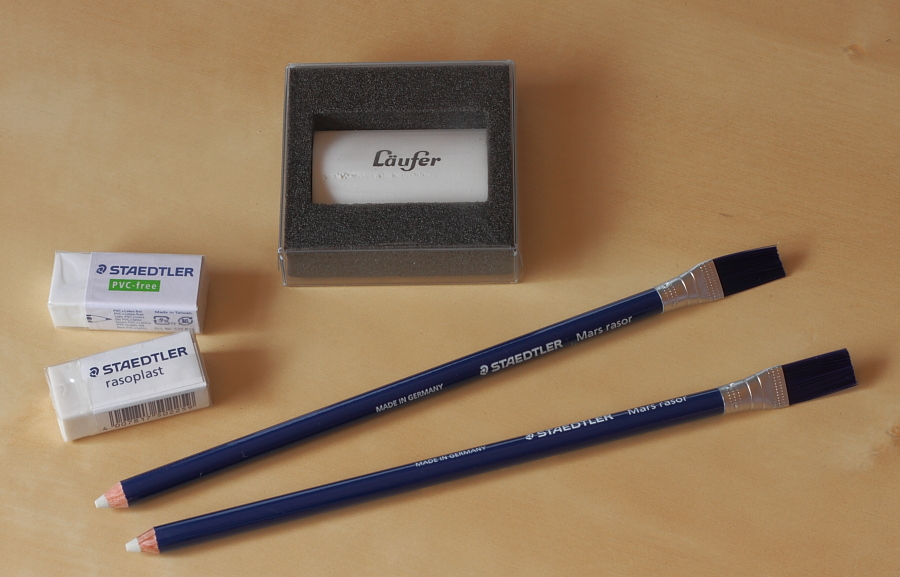
What I like most about the recently reviewed Faber-Castell 18 71 20 Dust-Free eraser is that you only need to apply very little force when erasing and that it does erase very thoroughly, much better than most other erasers. To my surprise the material of the Taiwanese-made Staedtler 525 B30 PVC-free eraser seems to be even softer than that of Faber-Castell’s dust-free eraser. It is therefore also no surprise that you do need to apply more force when you use the Faber-Castell eraser. This might be down to the fact that when I compared them the Staedtler eraser was brand new, freshly unwrapped, while one of my Faber-Castells has seen a few months, the other one a few years of use and contact with air. Just like Faber-Castell’s eraser the Staedler is also available in two sizes: the model number of the big one ends with 20, the number of the smaller one ends with 30.

Conclusion: The Staedtler is an exceptionally good eraser. It is not my favourite but comes very close. One disadvantage for me (others might not mind at all) is that the eraser waste does not twists up into strands, which makes it a bit more messy when you want to clean the paper and get rid of the eraser waste – but to be honest, for most erasers the waste does not twist up into strands, so this is nothing unusual.

I bought the Staedtler 525 B30 in November 2010 for 47c (~62¢, ~38p).

Läufer Oval Office

Läufer is relatively well known in Germany for their erasers. In 2004 Läufer merged with Gutenberg, a company some stationery fans might recognise because they supply indelible, permanent ink used for official documents – in Germany many dioceses and government offices use their G10 ink for official documents. As far as I know Läufer & Gutenberg are now part of Société Bic, the company that owns the BIC brand – but I have not been able to confirm this.

The Läufer Oval Office is, in my opinion, an average eraser when it comes to perfermance and the material it is made of. It is mainly interesting because of it’s shape and that is also why I bought it. The Oval Office has the shape of a stretched lens. While the 90° angle of a traditional eraser will soon get too wide for erasing small areas, the shape of the Oval Office means that it can be used for more precise erasing for longer.

Conclusion: A nice eraser I will use occasionally. The shape is practical and looks nice, but performance-wise I would describe this eraser as ‘normal’.

I bought the Läufer Oval Office in November 2010 for € 1.69 (~$ 2.20, ~£ 1.40).

The Staedtler Mars rasor you can see in the photos has been reviewed at pencil talk.

Prices: November 2010

Exchange rates: December 2010

I bought all three erasers in November 2010 from Schule-Uni-Shop. The Staedtler Mars rasor was € 1.37 (~$ 1.80, ~£ 1.15).

On a slighlty unrelated note: If you like Staedtler AND Star Wars, have a look at this article: Staedtler and Star Wars

Eraser Bonanza Read More »

Faber-Castell TK-Fine

Today: a mechanical pencil – The Faber-Castell TK-Fine, which is – despite the similar name – quite different to the TK-Fine Vario L, discussed by Dave. or the TK-Fine Executive, also reviewed by Dave.

Price-wise the TK-Fine is only about a third of the price of the TK-Fine Vario L. The TK-Fine is also slighlty cheaper than the Executive version, but this price difference is not that big.

All of the different TK-Fine pencils come in Faber-Castell’s famous dark green colour you know from the Castell 9000, but the TK-Fine version does not have the twist eraser, nor does it have (adjustable) lead cushioning. Another difference is that the Vario has a grooved metal grip area and that the Executive has a similar plastic grip while the TK-Fine‘s grip area is very much like the Apollo‘s. The Apollo has unfortunately disappeared, but a few weeks ago Lexikaliker had a post about the Apollo (Google translation of Lexikaliker’s Apollo post) and he was even kind enough to give his Apollo to an artist whose Apollo broke after 15 years of intense use.

…but the grip is not the only similarity between the Apollo and the TK-Fine. Let’s have a closer look at the similarities and differences between the Apollo and the TK-Fine.

The Apollo was available from 1983 until 2000. Different version can be seen in Lexikaliker’s post and in my opinion the Apollo XL looks just beautiful!

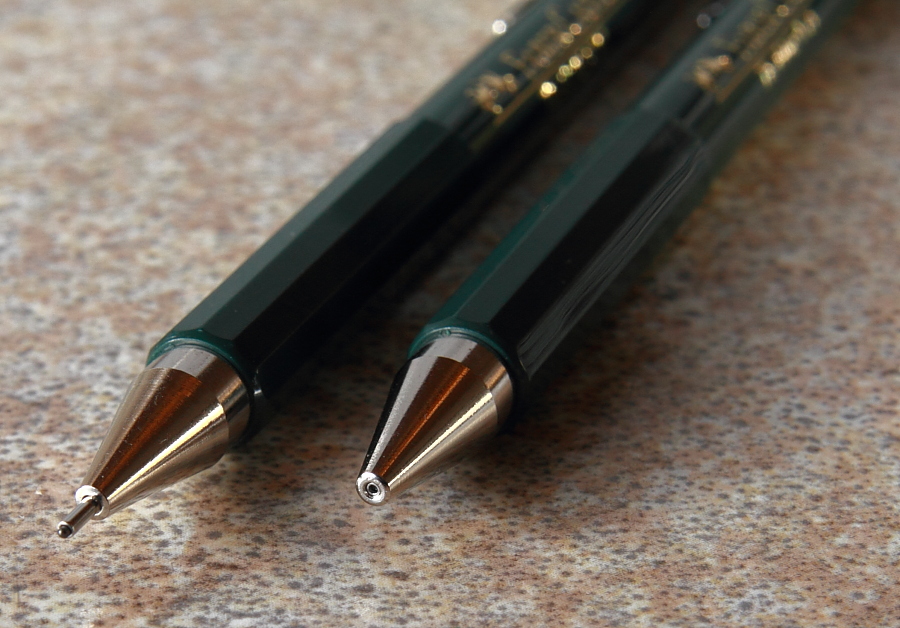
The TK-Fine has been available for over ten years and looks very similar, the main difference in appearance being the different top cap. It is actually being manufactured using the same tools that were used to make the Apollo, but the TK-Fine is made for technical drawings with a rigid, but fully-retractable lead sleeve, similar to the one you might know from Staedtler’s Mars micro. The Apollo on the other hand was made for writing and had a sliding sleeve that retracts as the pencil is used.

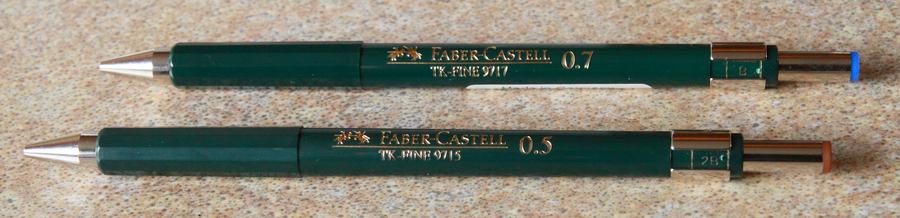
The TK-Fine is being produced in Geroldsgrün in Upper Franconia (Germany) available in 0.35mm (TK-Fine 9713), 0.5mm (9715), 0.7mm (9717) and 1.0mm (9719) and has an according top cap marked according to the ISO norm for technical drawing.

I bought the TK-Fine 9717 in April 2010 in Müller in Volkach (Germany) for €4,39 (~$5.80; £3.70) and the TK-Fine 9715 from Schule-Uni-Shop.de, who also ship internationally, for € 2,67 (~$3.50; £2.25). The price in the UK is comparatively high: At CultPens TK-Fine sells for £4.16 (~$6.50; €4.90).

Conclusion:

The TK-Fine offers great value for money if you find a shop that sells it for a reasonable price, but since it is not a common pencil you might have problems getting hold of one.It comes with 3 super-polymer leads in HB, offers a pocket-safe lead sleeve (fully-retractable), it is colour coded according to ISO for lead width, it has an adjustable lead-grade indicator (2B – 4H, plus one neutral setting) and the eraser comes with a cleaning pin.


Prices: April 2010 and November 2010

Exchange Rates: December 2010

I would like to thank Ms Schaklies from Faber-Castell Customer Care for the additional information about the TK-Fine.

By the way… Faber-Castel made it into the Economist again. This time into the Economist’s Schumpeter column, which was introduced about a year ago.

Faber-Castell TK-Fine Read More »