In my wife’s photo above you can see two Staedtler items for left-handers. Yes, that left-handed Metro pencil is apparently made by Staedtler UK in Pontyclun. They also made pencils for Berol and Chambers in their Pontyclun factory (You might remember the 2014 La La Land post with Chambers pencils and the 2013 Berol post).
Welcome to a new series of blog posts about Staedtler’s Wopex pencils.
The idea is to collect information about Wopex pencils while details are still available. By now several bloggers, including me, had to find out that stationery manufacturers don’t always store information about their products and in my opinion it would be a shame to lose the existing knowledge about these products.
Wopex -> 180
A quick introduction:
As explained in the past Staedtler has changed the way it’s using the term Wopex. Instead of calling the pencils Wopex the term is now only used to describe the material these pencils are made from. This started in 2015 and by now you won’t find any Wopex labelled pencils anymore on the German Staedtler web site. Instead these pencils are sold as the Noris eco or as the Staedtler 180 [1]From the beginning ‘180’ were the first digits of the Wopex article numbers.. In other markets, mainly South Africa, you can also get the Tradition eco, a Wopex based version of the Tradition, similar to the Noris eco.
Outside Germany you can however still find pencils with the Wopex label printed on them. In the UK there are quite a few of those sets left. I assume this means that for now they are still made – I can’t imagine all of them to be old stock from before 2015 – but who knows…
Neon Line
Staedtler’s Neon Line was introduced at Frankfurt’s Paperworld in January 2013. Neon refers to the fluoresent body of these pencils. The pencils themselves contain normal Wopex graphite leads.
Back then the pencils were still Wopex labelled, but the latest Neon Line pencils are sold without Wopex or even 180 printed on the front of the cover.
The different pencils
The Neon Line includes the following pencils
neon yellow – article number: 180 HB-F1
neon orange – article number: 180 HB-F4
neon pink – article number: 180 HB-F20
neon purple – article number: 180 HB-F61
neon green – article number: 180 HB-F50
neon blue – article number: 180 HB-F30
The different sets
There are different versions of this set, including sets with erasers and sharpeners. The current Staedtler UK web site lists different sets:
Article number: 180F BK3-1 a blistercard containing one HB pencil each in neon yellow, neon pink, neon purple
Article number: 180FSBK3-1 as above, but with a black eraser and a black sharpener
Article number: 180F BK3-2 a blistercard containing one HB pencil each in neon green, neon orange, neon blue
Article number: 180FSBK3-2 as above, but with a black eraser and a black sharpener
Article number: 180F BK6 a blistercard with all six colours
Article number: 180F BK12 a blistercard with twelve pencils (all six colours)
This information has also been added to the Stationery Wiki.
I would like to thank Benedikt Schindler for the historic information found in this blog post
Welcome to a slightly delayed blog post. The video for this blog post was put on YouTube quite a while ago, in February, but the blog post is only out now as a busy period at work meant that I didn’t get round looking for my protractor earlier. [1] …because I switched to using a protractor when measuring angles I want to stick with this method so that all pencil points are measured the same way.
The Wopex
Unfortunately there’s a lot of Wopex hate going on in some parts of social media where people discuss pencils – and there are very few people defending the Wopex [2]…with Johnny being the most determined defender in the Erasable group on Facebook. Thank you for that.. Luckily the Wopex can convince in the long term: I was very happy to read Deirdre’s blog post where she turned from a Wopex hater (‘I HATE WOPEX’) to someone not only tolerating the Wopex, but even accepting it and it’s advantages (Some quotes: ‘graphite […] actually isn’t that bad’, ‘point retention is great’, ‘if you are writing on toothy [3]As expressed previously, for various reasons I am not keen on the expression ‘toothy paper’, but since this is a direct quote it will be one of the few occasions you can find this word in … Continue reading paper, the WOPEX really shines’).
Suffice to say [4]Yes, I learned that expression when I watched the English version of Star Trek Voyager., I love the Wopex.
Just a quick reminder: Unlike normal wood cased pencils the Wopex uses a wood-plastic-composite instead of wood. The wood-plastic-composite consists mainly of wood and is, in my opinion, orders of magnitude better than pencils that use plastic instead of wood. Not only does the Wopex sharpen better, the lead – extruded together with the pencil – is also of much better quality, too.
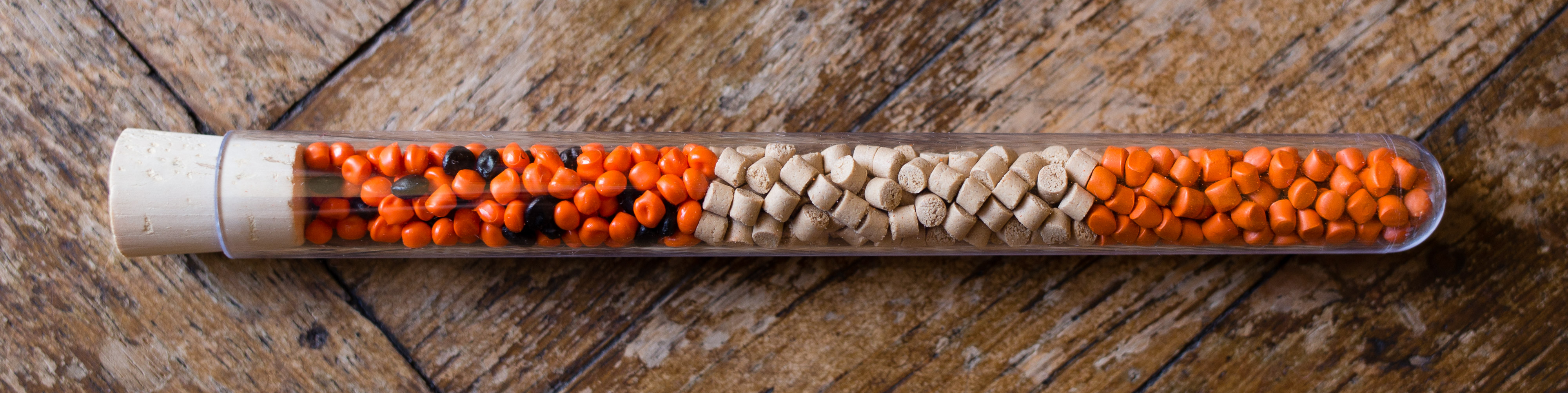
The pellets before they’re extruded into a pencil
In the vial above you can see how the material looks like before it is extruded into a pencil. I got this vial at the Insights X trade fair. The pellets remind me of a company I worked for during my holidays in the 1990s. They were manufacturing extruded pipes and had similar looking pellets. The recycled pellets smelled very much like washing powder. As far as I remember extruding from recycled material was not easy, the material kept expanding in the wrong place resulting in uneven products. Unrelated – but there must be so much knowledge going into the production of a product like the Wopex…
The new Noris eco pencils in 2B, HB and 2H
The Staedtler 501 180
I first mentioned the 501 180 in a blog post from 2014, but a few months ago I finally got my hands on one – they are not very common and not easy to come by in the UK. The article number has gives some clues to this sharpener’s purpose: Wopex pencils have article numbers starting with 180 (e.g. 180 40). Staedtler has now switched to using the word Wopex to describe the wood-plastic-composite material, and is not using Wopex anymore to describe pencils made from this material, but independent of how the name Wopex is used, the pencils made from Wopex material still use article numbers starting with 180 (e.g. 180 30 for the new Noris eco).
Article numbers for Staedtler’s rotary (i.e. hand crank) sharpener start with 501 (e.g. the Mars 501 20 rotary sharpener) so 501 180 is the perfect [5]I try to avoid using the word perfect, but in this case it is justified, I think. article number for this sharpener, 501 for a rotary sharpener and 180 for Wopex. The 501 180 was designed by Helmut Hufnagl and is made in Taiwan.
Left to right: Deli 0635, Staedtler 501 180, Deli 0620
The Video
Here’s a video where I compare the 501 180 to two other rotary sharpeners.
Clipping the pencils’ points off at about 7:30 really hurt and felt rather wasteful, but wasting so much good pencil when the auto stop of the other two sharpeners didn’t work was of course even more wasteful (…even though it didn’t hurt so much, maybe because the machine did the crippling of the pencils).
Left to right: Deli 0635, Staedtler 501 180, Deli 0620
Tip: Open the video in YouTube, you can then play it at higher speeds, e.g. 1.5x.
Here’s a little table comparing the different points created by the three different sharpeners.
Sharpener:
Deli 0635
Staedtler 501 180
Deli 0620
Angle:
17°
19°
17°
..and here are the different points made by the different sharpeners.
Left to right: point sharpened by Deli 0635, Staedtler 501 180, Deli 0620
The Auto Stop
There is just so much less material wasted when the auto stop works. If you don’t have the 501 180 and your sharpener’s auto stop doesn’t work, have a look at the end of the video where I show a way of dealing with this problem. I am mentioning this simple trick here because my simplest videos seem most appreciated (e.g. how to refill a mechanical pencil), while my complex videos (e.g. the DelGuard pen force test) remain rather unloved.
Left to right: point sharpened by Deli 0635, Staedtler 501 180, Deli 0620
As expressed previously, for various reasons I am not keen on the expression ‘toothy paper’, but since this is a direct quote it will be one of the few occasions you can find this word in this blog
Caroline Weaver’s pencil book has been the big topic in the stationery fandom. As there’s nothing much I can say about this book that hasn’t already been said publicly or privately here’s a look at another pencil book.
This was in the IKEA store in Warrington [1]..which was the first IKEA in the UK. They also have a pencil themed area for children to try out their products.
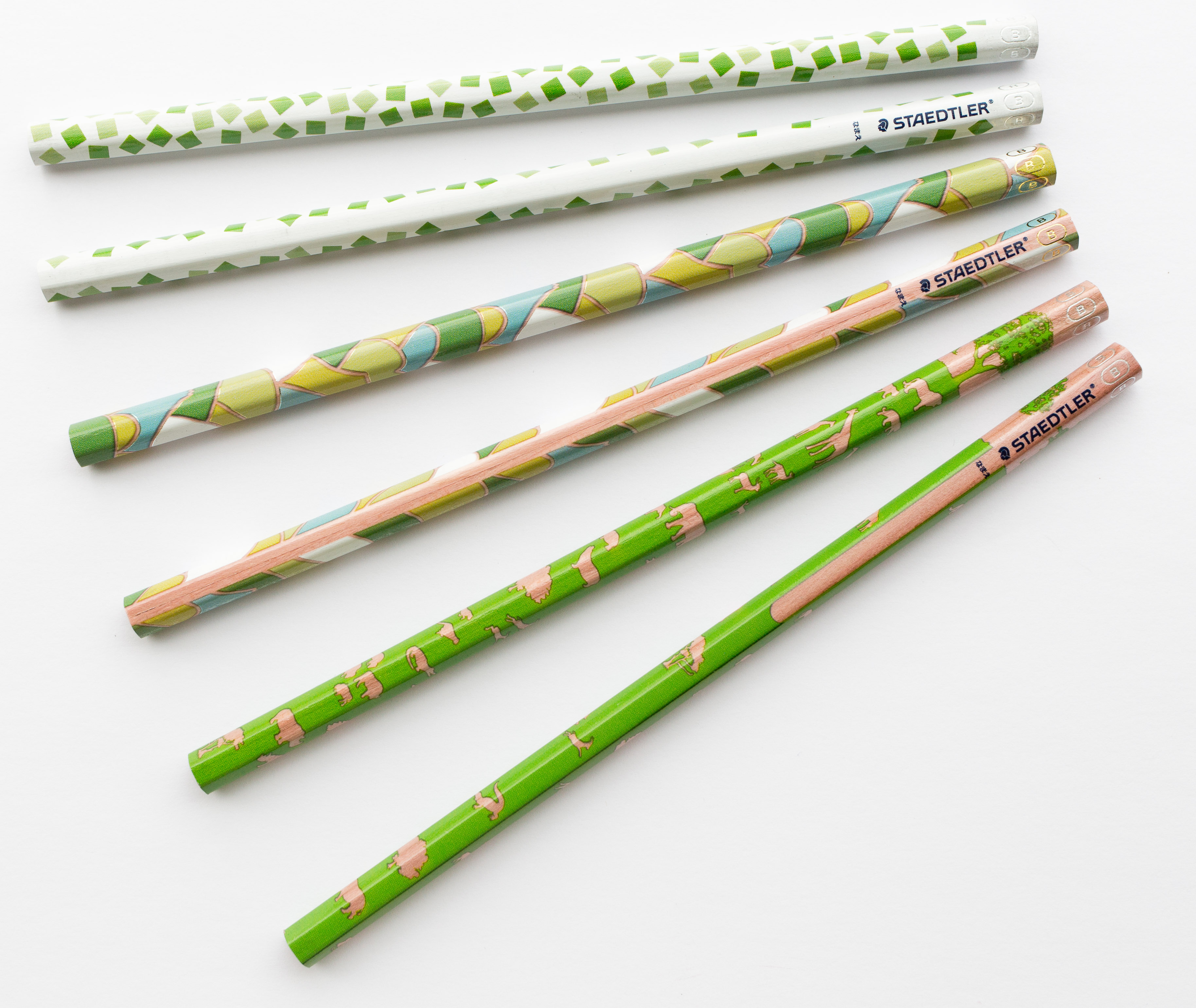
According to one JetPens product page Kakikata means ‘way of writing’. I can’t really comment, it’s now 20 years that I learned Japanese and I forgot virtually everything except the odd katakana ..but other sources seem to indicate that Kakikata means ‘how to write’, which seems to be a better translation, at least for the Staedtler Kakikata pencils I want to show today [1]I assume depending on context it can mean either..
They were released in December 2016 and are aimed at school children. An automatic translation of the text on the box also seems to confirm that they are for children (There are warnings like ‘don’t use for anything other than writing’, ‘please be careful when handling’ plus there are also instructions for parents.), as do some of the designs used, but the from what I have seen from the Staedtler Japan page they say adults can use them, too ;^)
Staedler’s Kakikata pencils are made from FSC certified wood in their factory in Thailand, where Staedtler’s Norica and other pencils are made, too. I found out that they are officially being sold in Japan, Hong Kong, South Korea, Singapore, China and Taiwan, but am not sure whether they will have a different packaging outside Japan, i.e. whether the box will be translated into the local language.
Boys’ toysGirlyI love how the look of the wood has been integrated into the designs of these pencils, as a background to the motifs used. There are three different packs, all available in HB, B and 2B, with three different pencil designs in each pack. The blue pack (Aorimo あおいも) is boy-themed, the red one (Akaimo あかいも) is girl-themed and the green one (Midori みどり) seems fairly gender neutral.
As is common in Japan the pencils are unsharpened and since these are for children there’s also space to write the child’s name on.
Near the end the body is silver or gold stamped with the lead degree (HB, B or 2B) and unlike the Noris or the Mars Lumograph that have lacquer caps the end of this Kakikata pencil is not capped.
..with the 501 180 sharpenerDepending on where you buy it you pay somewhere between ¥700 and ¥900 (~$7, £6; €7) for a dozen.
You can find the original press release at this address, including the product numbers for they various colour and lead grade combinations.
I would like to thank Claudia Förster for these pencils and for finding out in which countries they’re being sold.
The Staedtler sharpener form the last picture has been mentioned before and I’ve made a video review, but the blog post is still waiting to be finished.
There are also other unsharpened Staedtler pencils for the Japanese market. I have mentioned the Lumograph many times, so I’ll spare you the links to those videos and to Gunther’s blog post this time.