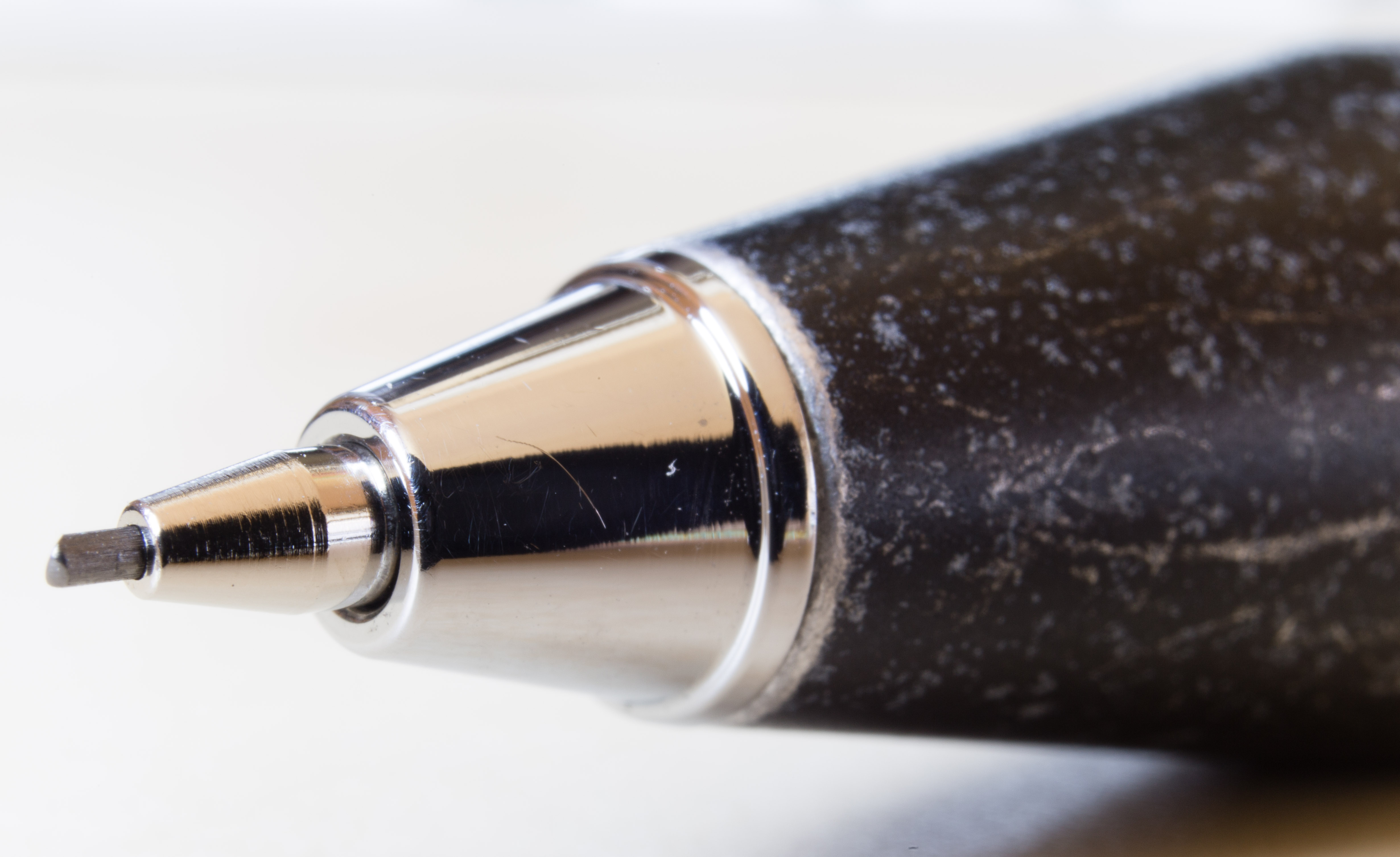
Well, it took a while before I got my Tactile Turn Gist – you might remember my previous blog post about this Kickstarter.
I guess I just happened to pick a combination (polycarbonate body and brass finial) that was produced very late. Others in the UK got their TT Gist more than a month before me.
Brass finial
Good looks
Now that I finally got it and I have to say that I really like the look. The lines on the pen’s body and the look of the clip are two of my favourite bits. This also happens to be my first fountain pen with a titanium nib.
Titanium knife and titanium pen
Marks on the pen’s body
One thing was however rather disappointing. The body of the pen has marks in three places of the body where it has been held in place during machining. After contacting Will Hodges I was told that these marks are normal, at least on the polycarbonate pens – but on pens made from harder materials he was able to buff them off to some extend.
Thinking how ‘violently’ the pen was rotating in Will’s youtube video I am not too surprised about the marks. Maybe I will get used to them over time.
Not so easy to see on the photo: the marks where the pen has been clamped
Titanium
As mentioned before this is my first titanium nib. To my excitement I like the flexibility of this nib. You don’t need much pressure to produce a wider line. I just wish the line was a bit finer when least pressure is applied. First tests in a Field Note with Finch Paper Opaque Smooth 50#T were disappointing, but that seems to be down to the paper and ink (I have only used this paper with pencils so far, also not a great choice). On copy room paper I got great line width variation without much effort.
The titanium nib is quite flexible
I don’t have much experience with titanium, but I do have titanium scales for my Victorinox Deluxe Tinker, so I thought I show the titanium nib and the titanium scales next to each other. I like the concrete-like look of the material – it has a very utilitarian feel to it.
My titanium scales are made from grade 5 titanium (Ti-6AL-4V). I am not sure what titanium is used for Bock’s titanium nibs.
A year ago Lexikaliker got me a Super5 fountain pen [1]It was the same time he got me a KUM Masterpiece. I paid just under €20 for the Super5. The Masterpiece was just under €10. . It has seen quite a bit of use in the last days – that’s when I noticed an issue I didn’t notice before. The outside of the cartridge keeps getting inky. First I thought that some ink got into the body of the pen, but a day after I cleaned the pen body the outside of the ink cartridge was full of ink again.
I am not sure what is happening. All I could come up with so far is that there might be some capillary action going on, between the wall of the cartridge and the grip section of the pen – similar to the capillary action in the nib. Maybe a different cartridge with a slightly different diameter or opening would behave differently.
Have you come across this issue – with the Super5 or another fountain pen?
Having used Kaweco’s AL Sport stonewashed fountain pen since 2014 I thought that a stonewashed pencil might look rather nice, too. Unfortunately, the ‘Stonewashed series’ only includes a fountain pen, a ballpen (that the official name) and a rollerball – no mechanical pencil (or push pencil, the name used by Kaweco).
No pencil
The ballpen and the push pencil look very similar, so I thought it might be possible to simply use the AL Sport pencil mechanism in the ballpen body, but that would mean having to buy the ballpen even though I wouldn’t use it – and it’s just guesswork that the parts would fit, so earlier this year, in February, I contacted Michael Gutberlet from Kaweco asking whether there is or will be a AL Sport stonewashed pencil. I had his contact details from an earlier email exchange in 2013, when Michael Marzani from Just Another Pen and I were discussing the brass body of the Kaweco Liliput he reviewed in his blog. As part of the discussion Michael Marzani contacted Michael Gurberlet, who was providing information about the brass he used for this pen.
Great balance: The centre of gravity is slightly towards the front
A prototype
To my surprise Michael Gutberlet then made a Prototype [1]A real prototype 8^) not like this year’s April Fools Day Prototype. Kaweco and Prototype, that reminds me of SBRE Brown’s blog post and video about the Kaweco Ranger, which, as far as I … Continue reading for me. I got the impression that the main issue when creating this pen was the push button, but since I don’t have an AL Sport ballpen I can’t really comment how much the ballpen and the pencil’s push button differ. I assume the top looks the same, but the button is different, probably because the pencil push button is held by the lead pipe, but the ballpen push button is on the click mechanism – but this is pure speculation. Michael Gutberlet seems to be very hands-on with the pens he creates, so as far as I know he made this prototype himself. He also finishes each Lilliput Fireblue fountain pen individually. Massdrop is currently selling them for $139.
In March 2016, when the pencil was ready, I was contacted by Sabine Götz – and she called it a prototype – how exciting! The word prototype hadn’t been mentioned before, so that was a very exciting moment. I guess this makes this pencil a one of a kind.
I also got a bill. The pencil was a bit more expensive than the AL Sport stonewashed fountain pen I bought a few years ago, but that was more down to the fact that I found a shop that sold it for a good price. I guess what I paid for the pencil is similar to what the official retail price for an AL Sport stonewashed pencil would be.
The pencil
Shape and lead
The pencil itself is quite stubby, but all Kaweco Sport push pencils are, so I knew what I was getting. Nevertheless, I think the stubbiness makes the pencil less elegant than the fountain pen version. The pencil takes 0.7 mm leads. According to the mini manual that came with the pen there seem to be versions of the Sport pencil in 0.5 mm, 0.7 mm, 0.9 mm and 2 mm, but I don’t think I ever saw the Sport in 0.5 mm.
Pencil and fountain pen
Clip
I ordered a clip for the pencil so that I can transport it easily. Pen Heaven had the best price I could find in the UK, £1.99 (~$2.90; €2.50), including postage. I do use the pen with the clip, but that does make rotating the pen (and using the lead up from all sides) more difficult.
Material
The pen itself feels solid and feels like it’s mainly made from metals (mainly aluminium) or metal alloys (the mechanism?), but the lead pipe is made of clear, slightly flexible plastic. The push button gets stuck on this pipe (friction fit). There is no eraser in this pencil.
The plastic pipe for the leads
Lead
According to the manual you can store two leads in the pipe. You might think that, as with mechanical pencils from many decades ago, you can store leads in the space between the pipe and the body, but you would only be able to store leads with a length of about 2 cm there, so this space is more or less ‘wasted’.
By the way, my wife was very impressed by the lead the pencil came with. Her comments were: ‘creamy and buttery, soft, but does not smudge’. That is high praise coming from her as she doesn’t like leads that smudge …so the Lamy Scribble’s original leads had to go. Her dislike for smudgy leads goes so far that she is using H leads in a pencil that is used for an Atoma notebook (H is actually great with Atoma’s paper).
Pencil and fountain pen
Numbers
A quick look at the dimensions of the pen:
It is hexagonal and has a diameter of 13 mm (just over half an inch) – much wider than most mechanical and wood cased pencil. For comparison: the current Noris has a diameter of 6.8 mm. The pens length is 10.8 cm and it has a weight of 29 g (just over one ounce).
This blog post has been brought to you by Kryten and the Jupiter Mining Corporation – Kryten’s wide words: If you don’t gosub a programme loop you never get a subroutine
Daily use and overall verdict
I have used this pencil for a while now, together with the AL Sport stonewashed fountain pen. Together they are such a nice pair. I have to say that I always preferred using the pencil, despite its stubiness. I find the pencil’s look much less attractive than the stonewashed fountain pen’s elegance, but because it is instantly ready it was my pen of choice – there is no cap that needs to be taken off and posted first.
Overall this is a great pencil, even though I would prefer a slimmer, longer version. I wonder whether this stonewashed pencil (not my imaginary slimmer, longer version) will be available in shops in the future. I guess the original problem was that different pen parts need ‘stonewashing’ for different lengths of time, but now that there is a prototype (and a recipe how long its parts need ‘stonewashing’) it should be easier to make more stonewashed pencils.
Regarding the stonewashing: I have to add that my fountain pen has a better stonewashed effect, but this might be caused by the different shape of the parts (or, less likely, the different paint). The question now is whether Kaweco sells enough pencils to think it’s worth offering an AL Sport stonewashed pencil.
Magnified from the previous photo: The AL Sport in action
Price: March / April 2016
Exchange rates: May 2016
I would like to thank Michael Gutberlet for making this prototype for me.
A real prototype 8^) not like this year’s April Fools Day Prototype. Kaweco and Prototype, that reminds me of SBRE Brown’s blog post and video about the Kaweco Ranger, which, as far as I know, is not a prototype, but one of the first models released after Kaweco became Gutberlet owned. Unless of course the reviewed set was a prototype for the Ranger series that was available in the 1990s.
Welcome to my blog post about the Lamy 2000 mechanical pencil, which was provided for free by The Pen Company. This blog post has also been published on their blog.
50 years of the Lamy 2000
The Lamy 2000 was first released in 1966 so this year is its 50th anniversary – and after several special editions covering materials like grenadill wood, ceramic, titanium, and more, we can expect a new special edition in 2016. I went ahead and compiled a list of the special editions so far, which can be seen at the still unnamed pen wiki. I checked with the company that handles the launch of the 50 years Lamy 2000 special edition. They checked with Lamy and I was told that the list is complete. I wonder whether someone has all of them. Maybe the person who bought the Jonathan Ive and Marc Newson special edition in red?
The material
It’s still not clear how the special edition will look, but however it looks, the ‘normal’ edition is stunning in itself. The main body is made from Makrolon (polycarbonate) and the surface is brushed, which means that use over time will slowly start to polish the surface and it will become shinier. This reminds me very much of Lexikaliker’s ‘beauty through use’ post (Translation / Original). It is a beautiful concept and idea and just one of the things I love about the Lamy 2000.
The surface of the Lamy 2000 in the middle changed after years of use.
The Lamy 2000 Fountain pen
Even though I’ve been using Lamy (Safari) fountain pens since the 1980s, I only bought my first Lamy 2000 fountain pen in 2008. The most expensive fountain pen I had before that was probably a Parker, which was less than half the 2000’s price. Before I bought it I was looking at the 2000 pen for several months before I decided that it’s worth the €89.95(~$102; £72) it cost back then, and in the end I got this pen as a Christmas gift that year from my wife. It’s a great pen! After I got it, it was the only fountain pen I used for a very long time. One unusual thing about my 2000 fountain pen is the enormous ink flow you get if you start using a bit of force. The M nibbed one I have is like this, but I wouldn’t know whether all Lamy 2000 in M are like that. Well, I liked this pen so much that I bought an EF version a bit later, mainly because of the fairly big line variation I got from my version in M.
Lamy 2000 fountain pen and mechanical pencil
Even today, after Lamy has increased their prices a few times, they provide excellent value for money. You won’t find many piston fillers with a gold nib for the price the Lamy 2000 fountain pen sells for – and you’ll find even fewer fountain pens as handsome as the Lamy 2000, especially not for this price.
The Lamy 2000 mechanical pencil
The Lamy 2000 mechanical pencil
Well, technically it’s not really the 50th anniversary of the Lamy 2000 mechanical pencil; even though the fountain pen was released in 1966 the mechanical pencil was only added in 1970 (and the ballpoint pen in 1968).
Despite loving wood-cased and mechanical pencils, and despite the good reviews out there, I hadn’t had the pleasure of using a Lamy 2000 mechanical pencil until I got one from The Pen Company in January 2016.
Vitals
My first impressions: the Lamy 2000 mechanical pencil was much lighter than expected. I know these numbers won’t mean much to most readers, but in case you want to compare it to another pen, here are the vitals: The length of the pen is just under 14cm, with the thickest part of the barrel having a diameter of 12mm. The weight is just under 19g. The centre of gravity is very much in the middle as you can see from the picture where the 2000 is balanced on a type.
What a well-balanced pencil!
Look and Feel
One of the other things I noticed first was that the Lamy 2000 pencil is much slimmer than the Lamy 2000 fountain pen version. As I was used to the thickness of the fountain pen version I did initially find the mechanical pencil too slim, but by now I like it the way it is. The clip has a similar design as the fountain pen, but again, is slimmer. This is a good thing as many users of mechanical pencils will rotate them in their hand, so a slimmer clip makes it less obtrusive when it rests on the purlicue between the thumb and index finger. You’ll still notice the clip in your hand though, because the corners are not rounded – the clip is still quite noticeable and can even be distracting.
The clip
If you write using a fairly acute angle, i.e. if you hold the pencil very flat, the pencil’s body can still be too wide, especially when writing near the spine in a notebook where the pages don’t lie flat. In that case, the body of the pen can touch the paper, making writing difficult – but this issue doesn’t usually occur.
The grip section
The good thing about the cap is that it fits quite firmly on the pen and there is no danger of it falling off by mistake. I mention this because the cap of the my Caran d’Ache 844 is quite loose and can come off easily.
Speaking of the cap: the 5 on the cap seems to be laser etched, similar to what you get on some keyboards, so I don’t expect the 5 to rub off anytime soon.
Conclusion
This is a great mechanical pencil. I am sure I will enjoy it for many years to come. Since I got it, it has been my most used mechanical pencil.
The fountain pen and the mechanical pencil – easy to distinguish in your shirt pocket
Price: 2008
Exchange rates: April 2016
I would like to thank The PenCompany for providing this pen free of charge for this review.
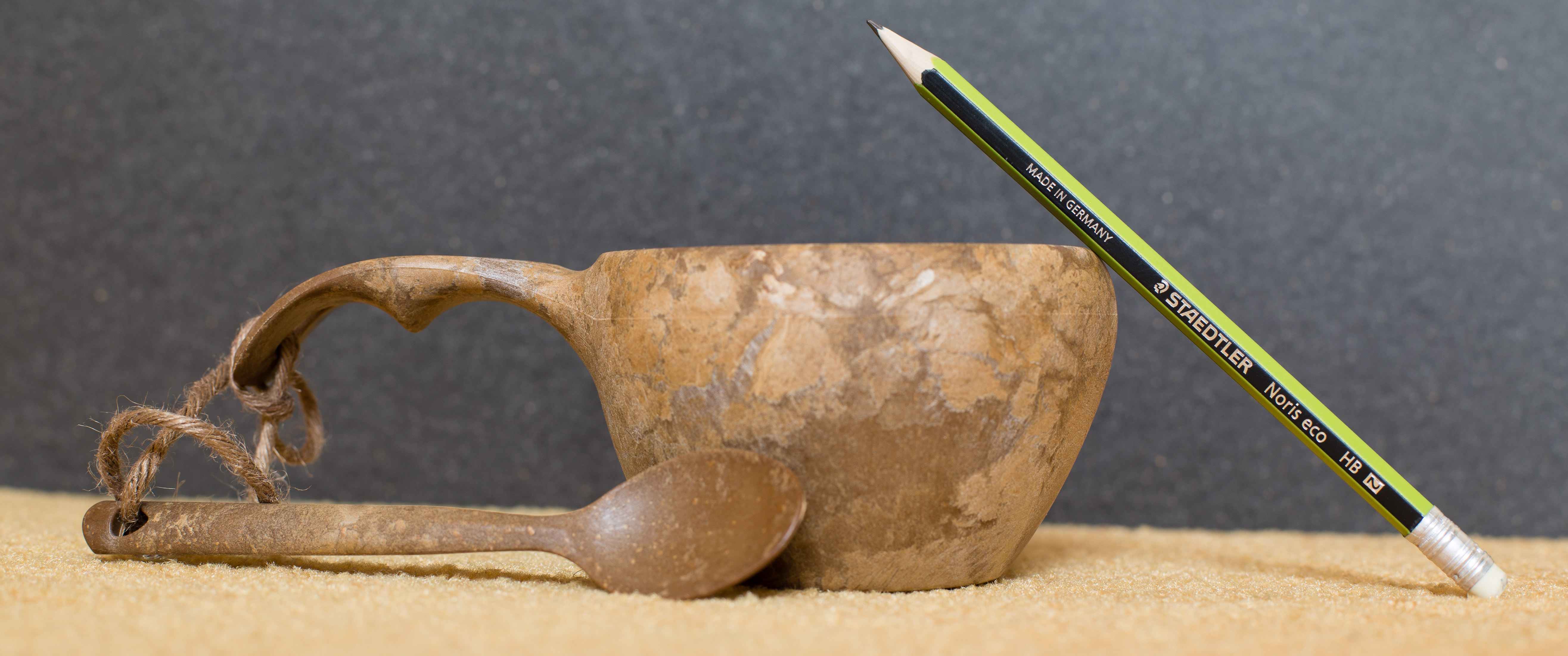
These items have something in common. Both are wood plastic composites.
The Wopex doesn’t need an introduction on a pencil blog. According to Staedtler’s website it contains more wood than plastic.
The cup is a Kupilka, a kind of modern Kuksa. The Kuksa is a traditional cup from northern Scandinavia, carved from birch burr. I was very tempted to buy one when I transferred in Helsinki airport a few years ago, but you’re only supposed to carve them yourself or get them as a gift, plus I mainly drink tea with milk and they’re not so good with milk I heard, so I skipped buying one. Well, this is a modern version and like the Wopex it’s a wood plastic composite. According to the manufacturer it’s 50% pine and 50% thermoplastic.
I bought mine in March 2016 for £16.93 (~$23.90; €20.90), including postage, from an Amazon Marketplace seller. I was quite surprise when it turned out that the company that sold the Kupilka is from the city where I live. They even have a Kuksa carving course this autumn. I’m very tempted!
I was quite surprised that my cup came with a spoon. I didn’t expect that as no spoon was pictured on Amazon.
Massdrop sold these recently, too, and you could even choose between different colours, but I already have my Kupilka so wasn’t tempted by their offer.
Price: March 2016
Exchange rates: April 2016
To see the high-res version of the photos please open in a new tab.