Made in Germany

Faber-Castell 1117

It is probably superfluous to write about the Faber-Castell 1117. Not because it is a very common pencil everybody knows about, but because this pencil is not new to the blogosphere. It has previously been reviewed at penciltalk and this isn’t its first appearance at Bleistift either: the 1117 was the supporting actor in the review of the Deli pencil sharpener 0668. So why do I write about it again? The reason is that I thought Faber-Castell stopped producing this entry level pencil – after I was unable to buy this pencil in shops that sold this specific model previously. Before you panic: Calm down, dear. The good news is that Faber-Castell confirmed that they are still making the 1117.

Price

My guess is that the 1117 is the cheapest pencil made in Germany [1]Probably even the cheapest pen. Today, you can find the version without ferrule and eraser for as little as € 0.20 (~ 28¢; 17p), if you buy them in Germany  over the Internet. That’s a bit more than half the Internet price of a Staedtler Noris and about ¼ of a good Internet price for the Castell 9000. I bought the last few dozen in the local stationery shop Schreibwaren Jäcklein in my home town of  Volkach when I went there in April. eraser-tipped 1117s for € 0.58 each (~ 82¢; 51p) and the untipped 1117s for € 0.36 each (~ 51¢; 32p). Last November I bought the eraser tipped 1117s in B for € 0.29 each (~ 41¢; 25p), online at Schule-Uni-Shop / CTK, but CTK do not stock the 1117 any more.

Writing qualities

The lead of the 1117 could be better, there is not doubt about that, but in good Faber-Castell tradition it does last a long time before it wears down and needs sharpening. Once the pencil it dull or blunt it is, at least in my experience, less pleasant to write with. This is however quite normal for inexpensive pencils and only very few pencils would excel in this category. The 1117 is however usually quite smooth and there would be very few combinations of paper and pencil point state that would result in a scratchy writing experience. The lead could be darker, but this is again something we shouldn’t be surprised about as Faber-Castell measure and label the softness of the lead quite conservatively. The 1117 shows no problems with smudging when being erased erased. I would describe the eraser from the eraser-tipped version as “normal quality”. It performs a bit worse than the eraser of a Dixon Ticonderoga , is similar to the eraser of a General’s Semi-Hex, but much better than the white eraser of the Palomino Blackwing. [2]In case you wonder why I picked these two for the comparison: Those pencils were just lying on my keyboard. Thanks to Sean, Kent and Adair for these.

Overall

This is an extremely cheap, or better: inexpensive,  pencil and value for money is definitely excellent.  Production of the 1117 started in 1991/1992 (20th anniversary soon!). When this pencil was first introduced it was unfinished, but for hygienic reasons later versions got a protective finish. The feel is however very similar to an unfinished pencil. Depending on your perspective this means that the pencil has a great grip or it is slightly too rough and therefore uncomfortable. The version without ferrule and eraser is available in 2B, B, HB and H. I have seen the eraser-tipped version in B and HB, but according to the label on the box the eraser-tipped version is available in five grades. All versions feature SV-bonded anti-break leads.

Næturvaktin, episode 8: Is Ólafur giving Daníel a Faber-Castell 1117? Will there be a pencil in the US remake? (Image © Saga Film)


Prices: November 2010, April 2011 and June 2011

Exchange rates: June 2011

I would like to thank Ms Schaklies from Faber-Castell for the additional information about the 1117.

The photo of Ólafur handing over a pencil to Daníel has been taken from episode 8 of the great, Icelandic comedy Næturvaktin. I believe that the use of this image falls under “fair dealing” as described by the UK Copyright service.


References

References
1 Probably even the cheapest pen
2 In case you wonder why I picked these two for the comparison: Those pencils were just lying on my keyboard. Thanks to Sean, Kent and Adair for these.

Faber-Castell 1117 Read More »

Kronenheft

Kronenheft, Morning Glory pencils (with point protectors) and Noodler’s X-Feather ink

Back from Germany, I am going to try another four-in-one blog post. I did not take part in the Faber-Castell factory tour mentioned in one of the previous comments because of a bereavement – which resulted in a very different trip than planned. I hope to take part in one of their factory tours in December and hope to find the time to visit Staedtler’s shop in Nuremberg, too.

This is going to be a four-in-one blog post because I want to speed things up as there are so many things I want to write about but I do not write enough blog posts – so the queue gets longer and longer. The low number [1]i.e. one of comments on the previous four-in-one blog post about the Black n’ Red polynote does however make me think that writing about multiple items in one blog post does not give each individual item the attention it deserves, so I might switch back to one or two items per post…

…but today another (the last?) many-in-one blog post.

Kronenheft

The Kronenheft must be one of the most understated notepads available. I bought mine at Antiquariat Daniel Osthoff in August 2010. I mentioned this shop and some of the papers they sell in my blog post about the OHTO Super Clip. The Kronenheft notepad has been on the market for many years and is distributed by Carta Pura. It measures 15 cm x 10 cm and features a 290 g/m² Preßspanersatzkarton cover, an “imitation particle board” traditionally used, amongst other things, for book covers. It is a sturdy material made from wood pulp. The paper of this pad is 80 g/m² Salzer Werkdruck paper from Austrian paper manufacturer Salzer. Even though paper has been manufactured in Salzer’s town since 1469 and at the their mill, Obere Papiermühle, since 1579, the history of Salzer is slightly younger as the founder Kaspar Salzer did not have his own paper mill until 1798. Even though the 80 g/m² Salzer Werkdruck paper is not their best paper it is very good with a great feel and texture and a slightly creme-coloured tint.

Carta Pura, the distributor, sells this notepad in twelve different colours for € 7 each. You can also get a refill (40 sheets) for € 3. I paid less, but I am not sure how much exactly. FontShop used to sell them for a good price, but when I check recently I could not find it in their online shop any more.

The crown (German: Krone) in the Kronenheft

Morning Glory

This is the second appearance of a Morning Glory pencil at Bleistift. The first appearance was last month, when I wrote about RAD AND HUNGRY’s STMT X Korea kit. This time I used a much older Morning Glory pencil that my wife bought about ten years ago, the morning glory No. 33322-45229 HB. You would think that such a long product number can definitely point to one specific type of pencil, but there are actually different versions of the morning glory No. 33322-45229 HB pencil, with different colours printed on the pencil, but with the same product number.

The pencil itself writes very well. It could be a bit smoother, but it is by no means a scratchy pencil.

Pelikan M100

Since today is Star Wars day (May the Fourth be with you) I have to include the Pelikan M100, too. I cannot look at this pen without thinking of Stormtroopers and am convinced that if Stormtroopers had fountain pens  this Pelikan M100 would be standard issue! It is a great fountain pen and all of its parts are either white or black, even the nib is black. The piston mechanism does not feel as smooth as it does with a Pelikan M200 or a Souverän, but when this fountain pen was released in 1987 it was not an expensive pen so it is no surprise that the piston mechanism is not on the same level. The nib however is excellent for a steel nib and is quite flexible, too.

If Stormtroopers had fountain pens this Pelikan M100 would be standard issue. Here you can see the M100 camouflaged between other black and white items.

Noodler’s X-Feather ink

The ink used in the M100 is Noodler’s X-Feather ink, a black ink that is bulletproof, i.e. resistant to bleach, chemicals, light, etc. I have used this ink for years and am very happy with it. There is only one disadvantage I noticed. If you use it in a wet writer and use paper that does not absorb ink easily (e.g. post cards) it can happen that a layer on top of the ink does not ‘dry’ completely. In this case it can smudge or smear, even days after the text has been written. Under normal circumstances this is however not really a problem.

Conclusion

The Kronenheft is just great, but with its price tag I am not sure I will use it often. It copes well with ink (no bleeding though) and pencil and has a nice colour and texture.


You can find another photo of the Kronenheft in my previous blog post Wooden Letter Rack with Draw.

You can find English blog posts about Carta Pura at bloesem travel and at snowflakes & blackvampires.

Noodler’s X-Feather ink has also been used in my previous blog post Carrefour Bloc-notes.

I’d like to thank Ms Schwamborn from Carta Pura for additional information about the Kronenheft.

In case you wonder where my Cherry G80-3000LSC went: the photos show my wife’s desk, which is very similar – except the keyboard.

References

References
1 i.e. one

Kronenheft Read More »

Quick on the Draw

What a nice surprise. I was just just driving home from work when I turned the radio on and heard the end of “Quick on the Draw“, a programme from Radio 4’s In Business series of programmes. This programme picked up two topics that The Economist covered over the last few months: Staedtler vs. Faber-Castell and the Mittelstand. Today’s Radio 4 programme featured an interview with Axel Marx, Managing Director of Staedtler, and Count Anton-Wolfgang von Faber-Castell. Axel Marx talked about the Wopex and Count Anton-Wolfgang von Faber-Castell talked about the perfect pencil and the luxurious Graf von Faber-Castell collection. I only heard the second half, but hope to listen to the whole programme on the BBC iPlayer soon [1]According the the information currently displayed on the BBC iPlayer page the programme will be available online until 2099, if I access the programme with my phone the programme is said to be online … Continue reading. I am not sure whether the content can be accessed outside the UK, though. If not: the programme will be repeated on Sunday, 17th May 2011, at 21:30 on BBC Radio 4. Even if you are outside the UK you should be able to listen to Radio 4 live over the Internet.

You can also read comments about this programme from the presenter Peter Day on his In Business page.

Two more comments:

  • It was nice to hear people speaking with a Franconian accent on the radio, even though the accent was not very strong.
  • I was not surprised to hear Count Anton-Wolfgang von Faber-Castell in this programme. He is the one who is often representing Faber-Castell in the media. Last month there was a rare chance to see his brother – in a children’s programme on the TV channel of the public broadcasting authority for the German Freistaat (Republic) of Bavaria. The programme (“Ralphi”) explained how pens and brushes are manufactured and Faber-Castell was represented by …not Count Anton, but Count Andreas von Faber-Castell, who settled in Australia in the 1970s.

References

References
1 According the the information currently displayed on the BBC iPlayer page the programme will be available online until 2099, if I access the programme with my phone the programme is said to be online for about 300 more days …but usually programmes are only available for a week, so I would not be surprised if this programme will disappear from the iPlayer

Quick on the Draw Read More »

STMT X Germany

I just found out that RAD AND HUNGRY’s new stationery kit features Germany. I am not a big fan of rollerball pens, but the Stabilo pointVisco is one of the few rollerball pens I really like – in the last few years I bought many of them, from Cult Pens and from local super markets (Sainsbury’s and Tesco, I think), in all sorts of colours, my favourite colours for this pen [1]normally not exactly my favourite colours: green and brown. I am not familiar with the manufacturer of the paper clips in this set, but Brunnen, the manufacturer of the notebook is probably the market leader in Germany and offers good quality notebooks for a good price.

References

References
1 normally not exactly my favourite colours

STMT X Germany Read More »

Faber-Castell TK-Fine

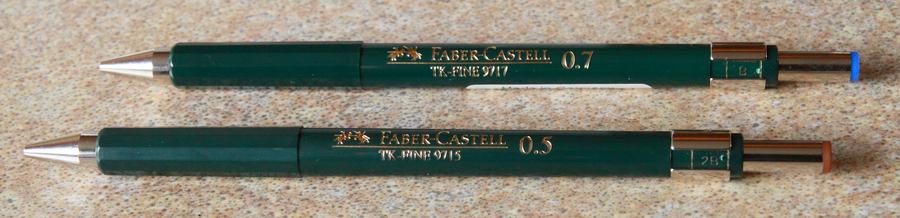
Today: a mechanical pencil – The Faber-Castell TK-Fine, which is – despite the similar name – quite different to the TK-Fine Vario L, discussed by Dave. or the TK-Fine Executive, also reviewed by Dave.

Price-wise the TK-Fine is only about a third of the price of the TK-Fine Vario L. The TK-Fine is also slighlty cheaper than the Executive version, but this price difference is not that big.

All of the different TK-Fine pencils come in Faber-Castell’s famous dark green colour you know from the Castell 9000, but the TK-Fine version does not have the twist eraser, nor does it have (adjustable) lead cushioning. Another difference is that the Vario has a grooved metal grip area and that the Executive has a similar plastic grip while the TK-Fine‘s grip area is very much like the Apollo‘s. The Apollo has unfortunately disappeared, but a few weeks ago Lexikaliker had a post about the Apollo (Google translation of Lexikaliker’s Apollo post) and he was even kind enough to give his Apollo to an artist whose Apollo broke after 15 years of intense use.

…but the grip is not the only similarity between the Apollo and the TK-Fine. Let’s have a closer look at the similarities and differences between the Apollo and the TK-Fine.

The Apollo was available from 1983 until 2000. Different version can be seen in Lexikaliker’s post and in my opinion the Apollo XL looks just beautiful!

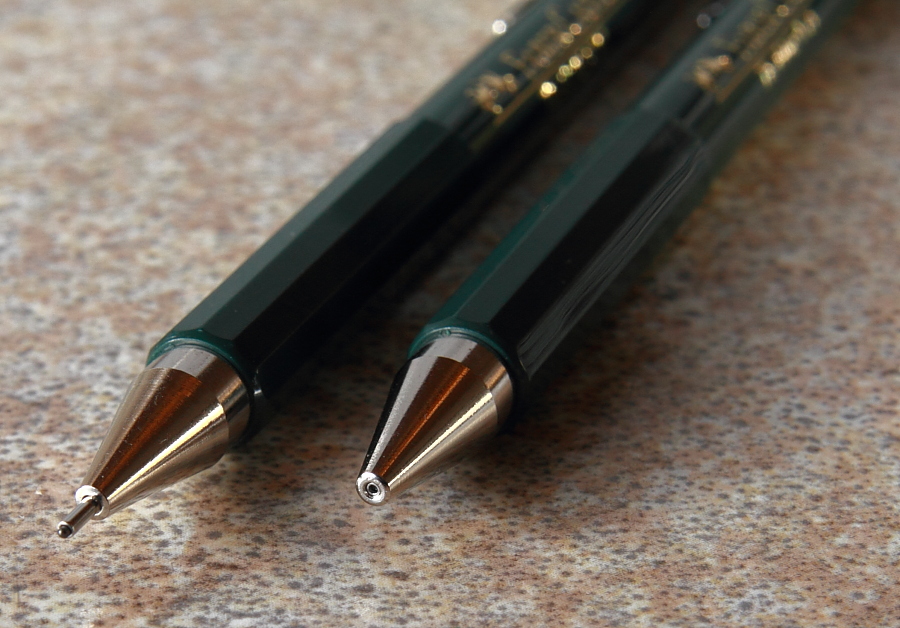
The TK-Fine has been available for over ten years and looks very similar, the main difference in appearance being the different top cap. It is actually being manufactured using the same tools that were used to make the Apollo, but the TK-Fine is made for technical drawings with a rigid, but fully-retractable lead sleeve, similar to the one you might know from Staedtler’s Mars micro. The Apollo on the other hand was made for writing and had a sliding sleeve that retracts as the pencil is used.

The TK-Fine is being produced in Geroldsgrün in Upper Franconia (Germany) available in 0.35mm (TK-Fine 9713), 0.5mm (9715), 0.7mm (9717) and 1.0mm (9719) and has an according top cap marked according to the ISO norm for technical drawing.

I bought the TK-Fine 9717 in April 2010 in Müller in Volkach (Germany) for €4,39 (~$5.80; £3.70) and the TK-Fine 9715 from Schule-Uni-Shop.de, who also ship internationally, for € 2,67 (~$3.50; £2.25). The price in the UK is comparatively high: At CultPens TK-Fine sells for £4.16 (~$6.50; €4.90).

Conclusion:

The TK-Fine offers great value for money if you find a shop that sells it for a reasonable price, but since it is not a common pencil you might have problems getting hold of one.It comes with 3 super-polymer leads in HB, offers a pocket-safe lead sleeve (fully-retractable), it is colour coded according to ISO for lead width, it has an adjustable lead-grade indicator (2B – 4H, plus one neutral setting) and the eraser comes with a cleaning pin.


Prices: April 2010 and November 2010

Exchange Rates: December 2010

I would like to thank Ms Schaklies from Faber-Castell Customer Care for the additional information about the TK-Fine.

By the way… Faber-Castel made it into the Economist again. This time into the Economist’s Schumpeter column, which was introduced about a year ago.

Faber-Castell TK-Fine Read More »