I believe that the use of the image shown, taken from Staedtler’s web site, in this blog post falls under “fair dealing” as described by the UK Copyright service.
A few days ago I have received a Magno from HribarCain. First I wasn’t sure what to think of it and its unique feature, but now that I have tried it for a while I have to say that I really like this pencil and love the mechanism used to propel the lead.
The Magno is a lead holder with a magnetic mechanism, invented by HribarCain – a team of two British design engineers who started working on this pencil one and a half years ago.
The mechanism
The special thing about this pencil is the magnetic mechanism used to propel the lead. Instead of clicking a button (..and the lead ‘falls out’) you first loosen the front of the pen. You then move a ring on the outside of the body which will move a magnet inside the pencil. This magnet is attached to the lead. This gives precise control over how much more lead you want to expose.
I know that some people who bought the Penxo, a very different Kickstarter pen in a similar price range, had problems with the lead breaking easily. I did some initial drop tests and the Magno seems to cope well with being dropped: the lead didn’t break.
The Kickstarter
My understanding is that everything is in place to produce the Magno and it will get made anyway, but instead of just selling these pencils in an online shop HribarCain is launching a Kickstarter campaign on 22 July where early backers can get this pen for £20. The money raised will then be used for other design products they plan to make.
The options
The pen will be available in four colours that have an iPhone vibe to them, but unlike the Lamy LX the Magno’s colours aren’t a copy of the iPhone colour, which I think is a good thing.
Conclusion
When I saw the photos I thought the Magno is a bit on the bling looking side, but in reality the pen was more ‘serious’ looking than I expected. The ring is still a bit shiny for my taste, but overall the Magno is serious looking enough to use at work.
I hope this pencil will sell well so that there will be even more versions in the future. A Rotring-style matt black version, maybe even hexagonal, with a slimmer ring would be such an amazing pen, at least for my taste, others will disagree.
The Magno is very well made and when keeping in mind that there are many lead holders and clutch pencils with a plastic body that cost nearly as much, £20 is great value for money.
Let me start by saying: It’s all Lexikaliker’s fault.
He praised the virtues of 0.4 mm pencils, so I had to order one.
I had a look at various 0.4 mm pencils and decided to go with the Uni Shift for £7.43 from Amazon Marketplace in the UK [1]When I bought it it was 3p more expensive: £7.46., in the USA it sells for $10.20, again on Amazon Marketplace …including shipping. In many online shops this pen can easily cost twice as much, though. I have no idea how the pen can be sent from Japan for such a good price.
The Uni Shift 0.4mm locked
Despite coming all the way from Japan it only took a few days before the pen arrived. The seller even remembered that I bought form him before.
0.4 mm
In theory
Well, this is my first 0.4mm pencil. You’d think 0.4mm doesn’t seem to be that different to 0.5mm, it’s just 20% smaller, but depending on how you write the difference in the graphite you lay down can easily be 30% or more.
Assuming a writing angle of 40° a 0.5mm pencil would cover a surface area more than 50% bigger than a 0.4mm pencil, so there is quite a difference.
In practice
…well at least that’s the theory. In reality things look a bit different. When I checked lead diameters with my caliper I got different numbers. Have a look at the table below. Note: 0.3mm and 0.35mm is used interchangeably my manufacturers.
Nominal value (mm)
0.2
0.3/0.35
0.4
0.5
0.7
Measured value (mm)
0.24
0.36
0.46
0.55
0.68
I am not sure whether I read about this discrepancy in the past, but when I had a look I couldn’t find any information about this on the web. Since my caliper isn’t ‘officially’ calibrated and is just for home use I won’t go into more details and speculation here, other that these might be legacy diameters manufacturers adhere to so that leads and pencil stay interchangeable.
Using the nominal value, an 0.5mm lead used at an angle of 40° has a 50% bigger surface area than an 0.4mm lead. Using the measured values the 0.4mm lead is closer to the 0.5mm lead, but the gap to the 0.35mm lead widens, see table below.
The main purpose of the pipe lock mechanism seems to be to make the pencil pocket safe, i.e. the rigid sleeve/pipe is hidden so that it can’t damage your pocket. I guess the mechanism used in the Uni Shift makes it easier to create a pencil where the sleeve is rigid and doesn’t wobble, compared to mechanical pencils with a retractable sleeve. Easier might in this case also equate to ‘cheaper to manufacture’.
All sleeves out
The mechanism that locks the lead feels a bit clumsy. I don’t find it as nice as some alternatives, shown in the video, mainly because it is more difficult to use single handedly.
I like the grip section. It is made from metal. The upper body of the pen is only plastic. Considering the price of the pen this is however not surprising.
All sleeves in
The pencil is excellent value for money, at least for the price I paid. If you don’t like 0.4mm you can buy the Uni Shift in many other lead diameters, too.
Price: June and July 2016
Exchange rates: July 2016
As usual please open images in a new tab to see a high resolution version. To see the video inhigh resolution please open in YouTube,
If you want to read more about Mitsubishi and it’s link to other companies with that name have a look as Estilofilos.
I usually do nearly all my writing with pencil or fountain pen (actually, most is pencil, I don’t use fountain pens that often anymore), but this week I had a situation where neither pencil nor fountain pen was good enough.
I tried to label a blue Atoma notebook, like the one seen here, but because the blue is quite dark graphite is too light and even my Tactile Turn Gist with black ink was too light, so I wrote with my Staedtler Pigment Liner in 0.5mm over the black ink from the Fountain Pen – this made the lines much darker. Off-topic: the finest pen I have is a Faber-Castell Ecco Pigment 0.1mm, which is pretty fine, but Staedtler’s Pigment Liner is even available in 0.05mm!
Why do I mention this? ..because of the surface of the Pigment Liner.
Lamy 2000
Lamy 2000
Many people, me included, love the Lamy 2000, which is not only because of its shape, but also because of the material used and its surface. I think many people put the good feel of the pen down to the material, Makrolon, but I think it is also down to the surface of the pen. The surface is not just smooth, but is made up of tiny lines that run along the body of the pen. As the lines are so fine the material is also worn down fairly soon which, I think, explains the ageing process where the Lamy 2000’s surface becomes more smooth – something we are all used to seeing from the often used keys on our keyboards.
Staedtler Pigment Liner
Staedtler Pigment Liner 308
Staedtler’s Pigment Liner has a very similar surface, made up of little lines. I guess the main difference between this pen’s surface and the surface of the Lamy 2000 is down to the material used and the shape. I don’t know how difficult it it so make this surface, but it looks fantastic and this is certainly the only single use, i.e. non-refillable, pen I know that has a surface like that.
Close-Up of the Lamy 2000 surfaceClose-Up of the Staedtler Pigment Liner surface
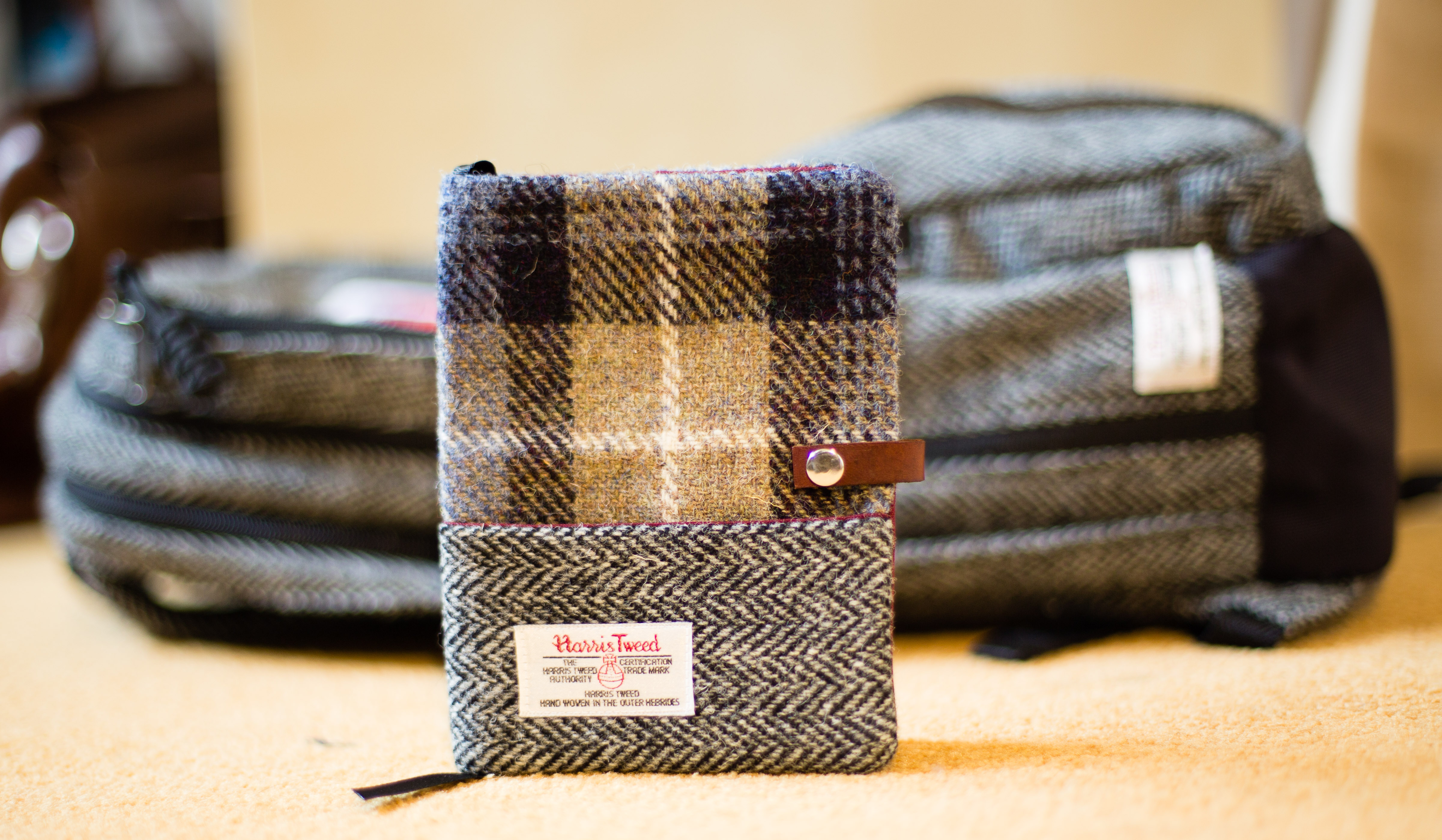
I still carry my Hobonichi Techo in the Galen Leather case, but I thought it would be nice to have a thinner alternative when I don’t want to carry ‘everything’ (phones etc) with me in one pack, so I ordered this Harris Tweed cover.
Too good looking to resist
..well, at least the point about it being thinner is my justification now. The truth is that I couldn’t resist ordering one after I saw how good looking this cover from Esplanade London is when I read Susan M. Pigott’s post at The Pen Addict. I’m not sure why there’s London in the name though, the cover seems to be from Kent. I guess London sounds good, especially for international buyers, but here in the North London doesn’t always conjure up the best associations.
Luckily I got one with a pen loop
Storage
Luckily Laura, the woman behind these covers, agreed to put a pen loop on the model I ordered. It normally doesn’t come with one.
Not much storage space
Storage wise the case could be better. The ‘pocket’s on the outside are quite small – even too small for a Kaweco Sport or an Ohto Tasche. I guess you could put an eraser shield or a credit or loyalty card in there.
More storage space on the back, but not enough for a small pen
Harris Tweed
This is actually my third Harris Tweed item. Harris Tweed is wool cloth handwoven by islanders in their homes in the Outer Hebrides, an island chain in the North West of Scotland, about 100 miles North or Ireland [1]In the past I had fun looking around these islands on Google Maps..
The cover and the rucksack/backpackThe coat
My first Hrris Tweed item was coat I got in 2014 (for my 40th birthday). Here’s a photo from that time. It was cheap, but the lining was poorly made, so I had to get it redone in my home town, but even with the cost of having the lining redone it was still good value for money. By the way: the little one’s hat was knitted by Shangching.
My second Harris Tweed item was a rucksack / backpack from Timberland. I was very lucky as a Timberland outlet store sold it for around £20, it was originally several times that price.
My third Harris Tweed item is this Hobonichi cover. I paid £29 (~$37; €34) plus shipping. Royal Mail was rather slow and it took a week to arrive, but I finally got it. It is great and since I use the ‘Avec’ version of the Techo, the six months version, using this cover and the Techo makes for a really slim diary carrying solution compared to the leather cover.