1983: 222 years Faber-Castell, 2005: 100 years Castell 9000
Let’s have a look at Faber-Castell’s 222nd anniversary in 1983. Back then pencileers, molyvophiles [1]Someone passionate about pencils and molyvologues [2]A student of pencils had more than enough reason to celebrate. I wonder whether there was a corporate party for their business partners in 1983, too. Personally, I prefer nice anniversary products, but that’s rather selfish, Faber-Castell business partners will probably prefer the party.
Click to read (subject to screen resolution)
Why is the 222nd anniversary so important? I don’t know. I certainly don’t know why there have been more exciting products back then than in the 250th anniversary year so far. In my experience people from German-speaking countries place more importance on Schnapszahlen (repdigits) than people from English-speaking countries. You might argue that a repdigit is not very important, but then a ’round number’ is actually not that exciting any more once you change to another positional notation[3]25010 = 3728 = FA16 = 111110102.
The Castell 9000 Jubilator pencils
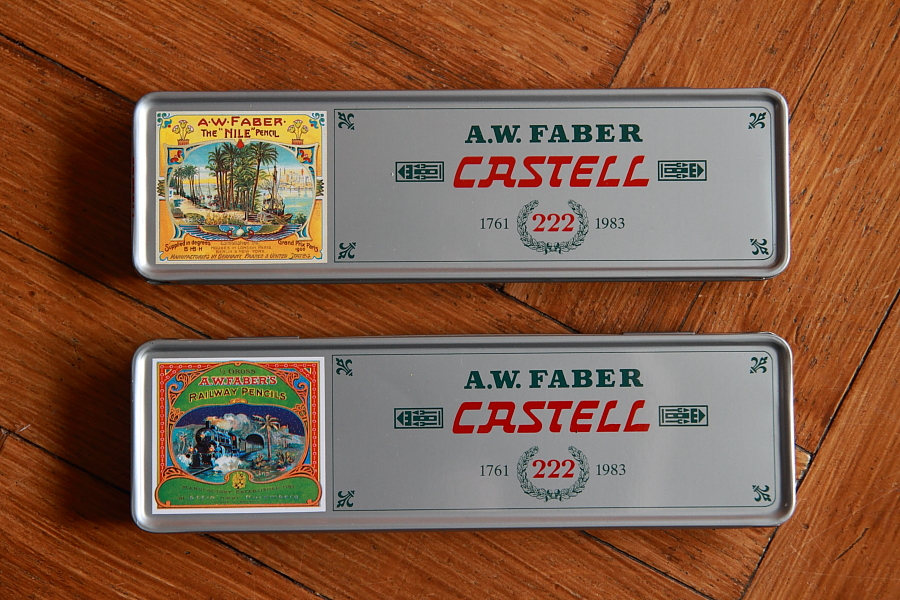
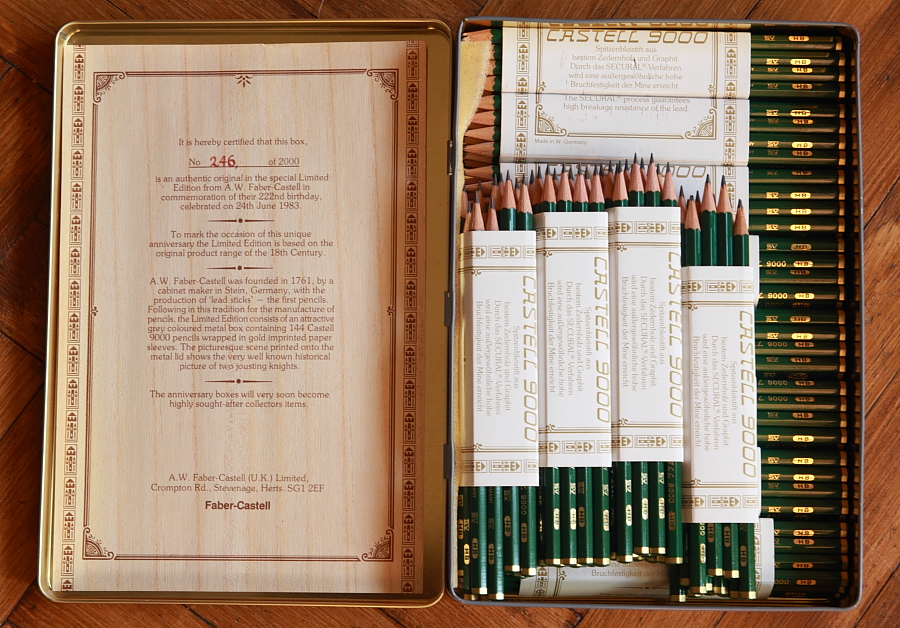
Faber-Castell released six different limited-edition tins for the Schnapszahl anniversary, featuring the following images: ‘The Nile Pencils’, ‘Railway Pencils’, ‘Aristocratic’, ‘The Caravan Pencils’, ‘Landscape Pencils’ and the picture with the jousting knights, previously discussed at pencil talk. Leadholder has more information about this picture – a mirrored version has been used on pencil tins in the early 20th century. The jousting knights image has also been used for a special box from the same year, containing one gross, i.e.12 dozen, Castell 9000 pencils and limited to 2000 boxes, and it has been used again in 2005 for a special tin commemorating the 100th anniversary of the Castell 9000.
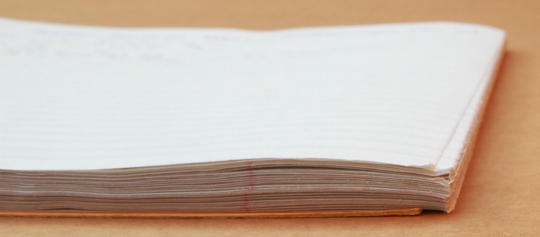
Seeing this notebook in the The Works store in Southport, I couldn’t resist but buy it. It looked like it had character. The paper didn’t have the sterile and boring look printer and copy paper has. It looked a bit rough and it looked a bit as if it was made on older machines – and even better: it’s Made in USA, you see too few of these products here in Europe. There’s the occasional Scotch tape, Made in USA (I’ve even seen these in China), and there’s the occasional pen and eraser, but that’s about it. Other promising details on the cover are: 100% recycled, more smear resistant, easy erase, less bleeds.
I cannot deny that I was quite disappointed after trying the paper out. One claim is not true – Less bleeds? The ink is bleeding was bleeding through the paper at a phenomenal rate. I was trying to write as fast as possible to compensate, but no use. Unless the paper was stored wrong when being shipped to Europe or unless ‘less bleeds’ refers to the sheets having softer edges, resulting in fewer paper cuts at the edge of the paper (‽), ‘less bleeds’ is certainly not an attribute of this paper.
Ink bleeding through
Good news however regarding the ‘more smear resistant’ and ‘easy erase’ claim. It is easy to erase graphite from this paper and the paper is definitely more smear resistant than probably any other paper I know. The paper is very soft, but the surface is rather unusual. Graphite does not stick to the surface as it does on most other paper. This results in most pencil strokes looking very light, certainly much lighter than usual. Some pencils like Faber-Castell’s Castell 9000 2B leave much lighter marks on this paper than on other paper. For other pencils the difference is not as big, most notably for the Chinese made, yellow Amos Dixon Ticonderoga HB, a pencil I came to like. The pencil point of this Ticonderoga does not last very long, it is being ‘eroded’ at an incredibly fast rate for an HB pencil, but it does write well and, I am sure I heard this before in the context of the Blackwing, the lead being used up so fast makes you feel like you’ve done some work [1]Update: I found a comment from Henrik about this.. The American-made General’s Kimberley 525 2B yielded excellent results, too.
I assume the Norcom notebook #77073 is either not being made any more or is not made for the American market, as it is not listed on Norcom’s website.
Conclusion
At 59p (~ 92¢; 67c) for 70 sheets this notebook provides excellent value for money, but the paper is not really suitable for use with pencils and definitely not suitable for use with fountain pens. It’s probably more than adequate when used with ballpoint pens.
In one of my previous blog posts I mentioned Staedtler’s Pepsi pen. Having found it in a pencil case, where it was hibernating together with its cousin, Staedtler’s Microfix S 0.5 773 05, I want to show you some photos of this nice Pepsi pen. After spending more than 30 years in a pencil case with pencils and mechanical pencils this pen did get some traces of graphite on its nice, yellow body, but despite its age it does still write.
Its cousin, the Microfix, must have been quite popular at the time if Lexikaliker and I both had one…
"I took the Pepsi Challenge !"
My previous blog posts mentioned the TWSBI Diamond 530, too. After having used the Diamond 530 for a while I have to say that it is a great fountain pen, but if you ever drop it by mistake it will spill rather huge amounts of ink, unlike other fountain pens I normally use – which have a much more conservative spillage-behaviour.
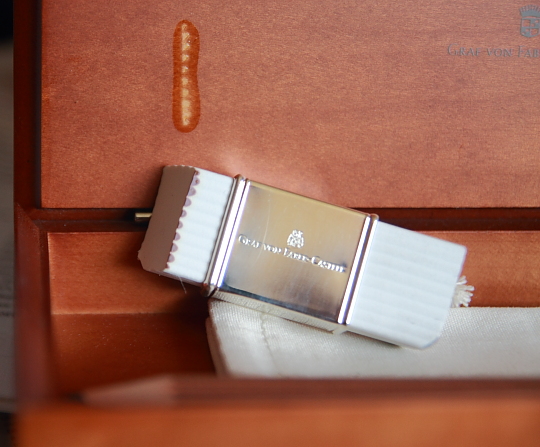
I keep a few Graf von Faber-Castell (GvFC) pencils, the ones with the silver-plated cap, in the wooden gift box that came with the GvFC Perfect Pencil. There’s something else I keep in this box: The GvFC eraser. You’d think they’d play well together, but unfortunately they don’t.
When I opened the box this weekend, after not having used it for a few weeks, I saw that the eraser got brown where it touched the wood. No problem, I don’t mind – my Staedtler Mars Plastic got brown when I stored it in my Sonnenleder Lasse case. The Staedtler / Sonnenleder combination did however not have any negative effect on the Lasse case. Back to Graf von Faber-Castell: I don’t mind the eraser changing colour, but what I do mind is that the wooden box changed. The colour changed where the eraser touched the inside of the lid and around the area of discolouration is a gluey layer of something – very sticky when you touch it.
Faber-Castell tries to use environmentally friendly production techniques, e.g. water-based varnish. I wonder whether that has something to do with this problem I encountered.
This is actually the second problem I have with this wooden box.The first problem was that one of the corners was bend. I am not sure whether this was due to bad packaging, I guess it was more likely because the parcel delivery service were not careful. I was able to fix this corner issue more or less by bending the corner back and by painting the discoloured wood there with a brown Stabilo marker.
I am not sure what to do about this new issue though. Use sandpaper to remove the sticky layer? …and never store the eraser in the box again? …or complain to Faber-Castell?
For now I left the eraser in the wooden box, this time wrapped in paper.
This is not the first time that I mention the fact that Staedtler pencils are quite common in the UK [1]The blog post about the Staedtler Tradition and the one about the Chung Hwa drawing pencil both mentioned this, then there also the post about Staedtler UK.. Today I want to show you some examples of Staedtler pencils seen on TV. In the UK school is about to start soon, so there’s even Staedtler advertising on TV these days. The examples shown here are however not part of an advertising campaign and I believe that Staedtler pencils have just been used because they are quite common. I apologise as nearly all picture shown have been taken from TV series. As usual, all pictures not taken by myself come with a note explaining where they are from or who owns the copyright.
Real people
Let’s start with real, i.e. non-fictional, people using Staedtler pencils.
Stephen Wiltshire
I’ll skip photos of Stephen Wiltshire using Staedtler pencils. One reason is that you might remember seeing him using a Staedtler pencil from a blog post from March 2010 about the Staedtler Tradition. The other reason is that about a year after the blog post he started making advertising for Staedtler, so any new pictures showing him using Staedtler pencils would arguably be because of his contract with Staedtler, not because of the omnipresence of Staedtler pencils. I have seen him using other pencils in the past, I assume he is only or mainly using Staedtler products now.
Gordon Ramsay is a celebrity chef in the UK. Since he has been mocked in South Park I assume he must be a celebrity in the USA, too – or at least be known there. Here are photos of him in an episode of his TV series Ramsay’s Best Restaurant, where a restaurant ten miles from where I live was competing. I first wasn’t sure whether this is a real Tradition 110 or one of those copies available in many shops, but during this episode there were some moments when the reflection of the writing on the pencil can be seen quite well. It is not a copy.
You can see Staedtler Tradition and Noris pencils in several school sketches in The Armstrong and Miller Show. Staedtler pencil’s use in The Armstrong and Miller Show is not really surprising. They are common and also to some extent the archetype of a pencil.
Staedtler’s pencils’ image as typical pencils means that you can see them often when an association with school is needed or in related advertising as in the example seen on the right. The advertising, probably created specifically for the UK and Ireland, was on a phone booth. A Staedtler Noris can be seen, even though the film is from the USA, where the Noris is not officially distributed and not available.
In the next example Harvey Nichols, a posh department store, used Noris look-alikes in their shop window to advertise perfume – I am not sure what the link between the perfume and the pencils is.
Noris look-alikes in Harvey Nichols shop window. (Thank you to Mrs Schmitt for allowing me to use Staedtler’s photo)
Before I finish this blog post, a quick look at fictional characters outside the UK who use Staedtler pencils.
In the US-American TV series How I Met Your Mother the main characters, architect Ted Mosby (actor: Josh Radnor), can be seen using a Staedtler Mars Lumograph. Unlike the Noris and the Tradition, the Mars Lumograph is officially being sold in the USA. A fitting pencil: in the past the Mars Lumograph has been advertised a pencil for technical drawings and for engineers.
His second appearance in this blog …both times with a pencil: Daníel Sævarsson (actor: Jörundur Ragnarsson), one of the main characters from the …vaktin series and from the film Bjarnfreðarson, this time with a Noris in episode two of Fangavaktin.
In previous blog posts the Tradition was written with lower case letters because this is how the name is printed on the current version of this pencil. I decided to capitalise Tradition from now on, but I will probably refrain from changing the spelling in previous blog posts.
I would like to thank Mrs Schmitt from Staedtler for giving me permission to use Staedtler’s photo of the Harvey Nichols shop window.
I believe that the use of the following images falls under “fair dealing” as described by the UK Copyright service:
The two photos of Gordon Ramsay and the Staedtler Tradition, taken from episode three of the TV series Ramsay’s Best Restaurant
The two school sketch photos, taken from the second series of the TV series The Armstrong and Miller Show
The photo of the UK advertising for the film Diary of a Wimpy Kid 2
The two (poor) photos taken from the TV series How I Met Your Mother
The two photos taken from the TV series Fangavaktin
By the way, this is blog post 112. Quite fitting, as 112 is the article number of the rubber-tipped Staedtler Tradition.