Erasers

The Mono Zero and the Mono One

Today: a comparison of different Tombow erasers – the Tombow Mono Zero, available either with a 2.3 mm round tip or broad 2.5 mm * 5 mm rectangular tip, and the Tombow Mono One, an eraser that looks as if it’s supposed to be used on a keyring or as a charm. I wrote this blog post originally for The Pen Company who send me these two erasers free of charge.

Mono Zero (back)
Mono Zero (white version, back)

Mono Zero background

The Mono Zero was originally released on 12 November 2007 and since its release it has won the iF product design award 2010 and the red dot design award 2010. It has also received Japan’s eco mark certification because of its high content of (pre-consumer) recycled plastic. The body of the eraser is made in Japan, while the eraser core itself is made in Korea. The Mono Zero has been designed by Ms. Chisato Takahashi, who  is also responsible for the Mono smart. I got mine as a free sample from The Pen Company where the current retail price is £3.47.

Mono Zero (black version, front)

Mono Zero body

The Mono Zero is available either with a 2.3 mm round tip or broad 2.5 mm * 5 mm rectangular tip and each of these versions is available in either a black body or a black, white and blue body. There used to be a silver version as well, which – to me – always used to be by far the least attractive looking version. This silver version does not seem to be available anymore.
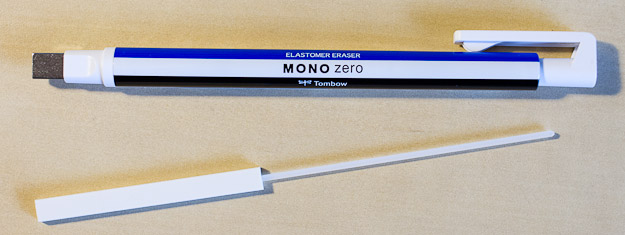
Mono Zero eraser removed - 2.5mm * 5 mm version
Mono Zero eraser removed – 2.5mm * 5 mm version
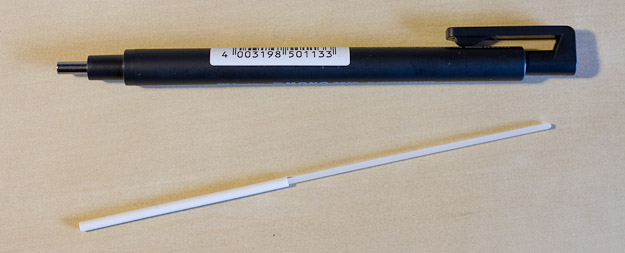
Mono Zero eraser removed - 2.3 mm round tip version
Mono Zero eraser removed – 2.3 mm round tip version

Mono Zero eraser

The eraser itself does not fill the whole body. This might come as a surprise when you have used other pen shaped erasers that come in a plastic body, but is not not really a problem. You do get slightly less eraser for your money, but the whole eraser (body plus eraser) itself is not expensive and the eraser core will still last a long time. Just to mention is explicitely, there are also refills available for these erasers, like for most pen shaped erasers. Labelled as an elastomer eraser, the Mono Zero contains an eraser made from ethylene propylene copolymer. When I received the eraser I did try it out and compared it to my favourite kind of eraser, a dust-free  or non-dust eraser (as long as it’s a dust-free eraser I usually like it very much). It’s probably not fair to compare it to my favourite type of eraser, or let’s say not objective – others might not like dust-free erasers, but then this comparison  is a valid approach as I am writing about what I like or dislike about the Mono Zero.

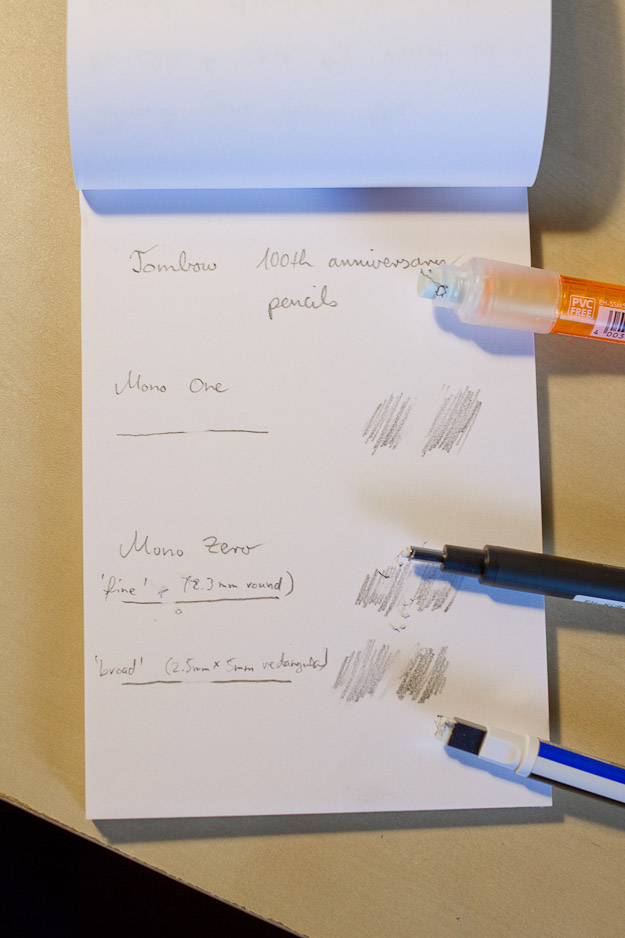
Comparison on Deli paper (A6)

For the pencil to be erased by the Mono Zero – I originally thought what better match could there be for the Tombow Mono erasers than a Tombow pencil, so I picked last year’s 100th anniversary special pencil.
Erasing the soft Tombow 100th anniversary pencil

Mono Zero performance

To my surprise the two Tombow products, pencil and eraser, didn’t seem to be able to cooperate that well with each other. This was due to the fact that the Tombow pencil is very soft. According to Pencils and other things the 100th anniversary edition has the same lead as the current Mono 100, but my 100th anniversary pencil seems much softer (and smudges easier) than a Mono 100 (both HB). I am not sure whether I’m imagining things here, or I just happened to have a softer than usual 100th anniversary pencil and a harder than usual Mono 100, or whether the lead is the same, but there’s actually a shift in grade (e.g. 100th anniversary HB = Mono 100 B). In any case, the Mono Zero was not able to eraser a strong line, i.e. drawn with some pressure, without a trace. It did however manage to eraser strong lines of harder pencils, in this case a Staedtler Mars Lumograph in HB, without a trace.

Erasing the harder Staedtler Mars Lumograph HB

Mono Zero conclusion

My impression of the Mono Zero was that it’s not the greatest performer when it comes to actual erasing (worse than a non-dust / dust-free eraser), but its strong point is precise erasing …because of the tip size and shape (a bit like a Kokuyo eraser). When I was looking for other blog posts to mention in this review I rediscovered Dave’s review of the Mono Zero, which came to the same conclusion regarding eraser performance.

A great eraser, because its fine ‘tip’ allows precise erasing, even though eraser performance itself could be better.

The Monos compared to a dust free eraser


Mono One

The Mono One, designed by Mr Kazunori Katami, who holds a lot of stationery patents, was released slightly earlier than the Mono Zero – on 5 February 2007. The Pen Company is selling this eraser for £2.60. The body of this eraser is also produced in Japan (no eco mark certification for the Mono One, though), while the eraser itself is made in in Vietnam. Labelled as a plastic eraser, the eraser is made from thermoplastic elastomers. Despite the different materials, performance seemed pretty similar between the Mono Zero and the Mono One, with the Mono One maybe performing a little bit better.

The Mono One does not offer as precise erasing as the Mono Zero, the tip is bigger, but it is a nice size, which makes it a great eraser to carry in a pencil case bag or, possibly even on your key ring.


I would like to thank The Pen Company for these erasers, I got them as free samples, and Mrs. Balsewicz from Tombow Europe for all the information she has given me about these erasers.

I would like thank Sean for the Tombow 100th anniversary pencils.

The Mono Zero and the Mono One Read More »

Pentel Ain Clic

After seeing my link on facebook about the effects of erasers on paper [1]Sorry, I didn’t find an English, only  a Dutch and a German version of the paper. you must have guessed that the next post is about erasers, so today: a belated blog post about the Pental Ain Clic, an eraser in a pen shaped holder [2]Previously reviewed at East…West…Everywhere.. There are strong links to the recent Temagraph blog post: More or less the same eraser is also available under the Temagraph brand.

Temagraph eraser (Image © Fila)

I don’t own the Temagraph version though, so my blog post is based on the Pentel Ain Clic version, which was sent to me by Fudepens.com, where it currently retails for €4 (~$5.50; £3.30). If you like their products: they do ship internationally and orders over €30 get free international shipping.

Pen Erasers Overview
Different erasers in pen shaped holders.

Shape

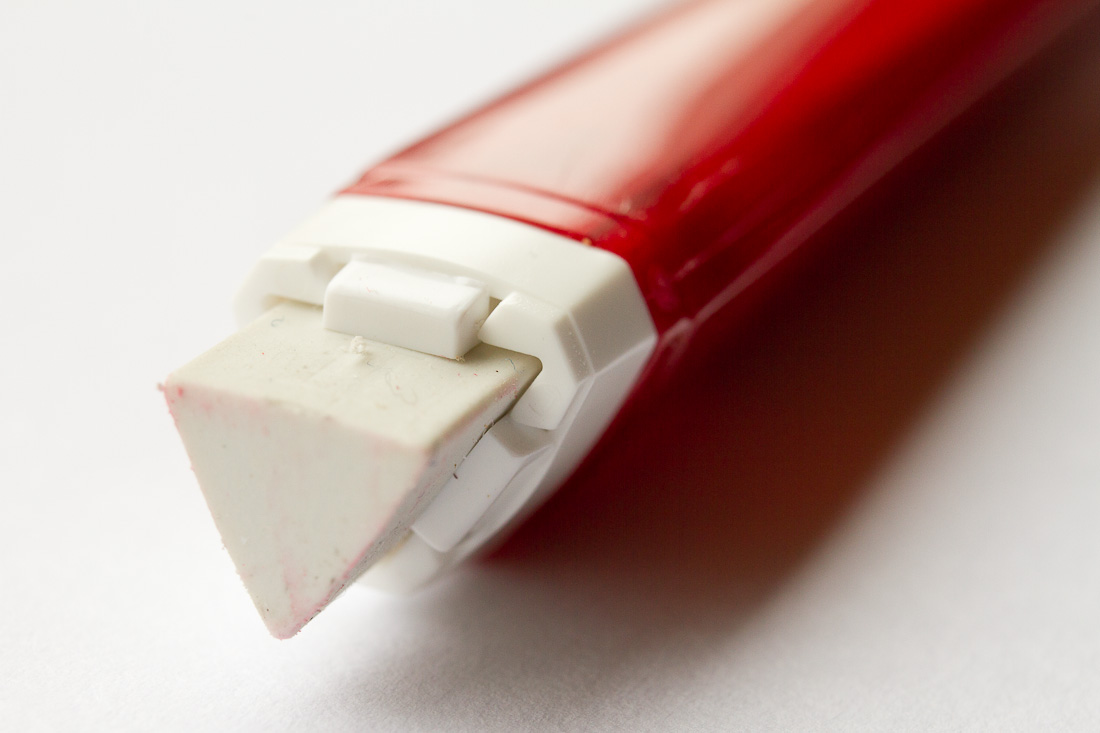
The main difference, compared to other erases that come in pen shaped holders, is that the eraser core is triangular. This means that you usually end up having a ‘corner’ of the eraser left when you need to erase small, tricky traces of graphite – a bit like Kokuyo erasers, just not that extreme. The problem with the round eraser sticks is not so much that the area you end up erasing is too big (the end of the stick ends up, more or less, in the shape of a half sphere. If you think of a ball lying on the ground, the contact area with the ground is very small), the problem is more that the point where you erase is difficult to control, because it is difficult to see where the eraser will make contact with the paper. This is where the triangular shape comes in handy, but the pointy corners you see in the picture will of course round off, too.

Pentel Ain Clic
New and unused, let’s try it out next….

Materials

The body of the Ain Clic eraser is made in Mexico, while the eraser itself is produced in Japan and is composed of PVC and DINP. Just a warning, the P in DINP stands for phthalate, which you might have come across in the news. In the EU DINP is banned in toys and childcare articles that children can put into their mouths (see European Directive 2005/84/EC [3]http://ec.europa.eu/health/opinions/en/phthalates-school-supplies/glossary/def/dinp-di-isononyl-phthalate.htm ). This eraser doesn’t seem to be marketed at children, but I would keep in mind that it contains phthalates and would keep it away from children (or adults tempted to put it in their mouth). It might also be advisable to put the eraser crumbs in the waste bin ,instead of just blowing them off the paper, so they don’t end up on the desk or floor.

The Staedtler Mars plastic eraser stick 528 50, used in the comparison, did contain phthalates in the past (as shown in the paper about the effects of erasers on paper), but the current product specification sheet shows that the Mars plastic, which is also PVC based, is now phthalate free. I hope Pentel will change the Ain Clic in the future and will switch to a more ‘human friendly’ plasticiser.

Pentel Ain Clic

Performance

The Ain Clic doesn’t only look good, performance-wise it’s also very good.

When just erasing with a single stroke (maybe more suitable for artists) performance is not too good, but when repeatedly moving the eraser across the graphite to be erased (which, I would think, is the standard way of doing it) performance is great. With repeated movement graphite doesn’t stick to much too the eraser and the eraser dust will roll up into strands – I like erasers where the dust rolls up like that.

Comparison
Comparison on Banditapple 3G paper. The shaded areas were erased using eight strokes (Mars left, Pentel right)

Conclusion

Overall a great and good looking eraser, but the use of DINP is a black mark against it and the eraser shouldn’t be given to children.

I use pencils and erasers for writing, where I don’t need to eraser very fine details, but I can imagine this being an eraser very suitable for artists.


I would like to thank Fudepens.com for the Pentel Ain Clic, which I got sent for free. I don’t think the fact that I didn’t pay for the eraser influenced my opinion of this eraser in any way.


I would like to thank Pentel USA and Staedtler for the additional information they have provided about their erasers.


The photo of the Temagraph eraser is © Fila. I believe that the use of the photo shown in this blog post falls under “fair dealing” as described by the UK Copyright service.


I bought the Staedtler Mars plastic eraser stick at Granthams, a local art supply shop. I paid between £1 and £2 for it, but I can’t remember how much exactly.


Price (for the Pentel) and exchange rates: April 2014.

References

References
1 Sorry, I didn’t find an English, only  a Dutch and a German version of the paper.
2 Previously reviewed at East…West…Everywhere.
3 http://ec.europa.eu/health/opinions/en/phthalates-school-supplies/glossary/def/dinp-di-isononyl-phthalate.htm

Pentel Ain Clic Read More »

Morrisons Pick and Mix Puzzle Erasers

Morrisons Pick and Mix Puzzle Eraser

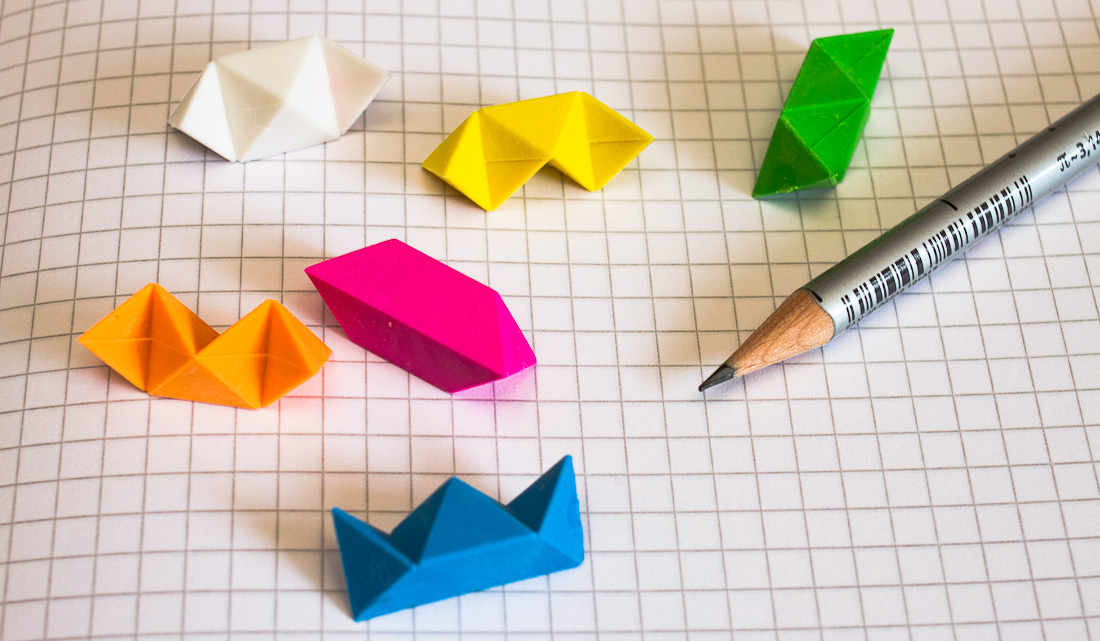
This weekend, I discovered a rather interesting eraser in Morrisons (a supermarket chain from the North of England): it’s an eraser that’s made of different smaller erasers, a bit like the Ty/iwako erasers, but it also provides many different corners, a bit like the Kokuyo eraser. The biggest surprise is the price: when I saw it on the shelf I assumed this was the novelty eraser for 50p (~81¢; 59c), but it turned out that this eraser is the Pick and Mix Puzzle Eraser, which is only 8p (~13¢; 9c).

How to assemble this one again...?
How to assemble this one again…?

The design reminds me of wooden puzzles from MENSA that some UK supermarkets sold last December.

Morrisons Pick and Mix Puzzle Eraser
It does erase rather well.

Performance is good to very good, especially when keeping the price in mind. The puzzle doesn’t fall apart after erasing a few words. Even though the puzzle parts might loosen up a bit you can put them back together – and even if they fell apart: you could see that either

  • as an opportunity for some puzzling/brain work to do
  • or alternatively as the sudden availability of more eraser corners so that you can do more precise erasing.
Morrisons Pick and Mix Puzzle Erasers
Both versions, here on a WH Smith Squared Exercise Book.


Price and exchange rates: October 2013

The pencil in the pictures is Staedtler’s 1810.

The paper squared paper in the pictures is from WH Smith’s Squared Exercise Book (5mm squares, 48 pages, 165mm x 203mm)

Morrisons Pick and Mix Puzzle Erasers Read More »

Factis and Ty/iwako erasers


The Factis 60 RP and the Ty Peepers (unboxed)

Post offices in the UK sell all sorts of things and the things they sell are often quite reasonably priced. This can include things like cakes, hand bags or kitchen foil, but naturally there is also a selection of stationery available. In July I bought the Factis 60 RP eraser at the Cinnamon Hill post office in Walton-le-Dale for 25p (~39¢; 32c). I have seen Factis erasers in Germany, too [1]I would even go as far as saying that there has also been a surge in Spanish made erasers in Germany, but it could just be that the few shops I have seen just happened to stock more or display them … Continue reading. It is often not possible to identify the manufacturer of these erasers, but I assume many of them are made by Factis. I assume the company is named after one of the components needed to make natural rubber erasers.

The Staedtler 1810 KP72 and the two erasers

Another eraser I bought in July is the Ty Beanie Puzzle Eraser Peepers. When I saw a selection of the Beanie Puzzle Erasers on the MS Pride of Rotterdam I remembered Shangching’s positive review and bought one for £1.19 (~$1.87; €1.50). There were many erasers to choose from, so I picked Peepers, the duck, one of the erasers with a more complex looking surface structure.

The Factis 60 RP and the Ty Peepers taken apart

Performance-wise both erasers perform similarly well, with the more rubbery 60 RP needing a little bit less effort to eraser graphite than the Peepers. Both erasers perform worse than a good eraser, like my favourite non-dust erasers or the Mars plastic stick 528 55, but better than the typical non-name eraser or the most erasers you’ll find at the end of an eraser-tipped pencil.

Comparison of the Factis 60 RP and the Ty Peepers

You can find out more about Factis on the Eraser World web site.

I bought the Staedtler pencil with the mathematical formulas, the 1810 KP72, used in the photos and for the comparison in Nuremberg’s Staedtler Welt for 95 cents (~$1.18; 75p).

References

References
1 I would even go as far as saying that there has also been a surge in Spanish made erasers in Germany, but it could just be that the few shops I have seen just happened to stock more or display them more prominently.

Factis and Ty/iwako erasers Read More »

Phthalate-free

I bought these erasers when I was in Germany over Easter.

The manufacturers of both erasers like to emphasise that the erasers are phthalate-free. A while ago plasticisers were a big topic in the news in Germany. I think there might have been a scandal regarding plasticisers in toys – or maybe this started another way. Both erasers were €0.79 (~ $1; £0.63).


Prices: April 2012

Exchange rates: May 2012

Phthalate-free Read More »