Rad and Hungry‘s fourth stationery kit is out. After Colombia, France and Mexico this month is Korea’s turn. I am looking forward to receiving my order because none of the items in this kit are part of my current selection of Korean stationery (some of which can be seen in my older blog posts).
You might have noticed that new blog posts at Bleistift were mainly announcements, there were no new review-style blog posts with images since last December. The reason behind this is simple: I have been quite busy at work (some colleagues left, but this is only part of the story) and I will be quite busy for some time to come.
Therefore, I am quite happy that I finally managed to put together some photos and a few words about two pencil stands I bought last November. They are from Wedo (Werner Dorsch) [1]Using this type of acronym to create a company name is quite common in Germany. Other company names created using a similar mechanism are Haribo (Hans Riegel Bonn) or Adidas (Adi Dassler)., a company established 1933 and located just south of Frankfurt. In the first years Wedo’s main business was repairing fountain pens. Later they started manufacturing nibs for fountain pens. These days Wedo’s main business seems to be the distribution of office products, school supplies and gifts.
Before I start talking about these pencil stands I want to emphasise first that I love products made from bamboo and I am quite happy that products made from bamboo have become more and more common. Ten years ago there were not many products made from bamboo available in non-specialist shops in Europe. The only “solid” bamboo products I can remember from that time are tea sets and tools used for tea ceremonies. Even earlier, in the 90s, only “thin” bamboo products, e.g. bamboo steamers, could be found in shops …at least as far as I know, but please let me know if this was different where you live or whether there are some products I left out. Luckily today you can get lots of products made from bamboo: chopping boards, trolleys, laundry baskets, pencil sharpeners, … I assume that part of the reason of the increased number of bamboo products must be that the gluing process involved improved dramatically over the last years.
Wedo Desktop Butler
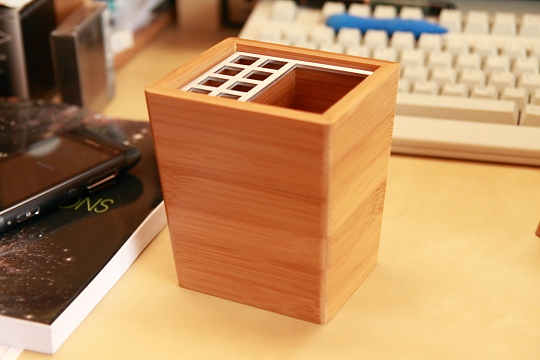
When I saw Wedo’s bamboo products online I could not resist and ordered their desktop butler and pencil pot, the fact that the price is very reasonable did not help resisting either. The desktop butler was € 9.40 ($ 12.85; £ 7.90) and the pencil pot was € 8.50 ($ 11.60; £ 7.15). Both products are extremely well made and look fantastic. I really like them. The strips of bamboo glued together are about 2 cm wide (nearly an inch), must bamboo products seem to be made from much narrower strips of bamboo. The walls of the desktop butler are 5mm thick, the walls of the pencil pot 7mm. This gives both products are very solid feel. My only concern with these pencil stands is the aluminium insert at the top. I fear they might scratch the surface of the pens out inside. This problem is however more perceived than real, at least in my case. I use these pencil stands for everyday pencils and if I store pens with polished surfaces in them I put them in and take them out carefully. The aluminium insert might not make any scratches, but I just don’t want to risk it…
Wedo Pencil Pot
Prices: November 2010
Exchange rates: February 2011
I bought both products in November 2010 from Schule-Uni-Shop.
Using this type of acronym to create a company name is quite common in Germany. Other company names created using a similar mechanism are Haribo (Hans Riegel Bonn) or Adidas (Adi Dassler).
If you are interested in fountain pens you probably came across Montblanc’s Mahatma Gandhi fountain pen. Keeping in mind that Gandhi led a simple lifestyle, gave up unnecessary expenditure and promoted Indian-made goods there is a huge discrepancy between what he represented and what Montblanc’s Mahatma Gandhi pen stands for. No wonder this pen made headlines in several newspapers, including USA Today and The Guardian.
More affordable was Montblanc’s saffron coloured Mahatma Gandhi ink, which was released around the same time but sold out very soon. De Atramentis started selling an ink with the same colour and the same name. Even though there is a chance that Montblanc’s Gandhi ink was manufactured by De Atramentis I wouldn’t bet on it. Old Montblanc ink and De Atramentis inks are made in Germany, but as far as I know Montblanc’s old inks were made by Gutenberg [1]previously mentioned in this article – not by De Atramentis. Montblanc’s new inks are made in Austria.
De Atramentis’ Mahatma Gandhi ink is probably a copy of Montblanc’s ink, but it might be worth a try if you were keen on getting Montblanc’s Gandhi ink and missed your chance when it was first released. Unfortunately, De Atramentis’ shipping costs outside Germany are quite steep.
This year Staedtler will offer a historic pencil construction kit. I have seen it in photos taken at their workshop and am really excited that it will be available to buy for those of us who can not attend the workshops.
Update: Staedtler’s German and Austrian web sites have a short video from a trade fair in Linz, Austria. This video shows how to “assemble” Staedtler’s historic pencil. Unfortunately there are no English subtitles.
I really like that Staedtler refers to this pencil as being historic, instead of historical – because Friedrich Staedtler’s pencils of similar design are such an important part of Staedtler’s history.