February 2017

Pentel’s new orenznero

Auto advancing pencils, from the 1970s to now

Auto-advancing mechanical pencils have been around for a while now. The Faber-Castell alpha-matic was released in the 1970s and was, as far as I know, the first of this type [1]You can’t this model them for quite a while now and used prices for the alpha-matic can easily reach £200 (~$250; €235) or more..

These pencils usually work by forwarding the lead a bit when the sleeve or cone near the tip is depressed while writing. This will forward the lead a bit. As forwarding the lead is done automatically every time the sleeve is pressed during writing there is no need to push the pencil’s button anymore.

Pilot has a pencil similar to the Faber-Castell alpha-matic, but Pilot’s version is still made today. It’s called the Automac and looking at the grip section I think that the mechanism isn’t the only thing this pencil has borrowed from the alpha-matic. I think the Automac pays homage to the original auto-advancing pencil with its similar grip section.

My experience with auto-advancing pencils

If you want to try out a pencil like this: Faber-Castell still has you covered: For under £3 (~<$3.50; <€3.50) you can get a plasticky one with a cone that does the job. Ten years ago I used these a lot, just because of the novelty (at least for me it was new at that time). It was the only auto-forwarding pencil I have ever used. It worked well for me, but anytime I’d hand it over to a colleague to write with, especially if the pencil is filled with coloured leads, the user was almost guaranteed to break the lead and clog up the mechanism as it didn’t work well with soft leads, like coloured leads, at all.

Umeda (Osaka) Loft (image © Yumiko)

Enter Pentel’s orenznero

When Pentel’s fibonacci mountain video came out last week I was immediately intrigued. In this video the new orenznero is used in a plotter. I never owned a plotter, but having spent most of my pocket money in the 1980s on computer magazines the video was more than fascinating as a normal plotter wouldn’t work with a pencil for long periods of time without some extra mechanism. Pencils tend to get shorter when you write, unlike ballpoint pens or fountain pens, so the plotter would either have to lower the pencil again and again (for wood-cased and mechanical pencils) or it would have to press the button to forward the lead (for mechanical pencils).

The plotter in Pentel’s video doesn’t do either, so the orenznero must have some sort of auto-forwarding mechanism. Just like when writing with a normal Orenz, you can write for a long time with the new orenznero without having to push the button to forward the lead, but this time it’s not the sleeve retracting, it’s the lead forwarding that makes this possible.

Some of the diagrams from Pentel make me think that their mechanism works even if the sleeve doesn’t touch the paper at all, but I am not sure about that and the Japanese I learned at university in the 1990s is just enough for me to decipher some Katakanas, not enought to figure out how the orenznero works, so I’ll have to wait and see.

The good news is that Yumiko, I mentioned her before on this blog, has bought me one already, from Umeda (Osaka) Loft, so I will be able to try it out soon.
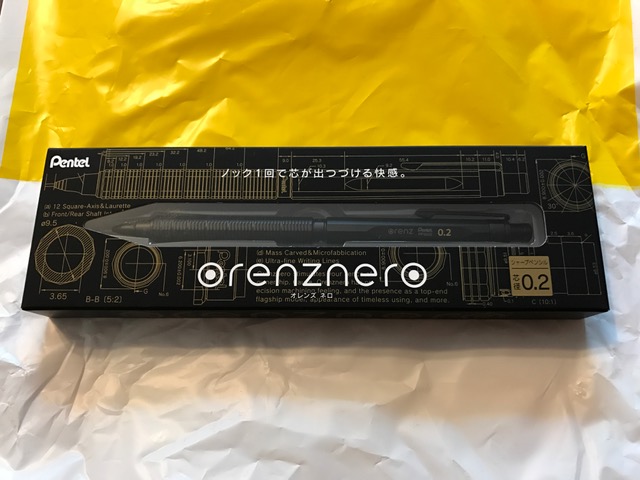
Mine 8^D (image © Yumiko)

There is a 0.2mm and a 0.3mm version. Even though 0.3mm would enable me to use Stadtler Mars micro and Pilot neox graphite leads I asked for the 0.2mm version as that is closer to a freshly sharpened wood-cased pencil and fits my small writing better. Well, it turned out that the 0.3mm version was sold out anyway and there were only two or three 0.2mm pencils left. Lucky me!


I would like to thank Yumiko for helping me to get this pencil.

If you want to find outmore about the (old) Orenz, here is my blog post about the 0.2mm version0.3mm version,  0.5mm version, and sliding sleeve pencils in general. There is also a page comparing different sliding sleeve pencils.

Reviews of the (old) Orenz can be found at Lexikaliker (german), The Pen Addict, I Liek Pencils, One Lone Man’s Pens and Pencils, and Rhonda Eudaly.


References

References
1 You can’t this model them for quite a while now and used prices for the alpha-matic can easily reach £200 (~$250; €235) or more.

Pentel’s new orenznero Read More »

Traces of graphite – Paul Kidby

It’s time for another Traces of Graphite blog post. All the previous blog posts in this series were Disney themed (Barks, Rosa and Fecchi), but this time the blog post is Discworld themed.

Paul Kidby‘s very impressive pencil point from my previous blog post made me want to find out more about the pencils he is using to create his drawings.

Paul Kidby’s pencil (image © BBC Scotland)

Luckily Paul was kind enough to answer my questions. Here is a little insight into his pencil use.

Bleistift Blog:

Thank you very much for agreeing to answer these questions.

Could you please introduce yourself and your work and tell us where people might have seen your work?

Paul Kidby:

Hello, my name is Paul Kidby and I am an illustrator based in the UK. I am best known for being the writer Terry Pratchett’s artist of choice to illustrate his best selling Discworld series.

Drawings for Discworld books (© Paul Kidby 2017, all rights reserved. http://www.paulkidby.com )

Bleistift Blog:

In the Terry Pratchett documentary, you can be seen with a hand-sharpened Castell 9000 with an impressive pencil point. Could you tell us which pencils and lead grades you use and how you use them? What other tools do you use to create your incredibly detailed work?

Paul Kidby:

When I draw I use Faber Castell 9000 series in lead grades 3B, 2B, B, HB, F, H 2H, 3H, 4H. My favourite is F & H. I don’t use 3B & 2B & B very often because it can make my work go smudgy – so I save them for areas where it needs to be very dark.

I also use Derwent stumps for blending and Faber Castell perfection 7056 pencil erasers which I can sharpen to take out accurate highlights in my drawing. I sharpen my pencils with a Swann-Morton DS2902 scalpel with 10A surgical blades, I then sand the pencil point using a Derwent sanding block.

Paul’s pencil drawer, including his scalpel (© Paul Kidby 2017, all rights reserved. http://www.paulkidby.com )

I draw on a white smooth surface – eitherSchoellershammer illustration board or Bristol Board.

Bleistift Blog:

That is great. Thank you very much! Could you please explain to non-artists why you sharpen the pencil to such a long point? Is it so that you have more control over the pencil, or does it help to see the drawing better, e.g. the pencil doesn’t cover the view of the image so much?

Paul Kidby:

I sharpen to a long point because it gives me better control.

© Paul Kidby 2017, all rights reserved. http://www.paulkidby.com

I would like to thank Paul Kidby for answering my questions.

With the colouring book craze of recent years going on his Discworld colouring book seems like a great idea (Paul Kidby’s shop (signed artist’s edition), Amazon US, AmazonUK).

One last bit of information : Paul Kidby also told me that he is inspired by the delicate pencil work of Ingres from the early 1800’s.

Jean-Auguste-Dominique Ingres: Mme Victor Baltard and Her Daughter, Paule, 1836


Traces of graphite – Paul Kidby Read More »

Paul Kidby’s pencil

This weekend saw the BBC airing their Terry Pratchett documentary Back in Black.

In the documentary Paul Kidby, the artist responsible for most of the fantastic Discworld artwork, can be seen with a rather impressive, hand sharpened pencil point on a Castell 9000. I think it can certainly compete with the longest pencil points I have seen in use. It’s even longer than the one on the James Bond cover.

Paul Kidby’s Castell 9000 (image © BBC Scotland)

In the documentary you can also see Rob Wilkins, Terry Pratchett’s former assistant, signing books with a Lamy Vista filled with green ink. Nice.

Rob Wilkins’ Lamy Vista (image © BBC Scotland)

If you are in the UK you can watch the documentary on BBC iPlayer for another 28 days.


The screenshots have been taken from Terry Pratchett documentary Back in Black. I believe that the use of the images shown in this blog post, falls under “fair dealing” as described by the UK Copyright service.

Paul Kidby’s pencil Read More »

The Lamy Horror Picture Show

Think of a random number between 1 and 1000.

No, really. Please do.

Ok, now multiply this number by 3 and remember it.

Well, imagine the shock I got when I recently had a closer look at my Lamy 2000.

Lamy 2000 exploded view
Cleaning my Lamy in expectance of the new ink

On a scale of 0 to 10, where 0 is ‘Not shocked at all’ and ’10’ is censored because of the expletives uttered, the number representing my shock was slightly higher than the number I just asked you to remember.

It all started with me happily going about my daily business and cleaning my Lamy 2000 (with an EF nib) in expectance of a Robert Oster ink from Kirit Dal, one of Robert Oster’s UK resellers.

When an ink ‘stain’ at the front of the Lamy’s grip section didn’t want to disappear I had a closer look and after moving the end of my fingernail over the ‘stain’ I started to have an ominous suspicion. Not much later the aforementioned shock happened [1]Well, where are the smelling salts and the defibrillator when you need them..

You’d think I’m a broken man now, looking back at the excitement and fun I once experienced when using fountain pens, but not able to have any joy anymore going forward from now on. The reality is different. I’ve come to stoically accept that mark on the grip section as something that makes this Lamy 2000 different to all its anonymous siblings that left Lamy’s conveyor belt since 1966. It is something, together with a dent on its body, that makes this Lamy mine. Who knows, maybe deep down, in some illogical part of the brain, I might even be a tiny bit ‘proud’ that I have my own unique Lamy 2000 now…


I am sorry for showing you all these gory details, especially after just showing you horrific pencil mutilations in the previous blog post. I guess you might be more careful form now on, avoiding to look at my blog anymore while eating food.

In case you’ve been sick over your pen collection while looking at these gory photos: I’ve heard that baking soda might eliminate the odour, but I haven’t tried it myself yet.

I thought of combining this blog post with a look at the ink I was expecting, but I didn’t do it because I thought someone who doesn’t read carefully and only looks at the pictures might that the ink I was expecting caused the issue. To avoid this the Oster ink I was expecting (cleaning the pen to be ready for this ink) will be covered in a separate blog post.

I have a suspicion which previously used ink might have caused the issue, but as I am not sure it was really that ink I don’t want to mention the brand in this blog post.

References

References
1 Well, where are the smelling salts and the defibrillator when you need them.

The Lamy Horror Picture Show Read More »

A broken Clarks Noris

If you don’t like gory pictures look away, we have a broken Staedtler Noris coming up.

Today: a Noris I came across in a Clarks store. Clarks is a British shoe shop chain. My guess is that they are the biggest shoe shop chain in the UK, but I could be wrong.

The Noris, which can be seen on the poster and which seems to be used by a worker in the shoe factory is broken, the end bit is partly split off – yes, I know, you just walk into a shoe store, don’t expect anything bad and then you are confronted with a broken Noris ..without warning!

The EAN code seems to indicate that this poor butchered Staedtler Noris has a B lead.

Close up


A broken Clarks Noris Read More »