Nespresso notebook and pen

Let’s start with this sentence: I don’t drink coffee but like the smell of coffee.
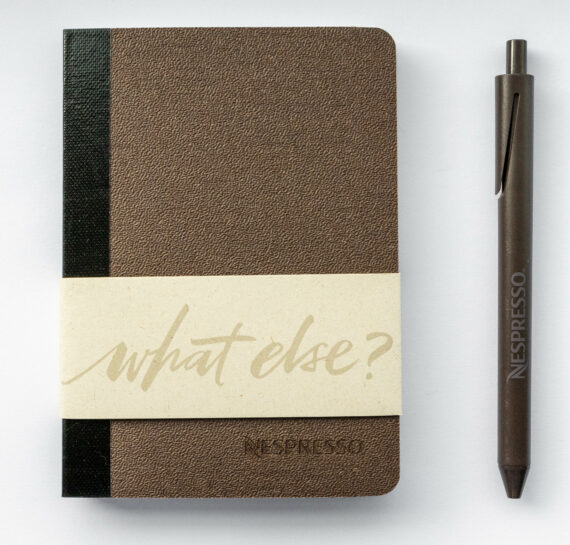
I obviously also like stationery and since last week I have some stationery that smells like coffee… A notebook and pen from Nespresso, made from coffee grounds.

Knives and pens, the posh ones

Nespresso has had cooperations with two other Swiss companies, linked to the recycling of their coffee capsules: Victorinox released Swiss Army Knives with scales made from the recycled aluminium from their coffee capsules and Caran d’Ache released the 849 ballpoint pen, also made from the recycled aluminium from their coffee capsules.

There were also cooperations with non-Swiss companies, like the one with Mikov in the Czech Republic. Their Nespresso knife is similarly priced to the Victorinox version. As far as I know, it is only available in the Czech Republic. In contrast, the Victorinox cooperation was available in many countries, but seems to have come to an end or is on hold after having run from 2016 to 2019.

Mikov left, Victorinox right (Images © Nespresso)

Recycled aluminium is common. Wikipedia has a reference from the Economist stating that recycling scrap aluminium requires only 5% of the energy compared to making new aluminium from raw ore and a reference from the US Geological Survey stating that approximately 36% of all aluminium produced in the United States comes from old recycled scrap.

When I came across the Nespresso 849 I was first sceptical of Caran d’Ache’s claim that the Nespresso 849 is actually made from recycled Nespresso capsules.
Why? Someone at Caran d’Ache, maybe the marketing department, has in the past been rather economical with facts. Best example: their Les Crayons de la Maison Caran d’Ache pencils. They now spell out that these are wood pencils reconstituted from poplar and abachi, but in the past their marketing material gave the impression that these pencils are made from exotic wood.
I am relieved that their Nespresso 849 has the text Made with recycled Nespresso capsules written in big, friendly letter on the side of the pencil. This explicitness gives me some reassurance that there is no misunderstanding and that the aluminium in the pen body contains recycled coffee capsules. I wonder whether all 849s are made with a small proportion of recycled Nespresso capsules or whether the Nespresso 849 is made from a completely different batch of aluminium. It seems easier to just mix some recycled capsules into all the scrap aluminium used to produce the new aluminium.

Caran d’Ache’s Nespresso Swiss Wood pencils seem even more exotic: The lead contains 25% coffee grounds. I’d love to see if that makes a difference in terms of erasability and writing experience. They also have metallic ‘colour capsules’ at the end. The first impression seems to be that these are made from recycled Nespresso capsules, but in their video, see below, you can see that the end is actually just paint.

Notebook and pen, the cheap (free) ones

Let’s close in on the main stars of this blog post: the notebook and pen currently being offered as a free gift to (some) Nespresso customers who place an order in the UK and some other markets. As is increasingly common in recent years, loyal customers get a worse deal: as far as I can tell this offer of a free notebook and pen with an order is by invitation only and the more Nespresso wants to bring you back into the fold the better the deal you get. I have seen similar offers from online grocery stores (Ocado) and from music streaming services (Spotify). From what I can tell the best deal offered by Nespresso to get this notebook and pen ‘for free’ was with an order of 5 strips (5*10 capsules). This includes free shipping. If you get this good 5 strips deal you spend around £20 and get the notebook and pen plus 50 capsules, i.e. enough for 50 cups of coffee.
In some areas you don’t need to rely on having been offered the deal as you can also buy the notebook on its own for €18.

The notebook contains 100% recycled paper and the cover contains the equivalent of 2 cups of coffee grounds waste.

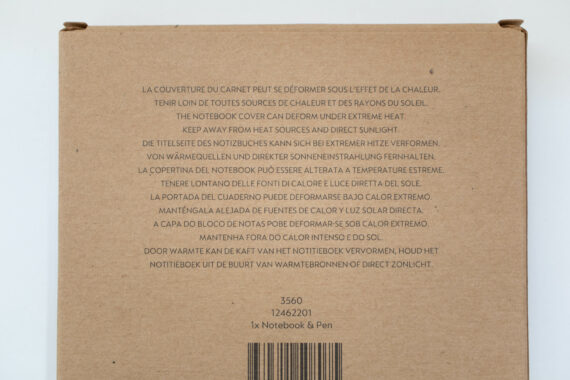
The first thing you notice when you open the cardboard box the notebook and pen come in is the strong coffee smell. I am not sure whether this strong and nice coffee odour is purely down to the coffee grounds used to produce the notebook (and maybe the pen) or whether the items have been ‘perfumed’ to smell like coffee or to increase the existing smell.
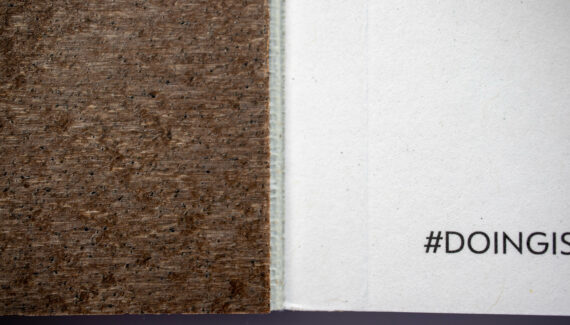
You can see the pattern of the plastic-like cover on the left

The notebook is made in the Netherlands and has a thick plastic-like board at the front and back. I assume it is some sort of composite material made form plastic and coffee grounds, similar to the Staedtler Wopex made from wood and plastic or the Kupilka (50% pine and 50% thermoplastic). The patterns on the notebook cover do remind me of the ones found on the Kupilka.

Kupilka and Wopex. Click on the photo for a link to the blog post.

The paper used is nice, but is not fountain pen friendly. It is however suitable for gel pens.

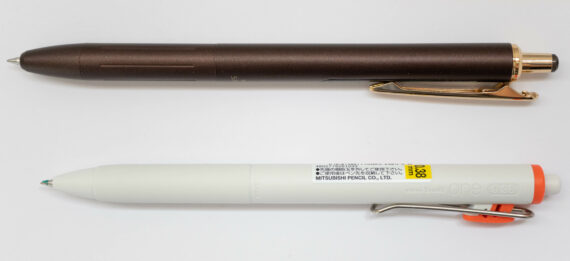
The pen has a similar look to the notebook cover, so I assume it is also made from coffee grounds, but I haven’t seen any official description from Nespresso that confirms this. The clip of the pen looks similar to the clip found on the Lamy Noto. I did not find any markings on the pen or refill, so am not sure who made it or which country it is from. I also did not see any markings on the black ballpoint refill it came with.

Top: Nespresso, Bottom: Lamy Noto – unfortunately the similarity of the clips is not easy to see on a two-dimensional photo, especially not on this one.

If it contains coffee grounds it is not the first pen available with coffee inside. A few years ago Shangching sent me the Fabula pencil, which also contains coffee.

https://www.instagram.com/p/6gMmWFBCZA/

Conclusion

A nice looking notebook and pen. I wish the paper was fountain pen friendly and both items were more easily available. If you can get your hands on them with a good offer then I’d certainly go for it.

Writing sample on the recycled paper. You can see that the paper sucks ink in. the EF in the last line should have been very thin.

The ballpoint pen looks nice, so I might look into putting a gel refill into it. That would make me use it more.

The ink is bleeding through the paper

You can buy the Nespresso 849 in the Gentleman Stationer shop.

Prices: July 2021

The images of the knives have been taken from the Nespresso web site. I believe that the use of these images falls under “fair dealing” as described by the UK Copyright service.

Nespresso notebook and pen Read More »

Lamy 2000 brown

I noticed that Lamy is releasing a limited brown edition of the Lamy 2000 fountain pen to celebrate the 2000’s 55th anniversary.

It is an absolutely beautiful pen, but unfortunately, it also comes with a price tag to match.

Brown

For everyday items brown can be a very nice colour. It often reminds me of wood or leather. In the past fake or real wood on everyday items used to be more common than they are now. My Atari VCS 2600, for example, had a fake wooden front and the brown colour complemented the console nicely. Later versions without the brown front just didn’t look as impressive.

1977 - atari 2600
The VCS 2600 is much nicer with the brown front. This is an embedded Flickr image. Click to go to this image on Flickr.

With brown colours sometimes appealing to my taste I also bought the Samsung Galaxy S3 in brown. At the time I read a review where the author made fun of the brown colour option. I didn’t quite understand why – to me, it was the best looking option.

Sarasa Grand Vintage

Back to pens: by coincidence, a few days before I found out about the Lamy 2000 in brown, I ordered the Sarasa Grand Vintage in brown. I only found two online shops in the UK selling the Sarasa Grand or Grand Vintage: MiSo Paper and Awesome Pens. In the end, I ordered from Awesome Pens (first time) as they also had the Uni-ball One I saw in a Pen Addict review.

The Sarasa is an unusual pen for me. According to Unsharpen it was released in 2000. I don’t think I saw it in the year 2000 and I first came across it in 2001 when I saw the ones my wife bought. I didn’t like them at all at the time, mainly because I didn’t like the look of the early clip. The newer clips with a metal spring do however look more attractive [1]at least to me, I wonder if some people prefer the old look…. So much so that the whole pen suddenly looks attractive to me. Once I saw the scented, i.e. smelly, version I was sold and bought some Sarasas myself.

The Sarasa Grand Vintage in brown and the uni-ball one in orange.

Unfortunately, neither MiSo Paper, nor Awesome Pens, the shops that had the Sarasa Grand I ordered, had the beautiful Sarasa R I saw in a Pen Addict Giveaway – in fact, I haven’t found any online shop in the UK selling the Sarasa R. The white colour of the Uni-ball One and the Sarasa R gives them a lovely clean look. That clean look reminds me a bit of the Lamy Safari Griso, mentioned previously.

For Sale: Vintage Lamy Safari Griso fountainpen and rollerball set. NOS. selling for 100€ including ww tracked shipping! rare set! Email me at miss.thundercat (at) gmail.com if your're interested. #forsale #pensforsale #selling #fountainpen #fpn #fountain
The Lamy Safari Griso. This is an embedded Flickr image. Click to go to this image on Flickr.

Lamy 2000 brown

Now that the topic has circled back to Lamy it’s time to talk about the Lamy 2000 in brown.

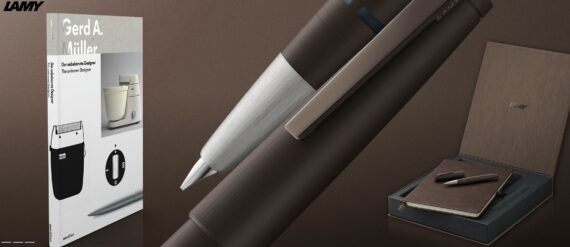
The brown version is the latest special edition (you can find out about other special editions on stationery.wiki) and is being released for the 55th anniversary of the Lamy 200. It comes in a nice presentation box, together with a nice, brown notebook and a biography of Gerd A. Müller, the designer.

Designs by Gerd A. Müller, Hannes Wettstein and related designs

When I checked the price I was rather disappointed. Here in the UK this set will cost nearly £500. In the USA the set will sell for $579. The set is limited to 3,300 pieces which explain the price, but I’d rather prefer an affordable version that can be used than an expensive limited version that will end up being a collector’s piece ending up in someone’s drawer. For comparison: my Lamy 2000 from 2008 was €89 (€105 / $124 in today’s money), my Lamy 200 from 2011 was £92 (£109 / $128 in today’s money). No matter how nice the colour, if I had the brown edition I would probably get the black 2000 out instead, as I would be worried the expensive and irreplaceable brown version would get damaged. Some people collect watches or motorbikes, so I can see that £500 can be cheap, compared to other hobbies, so I hope many of these brown 2000s get used.

Image © Lamy

Luckily you will be able to buy the Gerd A. Müller biography from the anniversary set on its own. It looks really good and is some consolation. I plan to buy it when it is out in the UK.


Price and exchange rates: July 2021

The last two images have been taken from Lamy and the avedition sites. I believe that the use of these images falls under “fair dealing” as described by the UK Copyright service.

References

References
↑1 at least to me, I wonder if some people prefer the old look…

Lamy 2000 brown Read More »

Beyond a pen

Extracting Ink, Photo by: Sirena Nieminen

By chance I came across a rather unusual student project from Finland’s Aalto Univeristy. It is called Beyond a pen and looks at mass produced pens, their stories and more.

Find out more on the Beyond a pen page of the Contemporary Design pages.


The image has been taken from the Beyond a pen page. I believe that the use of this image falls under “fair dealing” as described by the UK Copyright service.

Beyond a pen Read More »

The EGO.M Cento 3 – a graphene pencil

Lead holder and mechanical pencil (click to enlarge)

A few weeks ago I received a surprise parcel from John Hall of Write Here fame. Inside the parcel were two rather unusual pens that I have been using regularly since then. It’s time to send them back soon, but before I do that I want to show you these very special pens and talk about their unusual design.

Pens made from graphene on a notebook made from coffee (click to enlarge)

You can also find a video about the Cento3 on the Bleistift Youtube channel:

The mystery of a pen body made from graphene

Let’s get their most exotic property out of the way first: these pens are 3d printed from graphene. With graphene not being very think (one layer of atoms) you could think of it as being two-dimensional. You also commonly read that a one atom thick layer of graphite is graphene. With that in mind I am wondering how something three-dimensional can be graphene without turning into graphite. Maybe it is a flat ‘two-dimensional’ layer rolled up with some other material in between, but in that case, does it keep graphene’s properties and are they desirable in a pen body in the first place? So many questions….

The front of the mechanical pencil (click to enlarge)

I also wonder whether creating the Cento3 pen body requires very special 3d printers so that the graphene layers don’t melt together into a lump of graphite and whether the body has some sort of lacquer on top. Whatever the answers to all my questions are, the pen that Ego.M have produced is a very special pen and as I don’t understand enough about materials science I will just go along with the claim that this pen is made from graphene.

The design’s history

The idea for this pen was thought up 20 years ago, in 2001, when Achille Castiglione and Gianfranco Cavaglia came up with a pen design using the ‘trilobate’ shape. Think of three slim pens arranged together like a three-leaved clover and connected – I hope the image below gives you a better idea than my short description.

I hope this image give an idea how the ‘trilobate’ shape is being used for this pen. (click to enlarge)

At the time some non-working prototypes were made from wood, but the pen was not commercially produced until recently when the prototypes were rediscovered by the designer’s children and EGO.M, based in Bologna, started developing the prototypes into commercially produced pens which were then officially released in February 2021, 103 years (100 = Cento, so Cento3 = 103) after Achille Castiglione was born.

About the pen

Surface

The first thing most people will notice when they look at this pen is that the individual strands of extruded plastic filament are quite visible. On the body of the mechanical pencil I received for testing the pattern produced by the 3d printing process is much less ‘even’ than on the lead holder I got. I assume every pen is unique in this respect and if you pick another sample this might be different, i.e. another mechanical pencil might look ‘smoother’ and another lead holder might look less smooth. The uneven surface loves to attract dust which is quite visible if you enlarge the photos.

The EGO.M logo on the mechanical pencil(click to enlarge)

Weight

The next thing to notice is that for their length and diameter the Cento3 pens are quite light. In the diagram below you can see that compared to some of the mechanical pencils we looked at in the past only slim and plastic-y mechanical pencils and tiny mechanical pencils are lighter than the Cento3 mechanical pencil.

Mechanical pencils by weight (click to enlarge)

Amateurs like me often like heavy pens as they give the user the feeling of being more substantial and of higher quality, but professionals actually like light pens. It makes sense to use a light pen that isn’t tiring when you use it all day long.

Mechanism and ageing

I was not able to figure out what kind of mechanism is used in the mechanical pencil as I don’t see a non-destructive way of getting to the mechanism. I assume the 3d printing of the body is done directly on the mechanism.

Pens change over time. One example is the beautiful surface of the Lamy 2000. Over time it becomes more and more smooth and shiny. I am not sure how hard the filament is that was used to print the Cento3, but there is a good chance that over the years the surface might become more and more smooth. This is just a guess, but it might change the character of he pen over time.

The weight and shape make the pen surprisingly comfortable to hold and use. The 3d printed structure provides a good grip when you hold the mechanical pencil. Many mechanical pencil users rotate the pen automatically and even subconsciously to make the lead use up more evenly. This is slightly more difficult with the Cento3 compared to a thinner pen, but it is possible without hassle.

The lead holder

In my opinion the lead holder version of the Cento3 feels much posher than the mechanical pencil. Maybe it is down to the chrome-y front section or the more even printing of the filaments.

The front of the lead holder (click to enlarge)

Conclusion

These pens are a great innovation. They are not the first 3d printed pens available, but the first ones I know of with the graphene link. The mechanical pencil sells for £60, as does the lead holder. There’s also a fountain pen version for £80.

Thanks to John for lending me these for my blog post and video.

If you want to find out more about these pens you can do so

Please note that the pen is properly black, I just lit it so that you can see the surface well which made it looks less black on my photos than it actually is.

The EGO.M Cento 3 – a graphene pencil Read More »

A Danish Noris

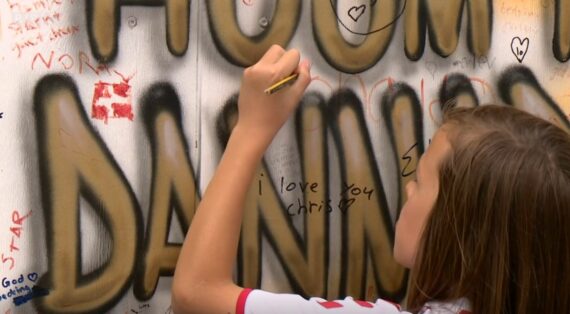
The Staedtler Noris can regularly be seen in news reports here in the UK (stock footage of school kids often include scenes of children writing with a Noris because of its popularity in schools) …so normally a Noris in the news (BBC or otherwise) wouldn’t be worth mentioning. Today is different though: because of a football (soccer) game between England and Denmark this evening the BBC News at Six viewers got a rare glimpse of what is going on on the streets in Copenhagen.

A fan writing well wishes on a wall – for a Danish football player who fell ill in a recent match (Image © BBC News)

Unlike here in the UK, where the ‘normal’ hexagonal Staedtler Noris is most popular, this unrepresentative sample of one from Denmark seems to suggest that the Noris Triplus Jumbo, which is not a common sight in the UK, is more common in the land of Hygge.


The screenshot has been taken from BBC News at Six on 7 July 2021. I believe that the use of this image falls under “fair dealing” as described by the UK Copyright service.

A Danish Noris Read More »