By Type

Pedlar’s Signet 100 HB


signet-boxThe Kimberly and Pedlars

Earlier this year, it was in February, Pedlars contacted me asking for some suggestions what pencils to add to their current offering. I believe Palimpsest suggested that they should contact me – and to be quite honest, I was quite excited to have a chance to make a (small) difference in the world of pencils. In my first email back I mentioned, among other pencils, the Kimberly – a pencil I really like, not only because of its metal cap and the fact that it’s made in the USA. Luckily Sean was kind enough to send me a pack a few years ago. Off topic: To my surprise the General Pencil Co seems to label their products, among other languages, in German, even though I’ve never seen their products in Germany – but it shows that exporting this pencil is an option they had in mind.

signet-box2

Much later did I found out by coincidence that Pedlars seemed to have liked my suggestion and started to actually add the Kimberly to their line of pencils. I’m very glad they did!

signet-front

Pedlar’s own pencil, the Signet 100

End of November I heard from Pedlars again. This time they sent me a new pencil they’re selling, their own model, called the Signet 100. According to the description in the box the pencil is made using American basswood/linden [1]Lexikaliker thought the Czech made Stabilo EasyGraph might possibly also be made using linden wood. and is made in the Czech Republic. The box it comes in, a very nice box with an old fashioned surface that implies quality is made in Cheshire.

signet-end

Where is it made?

I only know of two pencil factories in the Czech Republic. The Stabilo-Schwan factory is Český Krumlov and the Koh-I-Noor L. & C. Hardtmuth factory in Budweis. To be honest, my guess would have been that the Signet pencils are made by Koh-I-Noor L. & C. Hardtmuth, but according to the Signet box they are “made in the Czeck Republic by a long-established, family run company”, which means we can probably rule out Koh-I-Noor as the manufacturer.

Koh-I-Noor’s official name is Koh-I-Noor Hardtmuth a.s. and the company is a member of the Koh-I-Noor holding a.s. Group – and a.s. means that a company is a joint stock company, which makes an a.s. company not impossible, but less likely to be a family-run company. Stabilo Schwan is a limited company, so more likely to be seen as a family-run company, but there might very well be other pencil manufacturers in the Czech Republic. If you know of any, please let me know.

signet-overview

The pencil

The first impression I had when looking at the Signet was that it looks quite similar to the Palomino, which was also sold by Pedlars, so whoever might have designed the pencil might have gotten some inspiration (maybe subconscious, or maybe this is a coincidence), by Pedlar’s current range.
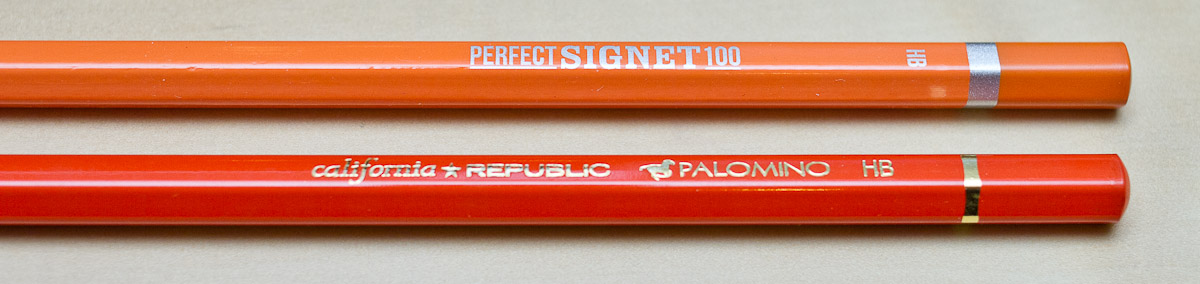
A Signet and a Palomino

Comparing this pencil in my mind to the recently discussed Koh-I-Noor, despite it being unlikely it’s from the same factory (‘family-run company’), I expected it to be a light writer, but it isn’t. There are smoother pencils out there, including many cheaper pencils (for example the really good and great value John Lewis pencils, the more I use them, the more I like them, but performance is good. Point retention is good, too, i.e. the point doesn’t wear down too fast. The pencil also doesn’t smudge and is easy to eraser.

Two Czech pencils
Two Czech pencils

The main issue with this pencil is probably the price, £24.95 (~$39; €31.50) for ten pencils. You do get a nice cardboard box with these pencils, but the price makes you compare this pencil to other high end pencils …where it can’t really compete and it therefore looks like a niche / hipster product.

Point retention
Point retention


Price and exchange rates: December 2014

You can find Palimpsest’s review of the Signet on her blog.

I would like to thank Ms Karie from Pedlar’s for the Signet pencils, which I have received for free.

Pedlar’s Signet 100 HB Read More »
A Viking invasion

The Vikings are coming

No one expects a Viking invasion [1]Their chief weapon is surprise… surprise and fear… fear and surprise… Their two weapons are fear and surprise… and ruthless efficiency… Their three weapons are fear, … Continue reading

…and when it’s coming there’s no escape.

Luckily I, Langskæg [2]the viking name given to be by Henrik, got invaded by the trading, not the raiding kind of Viking, thanks to Henrik’s generosity. You might know Henrik, who is from Denmark, from his comments on different stationery blogs.

How a full blown Viking invasion looks like.

Viking outside Denmark

Unfortunately Viking is one of those brands that is not very well known outside its home country. I hope that will change in the future. From my point of view Viking got most exposure in the English speaking stationery world when their products where released as past of the 2012 Rad and Hungry Denmark kit and the 2014 Rad and Hungry Denmark kit and booster pack. Rad and Hungry are also currently working with Viking to release their own notebooks and pencils, how exciting is that…


Viking’s history – a round trip from Denmark to Sweden and back

The Viking brand was registered in 1913 and the first pencils were produced 100 years ago, in 1914 [3]To commemorate the 100th anniversary Viking has released the Viking 100, a fountain pen (top right in the picture). , when the Danish matchstick factory H. E. Gosch started making pencils. The pencil branch of the matchstick factory was the brainchild of Folmer Preisler, who married the daughter of the matchstick factory’s owner. The beginning wasn’t easy, but after the two World Wars Viking was doing well. Their problems only started in the early 1970s, when a Swedish competitor bought the matchstick factory which, at that time, was still Viking’s parent. Just some context: At that time the Swedish matchstick maker Svenska Tändsticksaktiebolaget had a monopoly in Europe and many other parts of the world – when I was a kid these were the only matchsticks you could get (they had a monopoly in Germany from 1930 until 1983). After being taken over the Danish pencil factories closed down – the new owner was not interest in pencils. Later Viking ended up with Esselte, who used to own Dymo and who still owns Leitz. In 2010 Viking became Danish again when it was bought by Creas. Since Creas took over they started moving production back to Denmark or as close to Denmark as possible. They also put an emphasis on simple, good design and environmentally friendly production.


My Vikings

I’m really excited about trying out the new Vikings I have received from Henrik. The ones I have used so far, from Rad and Hungry, were very nice writers! A while ago I decided to produce shorter blog posts in the future, to make them less boring, so I won’t talk about the Viking stationery now but will write more about the them in a future blog post.


I’d like to thank Henrik for all the nice Viking stationery I have received. He’s not linked to Viking, doesn’t work in stationery and paid for the goods out of his own pocket.

Nearly all of the information in the Viking history paragraph was taken from Viking’s web site.

You can see more Viking products on their Danish web site.


References

References
1 Their chief weapon is surprise… surprise and fear… fear and surprise… Their two weapons are fear and surprise… and ruthless efficiency… Their three weapons are fear, surprise, and ruthless efficiency… and an almost fanatical devotion to stationery… Their four… no… Amongst their weapons… Amongst their weaponry …are such elements as fear, surprise… I’ll better leave that now and continue the blog post…
2 the viking name given to be by Henrik
3 To commemorate the 100th anniversary Viking has released the Viking 100, a fountain pen (top right in the picture).

A Viking invasion Read More »

Tachikawa School G for Manga 0.2 ~ 0.5

It’s fountain pen day – time for another fountain pen related post.


The pen

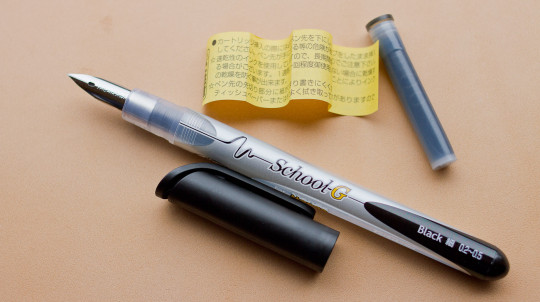
This time: the Tachikawa fountain pen, model School G for Manga. It comes with an extremely fine nib which for line widths from 0.2 mm to 0.5 mm. If you think that’s fine –  Tachikawa offers an even finer nib as well as version of this pen with sepia coloured ink. Just to help avoid confusion: Tachikawa also has a reputation for making very good flexible nibs for dip pens, one of them is called the G nib, but that’s a different nib. Tachikawa School G for Manga 0.2 ~ 0.5


The price

I got my Tachikawa pen a few months ago from Fudepens, together with the Pentel Ain Click eraser I wrote about earlier this year and other products. As far as I know Fudepens is only selling the 0.2-0.5 mm version, which costs €7 (~$8.70; £5.50), not the versions with other nibs or ink colours.


The ink

The pen comes with a adivce on a little yellow piece of paper. One of the recommendations suggests using the pen at least once a week. The implication is the “special quick-dry ink” might otherwise clog up the feed. The ink is really black, similar to Indian ink, which is probably why it is easier to clog up the pen.

Tachikawa School G for Manga 0.2 ~ 0.5

Writing  & line width

As you might have expected – a fountain pen with such a fine nib is rather scratchy. As mentioned earlier the body of the pen suggests a line width of 0.2 mm to 0.5 mm, but when I writing without applying much pressure the line width is not even as wide as that I get from my Faber-Castell Ecco Pigment 0.1 mm fine liner pen. You can vary line width by applying more pressure, but you have to use quiet a bit of pressure (at least with the pen I got) to get a line of ~0.5 mm – so much pressure that you have to write slowly to control the line.


Conclusion

An interesting fountain pen if you want a very fine line. It does produce a very clear line that is easy to see, despite being so exceptionally thin, thanks to it’s blackness. In comparison other black pens, like the Faber-Castell Ecco Pigment 0.1 mm look grey-ish, even though that is not easy to see on my photo, where I compared them on a Black n’Red Polynote A7.

Compared to other pens

I would like to thank Fudepens.com for the Tachikawa School G for Manga fountain pen, which I got sent for free. I don’t think the fact that I didn’t pay for the pen influenced my opinion of this pen in any way.

Tachikawa School G for Manga 0.2 ~ 0.5 Read More »

2x Staedtler

Just a quick note – actually: two.


First: It looks as if Staedtler will release a new sharpener next year. What makes it really interesting is the article number: 501 180. The article number of their current rotary (i.e. hand crank) sharpener starts with 501. …and number 180 is associated with another, very nice product from Staedtler. Franken Bleistift


Second: I came across this article: The coloured pencil’s 180th birthday – a Franconian invention used around the world. [1]With such a title I couldn’t resist displaying my Franconian pencil logo again.
Unfortunately the original article is in German, but here’s a link to the Bing translation and to the Google translation. The article talks about Johann Sebastian Staedtler’s coloured pencil breakthrough in 1834.


References

References
1 With such a title I couldn’t resist displaying my Franconian pencil logo again.

2x Staedtler Read More »

Look who’s 125

It’s the Koh-I-Noor’s 125th birthday this year! Congratulations!

This pencil just featured in Contrapuntalism’s latest blog post (last picture) and I also mentioned it in my previous blog post.


The colour

Austro-Hungarian flag
flag of the Habsburg Monarchy

If you are not familiar with the Koh-I-Noor: this is the pencil that might be the reason there are so many yellow pencils around, especially in North America. Petroski mentions a story in his book that describes how the L. & C. Hardtmuth Company picked yellow as the colour for this pencil because the flag of the Austro-Hungarian Empire (the same as the flag of the Habsburg Monarchy) was black and yellow [1]in the comments of this blog post Rick has corrected this: the flag of the Austro-Hungarian Empire was not black and yellow. However, both the flag of the Austrian Empire and the flag of the Kingdom … Continue reading – “and since the graphite was black, the pencil had to be painted golden yellow” [2]see Henry Petroski: The pencil (1989), p. 161 in my UK edition of this book.

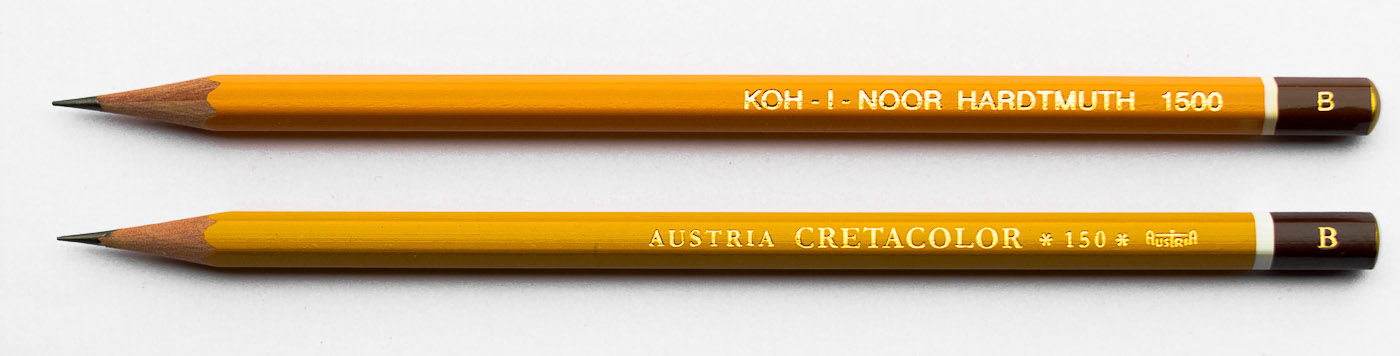
Different Koh-I-Noor pencils from Austria and the Czech Republic
Different Koh-I-Noor pencils,  made in Austria and the Czech Republic – bought in the UK, Germany and China.


The glory of the past

Now before I go any further I have to to say that the two descendants of the original Koh-I-Noor share the heritage but not the pompousness of the original Koh-I-Noor. I fear they also don’t share the high quality of the old Koh-I-Noor pencils which were given “fourteen coats of golden-yellow lacquer, the ends of the pencils were sprayed with gold paint, lettering was applied in 16-carat gold leaf” [3]see Henry Petroski: The pencil 1989, p. 191 in my UK edition of this book or the effort made to protect it – a Manx cat and her offspring were protecting the store rooms of this pencil from mice [4]again p. 191.


The Koh-I-Noor's look  before 1852.
The Koh-I-Noor’s look before 1852.

The name

Such a luxurious pencil needs a fitting name. The Koh-I-Noor pencil was named after the Koh-I-Noor diamond, a diamond from India that was once the largest known diamond. This diamond is set in the crown of Queen Elizabeth [5]see Wikipedia (That’s Queen Elizabeth, the wife of King George VI –  not Queen Elizabeth II, the current queen). You can admire the Koh-I-Noor diamond in the Tower of London.


 The Koh-I-Noor on both sides of the Iron Curtain

It all started to go a bit pear shaped for the Koh-I-Noor pencil when, after WWII, companies in Czechoslovakia were nationalised. At that time there was no pencil production in Austria as earlier production was moved to Budweis – when the Austro-Hungarian Empire was still around.  On the other side of the Iron Curtain the descendants of Joseph Hardtmuth, the founder of the company, managed to re-establish pencil production of the Koh-I-Noor in Upper Austria in 1950 [6]see the Ruling of the Federal Court (of Switzerland) 83 II 312, p. 317 and were also able to use the Hardtmuth and Koh-I-Noor trademarks. Much later, in 1996 production of the Austrian Koh-I-Noor pencils would move East to Austria’s state of Burgenland, an area which, in 1950, was in Austria’s Soviet-occupied zone [7]I’d like to thank Cretacolor’s Mr. Ellmauthaler for this information.


The real successor

Which of these companies is the ‘real’ Koh-I-Noor L. & C. Hardtmuth? It’s difficult to say even or especially in my very simplified version of the story. You could argue that the company in Budweis is the real successor. Pencils were made in the same factory as before the nationalisation. On the other hand you could also argue that the Western branch is the real successor. All seven shareholders as well as most senior staff flew Czechoslovakia when the company was nationalised [8]see the Ruling of the Federal Court (of Switzerland) 83 II 312, p. 316 and moved the company with them.

The Austrian and Czech successors.

For me both companies are successors of the original manufacturer. The company in Budweis does still exist. As mentioned earlier the Austrian branch moved to Burgenland.  Their pencils are still being produced there. You can get Austrian made Koh-I-Noors, but there has been a change in ownership so the Koh-I-Noor pencils are now being sold under the name Cretacolor. You won’t find the successor, the Cretacolor 150, on Cretacolor’s web site, because of the web site’s focus on artists, but the 150 is selling well, not only in Austria, but also in countries like China [9]I’d like to thank Cretacolor’s Mr. Ellmauthaler for this information.


The image of the Koh-I-Noor originates from the Nordisk familjebok. The copyright for this image has expired.


References

References
1 in the comments of this blog post Rick has corrected this: the flag of the Austro-Hungarian Empire was not black and yellow. However, both the flag of the Austrian Empire and the flag of the Kingdom of Hungary were black and yellow
2 see Henry Petroski: The pencil (1989), p. 161 in my UK edition of this book
3 see Henry Petroski: The pencil 1989, p. 191 in my UK edition of this book
4 again p. 191
5 see Wikipedia
6 see the Ruling of the Federal Court (of Switzerland) 83 II 312, p. 317
7, 9 I’d like to thank Cretacolor’s Mr. Ellmauthaler for this information
8 see the Ruling of the Federal Court (of Switzerland) 83 II 312, p. 316

Look who’s 125 Read More »