Sorted By Manufacturer

Muji “A6” Memo Pad, 200 Sheets

A few months ago, on a trip to the Trafford Centre in Manchester, I bought this Memo Pad from Muji. I used to write little notes on the reverse of calendar sheets, so there was no need to buy memo pads… but I seem to run out of calendar sheets, partly because the sheets of my Dutch Donald Duck calendar were printed on on both sides, partly because there has not been a sheet-a-day Star Trek calender for a few years, so I am reluctant to use the remaining Star Trek calendar sheets for notes.

Muji Memo Pad, Soennecken pencil, Läufer eraser


The Memo Pad (item code 1476353) has 200 sheets and is made from 50% recycled paper [1]At least according to the information provided by Muji. In the previous years there have been some concerns about the accuracy of the figures given by the manufacturers as several large Japanese … Continue reading. As expected the recycled paper is not pure white. The colour of the paper  from my memo pad is slightly more green than other recycled paper I know, but this might not apply to all Memo Pads. Writing on it with a pencil is working really well. Writing on it with a fountain pen is a very different thing though. It is actually quite problematic as the paper soak the ink up really fast. Enhanced difficulty – I used a really wet writer: the Lamy 2000 fountain pen and tried to use it on this paper, but writing very fast and with few pressure. It didn’t really work well either (as you can see). If you want to use this paper with a fountain pen (even if it not such a wet one) you will have to live with the fact that you can also see the ink on the reverse of the sheets.

The price is great, only £ 0.90 ($ 1.36, €1.04). In its native Japan the Memo Pad is even cheaper, ¥ 84, which is currently about 59 pence. In the USA it is cheaper, too: $1.25. One thing is rather odd about this Memo Pad: even though it is not advertised as being A6 in Japan (or the USA) it is being advertised as being A6 in the UK. “Hold on”, you might say, “that’s not odd, the USA is using ‘letter’ and ‘legal’, etc. and Japan… maybe they don’t use the ISO 216 standard in Japan” …but it is (odd), because they do (use ISO 216).

The odd thing is that the Memo Pad is not A6, but that someone from Muji UK seemed to think it would be a good idea to advertise it as A6 because it is a bit like A6. Most readers of this blog are from the USA, followed by Canada. As far as I know the ISO 216 format (i.e. A4, A5, ..) is relatively unknown in North America (please correct me if I am wrong!), maybe except among pen and stationery aficionados, so here is a bit more on ISO 216:

In 1786 physics professor Georg Christoph Lichtenberg wrote a letter to a friend. This letter included, amongst other things, a discussion about the materials used for paving the streets in London, and the idea that it would be nice to base paper sizes on a single aspect ratio of √2 (I am however not sure whether Prof. Lichtenberg or his English student thought of this). The advantage of this aspect ratio is that you can halve the paper, but still get the same aspect ratio. In 1922 Dr. Walter Porstmann made this idea, together with some fixed sizes and other bits and bobs, into the DIN 476 standard ..which became the ISO 216 standard. The A6 standard should have 105 mm × 148 mm (with a tolerance of ±1.5 mm). The Memo Pad is labelled as being 140 mm x 100mm, but is actually 138 mm x 99mm.

Conclusion:

All this A6 fuss? Much ado about nothing. Only engineer type people will be shocked, everybody else can’t be bothered. Not A6, but nearly A6. Not labelled A6 in Japan, but sold as A6 in the UK. Luckily it is smaller, not bigger, so it will still fit in folders and holders, etc. Paper good for pencils, bad for fountain pens. Good price. The End.

Prices and exchange rates: May 2010.

I would like to thank Lexikaliker for the Läufer eraser used in the photo.

References

References
1 At least according to the information provided by Muji. In the previous years there have been some concerns about the accuracy of the figures given by the manufacturers as several large Japanese paper manufacturers exaggerated when it came to the amount of recycled material used. I do not know whether the paper manufacturer of this memo pad is one of them.

Muji “A6” Memo Pad, 200 Sheets Read More »

Lego / Senator eraser

When I went to Germany over the Easter holidays I saw many pencils, erasers and sharpeners that are difficult to find in the UK. One of these difficult to get ones are the Lego erasers. I have actually seen them in the UK, at Selfridges, but they were very expensive. In Germany they were fairly cheap: usually a pack of two sells for € 1.49 (~£ 1.30, ~$ 2.00), but I bought mine in the first shop where I saw them ..for €1.99 (~£ 1.75, ~$ 2.68). There is also a version with three erasers available (red, blue and green).

The Lego erasers are manufactured under license by Senator, a company established 1920 and well known for their promotional ballpoint pens. They are one of the biggest manufacturers of ballpoint pens, producing about one million ballpoint pens each day, and their range includes unusual pens as well, e.g. biodegradable pens or the “only antibacterial pen approved to British standards”. Before I saw the Lego eraser I was not aware that Senator made erasers, except maybe the erasers used in their multifunctional pens.

The eraser is actually performing very well. I compared it to the Staedtler Mars plastic pen and the fantastic Faber Castell 18 71 20 on Bloc Rhodia No 13 paper, using a Faber-Castell 9008 Steno 2B pencil [1]which in my opinion is in some respects quite similar to the Tombow Mono 100 HB. The performance of the Lego / Senator is as good as the performance of the other two, maybe a tiny bit worse, but that might just be my subjective impression. Compared to the Staedtler eraser pen you need to apply fewer pressure when using the Lego / Senator eraser.

Conclusion:

A good looking novelty eraser that performs well.

Price and exchange rates: April 2010.

References

References
1 which in my opinion is in some respects quite similar to the Tombow Mono 100 HB

Lego / Senator eraser Read More »

Eco Bridge Paper Pencil

Last time I visited Selfridges, they had the Robot Pencil Sharpener from Kikkerland on a shelf. I recognised it from Dave’s Mechnical Pencils, but I am sure I have also seen it in other blogs. Of course I could not resist and was drawn to it. Next to it there were also some other novelty pencils and eraser, including big dinosaur shaped erasers, Penguin Book pencils and paper pencils. This being Selfridges the items were not cheap, but I still bought the robot sharpener and the paper pencils.

Eco Bridge Pencils & Kikkerland Robot Pencil Sharpener

The paper pencils are from a company called Eco Bridge and are made in Korea. I paid £3.95 (~ $ 5.95, ~ € 4.40) for three pencils. The price in Korea is 2300 Won (~ £ 1.35, ~ $ 2.00, ~ € 1.50). Not cheap, especially when keeping in mind that until recently Tesco sold similar pencils made from rolled Chinese newspaper for less than 5p (~ 8¢, ~6ct) each. O’Bon’s newsprint pencils, reviewed at pencil talk, cost $5 (~ £ 3.30, ~ € 3.70) for a pack of 10.

The Eco Bridge pencils  is definitely softer than the Tesco pencil or the average European HB pencil, its softness is comparable to a Staedtler Mars Lumograph B, Faber-Castell 9000 2B or Palomino HB. Smudging is similar to other pencils of this softness. To my surprise the Eco Bridge is a very good pencil. It is much smoother than a Dong-A Fable HB, one of the few pencils from a Korean company that is, as far as I know, produced in Korea. I normally prefer pencils where the point stays sharp for longer, but softer pencils like the Eco Bridge have the advantage of delivering a nicer, darker black when writing.

Eco Bridge Pencil (front) & Tesco Pencil (back)

When it comes to sharpening the pencils the Tesco pencil performs better than the Eco Bridge. The blade of the sharpener (in this case the Eisen 402) seems to cut the Tesco paper much better, while the paper in the Eco Bridge is more likely to get ripped away. While the paper used for the Tesco pencil is rolled paper with Chinese characters on it, probably from a newspaper or something similar, all three Eco Bridge pencils have a similar colour distribution on the paper, red in the middle, near the lead, and recycling beige on the outside. I suspect that the paper used for the Eco Bridge has been recycled and printed on specifically for this pencil, in order to produce this pattern on the paper. This would also explain the higher price tag. This recycling process might be responsible for the rougher paper, compared to the Tesco pencil, which results in the paper ripping easier.

Eco Bridge & Tesco on Bloc Rhodia No 13, eraser test with Mars plastic pen, smudge test on the right

Conclusion:

The Eco Bridge is not cheap, but it is a nice pencil. It might not be able to compete with really good pencils, but it is better than most “average” pencils. If you like B or 2B pencils and happen to see the Eco Bridge pencils in a shop you could give it a try. On the other hand this money would (nearly) buy you one of the good pencils (9000, Lumograph, Palomino, Mono).

Price and exchange rates: March 2010.

I would like to thank Kent from Pencilog for the Dong-A Fable used for the comparison.

Eco Bridge Paper Pencil Read More »

Graf von Faber-Castell

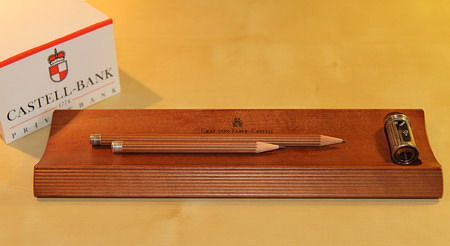
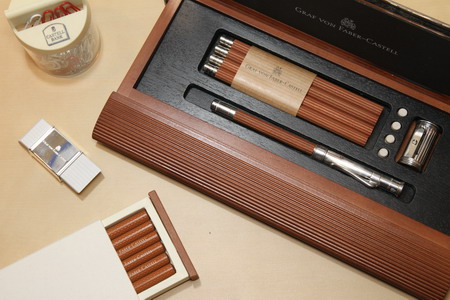
I would just like to say thank you to Sean from Pencils and Music. He told me about several auctions where old Graf von Faber-Castell items were offered that are no longer available …and as you can see I managed to be the winning bidder for some of these items.

In case you wonder about the Castell-Bank paper block and paper clip holder: They are promotional gifts from the “Fürstlich Castell‘sche Bank”, a bank that belong to the Castell-Castell and Castell-Rüdenhausen branches of the Castell family. I had the paper block and the paper clip holder since the 1980s or the 1990s, so I doubt they are still available.

The Faber family, manufacturers of pencils, and the Castell family, one of Europe’s old noble families with roots going back to the 11th century, crossed paths in 1898. You can find more information about the Castell family in the Faber-Castell Topics newsletter 1/2008 and on the history pages of the Faber-Castell web site.

Links:

Graf von Faber-Castell Read More »

Staedtler tradition 110

When it comes to the recognition value of their pencils there is one company that – in my opinion – does by far the best job: Staedtler. Compared to other companies in this industry Staedtler is quite unusual as the company belongs to the Staedtler foundation whose main purpose is the promotion of scientific research… but I digress. Let’s get back to the pencils: As much as I like to use pencils from other companies, the Faber-Castell 9000 for example, for me the archetype of a pencil is the Staedtler Noris, available in two versions: as the 120 (without eraser) and as the 122 (with eraser).

The Noris is a pencil that is very common in Europe, but I would not say that it dominates the market. Noris as a brand name for pencils has been registered in 1901 and the name Noris itself is closely related to Staedtler: the nymph Noris is the personification of Nuremberg, the city where Staedtler has its headquarters. The Noris pencil is definitely quite popular in Germany. In UK it is also quite popular: in supermarkets you can usually find at least two types of pencils, often more, but a no name pencil and the Staedtler Noris seem to be the common denominator.

Somehow the look of the Noris is easy to remember, but this is not a feature unique to the Noris: Staedtler also did a great job in that respect with some of their other pencils: the tradition and the Mars Lumograph. These three models are instantly recognisable and unless you count the yellow Koh-I-Noor [1]which was not the first yellow pencil, but seemed to have sparked the popularity of yellow pencils in America they seem to be the most copied pencils in the world.

Stephen Wiltshire, using a Staedtler tradition, on BBC’s Top Gear (Image © BBC)

The look of some of the most popular pencils in India, the Reynolds 432, the Nataraj 621 and the Doms Ajanta, seem to be based on the Staedtler tradition, as is the look of the Chunghwa 6151, reviewed at pencil talk as well as countless other copies. You can also come across the tradition in the media. In a recent episode of Top Gear for example, Stephen Wiltshire was using a Staedtler tradition for his drawings.

Icon in Okular (Image © Okular)

The Staedtler Noris was the antetype for the Chunghwa 6181, reviewed at oh! super tooth, but even though the Noris has probably been less often copied than the tradition and the Mars Lumograph, it can be seen on TV more often, usually used by somebody who is probably not even aware what make or model it is.

In one episode of Black Books the main character is using a Noris to control who is allowed to talk. I just saw the Noris again last week in a BBC documentary unrelated to pencils, and I see an icon that looks like the Noris on a daily basis in Okular, the document viewer in KDE 4.

Slightly younger than the Noris, with Mars being registered as a pencil brand in 1900, but with the Lumograph being released about 30 years later, the Mars Lumograph would probably have to top the list when it comes to how often the look of a pencil has been copied by no name pencils. I have seen no name pencils with the look of the Mars Lumograph, but without any writing on it countless times. Sometimes you can also see copies of this pencil with the name of the manufacturer on it, e.g. the Chunghwa Drawing pencil, reviewed at Blyantsiden (Google translation) or the Medicise Drawing pencil 9002. Of course the Mars Lumograph also got its fair share of TV presence. Just to name one example, there is a Derrick episode from the Seventies where a secretary is using a pencil, unmistakably a Mars Lumograph.

Top to bottom: Great Britain, Australia, Germany

The distinct look of the Staetdler pencils makes recognising them so easy. This must surely be an important factor that influences the decision of customers when they are in front of a shelf of pencils and need to decide which pencil to buy.

Unfortunately Staedtler stopped producing pencils in Australia and Great Britain, but some shops still have stock left that was produced in these two countries. You might know where this is going… After this really long-winded introduction I will now compare Staedtler pencils from different countries, to be more precise: I will be comparing the Staedtler tradition 110 from Australia, Germany and Great Britain. For this comparison I used recently produced pencils from the three different factories. It would be wrong to assume that there is no variation in the production, so please do not take this comparison too seriously.

Top to bottom: Great Britain, Australia, Germany

When comparing the different HB versions [2]Even though I have most grades of the British (actually Welsh to be precise) and of the Australian tradition I only have the HB version of the German tradition. you can see that the Australian version has the thinnest layer of paint. I have to say that I actually like it, because you can see the texture of the wood through the paint. On a negative note I also have to add that the Australian pencils (all grades) have the paint applied less consistently. All pencils came pre-sharpened, but the pencil from the German factory has been pre-sharpened using a different method than the other pencils. The pencil from Great Britain is definitely softer than the other two. It also smudges a bit more. When I tried to erase all three using the Mars plastic eraser pen (528 50) there was no real difference between the different pencils.

Different tradtitions on Brunnen Kompagnon Anno 1877 paper

Comparing the Australian 4B and the British 4B I also thought that the British pencil was a tick softer, but this was definitely not as noticeable as it was for the HB pencils. Using the Mars plastic eraser pen the Australian 4B was maybe a bit easier to erase than the British 4B, but again there was not a big difference.

Different tradtitions on Brunnen Kompagnon Anno 1877 paper

Conclusion: The tradition is a really good pencil. I am not sure why, but the German Staedtler web site lists the tradition in the artist category, not in the category for pencils used for writing. Nevertheless the tradition is very suitable for writing. Stock of Australian and British tradition pencils will be exhausted soon, so get some while you can …not that the performance of the German tradition is worse, but if you just spent a few minutes reading this post you must be pencil-crazy enough to want the Australian and British version as well.

Click to see full size

Click to see full size

Links:

Acknowledgements:

I would like to thank David from Dave’s Mechanical Pencils for the selection of Australian pencils, including the Staedtler tradition, he sent me.

The photo of Stephen Wiltshire using a Staedtler Tradition has been taken from Top Gear Episode 5 of Series 14. I believe that the use of this image falls under “fair dealing” as described by the UK Copyright service.

The pencil icon has been taken from Okular, the document viewer in KDE 4.

References

References
1 which was not the first yellow pencil, but seemed to have sparked the popularity of yellow pencils in America
2 Even though I have most grades of the British (actually Welsh to be precise) and of the Australian tradition I only have the HB version of the German tradition.

Staedtler tradition 110 Read More »