Congratulations to the winners of the first Bleistift giveaway. I’ll send your prizes out first thing tomorrow morning and will also include a few other pencils I have lying around, including the Faber-Castell 1117 and a Graf von Faber Castell pencil.
The first number I got from random.org was 20, this means Kartike E from Indonesia gets the first prize. She chose the rubber-tipped version of the Noris, the Noris 122 HB.
The next number from random.org was 16 – Palimpsest from the UK wins the Welsh-made sketching pencils.
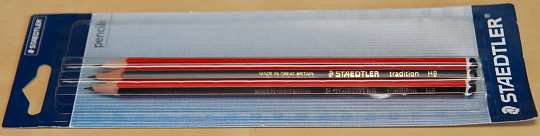
Number 15 came next. That was a post by myself, so I requested another number from random.org instead, which was number 5: Lexikaliker from Germany. Since he already has some Staedtler Tradition 110s he was kind enough to give someone else the chance to win. Thank you! The replacement number I got was the 13, which means that Sheryl C from the USA wins the blister pack with Welsh-made Staedtler Tradition 110s.
Thanks again to all who took part. I hope the winners will receive the pencils soon.
I was very sure that I wanted a tan coloured notebook [2]which might fit well with my Sonnenleder pencil cases, not the brown or black one. Deciding on the size was easy, too. A6 is a bit small unless you want to carry the notebook around, A4 is a bit big – so I chose A5. But what paper to choose? I didn’t want the plain 90 g/m² paper …but the 140 g/m² paper from Star Paper Mills was certainly tempting. In the end Vulcan logic won over Romulan passion and I chose the more practical, ruled version with 90 g/m² paper from BILT industries, a company which traces its roots back to 1945 when Ballarpur Straw Board Mills was established in India. BILT industries is not only making paper, they also manufacture other stationery. One of their pencils has been reviewed at pencil talk. In the future there will also be a version of the Monsieur notebook with 100 g/m² paper from the Finnish paper manufacturer Stora Enso.
Leather
Let’s look at the leather used. The leather is vegetable tanned, which means the environmental impact is not as high as it is with many other types of leather. The leather looks more red than other vegetable leathers I have seen in the past and it certainly didn’t have an artificial grain applied to its surface – you can see blemishes and marks. Personally, I like this natural, slightly rough look very much. It gives the leather a handmade and traditional look. Despite the look, the surface of the leather has a very even feel to it. So nice, that my wife first thought it’s not real leather as the surface is quite hard, but still feels smooth the same time. I have to say that she wasn’t too keen on it, maybe because of the natural look. Not that the leather is like “saddleback” leather in any way, but I would say that if you like matte, raw finished leather, like saddleback leather, and a natural look you will like this notebook – I certainly do. If you like perfectly looking leather with artificial grain, the one you see so often these days, you might not be too happy with the “naturalness” of this notebook.
The paper performed really well. Even though it seemed to be sucking ink of very wet pens in, the picture shows this effect from a Pelikan M250, the ink didn’t bleed through the page and even though there was slight feathering with very wet pens the paper behaved well with pens that have a normal ink-flow, like the Hero 616 or the Lamy joy. Uncareful erasing of graphite with a Sanford Artgum Eraser did roughen the surface of the paper slightly, but gentle erasing was problem-free.
Conclusion
Overall, a great notebook. If you like leather and don’t reject it for ethical reasons [3]Most vegetarians I know don’t mind buying leather this is a great notebook. Similarly priced as other notebooks with PVC or plastic covers, the notebook I reviewed here sells for £12.99 (~ $20.70; €14.50), but has a classic, much better feel to it.
Price and exchange rates: July 2011
I started using a new image plug-in. The old one didn’t really work well. From now on you should be able to get a close-up of most images by clicking on them. I would be happy if you could let me know, e.g. as a comment on this blog post, whether this function works well on your computer.
I would like to thank
Tom from Hide stationery for the Monsieur notebook, who sent me the notebook free of charge
The photo of Nick Hewer using a Lamy Joy has been taken from series 7 episode 8 of The Apprentice UK. I believe that the use of this image falls under “fair dealing” as described by the UK Copyright service.
The 100th post at Bleistift. I thought I should make an extra effort for this blog post, so there will be the first ever giveaway at Bleistift (oh, go on then, scroll down to find out more about the giveaway before you read the article). Today’s post will look at the history of Staedtler UK. It is a follow-up post to the Staedtler Tradition [1]Last time I spelled Tradition lower case, as printed on the pencils, but for this post I decided to consistently start with a Capital. 110 post from March 2010[2]A post that mentioned that Stephen Wiltshire is using the Staedtler Tradition. Twelve months later Staedtler managed to get his support for their pigment liners..
By Appointment to the Late King George V
1790 – 1920 Wolff and Cohen
Elias Wolff
The history of Staedtler in the UK seems to date back as far as 1796. As far as I can tell this was the year when Elias Wolff, aged 15, started his career as a pencil maker. In 1822 he officially started his own company and by 1840 his son was on board and the name of the company changes to Elias Wolff and Son.
Why London?
The company was based in London, which is not surprising. The UK was and is very centralised and in the past graphite mining and production was controlled by the crown. Graphite had to be transported all the way from Cumbria to London, to be sold or auctioned. Soon Flemish traders were supplying graphite to all of Europe and the Society of Mines Royal asked the family of Höchstetter to apply their Bavarian mining techniques to make mining more efficient.
Solomon Cohen
Solomon Cohen, another pencil maker, was born around the same time as Elias Wolff. When his son Barnet Solomon Cohen took the business over he started trading as B.S. Cohen. In 1919, at a time when England had some of the best pencil factories in the world, B.S. Cohen and E. Wolff and Sons merged. The name for the new company: Royal Sovereign Pencil Co.
… and Napoleon?
These were turbulent times. Elias Wolff and Solomon Cohen were born around the time of the French Revolution and worked as pencil makers while the war between Britain and France and the Napoleonic Wars were going on.
Paulus Staedtler
Paulus Staedtler, another pencil maker, was born in 1779, in Nuremberg. Turbulent times there as well: Prussia took Nuremberg over before, in 1806, Napoleon’s army gave the city to their ally Bavaria – not long before all of Franconia was annexed to Bavaria in 1815. In 1835 Paulus’ son Johann Sebastian Staedtler started his own factory, the company we know today as Staedtler.
1919 – 1992 Royal Sovereign Pencil Co
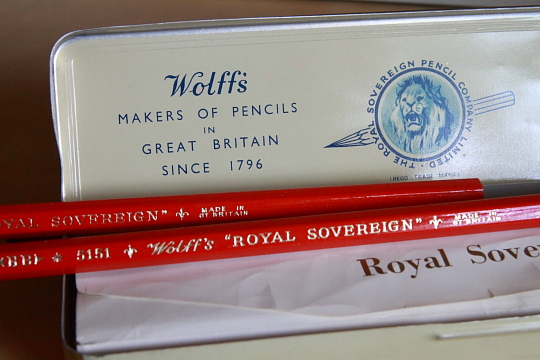
The Royal Sovereign Pencil Co started life in 1919 and was renamed to Royal Sovereign Group Ltd in 1974, just before the factories where taken over by Staedtler. Strangely enough the names Wolff and Royal Sovereign never belonged to Staedtler. I have to assume that the new Royal Sovereign company only held on to the names and maybe some other intellectual property rights, not to any hardware. As far as I can tell, based on information provided by Companies House, the United Kingdom Registrar of Companies, the company was taken over in 1987. It took me a while to figure out that the company that took over the rights to the trademarks etc must be the Dickinson Robinson Group, a company that pioneered a number of innovations in paper-making in the 19th century. In 1989 this group was then taken over by Pembridge Investments, around the same time the rest of Royal Sovereign became part on Nontradorm, before the rest of the Royal Sovereign Group was officially dissolved in 1992. The names “Wolff” and “Royal Sovereign” do however live on. A family owned business, West Design Products, somehow got hold of the rights to the names Wolff and Royal Sovereign and sell Indonesian-made pencils under this name. A first attempt at contacting West Design Products nearly twelve months ago was unfortunately left unanswered, as was a subsequent attempt, so I was not able to find out how these traditional names came into their possession and whether their pencils are made in Staedtler’s Indonesian factory.
West Design’s Wolff’s Graphite Sketch Set
1975 – 2009 from Royal Sovereign to Staedtler UK – how the pencils changed
RS Bonded
In April 1966 Royal Sovereign started to produce two different types of Staedtler pencils in Pontyclun, Wales. The early Staedtler Tradition 110 pencils made there had “RS – Bonded” printed on them. The factory still made Royal Sovereign pencils and they, too, had “RS – Bonded” printed on them. These early Staedtler Tradition pencils were pre-sharpened on the right side, i.e. looking at the pencil with the print facing up, the right side of the pencil has been sharpened. The RS Bonded version hexagonal, like all other Tradition 110s, and mainly red. The cap has the typical Staedtler look, but only the side of the pencil with the gold letter print is painted black. All other sides of the pencil are red with a thin black strip in the middle.
Bonded
The next generation of Welsh-made Tradition 110 pencils is pre-sharpened on the left, the same way as nearly all modern pencils. This means that the text on the pencil is not upside down if the pencil is held in the right hand, as was the case with the RS Bonded version. The black and red pattern changed, too, and is identical to modern Staedtler Tradition 110s. The side with the print and the opposite side are black. The other fours sides are red with a black strip between two adjacent red sides. For this generation the stamped text “RS Bonded” has been replaced with “Bonded”.
Jet Bonded
The next generation of Tradition 110 pencils was probably released around 1972, a few years before Staedtler bought the factory in Pontyclun in 1975. This is the first generation of UK Tradition 110s, where the glue has been applied by a machine. Previous version had the glue applied manually. The print changed from “Bonded” to “Jet Bonded”.
Barcode S
I am not sure whether there has been a generation [3]or several generations of Tradition 110s between the previous Jet Bonded version and the next version that features a bar code. It is more than likely that this version of the Tradition 110 was released in 1990 or shortly after.
Last generation
You can still find the last generation of the Tradition 110 made in Pontyclun in some shops that have old stock. This generation was in production until the factory was closed in 2007/2008. Around the same time, in 2008/09, the rest of Staedtler UK moved to nearby Bocam Park, about five miles West of Pontyclun.
Australia
Royal Sovereign had two factories, one in Pontyclun, South Wales (UK) and one in Sydney, New South Wales (Australia) and when Staedtler took over they bought both factories. Unfortunately, the one in Dee Why (Sydney) closed down nearly 40 years after it opened, around the same time as the one in Pontyclun. Another Staedtler plant that was closed shortly after was the one in Pahang, Malaysia. Products previously manufactured in Australia and Malaysia are now made in Thailand (pens) and Indonesia (pencils). It is a real shame that these factories had to close down.
Pencils can last a long time. On several occasions I took a whole day worth of notes using a Staedtler Mars Lumograph F without having the sharpen the pencil the whole day. In comparison some other pencils wear down really fast, a Dixon Ticonderoga for example, or most of the Korean pencils I know [4]This is not meant as complaint. These pencils have other advantages, e.g. a very dark line. Even the ones that wear down fast are usually good value for money, the ones that last longer often cost a bit more, but are even better value for money. In a time when many consumers will buy the cheapest pencil they see in the supermarket it must be difficult for the established, high quality pencil manufacturers to keep smaller factories and factories in high wage countries alive. I hope that in the future consumers will not just buy any old, scratchy pencil, but a good one, so that these factories can stay open as long as possible.
Pencil and ballpoint pen from Staedtler UK, sharpener from KUM
I hope you enjoyed reading this post. There was more I wanted to include, but this post starts to get a bit too long, so I will write more about Staedtler’s popularity in the UK another time. If you have further information about Staedtler UK’s history or pencils, not mentioned here, or if you find any mistakes please let me know.
Giveaway
After I heard that Staedtler’s Welsh factory closed down I started buying pencils from this factory in different shops. To celebrate the 100th blog post I am giving away three prizes, they are not worth a lot (check penciltalk’s anniversary post: How much is my pencil worth? Probably nothing! …but they were made in Staedtler’s UK factory in Pontyclun).
You can win…
A dozen Welsh-made Staedtler Noris. You can choose between the rubber-tipped version (Noris 122 HB) or the version with the traditional Staedtler cap (Noris 120 HB)
A pack of six Welsh-made sketching pencils
A blister pack with three Welsh-made Staedtler Tradition 110s
I am happy to send the prizes to any country as long as Royal Mail doesn’t refuse to send them there. I will use random.org to get a random number and the author of the corresponding article will get the price (unless I am the author or the comment is definitely spam, e.g. advertising for medicine, …). To take part please leave your comments before Friday, 8th July, 23:59 UTC.
I bought West Design’s Wolff’s Graphite Sketch Set in September 2010 from Granthams in Preston for £4.25 (~ $6.80; €4.70). The Sketching pencils set with six pencils (B – 6B) used to sell for £1.70 (~ $2.70; €1.90) in Granthams and for £3.70 (~ $5.90; €4.10) in Paperchase. All the old Staedtler Tradition 110 pencils are from shops in and around Lancashire. The oldest ones are from a corner shop about 200 yards from my home.
Exchange rates: July 2011
If you want to read more about Staedtler UK’s pencils…
…Paulus and Johann Sebastian Staedtler at nuernberginfos.de (in German)
I would like to thank my colleague and business historian, Dr. Mitch Larson, who gave me very useful information and suggested contacting Companies House, a registrar I hadn’t been in contact with for ten years.
A post that mentioned that Stephen Wiltshire is using the Staedtler Tradition. Twelve months later Staedtler managed to get his support for their pigment liners.
It is probably superfluous to write about the Faber-Castell 1117. Not because it is a very common pencil everybody knows about, but because this pencil is not new to the blogosphere. It has previously been reviewed at penciltalk and this isn’t its first appearance at Bleistift either: the 1117 was the supporting actor in the review of the Deli pencil sharpener 0668. So why do I write about it again? The reason is that I thought Faber-Castell stopped producing this entry level pencil – after I was unable to buy this pencil in shops that sold this specific model previously. Before you panic: Calm down, dear. The good news is that Faber-Castell confirmed that they are still making the 1117.
Price
My guess is that the 1117 is the cheapest pencil made in Germany [1]Probably even the cheapest pen. Today, you can find the version without ferrule and eraser for as little as € 0.20 (~ 28¢; 17p), if you buy them in Germany over the Internet. That’s a bit more than half the Internet price of a Staedtler Noris and about ¼ of a good Internet price for the Castell 9000. I bought the last few dozen in the local stationery shop Schreibwaren Jäcklein in my home town of Volkach when I went there in April. eraser-tipped 1117s for € 0.58 each (~ 82¢; 51p) and the untipped 1117s for € 0.36 each (~ 51¢; 32p). Last November I bought the eraser tipped 1117s in B for € 0.29 each (~ 41¢; 25p), online at Schule-Uni-Shop / CTK, but CTK do not stock the 1117 any more.
Writing qualities
The lead of the 1117 could be better, there is not doubt about that, but in good Faber-Castell tradition it does last a long time before it wears down and needs sharpening. Once the pencil it dull or blunt it is, at least in my experience, less pleasant to write with. This is however quite normal for inexpensive pencils and only very few pencils would excel in this category. The 1117 is however usually quite smooth and there would be very few combinations of paper and pencil point state that would result in a scratchy writing experience. The lead could be darker, but this is again something we shouldn’t be surprised about as Faber-Castell measure and label the softness of the lead quite conservatively. The 1117 shows no problems with smudging when being erased erased. I would describe the eraser from the eraser-tipped version as “normal quality”. It performs a bit worse than the eraser of a Dixon Ticonderoga , is similar to the eraser of a General’s Semi-Hex, but much better than the white eraser of the Palomino Blackwing. [2]In case you wonder why I picked these two for the comparison: Those pencils were just lying on my keyboard. Thanks to Sean, Kent and Adair for these.
Overall
This is an extremely cheap, or better: inexpensive, pencil and value for money is definitely excellent. Production of the 1117 started in 1991/1992 (20th anniversary soon!). When this pencil was first introduced it was unfinished, but for hygienic reasons later versions got a protective finish. The feel is however very similar to an unfinished pencil. Depending on your perspective this means that the pencil has a great grip or it is slightly too rough and therefore uncomfortable. The version without ferrule and eraser is available in 2B, B, HB and H. I have seen the eraser-tipped version in B and HB, but according to the label on the box the eraser-tipped version is available in five grades. All versions feature SV-bonded anti-break leads.
I would like to thank Ms Schaklies from Faber-Castell for the additional information about the 1117.
The photo of Ólafur handing over a pencil to Daníel has been taken from episode 8 of the great, Icelandic comedy Næturvaktin. I believe that the use of this image falls under “fair dealing” as described by the UK Copyright service.
If you live in the UK you might like this: I noticed that The Pen Shop in Manchester (Trafford Centre) offers a 30% discount on Pelikan pens. The discounts are even better for Graf von Faber-Castell pens: they are 1/3 off. There is a good chance that other stores of this chain offer similar discounts. The Pen Shop is not cheap in the first place – which means that many of their Pelikan pens are not really cheaper than in some online shops. Some of their Graf von Faber-Castell pens are however real bargains I haven’t seen that “well priced” before (I don’t want to call them cheap). Unfortunately they didn’t have the GvFC mechanical pencil I am interested in.
These discounts seem to be across the range, i.e. including mechanical pencils, fountain pens, etc. Some of the (not so exciting) Pelikan discounts are available online, too, but the GvFC discount are unfortunately not available online.
The information I was given by the employee implied that the discounts would last until they sold these pens/brands off, but I don’t believe this as I was told something similar in the same shop in December 2009, but back then the discount were only for a short period of time.