I have created a table showing some of the sliding sleeve pencils and the force needed to slide the sleeve. I have averaged the values displayed in previous blog posts, just to make the table sortable. I plan to add the Orenz in 0.3 and the M9 to this table very soon.
I have also ordered the new sliding sleeve version of the Kuru Toga. I did learn some Japanese in the 90s, but all I remember is some Katakana characters. Just enough to figure out that this version of the Kuru Toga is called “Pipe Slide”. Michael Fryda has published a video review of this pencil.
There is also a limited Adidas edition of the Kuru Toga. There used to be a Faber-Castell and Adidas cooperation in the past, not surprising as they are both from the Nuremberg area, but now Adidas seems to cooperate with Uni Mitsubishi Pencil.
Speaking of the Kuru Toga: M&G seems to offer a Kuru Toga copy, the AMP89202, but I haven’t seen it in reality, so I am not sure whether it is functional or only copies the look, not the functionality of the Kuru Toga.
DelGuard
One last point to mention, I noticed that two weeks after my DelGuard blog post and its video Zebra published a video that seems somehow similar – featuring the new 0.3 mm and 0.7 mm version of the DelGuard. There’s not as much information about the force needed in the video, but they have proper equipment to take close-ups, so it looks much better. Have a look at their video.
Wooden paper
One last thing I came across: Kizara memo pads, instead of paper they use wood shavings. Reminds me of the wooden Field Notes cover.
After having heard good things about Pilot’s neox Graphite leads from Lexikaliker I bought some to try them out. This blog post is just a quick comparison between the neox Graphite leads and my standard leads, Staedtler’s Mars micro carbon. In this comparison both, the neox Graphite and the Mars micro carbon, were 0.3 mm leads in B.
I know that Pentel’s Ain Stein leads are liked by many, but I don’t have those in 0.3 mm in B, so I couldn’t compare them to Pilot’s and Staedtler’s leads.
I bought my neox Graphite leads from eBay for $2.80 plus 50¢ postage, i.e. $3.30 (~£2.20; €3.10) including shipping. They came from Taiwan and took about a week to get to me.
The pencils
Filling the pencils
To test the leads I put the Pilot leads in a Pilot pen and the Staedtler leads in a Staedtler pen. Without a doubt the Staedtler system has the better filling system. The opening of the lead container has a width that fits in Staedtler pens, so you can just slide all leads into the pen. The lead containers are ISO colour coded (0.3 mm is yellow). You will also find this colour coding on some other mechanical pencils, e.g. Faber-Castell’s TK-Fine 9717. Filling the Staedtler is so easy that I made a video to demonstrate it.
Lead darkness
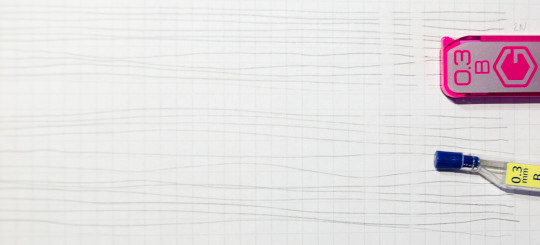
Both leads seem to provide similarly dark lines. The neox Graphite might be a little bit darker, but I didn’t see much of a difference. I thought I have a look whether I can easily quantify the darkness of the marks made by the leads. To do this I drew a line with both leads on Brunnen Der Grüne Block paper, using ~1.2 N of pressure (axial and normal pen force) and moving both pens at ~15 mm per second. I then scanned the result using an Epson V700 scanner, turning auto improvements etc off. In the HSB representation most pixels for both leads had a brightness of between 40% and 60%. If I ever buy other leads, like the Ain Stein leads, to compare these too I might do a frequency analysis of the different levels of black to show the distribution, but I tried to keep this blog post short so didn’t do this as there are so many blog posts to write on my to do list.
The leads
Lead hardness
To test how hard the lead is, i.e. how long it will last, independent of lead darkness, I extended both leads by ~0.7 mm and drew a lines with both leads on Brunnen Der Grüne Block paper, using ~2N of pressure (axial and normal pen force). The Mars micro lasted about 216 cm, the neox Graphite lasted about 189 cm.
Lead reflectiveness and erasability
I didn’t try to quantify the leads reflectiveness, i.e. how much it reflects light, but if you look at the lead markings on paper at an acute angle when there is a strong light source the Mars micro lead seems to reflect the light a bit more. In terms of erasability the neox Graphite seems to perform slightly better, too.
The lines
Conclusion
Pilot’s neox Graphite is a great lead. Depending on where you live it might be hard to get as Pilot doesn’t sell this lead in many of their markets (including the UK). The fact that the Mars micro was able to draw longer lines with the same amount of graphite could indicate that the neox Graphite B is more similar to the Mars micro in 2B, this would not be a surprise as Japanese pencils are often softer than European pencils of the same grade, but I don’t have the leads at home to confirm that this is the case for these leads.
Price and exchange rates: November 2015
I couldn’t find any reviews of the neox Graphite leads in other blogs, but there must be some in Japanese or Korean.
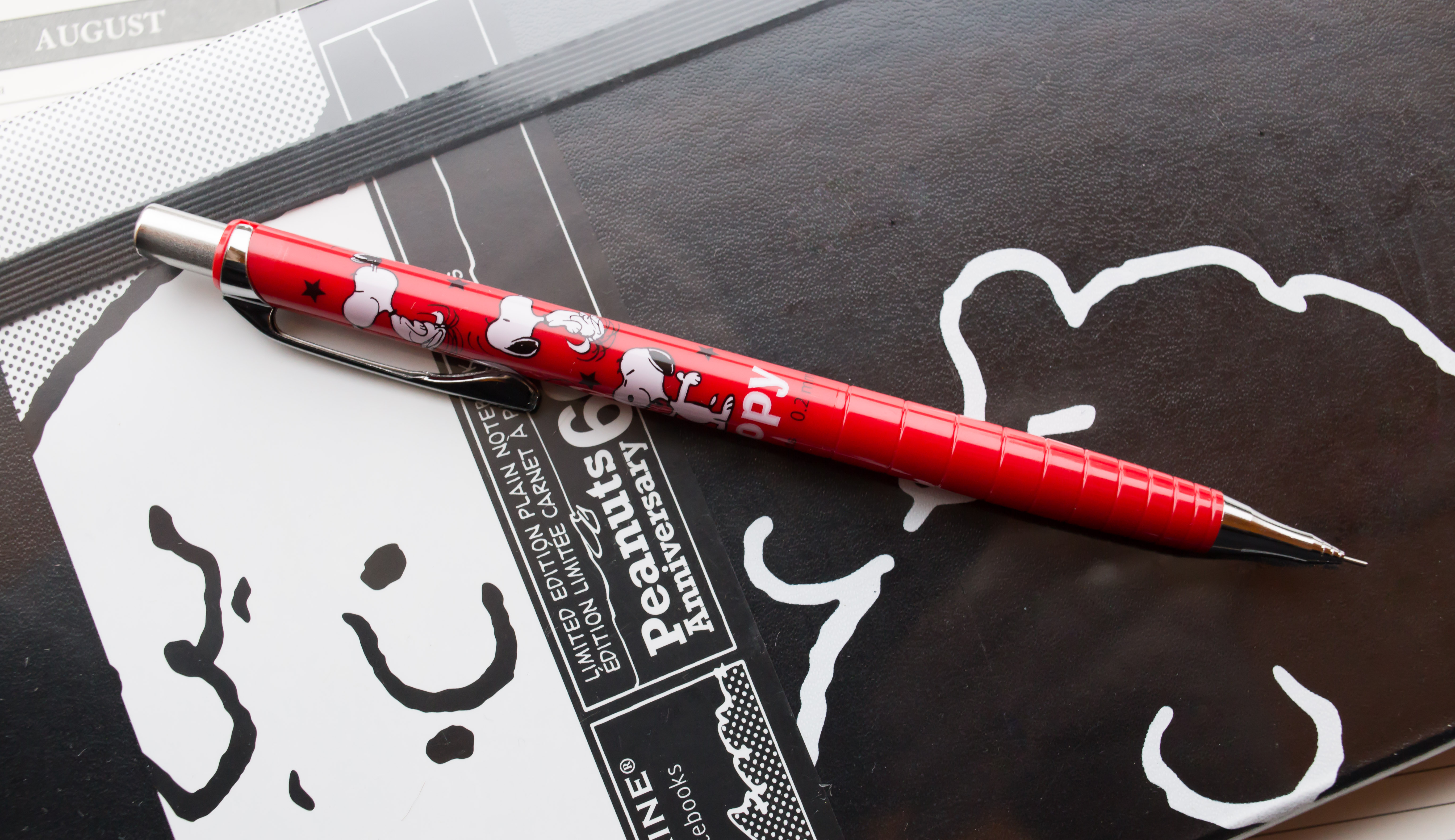
My new Orenz reminds me of a summer probably about 30 years ag when I was playing Snoopy and the Red Baron [1]I still remember the title screen music (borrowed from a friend) on my Atari VCS 2600. Around that time I also had a red, mechanical Snoopy pencil [2]Now that I think of it I think it might have been a Zebra pencil, but I am not sure. The pencil should still be in my mother’s house so I’ll check next time I’ll be there.. I even think that the Snoopies printed on that pencil were quite similar to the ones you can find on the Orenz.
I bought this ‘Vintage Peanuts – Snoopy’ pencil from a Taiwanese eBay seller and paid £11.65 (~ $18; €16.35) – £8.15 for the pencil and £3.50 for postage.
A use for the Orenz
Like all Orenz pencil it is great for someone with small handwriting or if you need to make small annotations in documents.
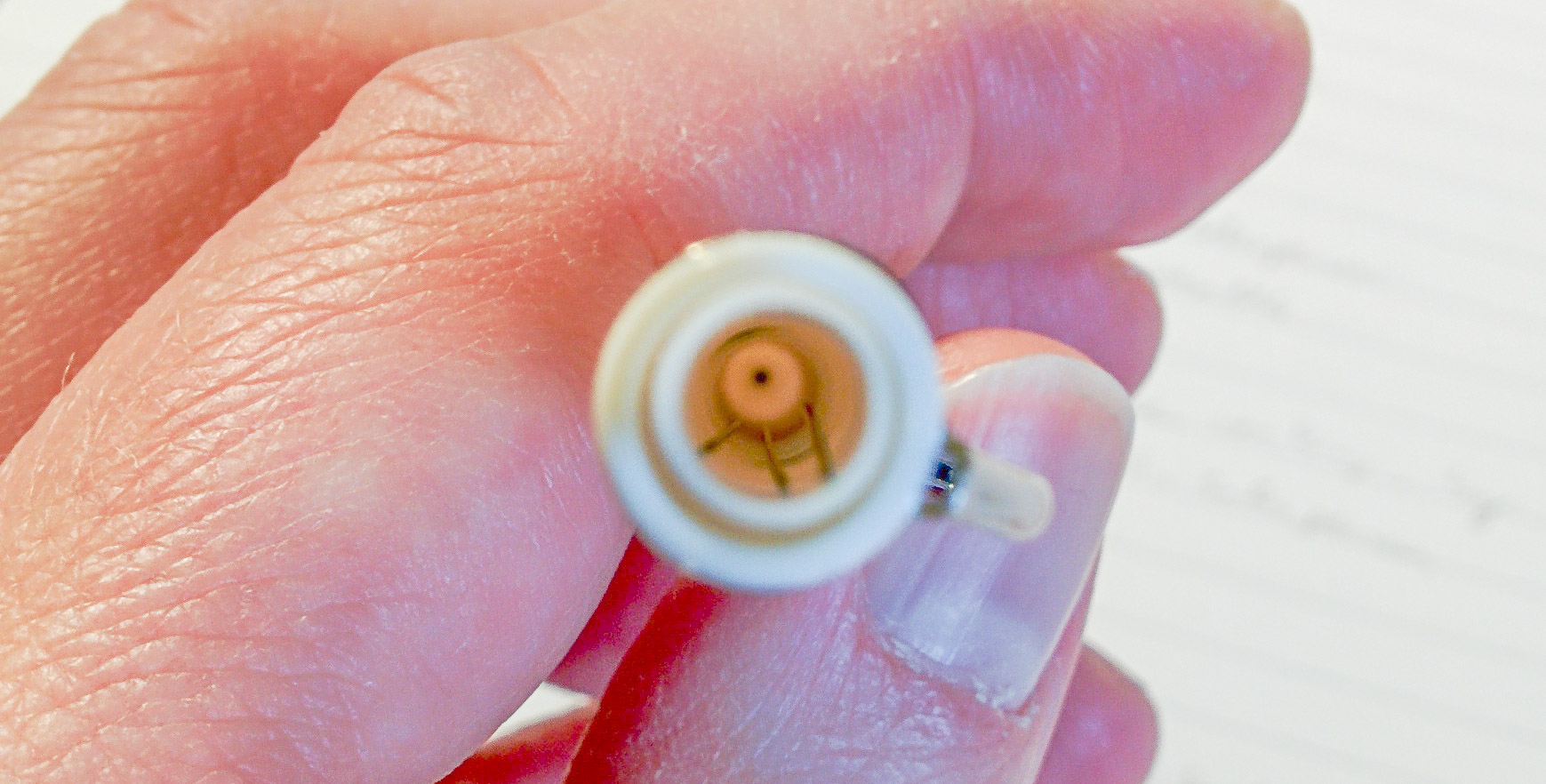
Unfortunately there is one of the problems you will find with 0.2 mm leads that you probably won’t encounter with more traditional mechanical pencils. When I got the white Orenz and tried to use it for the first time the 0.2 mm leads are so light, the static charge of the plastic barrel made them stick to the inside barrel of the pencil and it wasn’t possible to get the leads to forward the normal way. In the end I had to take a lead and feed it though the sleeve / front of the pencil. Once that sleeve was used up the pencil was clogged up, too – but it was then possible to unclog the pencil by disassembling it. Not great, but still much better than the kind of mess I experienced with a Rotring Newton.
0.2 mm leads, stuck to the barrel because of a static charge
Price: January 2015 (white Orenz) / October 2015 (Snoopy Orenz)
Exchange rates: November 2015
As usual, please click on the images for a larger version or open in a new tab for a really big version of the image.
The cover of the Atari VCS cartridge has been taken from Wikipedia, where it has been provided by user NBATrades. I believe that the use of the cover falls under “fair dealing” as described by the UK Copyright service.
Now that I think of it I think it might have been a Zebra pencil, but I am not sure. The pencil should still be in my mother’s house so I’ll check next time I’ll be there.
The main purpose of a sliding sleeve is, in my opinion, to slide back while you write so that you can keep writing without having to press the button / use whatever mechanism there is to advance the lead.
If the sliding sleeve doesn’t slide back easily you might as well got for a retractable sleeve, one that is either all the way in or out. This make the pencil pocket safe and allows work that is more suitable for drafting purposes, too.
On the unmodified rapid PRO 0.5 you had to use a force of about 1.2 N to get the sleeve to move – far too much to make the sleeve slide back automatically while you write.
The sleeve
Pimp my sliding sleeve
Having never explored how the sliding sleeve mechanism works I assumed ‘simple’ friction is responsible for the force needed to slide the sleeve. The problem is: I thought it’s the friction between the sleeve and grip section holding the sleeve (the grip section can be seen on the left in the first picture). To reduce the friction I took the sleeve out and started removing material from the sleeve on my Spyderco Sharpmaker. This made the sleeve thinner, something I had hoped would reduce the friction, but after a while I noticed that this treatment didn’t help making the sleeve slide easier at all.
Trying to reduce the friction – the wrong way: the sleeve on a Sharpmaker
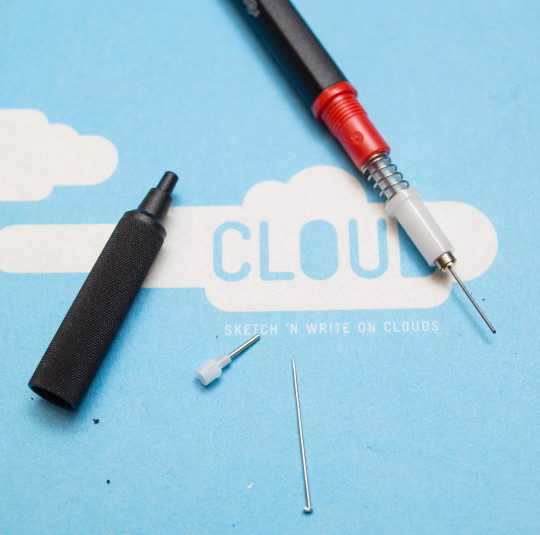
I then figured out that the friction holding the sleeve in place must be caused by the white plastic holder at the bottom of the sleeve. I started using the file from my Swiss Army knife [1]Fun fact: I got this knife from my godfather in the 1980s and I believe it is the same model as the one that the astronauts used on the Space Shuttle, just mine has a cork screw instead of a screw … Continue reading to remove some of the plastic, i.e. making the plastic holder narrower, but that took too long, so in the end I just cut bits of the plastic off with the knife.
This time it worked. Great!
Trying to file some of the sleeve holder’s plastic off….
From 1.2 N to 0.2 N
The result: You now only need about 0.2 N to slide the sleeve of my rapid PRO, which makes it suitable for writing without having to advance the lead all the time. This is an amazing result – because of the bigger lead diameter you can’t compare an 0.5 mm sleeve directly to the 0.2 mm sleeve of the Orenz. Just the friction caused by the 0.5 mm lead in the rapid PRO’s sleeve (i.e. just these two parts, ‘outside’ the pencil) means that you need 0.1 N just to slide the sleeve down the lead – that’s without the additional force needed to slide the sleeve within the pencil barrel/ grip section.
If I’d have to do it all again I obviously wouldn’t make the metal sleeve narrower. It made the sleeve a bit more wobbly, but it is not really an issue. It is certainly still less wobbly than a Kuru Toga or Muji’s flat clip mechanical pencil.
That’s one small scrape off [a] sleeve, one giant leap in the friction chart.
Fun fact: I got this knife from my godfather in the 1980s and I believe it is the same model as the one that the astronauts used on the Space Shuttle, just mine has a cork screw instead of a screw driver.
This isn’t really a follow up to my 2009 blog post The Kuru Toga – a disappointment, t’s more of a separate blog post – by coincidence I’ve come across a document I want to share.
As consumers we usually see Schmidt as a manufacturer of pen refills, but they actually do manufacture a lot of pens. If you look at their catalogue you can see pen parts that look as if Schmidt is manufacturing pens or parts of pens for big companies like Lamy and Montblanc.
They also seem to invent a lot and are very innovative when it comes to pens, even though very often we don’t see these inventions in mass market products. Just one example, I remember reading about a fountain pen they invented that uses microscopic pumps to transport the ink to the nib.
Well, it looks as if they have also invented something very similar to the Kuru Toga, just that they did this 25 years before Uni / Mitsubishi. You can read more about it in this patent: DE 3641432 C1 , but be warned: Google’s translation of this patent isn’t brilliant.
It even looks a bit like the Kuru Toga (Image from Schmidt’s patent document)
I assume I can show the image from the patent here (‘fair dealing’), as the patent is available to look at via Google anyway.






![That's one small scrape off [a] sleeve, one giant leap in the friction chart.](https://bleistift.blog/wp-content/uploads/2015/10/pimpmyrotring5.jpg)
