Faber-Castell

A.W. Faber Castell Jubilator
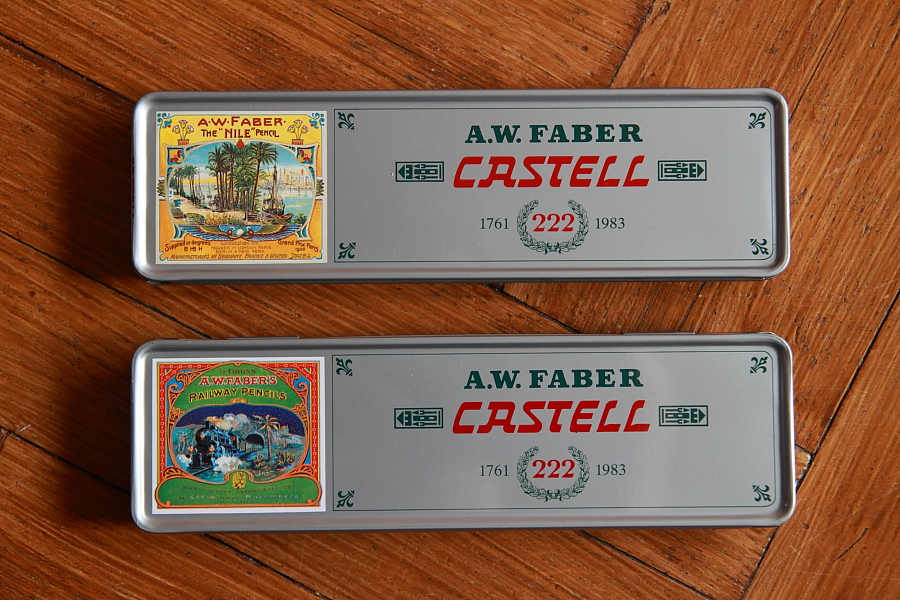
Two of the Castell 9000 Jubilator tins

Our favourite count certainly knows how to to party like it’s 1761, but in terms of products celebrating Faber-Castell’s 250th anniversary there hasn’t been a lot. The anniversary pencils, discussed at pencil talk, seem to be the best products so far. Artists might like the set of coloured pencils, limited to 1761 boxes, and if you have a bit more money to spare the Elemento pens, released for the anniversary, might be just the thing for you, but they are out of reach for most of us.

1983: 222 years Faber-Castell, 2005: 100 years Castell 9000


Let’s have a look at Faber-Castell’s 222nd anniversary in 1983. Back then pencileers, molyvophiles [1]Someone passionate about pencils and molyvologues [2]A student of pencils had more than enough reason to celebrate. I wonder whether there was a corporate party for their business partners in 1983, too. Personally, I prefer nice anniversary products, but that’s rather selfish, Faber-Castell business partners will probably prefer the party.

Click to read (subject to screen resolution)

Why is the 222nd anniversary so important? I don’t know. I certainly don’t know why there have been more exciting products back then than in the 250th anniversary year so far. In my experience people from German-speaking countries place more importance on Schnapszahlen (repdigits) than people from English-speaking countries. You might argue that a repdigit is not very important, but then a ’round number’ is actually not that exciting any more once you change to another positional notation [3]25010 = 3728 = FA16 = 111110102.

The Castell 9000 Jubilator pencils

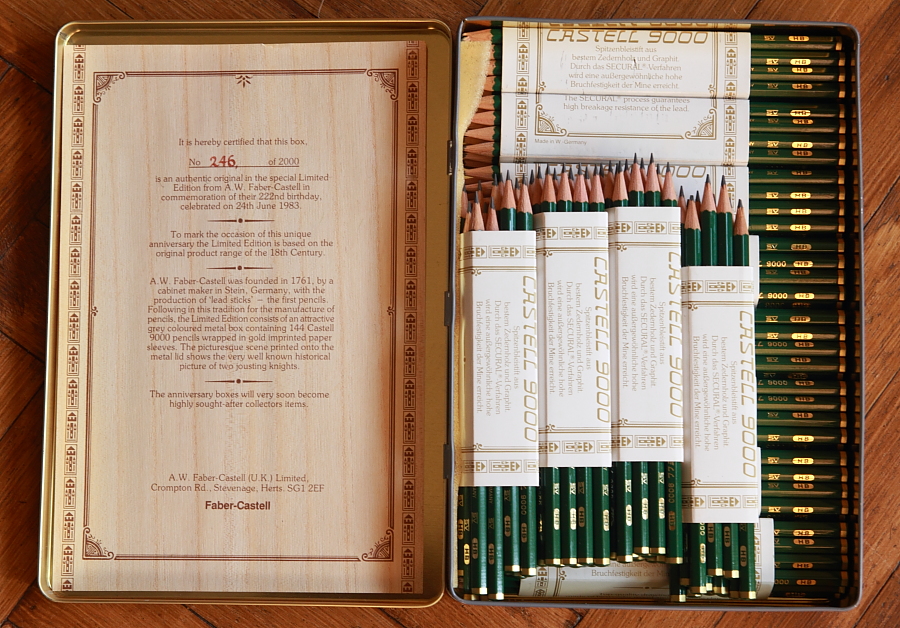
Faber-Castell released six different limited-edition tins for the Schnapszahl anniversary, featuring the following images: ‘The Nile Pencils’, ‘Railway Pencils’, ‘Aristocratic’, ‘The Caravan Pencils’, ‘Landscape Pencils’ and the picture with the jousting knights, previously discussed at pencil talk. Leadholder has more information about this picture – a mirrored version has  been used on pencil tins in the early 20th century. The jousting knights image has also been used for a special box from the same year, containing one gross, i.e.12 dozen, Castell 9000 pencils and limited to 2000 boxes, and it has been used again in 2005 for a special tin commemorating the 100th anniversary of the Castell 9000.
References

References
1 Someone passionate about pencils
2 A student of pencils
3 25010 = 3728 = FA16 = 111110102

A.W. Faber Castell Jubilator Read More »
Graf von Faber-Castell wooden box

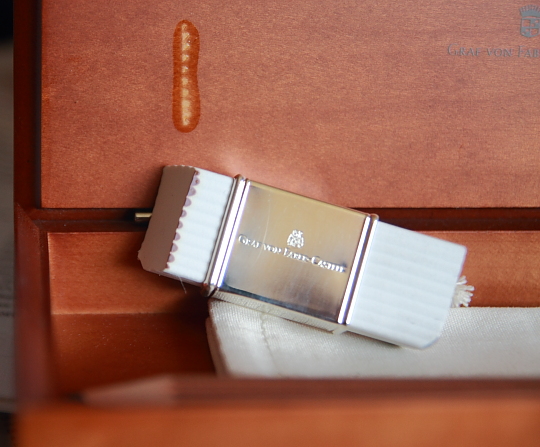
I keep a few Graf von Faber-Castell (GvFC) pencils, the ones with the silver-plated cap, in the wooden gift box that came with the GvFC Perfect Pencil. There’s something else I keep in this box: The GvFC eraser. You’d think they’d play well together, but unfortunately they don’t.

When I opened the box this weekend, after not having used it for a few weeks, I saw that the eraser got brown where it touched the wood. No problem, I don’t mind – my Staedtler Mars Plastic got brown when I stored it in my Sonnenleder Lasse case. The Staedtler / Sonnenleder combination did however not have any negative effect on the Lasse case. Back to Graf von Faber-Castell: I don’t mind the eraser changing colour, but what I do mind is that the wooden box changed. The colour changed where the eraser touched the inside of the lid and around the area of discolouration is a gluey layer of something – very sticky when you touch it.

Faber-Castell tries to use environmentally friendly production techniques, e.g. water-based varnish. I wonder whether that has something to do with this problem I encountered.

This is actually the second problem I have with this wooden box.The first problem was that one of the corners was bend. I am not sure whether this was due to bad packaging, I guess it was more likely because the parcel delivery service were not careful. I was able to fix this corner issue more or less by bending the corner back and by painting the discoloured wood there with a brown Stabilo marker.

I am not sure what to do about this new issue though. Use sandpaper to remove the sticky layer? …and never store the eraser in the box again? …or complain to Faber-Castell?

For now I left the eraser in the wooden box, this time wrapped in paper.

Graf von Faber-Castell wooden box Read More »

Schwanberg and the Pencil Cedar

The 'town' of Castell

In the 12th century my home town, Volkach, became part of the county of Castell, which belonged to – you might have guessed – the Counts of Castell [1]At that time it actually wasn’t a town yet, but documents show that by 1258 it was a town (‘in civitate nostra Volka’).. Quite a bit later, in 1896, Alexander Graf zu Castell-Rüdenhausen married Ottilie Freiin von Faber and the name of the pencil manufacturer Faber changed to Faber-Castell.

Except this link to Faber-Castell there isn’t really much of a “pencil link” in the surrounding area of Volkach. All the exiting pencil stuff is happening about 100 km further South where you’d find the big pencil manufacturers like Staedtler, Faber-Castell, Schwan-Stabilo and Lyra.


Some branches the forest's caretaker removed. He also cut other trees nearby to give the Pencil Cedars more space.


I wrote there isn’t much of a “pencil link” here – well, the area around my home town can boast with one other link to the world of pencils, even though it is rather unknown. Trees from North America were planted in Germany to test the suitability of the wood for use in pencil production …and some of them were planted on Schwanberg [2]The Schwanberg isn’t really a hill, but an elevation (474m / 1555 feet) – about 200m above the surrounding area. According to legend Saint Hadeloga (sometimes called Adeloga or Hadla) … Continue reading, an elevation not far from the town of Castell, by the Counts of Castell – to test the suitability of the wood for use in pencil production. The trees brought over from North America were the Pencil Cedar (juniperus virginiana) and the Eastern White Pine (pinus strobus). You can still find some of the Pencil Cedars near Castell. 100 years ago there were also many well established Pencil Cedars North East of Faber-Castell’s home town, Stein, planted by Faber, which probably didn’t survive [3]This tree was first introduced to Europe in the 17th century. Faber is supposed to have planted, between several thousand and several tens of thousands of these trees in the 19th century, depending … Continue reading. These trees are not really used any more for pencil production, but if you have an old pencil that is more than 70 years old, the wood might be from a Pencil Cedar.

The Schwanberg, seen from Volkach


More about the Pencil Cedars at Lexikaliker’s blog post “Der Graphit” (German) (Link to the Google Translation)

References

References
1 At that time it actually wasn’t a town yet, but documents show that by 1258 it was a town (‘in civitate nostra Volka’).
2 The Schwanberg isn’t really a hill, but an elevation (474m / 1555 feet) – about 200m above the surrounding area. According to legend Saint Hadeloga (sometimes called Adeloga or Hadla) built an abbey (nunnery) on Schwanberg. She was the daughter of Karl Martell (Charles the Hammer). He repudiated her when she vowed virginity (so she is not mentioned very often in history) but they reconciled many years later. She is actually an aunt of Charlemagne, King of the Franks, and she is the patron saint for fever.
3 This tree was first introduced to Europe in the 17th century. Faber is supposed to have planted, between several thousand and several tens of thousands of these trees in the 19th century, depending on which source you check. I assume many must have survived outside Schwanberg, but it is unknown how many are left and where they are. One of Lexikaliker’s blog posts indicates that the trees planted by Faber near Nuremberg did not survive. Other Pencil Cedars planted in Germany did not survive either.

Schwanberg and the Pencil Cedar Read More »

Congratulations

Congratulations to the winners of the first Bleistift giveaway. I’ll send your prizes out first thing tomorrow morning and will also include a few other pencils I have lying around,  including the Faber-Castell 1117 and a Graf von Faber Castell pencil.

The first number I got from random.org was 20, this means Kartike E from Indonesia gets the first prize. She chose the rubber-tipped version of the Noris, the Noris 122 HB.

The next number from random.org was 16 – Palimpsest from the UK wins the Welsh-made sketching pencils.

Number 15 came next. That was a post by myself, so I requested another number from random.org instead, which was number 5: Lexikaliker from Germany. Since he already has some Staedtler Tradition 110s he was kind enough to give someone else the chance to win. Thank you! The replacement number I got was the 13, which means that Sheryl C from the USA wins the blister pack with Welsh-made Staedtler Tradition 110s.

Thanks again to all who took part. I hope the winners will receive the pencils soon.

Congratulations Read More »

Faber-Castell 1117

It is probably superfluous to write about the Faber-Castell 1117. Not because it is a very common pencil everybody knows about, but because this pencil is not new to the blogosphere. It has previously been reviewed at penciltalk and this isn’t its first appearance at Bleistift either: the 1117 was the supporting actor in the review of the Deli pencil sharpener 0668. So why do I write about it again? The reason is that I thought Faber-Castell stopped producing this entry level pencil – after I was unable to buy this pencil in shops that sold this specific model previously. Before you panic: Calm down, dear. The good news is that Faber-Castell confirmed that they are still making the 1117.

Price

My guess is that the 1117 is the cheapest pencil made in Germany [1]Probably even the cheapest pen. Today, you can find the version without ferrule and eraser for as little as € 0.20 (~ 28¢; 17p), if you buy them in Germany  over the Internet. That’s a bit more than half the Internet price of a Staedtler Noris and about ¼ of a good Internet price for the Castell 9000. I bought the last few dozen in the local stationery shop Schreibwaren Jäcklein in my home town of  Volkach when I went there in April. eraser-tipped 1117s for € 0.58 each (~ 82¢; 51p) and the untipped 1117s for € 0.36 each (~ 51¢; 32p). Last November I bought the eraser tipped 1117s in B for € 0.29 each (~ 41¢; 25p), online at Schule-Uni-Shop / CTK, but CTK do not stock the 1117 any more.

Writing qualities

The lead of the 1117 could be better, there is not doubt about that, but in good Faber-Castell tradition it does last a long time before it wears down and needs sharpening. Once the pencil it dull or blunt it is, at least in my experience, less pleasant to write with. This is however quite normal for inexpensive pencils and only very few pencils would excel in this category. The 1117 is however usually quite smooth and there would be very few combinations of paper and pencil point state that would result in a scratchy writing experience. The lead could be darker, but this is again something we shouldn’t be surprised about as Faber-Castell measure and label the softness of the lead quite conservatively. The 1117 shows no problems with smudging when being erased erased. I would describe the eraser from the eraser-tipped version as “normal quality”. It performs a bit worse than the eraser of a Dixon Ticonderoga , is similar to the eraser of a General’s Semi-Hex, but much better than the white eraser of the Palomino Blackwing. [2]In case you wonder why I picked these two for the comparison: Those pencils were just lying on my keyboard. Thanks to Sean, Kent and Adair for these.

Overall

This is an extremely cheap, or better: inexpensive,  pencil and value for money is definitely excellent.  Production of the 1117 started in 1991/1992 (20th anniversary soon!). When this pencil was first introduced it was unfinished, but for hygienic reasons later versions got a protective finish. The feel is however very similar to an unfinished pencil. Depending on your perspective this means that the pencil has a great grip or it is slightly too rough and therefore uncomfortable. The version without ferrule and eraser is available in 2B, B, HB and H. I have seen the eraser-tipped version in B and HB, but according to the label on the box the eraser-tipped version is available in five grades. All versions feature SV-bonded anti-break leads.

Næturvaktin, episode 8: Is Ólafur giving Daníel a Faber-Castell 1117? Will there be a pencil in the US remake? (Image © Saga Film)


Prices: November 2010, April 2011 and June 2011

Exchange rates: June 2011

I would like to thank Ms Schaklies from Faber-Castell for the additional information about the 1117.

The photo of Ólafur handing over a pencil to Daníel has been taken from episode 8 of the great, Icelandic comedy Næturvaktin. I believe that the use of this image falls under “fair dealing” as described by the UK Copyright service.


References

References
1 Probably even the cheapest pen
2 In case you wonder why I picked these two for the comparison: Those pencils were just lying on my keyboard. Thanks to Sean, Kent and Adair for these.

Faber-Castell 1117 Read More »