By Type

No clipboard as we know it

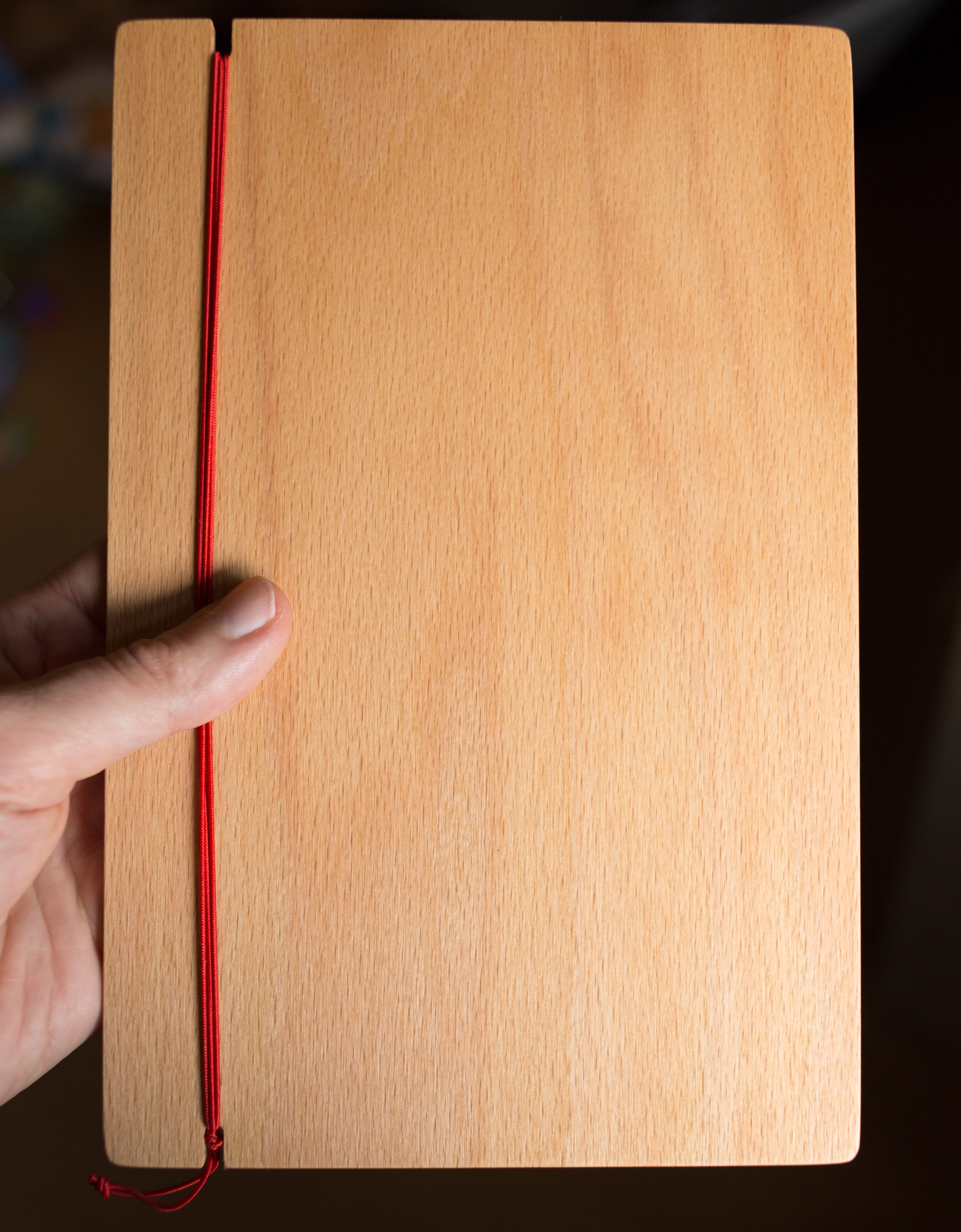
tobewoodenboard4The Banditapple carnet x ToBe wooden board
tobewoodenboard1

Because of Kent from Pencilog I got to know Arnie, the guy behind Banditapple, and because of Arnie I got to know Eun Suk Bang, the designer behind ToBe Story.

I really love the Banditapple carnets, I must have used them for more than five years now (just because my first review of them was a bit more than five years ago) and together with Atoma they are definitely one of my two favourite notebooks. Banditapple has the better paper, Atoma is more practical in terms of reorganising/reshuffling things around within the notebook.

My recent Lamy Line Friends and Banditapple carnet order also included two items from Eun Suk. One of them was the “wooden board”, being described as a little table to write on. The idea came from the fact the carnets are made from a tree, as should the surface be you put them on.

tobewoodenboard2The wooden board is not only designed by her, she is also making them herself. Each board takes three to five days to manufacture, which involves cutting beech plywood with a CNC machine as well as applying three oil coatings before they get to dry.

They were sold in May this year as the Banditapple carnet x ToBe: wooden board. The price was $15. It was one of a number of side projects Banditapple was taking part in, all with low numbers of items being handmade and all of the items sold out very fast. There’s a good chance the wooden board will be available again if there is enough demand.

tobewoodenboard5

If have used the board many times when I needed a surface to write on and when the board was nearby. It was always very hand. There are three strings, so you can attach three notebooks if you want, but I usually just used it as a surface to write on.  tobewoodenboard6

Despite my admiration for the simple beauty of this board I have to say that there are also drawbacks, mainly that I haven’t figured out whether there’s an easy way of writing on the left pages of your notebooks if you use the wooden board as a clipboard and that the wooden board is only useful is you have it with you, but for practical reasons you usually wouldn’t have the board with you when you need it, unless you use it as a stationary notebook holder / organiser. In any case, it is a beautiful board!

tobewoodenboard8


Just a reminder, since I changed the WordPress Theme a few months ago most images are available in high resolution. Open them in a new tab for the hires version.

You can read more Banditapple related posts here. The Well-Appointed Desk has reviewed them, too.

You can read more about the John Lewis pencil used in the last photo in this blog post.

You can read more about the Noris colour used in the last photo in this blog post.

No clipboard as we know it Read More »

Zebra DelGuard

I realise that the blog post about the force needed for the sliding sleeve of different mechanical pencils was not very popular, so please bear with me for a similar blog post, before I get back to more traditional blog posts.

In January this year I bought the Zebra DelGuard mechanical pencil in 0.5mm. You might have come across it on Lexikaliker, where it was mentioned in October 2014. I bought mine from Japan, through Amazon Marketplace where it was sold as the Delgado pencil, instead of DelGuard, based on the Katakana spelling of the pencil’s Japanese name.

I paid £5, but I noticed that it is now available for £4.26, including free delivery.

Two different mechanisms

This mechanical pencil’s ‘specialty’ are two different mechanisms that help prevent the leads from breaking.

If there is too much axial pen force, i.e. pressure is applied to the lead towards the centre of the pen, the lead will retract, i.e. it is cushioned, somehow similar to the Faber-Castell TK_Fine Vario L.

If there is too much normal pen force, i.e. pressure is applied to the side of the lead, a protective guard will extend to protect the lead from breaking. This guard can obviously only extend a certain amount, so it is possible to break an excessively long lead, more about this later.

Axial vs Normal Pen Force
Axial vs Normal Pen Force (open in new Tab for details)

Not working as advertised?

The packaging states that ‘If you advance lead more than 4 times breakage is possible‘. I wonder whether they either explained it wrong or whether I got a dodgy DelGuard, because using my normal writing angle on my DelGuard the lead will also break if the lead has been advanced 4 times. More on the clicks later. Maybe the text should read  ‘If you advance lead 4 or more times’? Maybe other DelGuard users can comment on this.

Comparison with another mechanical pencil

I compared the pressure that will cause the lead to break to another mechanical pencil. I chose the Kuru Toga, previously mentioned here, thinking that both are from Japan, so there is a higher probability of the leads they come with being similar in terms of softness and strength [1]Comparing the breakage point to a pencil with much harder or softer lead would be less exciting.. Both mechanical pencils were tested with the leads they came with using an angle of 45°.

What force is needed to break a lead of what length.

The axis at the bottom shows the lead length in millimetres, with the number of clicks marked as well. You will probably have to enlarge this image to see it well (right click and open in new tab/window). The axis on the left shows the force needed, in Newton, to break the lead.

To put things in context: The highest force needed for moving sliding sleeves was 1 N, but even to break a very long lead you need more than 2 N.

Personally I don’t extend the lead more than 0.5 mm or 1 mm, so I don’t really have problems with lead breakage anyway, but that didn’t prevent me from getting a DelGuard to marvel at the engineering ingenuity that built this pencil.

As you can see, the longer the lead extended on the Kuru Toga (red line) the easier it is to break.

For the DelGuard (blue line) it is virtually impossible to break the lead if it”s extended less than 1.5 mm, because of the guard that will extend. The dotted blue line represents the situation if you count bits of the lead being chipped off as breakage, the solid blue line represents proper breakage.

The warnings that came with the diagram from the Color Eno blog post apply here as well [2]Here’s a copy and paste: I have neither the training, nor experience, nor the equipment to take these measurements properly, so you better take these measurements with a pinch of salt, or even … Continue reading.

Leads and millimetres

One click on the DelGuard will advance the lead by ~0.52 mm, less than what you get with the Kuru Toga, where one click will advance the lead by ~ 0.57 mm and certainly less than what you got with many pencils reviewed at Dave’s Mechanical Pencils. The break safe ‘zone’ for the extended lead is therefore everything between 0 mm and 1.6 mm. I usually don’t extend the lead more than 1 mm, so the lead is quite safe, but other people might use their pencils in different ways.

Video

Please have a look at this little video I made to see the DelGuard in action (Watch in YouTube for higher resolution).


If you like this blog post you might also like the blog post about the Noris colour wear and tear.


You can find a review of the DelGuard at The Pen Addict and at That One Pen.

You can read more about Axial and Normal Pen Force in this paper. 

References

References
1 Comparing the breakage point to a pencil with much harder or softer lead would be less exciting.
2 Here’s a copy and paste: I have neither the training, nor experience, nor the equipment to take these measurements properly, so you better take these measurements with a pinch of salt, or even better with a whole lorryload full of salt.

Zebra DelGuard Read More »

Lamy Line Friends

lamy-linefriends1

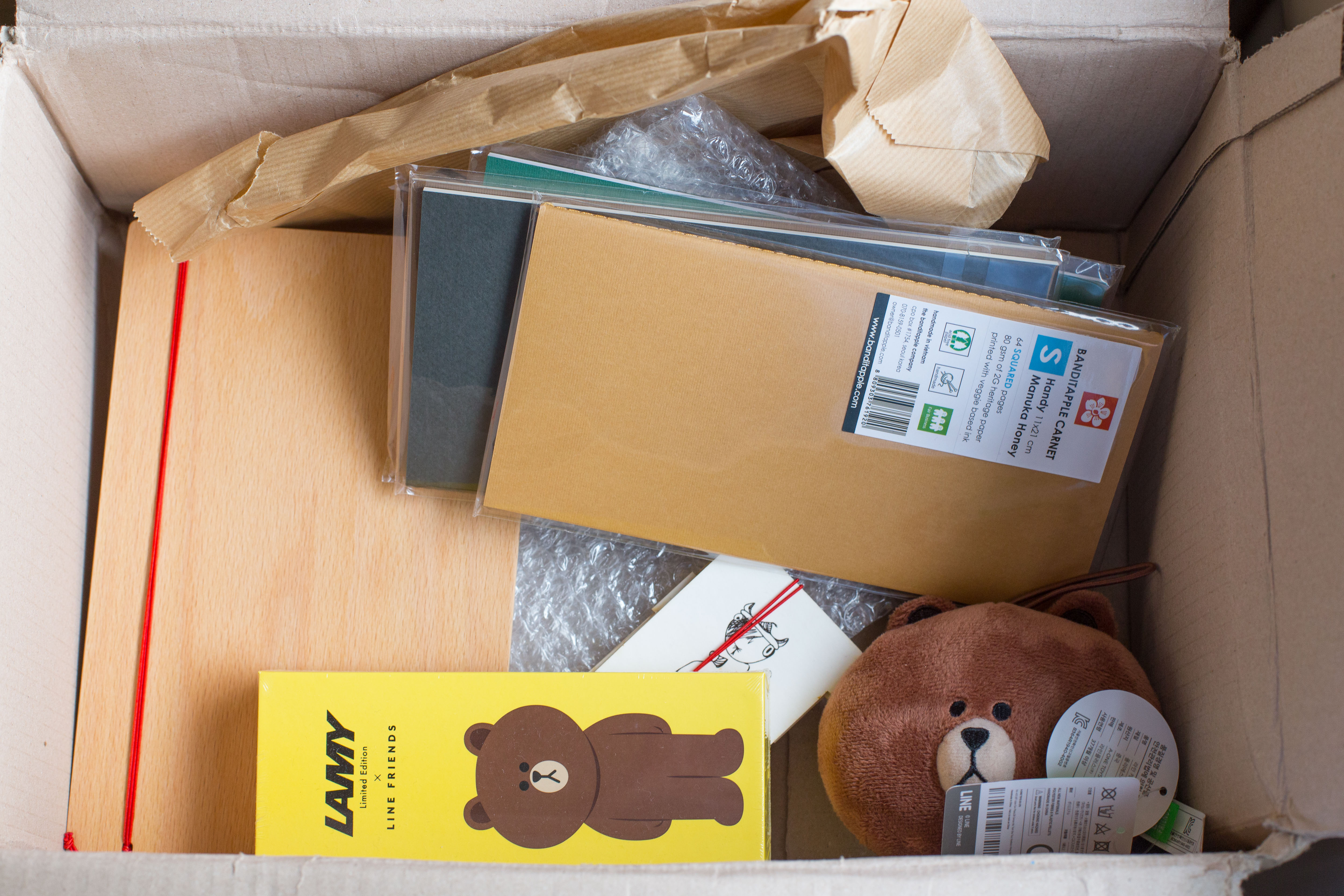
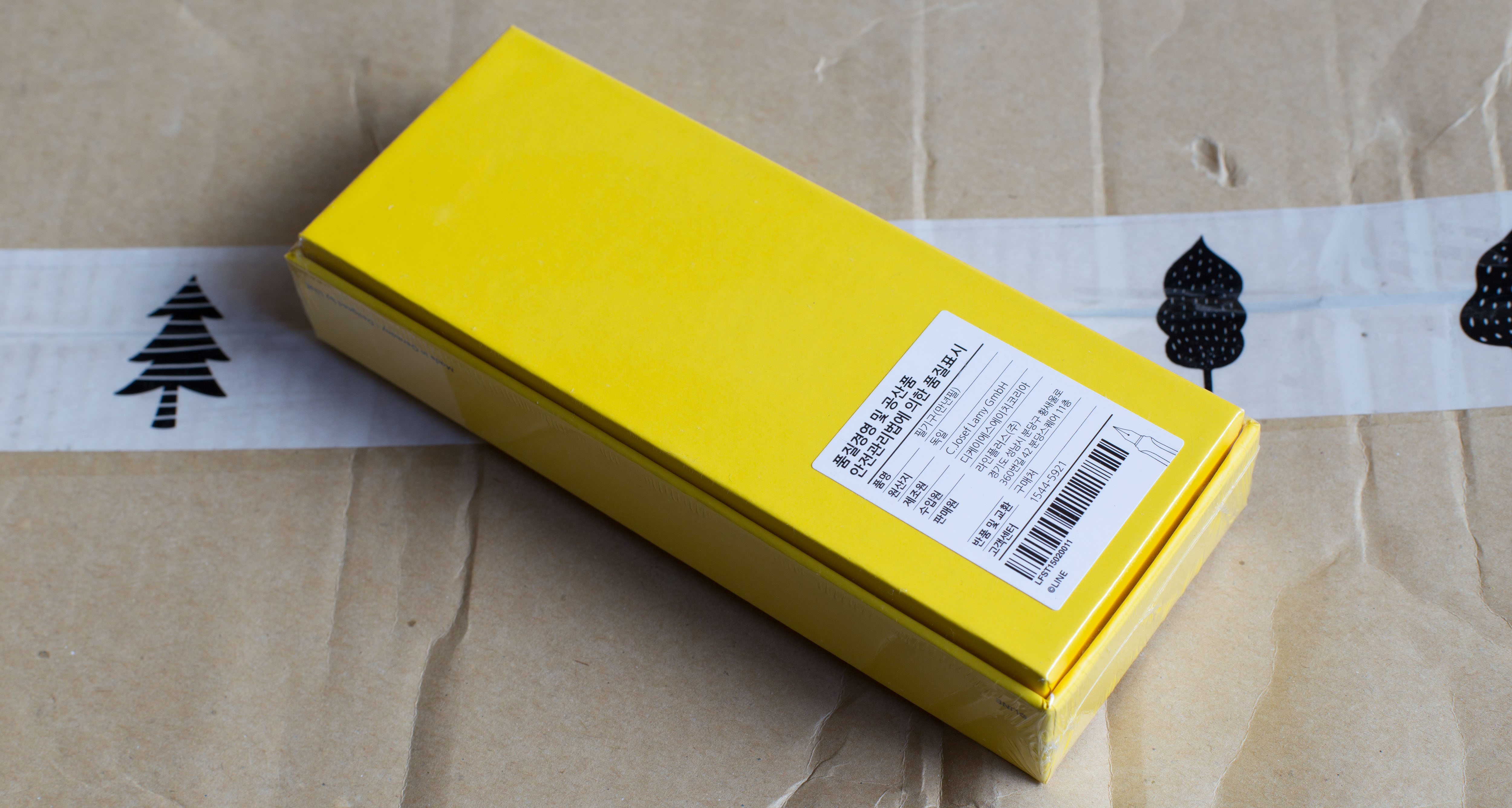
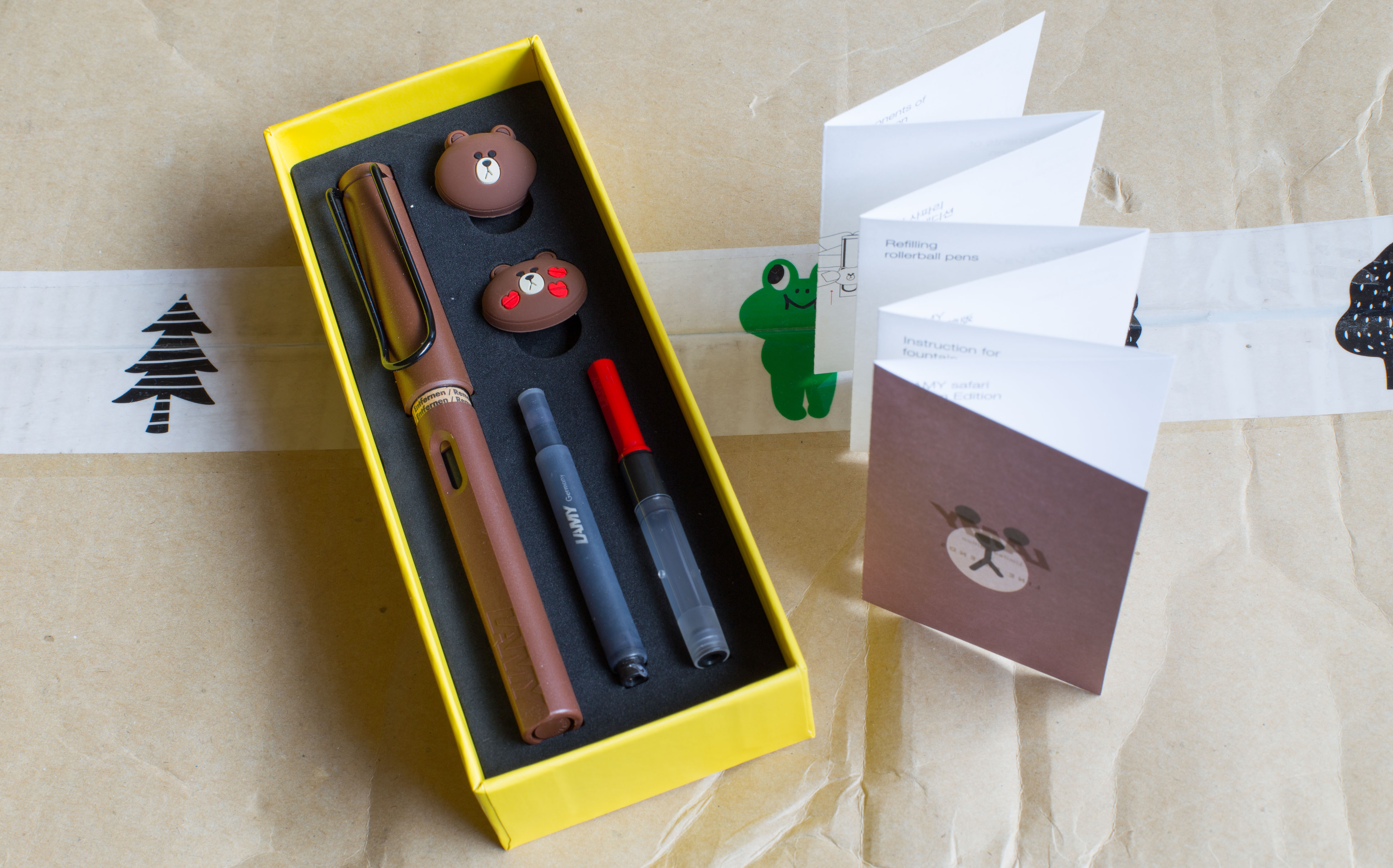
After Brad and Myke mentioned the Lamy Line Friends pens in the last two episodes of the Pen Addict podcast I couldn’t resist and just have to show my ‘Line Safari’ – despite my intentions of keeping the number of fountain pen posts in the blog low so that the focus can be on pencils.

lamy-linefriends2

The Line characters started life as icons in a messaging app, but became so popular that now there’s a whole range of merchandise based around them. I think my first exposure to them was as icons in the WeChat app.

lamy-linefriends3

I got Line Friends Lamy Safari  from Arnie Kim, the man behind the Banditapple notebooks I reviewed five years ago. Initially I contacted Arnie about this in February or early March, but it took quite a while for him to get his hands on any, in the beginning they always sold out as soon as new stock arrived, with long queues forming.

lamy-linefriends4

I think I paid about ₩ 54.000 (~$45; €40; £30) plus shipping, but I also ordered a few Banditapple notebooks the same time.

lamy-linefriends6

I plan to soon write more about the other exciting items I got in this parcel from Korea.

lamy-linefriends5


Price: March 2015
Exchange rates: September 2015

IMG_0190-2

Lamy Line Friends Read More »

Duck Quacks Don’t Echo

Back in May this year television production company Magnum Media contacted me to ask me whether I would be interested in being one of their experts on their TV series “Duck Quacks Don’t Echo”.

If you are not from the UK: It’s a factual quiz show with Lee Mack, a comedian [1]from Southport, not far from where I live and where I bought my Norcom notebook. People from Southport are ‘Sandgrounders’., which aims to investigate and replicate interesting scientific studies.

They were looking for a pencil and graphite expert to discuss the abilities of the pencil and the history of the pencil and they gave me some details of what was supposed to happen on the show. It would have been great to take part, but I’m certainly not an expert, also not a professional (not even semi-professional) in any sense of the word, so I replied that I am only an enthusiastic pencil user, but would be very interested in taking part.

I haven’t heard  from them since, but this week the episode they asked me to take part in was broadcasted – and they got a proper pencil expert: The technical manager of Derwent, Barbara Murray, who is also a chair of the UK Coloured Pencil Society.

The pencil expert (Image © Sky 1)

There were a few things to learn:

In Ireland they call sharpening a pencil paring a pencil. Irish comedian Jason Byrne also mentioned something about pencil paring on New Year’s Eve, but I didn’t get that. Maybe someone can explain what is going on with pencil paring in Ireland on New Year’s Eve.

There was some talk about that there’s no lead in pencil leads. I think David would have been quite upset about the kind of things they said.

Emma Bunton, of Spice Girls fame, then presented her fact (the show is about checking whether these fact, presented by the guests, are true or not): a normal sized pencil can write for 20 miles.

In an effort to keep this blog post short I will spare you my thoughts on this topic. The fact was checked with with a custom made device similar to a football pitch line marker.

The device that measured the pencil line length (Image © Sky 1)

They then ran a pencil lead down (HB). The lead was removed from the wood and no sharpening (except the initial point) took place. I want to add that it did look as if the lead was repeatedly covering the same paper again and again, which, in my opinion, will have prolonged the life of the lead as graphite coated paper wouldn’t be as abrasive as pure paper. After 10 hours of ‘walking with the machine’ the lead was used up. It survived 24.31 miles.

The lead being worn down and measured (Image © Sky 1)

Their estimate was that the pencil will be able to write between 20 and 25 miles. This was based on a pencil lead having 1.25 g of weight with 0.00032 g of lead being used per metre of writing. If you do the calculation that should be 3906 metres, just under 2.5 miles,  so I assume there was just a 0 missing in the figures for grammes used per metre.

Lead usage (Image © Sky 1)

Unfortunately the pencil fact, one of three fact presented in the show, was voted least popular fact. The audience found the fact that 10 rubber bands can hold the weight of a person and the fact that men prefer to inflict pain to themselves rather than be bored more interesting.


The screenshots in this blog post has been taken from Episode One of the Third Season of the UK version of Duck Quacks Don’t Echo. I believe that the use of the screenshot shown in this blog post falls under “fair dealing” as described by the UK Copyright service.

References

References
1 from Southport, not far from where I live and where I bought my Norcom notebook. People from Southport are ‘Sandgrounders’.

Duck Quacks Don’t Echo Read More »

Deutschland 83

After The Game: Another TV series about cold war spies. Sean told me about this one. It’s called Deutschland 83 and its current IMDB rating is 8.5.

As the name suggests it takes place in 1983. Here’s a Castell 9000 in B you can see in episode 4, used by Professor Tischbier (Alexander Beyer) from the East German Secret Service.

A Castell 9000 in B (Image © UF Fiction)

Faber-Castell pencils from 1983 – sounds familiar, you might remember this previous blog post about the Castell 9000 pencils for their 222nd anniversary – that anniversary was in 1983.

Here’s a comparison of the modern Castell 9000, as seen in Deutschland 83 – with the water-based varnish side facing the camera, and the actual Castell 9000 from 1983. The green got even darker, the thick line on the end of the pencils changed from gold to silver/grey and the text printed on the pencils has changed.

Castell 9000, 1983 and now
Castell 9000, now (top) and 1983 (bottom)

The screenshot in this blog post has been taken from Episode Four of Deutschland 83. I believe that the use of the screenshot shown in this blog post falls under “fair dealing” as described by the UK Copyright service.

Deutschland 83 Read More »