By Type

Pimp my Rotring rapid PRO 0.5

This is a follow-up blog post to my earlier blog post about the Rotring rapid PRO 0.5.

The Rotring rapid PRO is a stunningly beautiful mechanical pencil, at least the black version is …for my taste. As you might remember the sliding sleeve was the worst performing sliding sleeve I have seen so far.
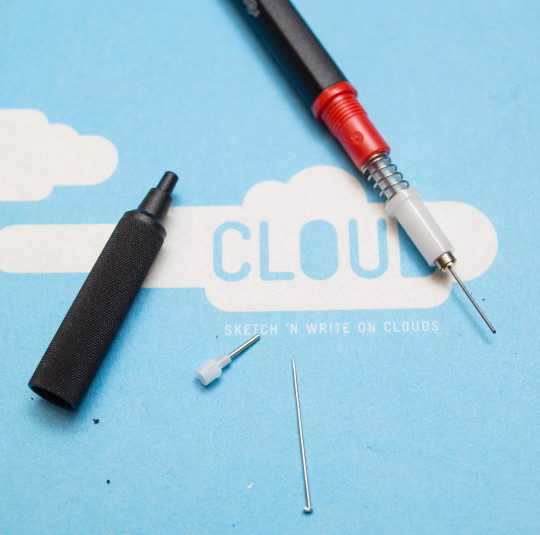
My Rotring rapid PRO 0.5 taken apart

The purpose of a sliding sleeve

The main purpose of a sliding sleeve is, in my opinion, to slide back while you write so that you can keep writing without having to press the button / use whatever mechanism there is to advance the lead.

If the sliding sleeve doesn’t slide back easily you might as well got for a retractable sleeve, one that is either all the way in or out. This make the pencil pocket safe and allows work that is more suitable for drafting purposes, too.

On the unmodified rapid PRO 0.5 you had to use a force of about 1.2 N to get the sleeve to move – far too much to make the sleeve slide back automatically while you write.

The Rotring rapid PRO 0.5's sleeve
The sleeve

Pimp my sliding sleeve

Having never explored how the sliding sleeve mechanism works I assumed ‘simple’ friction is responsible for the force needed to slide the sleeve. The problem is: I thought it’s the friction between the sleeve and grip section holding the sleeve (the grip section can be seen on the left in the first picture). To reduce the friction I took the sleeve out and started removing material from the sleeve on my Spyderco Sharpmaker. This made the sleeve thinner, something I had hoped would reduce the friction, but after a while I noticed that this treatment didn’t help making the sleeve slide easier at all.

The Rotring rapid PRO 0.5's sleeve on a Spyderco Sharpmaker
Trying to reduce the friction – the wrong way: the sleeve on a Sharpmaker

I then figured out that the friction holding the sleeve in place must be caused by the white plastic holder at the bottom of the sleeve. I started using the file from my Swiss Army knife [1]Fun fact: I got this knife from my godfather in the 1980s and I believe it is the same model as the one that the astronauts used on the Space Shuttle, just mine has a cork screw instead of a screw … Continue reading to remove some of the plastic, i.e. making the plastic holder narrower, but that took too long, so in the end I just cut bits of the plastic off with the knife.

This time it worked. Great!

Trying to file some of the plastic off....
Trying to file some of the sleeve holder’s plastic off….

From 1.2 N to 0.2 N

The result: You now only need about 0.2 N to slide the sleeve of my rapid PRO, which makes it suitable for writing without having to advance the lead all the time. This is an amazing result – because of the bigger lead diameter you can’t compare an 0.5 mm sleeve directly to the 0.2 mm sleeve of the Orenz. Just the friction caused by the 0.5 mm lead in the rapid PRO’s sleeve (i.e. just these two parts, ‘outside’ the pencil) means that you need 0.1 N just to slide the sleeve down the lead – that’s without the additional force needed to slide the sleeve within the pencil barrel/ grip section.

If I’d have to do it all again I obviously wouldn’t make the metal sleeve narrower. It made the sleeve a bit more wobbly, but it is not really an issue. It is certainly still less wobbly than a Kuru Toga or Muji’s flat clip mechanical pencil.

That's one small scrape off [a] sleeve, one giant leap in the friction chart.
That’s one small scrape off [a] sleeve, one giant leap in the friction chart.

More about the Cloud Book in the blog post, I’m still using it regularly.

References

References
1 Fun fact: I got this knife from my godfather in the 1980s and I believe it is the same model as the one that the astronauts used on the Space Shuttle, just mine has a cork screw instead of a screw driver.

Pimp my Rotring rapid PRO 0.5 Read More »

The Kuru Toga – an old hat?

This isn’t really a follow up to my 2009 blog post The Kuru Toga – a disappointment, t’s more of a separate blog post – by coincidence I’ve come across a document I want to share.

As consumers we usually see Schmidt as a manufacturer of pen refills, but they actually do manufacture a lot of pens. If you look at their catalogue you can see pen parts that look as if Schmidt is manufacturing pens or parts of pens for big companies like Lamy and Montblanc.

They also seem to invent a lot and are very innovative when it comes to pens, even though very often we don’t see these inventions in mass market products. Just one example, I remember reading about a fountain pen they invented that uses microscopic pumps to transport the ink to the nib.

Well, it looks as if they have also invented something very similar to the Kuru Toga, just that they did this 25 years before Uni / Mitsubishi.  You can read more about it in this patent: DE 3641432 C1 , but be warned: Google’s translation of this patent isn’t brilliant.


It even looks a bit like the Kuru Toga
It even looks a bit like the Kuru Toga (Image from Schmidt’s patent document)

I assume I can show the image from the patent here (‘fair dealing’), as the patent is available to look at via Google anyway.

The Kuru Toga – an old hat? Read More »

Tactile Turn Gist

I’m interested in the Tactile Turn Gist, but am not sure yet whether I should back this project on Kickstarter. I probably will, but I am also not sure which combination to pick. So much choice. I had a few questions I tried to answer by searching on the web and thought what I found might also be interesting for others, too.


The nib

The Campaign page states these are Bock #6 nibs. I have heard of them, but have never used them, so my first question was: how do they perform, especially: are they springy? I prefer springy nibs to stiff nibs.

#6 seems to refer to the fact that the nib feed has a diameter of 6mm.  If you want to know more about Bock: The Southern Scribe wrote about a visit to the Bock factory.

According to Peter Unbehauen’s video a Bock titanium nib seems to be more flexible than than a Bock gold nib, which again is more flexible than a Bock steel nib, which seems quite stiff. The nibs used for the Gist might be different, but this might give you an initial idea about the nibs. I am sure The Pen Addict talked about the nibs in the podcast, espeiclaly the Titanium one, but but I don’t remember the details, just that it is a different writing experience and podcasts aren’t easily searchable. If I have more time I will check again.

Diagram showing the different prices for the different Gist materials
You know it’s serious when I get the Eberhart Faber Blackwing 602 out to do a diagram.

The materials

Polycarbonate

According to the Campaign page polycarbonate is like Makrolon, the material used for the Lamy 2000. I guess the Gist will feel different to the Lamy 2000 because of the different surface, but it makes me think that the pen, if ordered in this material will be very durable. Nice.

Brass

Brass sharpeners have more or less disappeared, partly because brass often contains lead to make the material easier to work with, but new regulations in many parts of the world want to ban lead or put warning labels on these products because of possible health effects. Lead free brass is available, but usually comes with a higher price tag. 360 Brass, as used for the Gist, seems to contain lead which makes me think whether I should pick another material if I back this Kickstarter.

Copper

Lead also seems to be common in many copper alloys. I haven’t yet figured out what 145 Copper is and whether it contains lead. I will need to find the time to find out more and expand this blog post.

Tactile Turn Gist Read More »

Scraping pencils

Pencils not only seem to be reliable writers, they also seem to be reliable in terms of keeping their prices affordable.

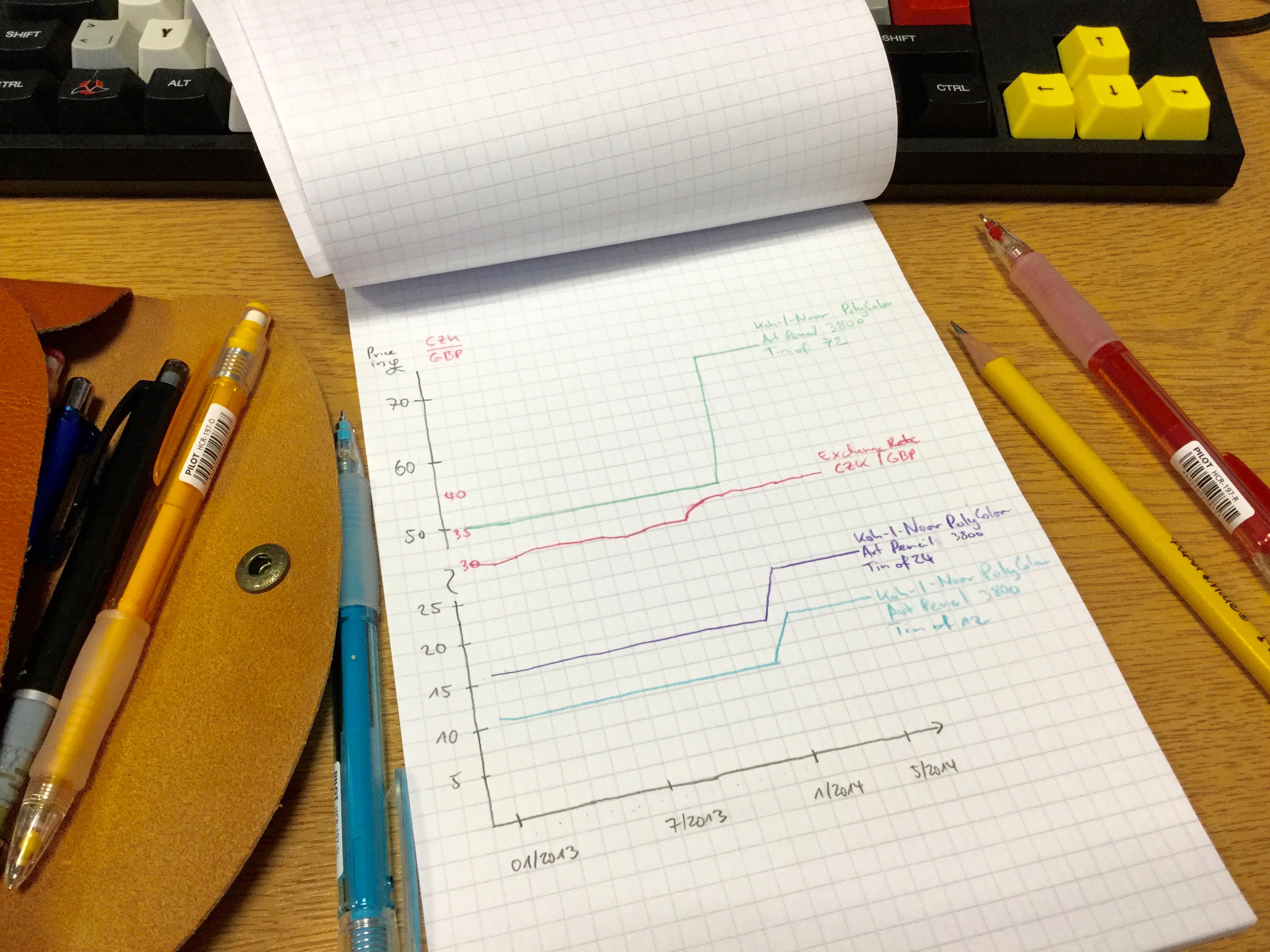
In June this year, I used R to do some web scraping. The data collected was supposed to be for a follow-up of my Why did stationery become so expensive? blog post. Well, this is the follow up blog post and there isn’t much to show, maybe because we are talking about wood-cased pencils. Fountain pens and mechanical pencils had a more extreme price development.

I did the R code not only for the follow up, but also to teach myself a bit more R, I would have normally done this in PHP, which I am more familiar with, having used it since the 90s and having used it for similar tasks in the past (even though people didn’t call these tasks web scraping at that time, or if they did I didn’t know).

chart showing how the Koh-I-Noor PolyColor Art Pencil prices have changed.So what exactly did I do? I was looking at how the prices for pencils have changed on the Cultpens web site over time. My code that will get historic prices from archived versions of the Cult Pens pencil web page from archive.org is available on GitHub if you want to try it or change it for your own purposes. If you do please bear in mind that my code is not very good, I realise this, but as I am new to R I don’t know how to improve it (at the moment – I hope to find more time to learn R in the future). Also, if you try this please try to minimise any strain on the server you get your data from.

The findings were less exciting than expected. VAT has changed a few times over the last few years and there are obviously currency exchange rate fluctuations to be taken into account, as well as inflation and other factors.

The most interesting changes I could see was a > 10% price increase for some Graf von Faber-Castell products between 2010 and 2011.

The  Tomboy Mono 100 got cheaper over the years. Between 2010 and 2013 it got > 20% cheaper.

The most extreme price rise was for Koh-I-Noor products. At the beginning of 2014 the big Polycolor Art Pencil tin got nearly 40% more expensive, smaller tins got more expensive, too.

Overall prices seem remarkably stable.

As mentioned before I assume the price stability is also linked to this being pencils. As shown in my previous blog post fountain pens seem to attract more extreme price hikes.


Picture: Mongol plus Pilot Color Eno pencils on Brunnen Der Grüne Block.

Scraping pencils Read More »

Red M+R 0981 sharpener - Möbius und Rupper

M+R 0981 sharpener

I recently got the M+R 0981″crank-style sharpener” from Lexikaliker.

The 0981 is one of the Möbius und Ruppert sharpeners that is not manufactured by M+R – according to their website it is produced by premium partners in Asia. I’m not sure whether this means that M+R designed this sharpener or whether they just put their name on an existing sharpener. In any case, it does look very similar to the Dahle 133, as discussed by Lexikaliker.

Red M+R 0981 sharpener - Möbius und Rupper

Overall this is a really nice sharpener.

No bite marks

It doesn’t leave bite marks on the pencil, that’s a big advantage – or in my case even a necessary requirement. I don’t think I’d use a pencil sharpener regularly if it leaves bite marks – however good the sharpening mechanism might be.

Crank - Red M+R 0981 sharpener - Möbius und Rupper

The point

The point it creates is quite nice and concave. Concave points look good, but I find measuring the angle more difficult. When I try to measure the 0981’s angle using my traditional method I get an angle of 20°. When I measure the angle on a computer I get an angle of slightly more than 21°. In any case the point produced suitable for most purposes, you can compare this angle to other angles on my sharpener page.

Viking pencils - Red M+R 0981 sharpener - Möbius und Rupper
Viking pencils sharpened with the two different crank settings.

Other features

The crank features a dial, not uncommon for this kind of sharpener. If you dial all the way to the left you get a ‘full’ point, but you can also create a ‘flat’ point, more suitable for coloured pencils if you set the dial to the right. Any setting in-between both extremes is also possible (the difference between both settings is about 3.5 full turn of the dial (1260°)).

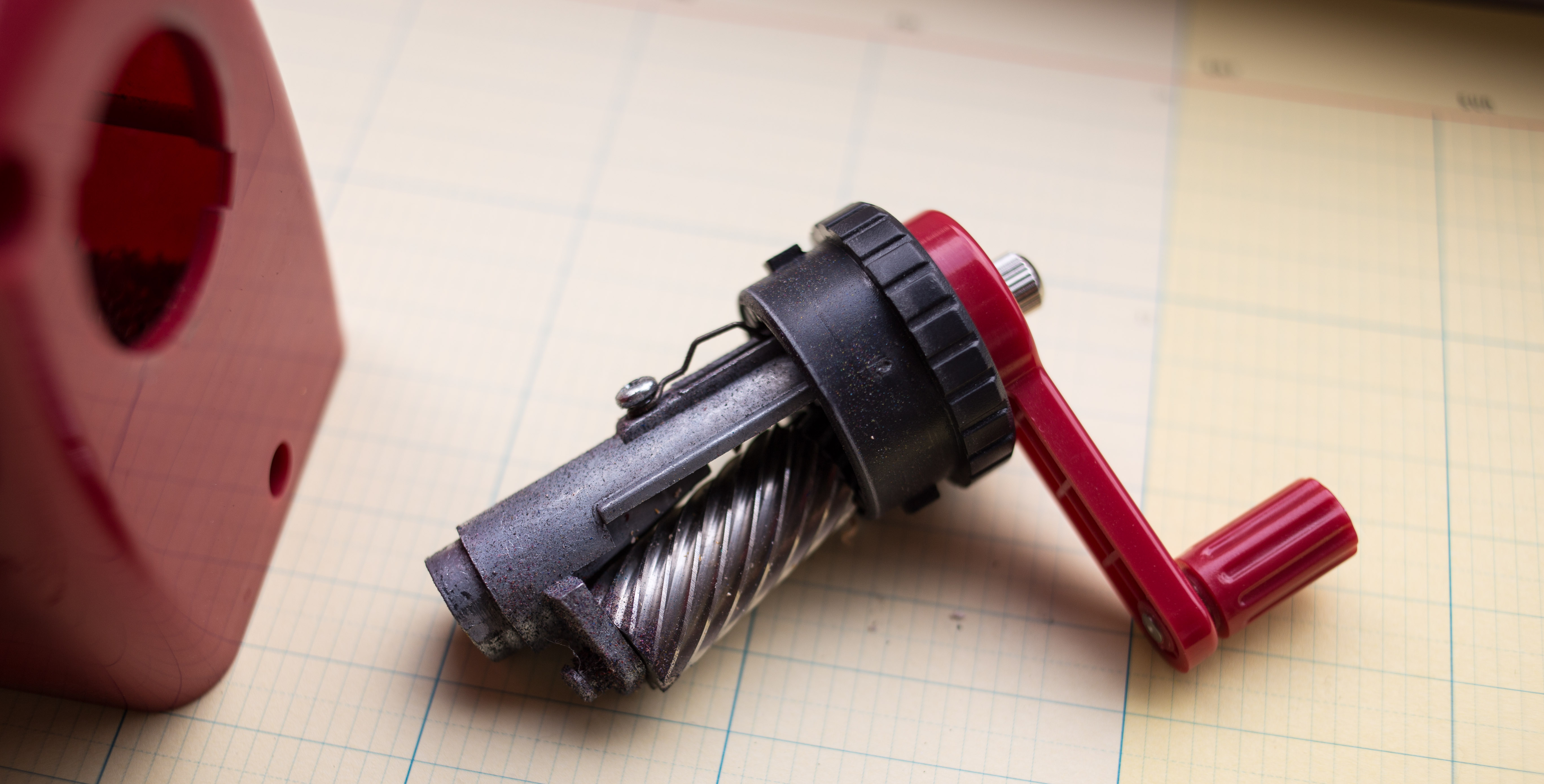
The drawer is of course removable, for emptying the waste created during sharpening. The cutting mechanism is removable as well.

I tried to sharpen a Wopex in the 0981, but the auto stop doesn’t work with the harder material encasing the Wopex lead – this is common for crank sharpeners.

Red M+R 0981 sharpener - Möbius und Rupper

Price and availability

When you search for this sharpener on the internet most pages you can find seem to be from Japan. I assume this means that this sharpener is more commonly available in Japan. You can however find some sellers in the West. In Germany you can get this sharpener for €10 – €15 (~$11 – $22: £7.50 – £15), which seems good value for money.

Viking pencils - Red M+R 0981 sharpener - Möbius und Rupper
Close view of the Viking pencils sharpened with two different settings


Price and exchange rates: October 2015

Please open the pictures in a new tab for a high-res view.

You can read more about the red Viking pencil in this blog post.

M+R 0981 sharpener Read More »