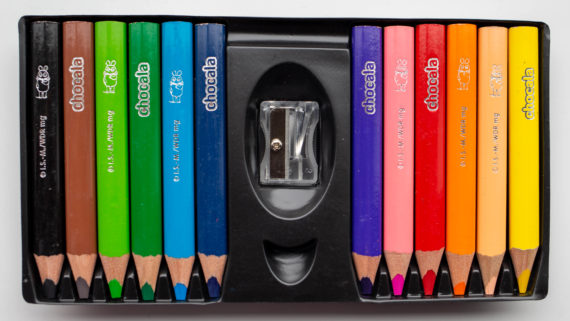
The Maus pencils are triangular and come in 12 colours
This year the German TV show “Die Sendung mit der Maus” celebrates 50 years on air. By now it is apparently being broadcast in 100 different countries, but I am not sure how popular it actually is outside Germany as I couldn’t find much information online that confirms what I read on Wikipedia about its popularity [1]Wikipedia tells me that there are also English dubbed versions being broadcast, but when I had a quick look I didn’t see any..
The packaging is nice, but on the pencil the outline of the Maus is smaller than the company logo
It is however very popular in Germany and teaches children a lot of things, including how products and things work and how they are made. By now there also a Maus radio station and, of course, there are (or were) Maus pencils.
I am not familiar with the maker of the Maus pencils. Based on what I have seen and based on the sparse information I have seen on the FSC web site I assume the company behind the pencils is a ‘marketing company’ that just paid to use the Maus logo and name on a pencil and then paid a manufacturer to put produce the Maus pencils for them.
The pencils are quite good for a ‘marketing product’, certainly better than some other coloured pencils with famous children characters.
Happy Birthday
All the best to the Maus. If you have a chance to watch an episode, please do so. They are quite informative – even for adults.
Acrylic fountain pens [1]fountain pens with bodies made from acrylic resin are still fairly new to me. The ones I used to see in the past didn’t appeal to me, but in recent months I seem to be warming up to some types of acrylic ‘looks’ or rather: there seem seem to be more and more acrylic fountain pens that appeal to my taste.
The first one I really liked was the (in my opinion ‘happy’ looking) FanMu Hawaii fountain pen. I bought this one on eBay. [2]It wasn’t expensive, but later I found out that I overpaid when I found it being offered much cheaper from another seller
The second acrylic fountain pen I really like is the Narwhal piston filler. The look of the acrylic Narwhal is rather fascinating and nice in a completely different way to the Hawaii: the acrylic resin has a beautiful colour and rather attractive swirl patterns in it.
The Narwhal box
My Narwhal adventure started with KT from Goldspot Pens contacting me and asking whether I want to try the Narwhal. I couldn’t resist (of course), but was torn between the yellow and the blue version. KT then sent me the yellow one.
Inside the box – notice the metal tool that comes with the pen
Nib choice and line width
Goldspot’s blog provides some background information about the Narwhal and the two guys behind the brand and the pens. Times have moved on since this blog post was published: the nib is now also available in medium (the fine nib is of course still available).
Regarding the writing experience: the nib is very smooth. There isn’t much line variation unless you press very hard, i.e. it is not a flexible nib even though you can create a wider line if you want to force it.
Size and colour comparison (top to bottom): Pilot Kakuno, Pelikan M200, Lamy Safari, Narwhal
I asked for the fine nib, because of my small handwriting. For my normal style of writing the nib is actually a bit too big: the nib’s line width is quite wide for a fine nib, certainly wider than lines from fine Kaweco or Lamy steel nibs. I take Pelikan out of this comparison as there is a lot of variation within the Pelikan brand and its nibs [3]in my experience much more than with Kaweco or Lamy nibs.
On Hobonichi paper – top: Narwhal, bottom: Super5 with the 0.7mm nib
My fine Narwhal nib lays down a 0.6mm wide line [4]scanned at 1200 dpi and measured in Photoshop, seen in the picture above, in blue. For comparison: the grey lines under the blue Narwhal lines are from a Super5 with the 0.7mm nib, which produces a (surprise, surprise) 0.7mm line. Please note that these are not standard 5mm squares but smaller Hobonichi squares (English version).
Looks, price and functionality
The pen itself looks great and certainly like a pen from a higher price band than the Narwhal’s $45 (~€38; ~£33). You even get a tool with your pen to help with disassembly, similar to what you get with a TWSBI.
The Narwhal nib
The gold band after the grip section looks very nice, especially without the cap. When the cap is on the pen the transition between the cap and the gold band looks a bit abrupt (check the photos earlier in this blog post) – most pen with bands seem to have the bands at the end of the caps rather than having none at the end of the cap but one ‘in the middle of the pen body’, i.e. after the grip section.
The modern looking cap with I call a ‘goldspot finial’.
The main attractions for me are, other than the smooth piston filling mechanism, the beautiful three-dimensional swirls that seem to defy the laws of physics because the seem to be much deeper and more three-dimensional than the narrow space between the outside of the pen and the ink reservoir should allow. Have look at them in the video below.
You can’t post the cap, at least not in a way that is comfortable and works well, but as I don’t post pens unless they have to be posted (OHTO Tasche, Cult Pens by Kaweco, …) I don’t mind at all.
Ink capacity
I had a look at the ink capacity of the Narwhal and I could fit in a bit more than 1 ml of ink. For comparison: a standard international ink cartridge can hold about 0.8 ml. There is actually more space in the Narwhal than 1 ml, but when you move the piston to the feed there is quite a gap, i.e. there is unexpelled air which is using space that consequently cannot be filled. When filling your fountain pen the traditional way, nib down, the air travels to the top and you still cannot expel the air to fill the ink chamber to capacity. You should be able to get more than 1.5 ml of ink into the pen, if you fill it with the nib pointing upwards, but you’d need some sort of travel inkwell that fits well.
The knob and piston filling mechanism
Conclusion
Overall this pen provides excellent value for money. There are not that many piston fillers in the same price range. The Narwhal is very well made and is also available in a choice of colours. I just wish the nib was also available in EF.
Goldspot provided the pen free of charge and KT patiently answered all questions I could think of. I did no receive any money for this review.
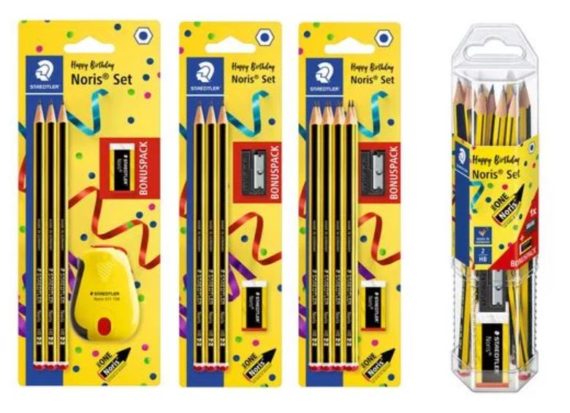
To celebrate the 120th anniversary of the Noris Staedtler has created a special page for our [1]..certainly my and maybe also your favourite pencil favourite pencil. You can find it in the ‘Highlights’ section of Staedtler’s website (it’s part of the the ‘Discover’ menu item).
I wish this important brand and pencil could have been in the limelight a bit longer – by Staedtler featuring the Noris anniversary article on their landing page for a few weeks – especially in countries like the UK where the Noris is very popular and people might appreciate this special anniversary [2]The 120th anniversary of the pencil with then umber 120.. Addendum: I have been told that that the Noris anniversary pages will be expanded throughout the year.
The special Noris web page is a great read with lots of historic details plus some quirky titbits thrown in, like the record-breaking Noris color pencil that is more than 450 meters long or the giant Noris Obelisk in Barcelona. Unfortunately the translation into English seems to have been done by a computer, which resulted in the occasional information hiccup, but that doesn’t detract from the enjoyment you get from all the details. Addendum: My understanding is that Staedtler will get the translation issues fixed.
The anniversary details from this page are great, so I couldn’t resist and added some of them to the Noris page on Stationery.wiki.
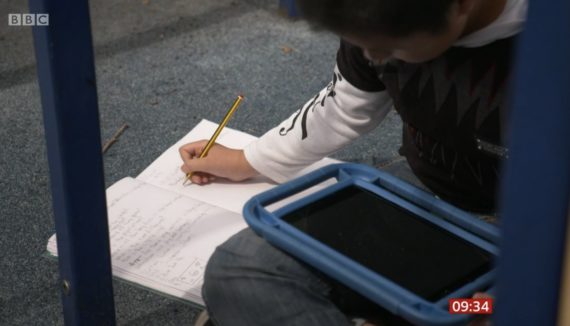
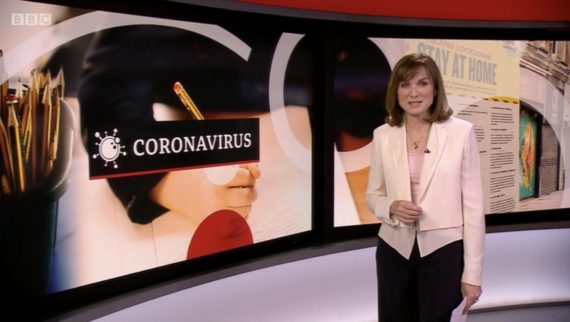
The screenshots have been taken from BBC News. I believe that the use of these images falls under “fair dealing” as described by the UK Copyright service.
When I saw the Noris 511 120 Sharpener, mentioned in the previous blog post, my first thought was that Helmut Hufnagl was probably involved in the development of this sharpener. Two reasons: like the 562 300 PB ruler it is suitable for left-handed users [1]no wonder Staedtler won an award for non-discriminatory corporate culture and like the 512 60C sharpener the 511 120 tries to provide a mess-free experience, thanks to the cap. The similarity to the Sonic Ratchetta is another thing to notice. The 511 120 , like the Ratchetta, has a ratchet mechanism. This also means you can sharpen without having to ‘regrab’ the pencil and it makes the sharpener easier to use for left-handed users. In the West, the Sonic Ratchetta seems to be more commonly available than other sharpeners of a similar design. Similar sharpeners are being sold under other names (Bostitch, Paperpro and more), but as far as I can tell the original version was not the Sonic Ratchetta but was the SDI Buggy, first released in 2013. (You have to watch that video!)
The maestro did it again
I feel lucky and privileged to have been able to not only get answers to my questions about this sharpener but to even some additional information, directly from Mr Hufnagl. As suspected this sharpener is really his brainchild and even though it is being produced at one of the two factories were Sonic Ratchettas/SDI Buggies, etc, are being made, the Noris 511 120 is a different product, i.e. has different specs.
Super 5 (top) vs Dex (bottom) the photo doesn’t help in understanding the differences
Super sharpener, Super 5
The whole ‘looks similar but is different’ situation reminds me a bit of the Super 5. The fantastic Super 5 fountain pen looks quite similar to Kingsley’s Dex and thanks to Scribble I found out that both of these, and also the Manuscript Master, use Helit bodies. These pens are however quite different in terms of ‘feel quality’ and even function: while the Dex feels cheap and plasticky the Super 5 is a great pen to use and has a very special nib. They are quite different even though both use Helit bodies. As mentioned previously, Helit is actually owned by Maped which brings us back to the topic of sharpeners: The 511 120 isn’t out yet, but I am looking forward to finding out how it will perform.
Testing
Mr Hufnagl asked different kinds of users to test the new sharpener. Doctors / GP practices and hairdressers were particularly impressed with this sharpener. Different employees were sharing pencils, e.g. to write down appointments, and ratchet mechanism made sharpening easy for left-handed users while the shape made the sharpener easy to clean (think Covid). Pupils from secondary schools also loved this sharpener.
I’m really looking forward to the 511 120. It certainly seems worthy of sporting the Noris’ colours and is a great addition to the Noris line in the Noris anniversary year.
It’s 2021 and the Staedtler Noris, Staedtler’s pencil with the article number 120, is 120 years old this year.
One of the new anniversary sets from Staedtler’s web site, released for this occasion, looks extremely desirable: it contains a new sharpener that will be available soon. The article number will be 511 120, a nice nod to the Noris’ number.
Staedtler’s keeps trying to allow your pencil case to stay mess-free: Similar to the 512 60C from 2017, the new sharpener can be closed to prevent graphite and wood shavings from falling out.
Are you sitting comfortably? Good: the 511 120 will display when the pencil is sufficiently sharpened and will have a ratchet function to make it suitable for left-handed users. I am not left-handed but like how Staedtler cares for all users – like they did when they introduced the 562 300 PB ruler. The sharpener will be suitable for pencils with a diameter of up to 8.2 mm. I can’t wait for the 511 120 to hit the shelves in the UK …finally some good news in these sad times.