Produced in Poland for PZ Cussons, a manufacturer of soap and personal hygiene products from North West England, this shaving cream is very interesting for pencileers, molyvophiles [1]Someone passionate about pencils and molyvologues [2]A student of pencils – mainly because of its name. Disappointment is however unavoidable after a quick look at the list of ingredients: there is no graphite in this cream. This is possibly a precaution to spare modern office workers the chimney sweeper look when they go to the office after having used a graphite based shaving cream. Graphite lovers will have to make do with pencils and graphite pots, but they can be satisfied with the knowledge that there are personal hygiene products with them in mind, even though they don’t contain graphite…
A big thank you to Sean from The Blackwing Pages for making the world a happier place by inventing the word pencileer and to Lito from Palimpsest for enriching our vocabulary with the word molyvologue.
I bought the razor, seen in the photo, many years ago. It’s Merkur’s 34C, which has been on the market for 80 years. I was very surprised when I recently noticed that the 34C won About’s Reader Choice razor of the year 2011 award. What a good choice. This razor is really great.
You might recognise the name Reidinger from Lexkaliker’s blog. He wrote about their “Pencil Configurator” in one of his previous blog posts. Despite their pencil configurator, Reidinger is not really a pencil manufacturer but is selling pencils, including carpenter pencils, and folding rules as promotional gifts.
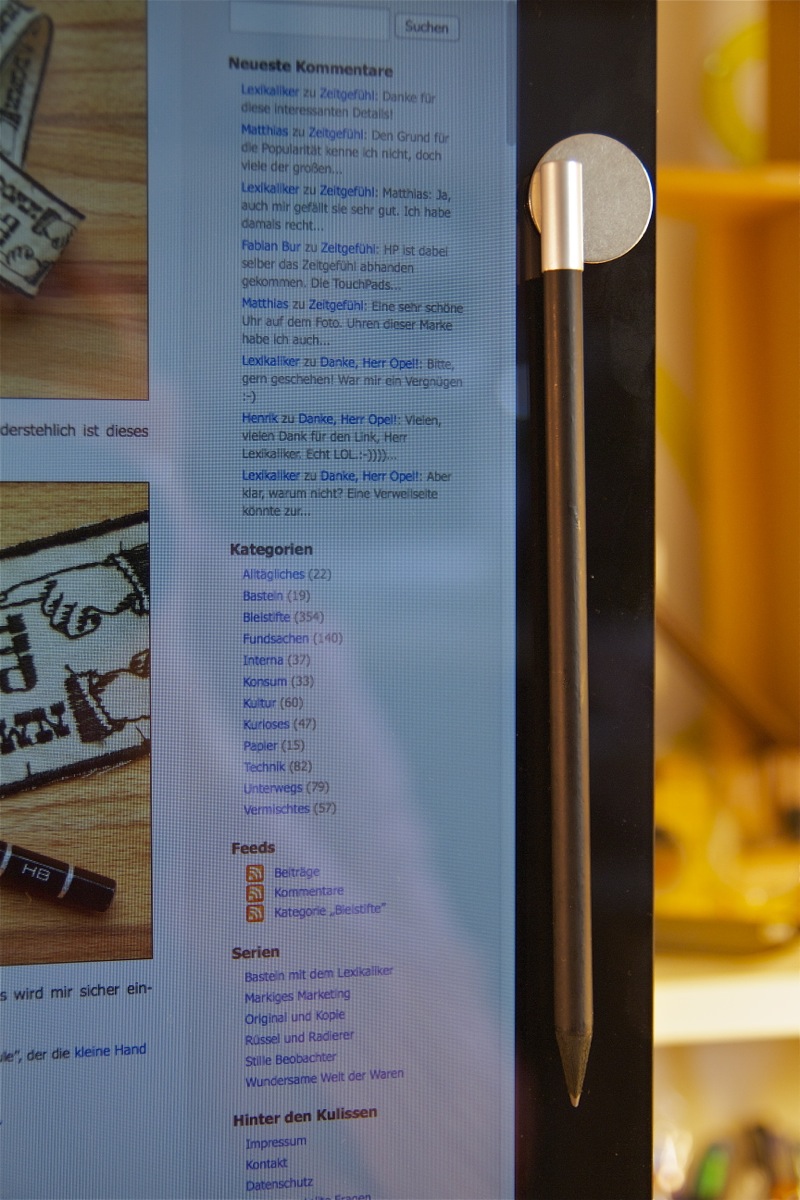
The magnet
Good it's not a CRT...
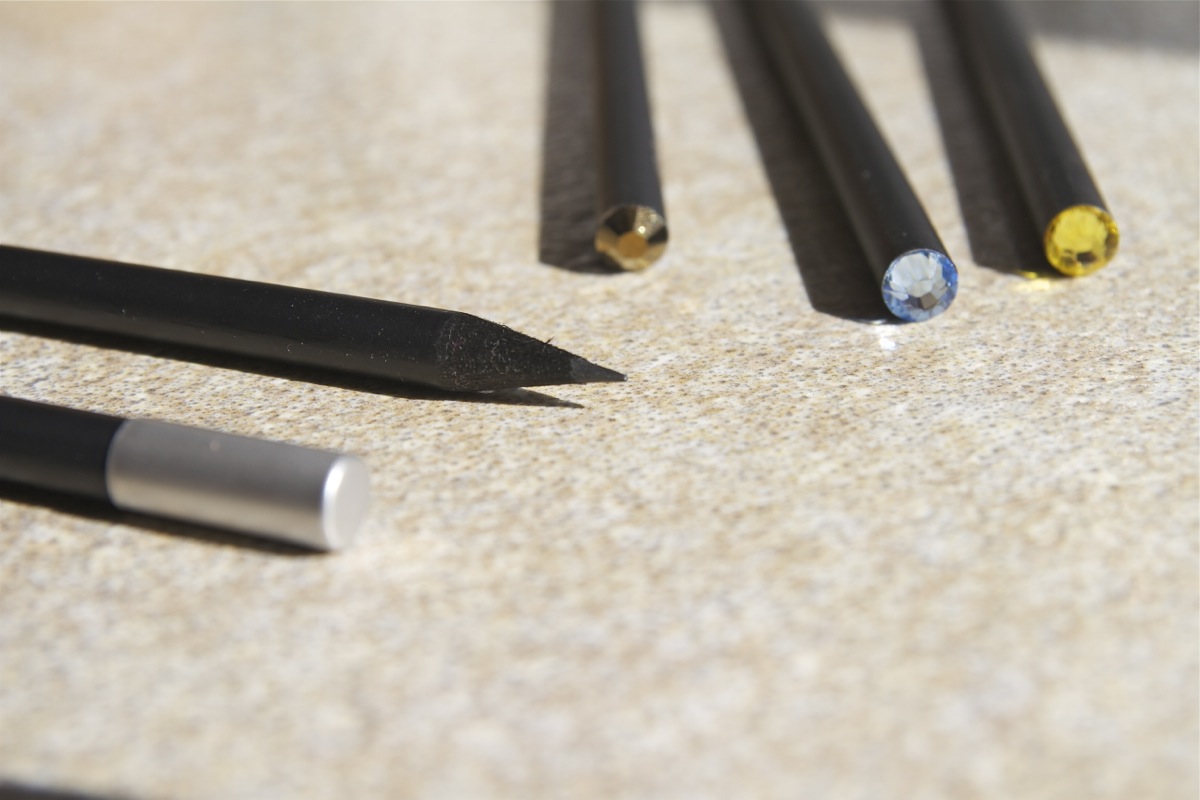
One of their products is a magnetic pencil, which I got sent by Mr Lorber earlier this month, together with some of Reidinger’s crystal pencils [1]using Swarovski elements. It is a black wood pencil with a neodymium magnet at the end. Unlike Viarco’s or Lexikaliker’s version the magnet is hidden by a metal sleeve and is not directly visible. A metal disc is available and comes with one of the magnetic pencil sets, for sticking to non-metallic surfaces so that the pencil can be placed there. The disc is however not magnetic. A quick attempt to magnetise the disc using the magnetic pencil was unsuccessful (I was hoping to magnetise the disc to be able to use it for Eberhard Faber’s Microtomic or General’s Kimberly pencils). You might know that neodymium magnets are the strongest permanent magnets available and I have to say it is pretty amazing how much these pencils “stick” and what you can do with them: if you can connect two pencils at the end you can swing them around, which is pretty fun.
The pencil
Don't need the metal disc here...
The pencil itself is very good. It lays down a very dark line, is easy to erase and sharpen and is quite smooth, similar to a good pencil, like the Staedtler Tradition or Noris, but short of an excellent pencils, like the Faber-Castell Castell 9000, the Tombow Mono 100 or the Staedtler Mars Lumograph.
After talking to Mrs Morse from Reidinger I found out that many of their pencils are manufactured in Eastern Europe and are made using lime wood [2]American English: Linden wood and was told that the quality of the materials has been certified by TÜV. I am however not sure where exactly the magnetic pencils and the crystal pencils are made. I know that some of the other crystal pencils available are made in China, but to my surprise there seem to be several factories making black wood crystal pencils as Mrs Morse confirmed that their pencils are not from China. Last year my wife bought some crystal pencils from The Pen Shop. They are in her office at the moment – so I cannot check now, but I should have a look and compare them to the ones from Reidinger…
Magnetic and Crystal Pencils
Giveaway
As these magnetic pencils are promotional gifts you cannot buy them individually. I believe you have to buy at least 288 for an order, but since Mr Lorber sent me several of them I am happy to give away a pack of three crystal pencils with Swarovski elements and a magnetic pencil with a metal disc. I am happy to send the prizes to any country as long as Royal Mail doesn’t refuse to send them there. I will use random.org to get a random number and the author of the corresponding article will get the price (unless I am the author or the comment is definitely spam). To take part please leave your comments at this blog post before Sunday, 4th September 2011, 23:59 UTC.
I would like to thank
Mr Lorber for sending me these pencils and
Mrs Morse from Reidinger for providing me with more information about Reidinger’s pencils.
Sean from The Blackwing Pages for the Eberhard Faber Microtomic and the General’s Kimberly pencils I tried to use with the metal disc.
I was just looking for Staedtler carbon leads at Cult Pens when I noticed that there are four Staedtler pencilmaker sets to be won on their blog. They post internationally, deadline is 31 August 2011.
In the 12th century my home town, Volkach, became part of the county of Castell, which belonged to – you might have guessed – the Counts of Castell [1]At that time it actually wasn’t a town yet, but documents show that by 1258 it was a town (‘in civitate nostra Volka’).. Quite a bit later, in 1896, Alexander Graf zu Castell-Rüdenhausen married Ottilie Freiin von Faber and the name of the pencil manufacturer Faber changed to Faber-Castell.
Except this link to Faber-Castell there isn’t really much of a “pencil link” in the surrounding area of Volkach. All the exiting pencil stuff is happening about 100 km further South where you’d find the big pencil manufacturers like Staedtler, Faber-Castell, Schwan-Stabilo and Lyra.
Some branches the forest's caretaker removed. He also cut other trees nearby to give the Pencil Cedars more space.
I wrote there isn’t much of a “pencil link” here – well, the area around my home town can boast with one other link to the world of pencils, even though it is rather unknown. Trees from North America were planted in Germany to test the suitability of the wood for use in pencil production …and some of them were planted on Schwanberg [2]The Schwanberg isn’t really a hill, but an elevation (474m / 1555 feet) – about 200m above the surrounding area. According to legend Saint Hadeloga (sometimes called Adeloga or Hadla) … Continue reading, an elevation not far from the town of Castell, by the Counts of Castell – to test the suitability of the wood for use in pencil production. The trees brought over from North America were the Pencil Cedar (juniperus virginiana) and the Eastern White Pine (pinus strobus). You can still find some of the Pencil Cedars near Castell. 100 years ago there were also many well established Pencil Cedars North East of Faber-Castell’s home town, Stein, planted by Faber, which probably didn’t survive [3]This tree was first introduced to Europe in the 17th century. Faber is supposed to have planted, between several thousand and several tens of thousands of these trees in the 19th century, depending … Continue reading. These trees are not really used any more for pencil production, but if you have an old pencil that is more than 70 years old, the wood might be from a Pencil Cedar.
The Schwanberg isn’t really a hill, but an elevation (474m / 1555 feet) – about 200m above the surrounding area. According to legend Saint Hadeloga (sometimes called Adeloga or Hadla) built an abbey (nunnery) on Schwanberg. She was the daughter of Karl Martell (Charles the Hammer). He repudiated her when she vowed virginity (so she is not mentioned very often in history) but they reconciled many years later. She is actually an aunt of Charlemagne, King of the Franks, and she is the patron saint for fever.
This tree was first introduced to Europe in the 17th century. Faber is supposed to have planted, between several thousand and several tens of thousands of these trees in the 19th century, depending on which source you check. I assume many must have survived outside Schwanberg, but it is unknown how many are left and where they are. One of Lexikaliker’s blog posts indicates that the trees planted by Faber near Nuremberg did not survive. Other Pencil Cedars planted in Germany did not survive either.
When I go to the supermarkets in Shanghai it’s usually E-Mart, a large Korean supermarket chain. In the past I used to go to Carrefour, but I think I haven’t been to a Carrefour in Shanghai for at least five years – just because it’s less convenient to go there. It’s a shame, because they always had a good selection of Faber-Castel products with very low prices. Even though I’ve seen Tesco in Shanghai [1]Tesco entered the Chinese market in 2004 when they bought the Chinese supermarket chain 乐购 (LeGou – Happy shopper) in the past, I’ve never actually visited one. This had to change. I mentioned Tesco in previous blog posts. It’s one of the biggest or the biggest supermaerket chain in the UK. Many Brits try to avoid Tesco for various reasons, but my wife and I usually don’t mind and visit more or less all supermarket chains nearby, we don’t have a particular favourite.
The Tesco I went to is in SongJiang, not far from the Shanghai Institute of Foreign Trade. The selection of stationery is fantastic, much better than in the English Tesco extra I usually visit. The stationery products on offer are dominated by Chinese brands, which is no surprise – there are a lot of Shanghainese M&G products in the shelves. Even though I did not notice this brand in the beginning of the decade, it has certainly been in all the supermarket chains in recent years. Pencil-wise the choice is not great, there are only a few different pencils to choose from. Most are hexagonal, some are triangular. Most space was reserved for Tesco’s own brand yellow pencils (I’ll try to check where they are made when I go there again), Staedtler’s yellow pencil 134 (produced in Shanghai) and Chung Hwa’s Drawing Pencil 101. Pens are surprisingly cheap, but I’ll write more about that another time. One brand that seems to grow year on year in China, Britain and Germany is Maped. Maped – Manufacture d’Articles de Précision Et de Dessin (Manufacture of Precision and Drawing Tools) is a French company established in 1947. Unlike companies like Staedtler or Faber-Castell, Maped concentrates more on non-pen stationery, like paper-clips, scissors, etc. Since 2006 they own Helit and Diplomat, two German companies. Helit manufactures Bakelite desk accessories and other items. You can see their Bakelite blotting roller in this blog post. This blotting roller is from a mould or based on a mould that is at least 90 years old. Back to Shanghai: I’m quite happy to have so much choice. You can be sure that I already bought quite a few stationery products in LeGou Tesco.