Next year Staetdler will release “nostalgic metal tins” as a limited edition. There will be tins for the Mars Lumograph, the Noris and the Tradition (yes, this time with an upper case “T”).
I assume that that only the tins have the nostalgic look and that the pencils inside will have the modern look.
Fantastic! I hope I will be able to buy some before they are gone. Getting this years 1835-2010 set was difficult enough.
For me the Staedtler Noris has always been the archetype of a pencil. The Mars Lumograph might come close and these days I might also consider the Castell 9000, but somehow I never really saw the Castell 9000 being used around me when I was younger. My father was a joiner, so he used carpenter pencils and normal pencils …and because he used a lot of them he would not buy the more expensive ones. There was a point, I think it was the early nineties, when Herlitz Scolair pencils became quite cheap. So he usually used those …and he used a lot of them. Even though I also used to use them I never thought of them as nice pencils, they were always just cheap pencils to me. In the eighties there were of course Japanese pencils in Germany, too, but they were usually novelty pencils, not branded pencils. Their selling point would be the unusual look, e.g. unusual patterns or colours printed on them, often metallic. Unfortunately they usually suffered from lead breakage, probably because the manufacturers did not have to try hard: Everybody who bought them did so because of how nice they looked, not because of their reputation – and since they were not branded you could not really know which ones to avoid in the future .
Shanghai's Chung Hwa Drawing Pencil 101
Back to my original topic: I think the Staedtler Noris can be seen as the archetype of a pencil in the UK and in Germany. In the UK the Staedtler tradition can also be seen quite often, but in both countries the Noris seems to be the pencil that is most ‘common’ and recognisable the same time.
Shanghai’s popular pencil
Last time I was in Shanghai I was trying find the Shanghainese equivalent by looking for the most common pencil in everyday life. I expected it would be the Chung Hwa 6151, just because it was a Shanghainese pencil you come across in stationery blogs or web sites, but I never really saw the 6151 in the wild. Instead I came across the Chung Hwa Drawing Pencil 101 again and again. Employees in supermarkets used it to make notes. Waiters in restaurants used it to take orders. It just seemed to be the most common pencil in Shanghai. If there are any reader who know or live in Shanghai and disagree please let me know. I would like to know what your experience is.
China First Pencil Company Ltd.
Before I go into more detail about this pencil I would like to talk about the manufacturer, Chung Hwa, first. There are many Chinese companies and products in different and unrelated industry sectors that are called Chung Hwa: there are Chung Hwa cigarettes, cars, there is Chung Hwa cognac, ink, etc. As far as I can tell these companies have usually no connection except the common name. Chung Hwa (PinYin: ZhongHua) does translate as ‘China’ but not in the normal sense, i.e. when you talk about the country, but in a cultural or literary sense.
The Chung Hwa pencil company traces it roots back to 1935. It changed the name a few times and today’s official name is China First Pencil Company Ltd. They manufacture graphite, colour and cosmetic pencils as well as pencil related stationery and machines for the pencil industry.
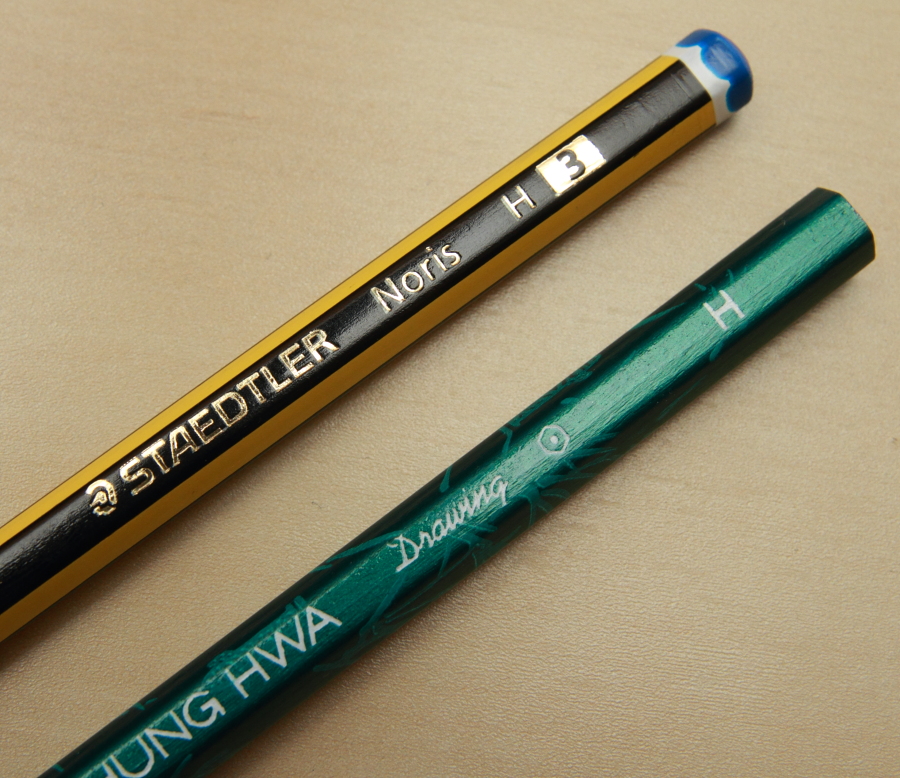
Today the Chung Hwa Drawing pencil‘s body has a dark green body colour with a light green pattern of bamboo leaves and totems printed over it. The pencil is hexagonal without a painted cap and is labelled on three sides. The wood used is rather red, but does not seem to be the Vatta wood (Macaranga Peltata) mention in a previous blog post. Two sides are labelled in white, one in white and gold. As far as I know the Chung Hwa 101 should be available 6H – H, F, HB, H – 6H. Despite my best efforts I was however unable to find this pencil in F, so I bought one pack in HB and one in H.
…compared to the Staedtler Noris
Since this pencil seems to be Shanghai’s everyday pencil I thought it would be a good idea to compare it to what I think is the UK’s and Germany’s everyday pencil, the Staedtler Noris, as explained earlier. Let’s start by looking at the finish. I like the fact that you can see the wood grain through the paint, but on the 101 the paint has not been applied as well as on the Noris. This applies to both the dark green base and the light green pattern. The Chung Hwa Drawing Pencil 101 in HB is also not as soft and smooth as a Noris HB. It is not yet scratchy and certainly not worse than an average pencil. The graphite is not too reflective and does not smudge, so keeping the price in mind the 101 HB is very good value for money. The 101 in H is also very good for the price, but compared to the Noris in H it is much softer, more like an F grade pencil.
Conclusion
The Chun Hwa Drawing Pencil 101 offers very good value for money. It is not really a great pencil that can compete with good pencils, but it is definitely better than the average no name pencil and better than many cheap branded pencils.
As usual: the paper that can be seen in the comparison photo of this blog post is the Bloc Rhodia Nº 13.
I think I should start this blog entry with a warning. If you expect this to be a pencil case review you might be slightly disappointed …there is a bit, but not too much, to be written about this pencil case, so to make this blog entry more substantial I will also talk a little bit about the Eberhard Faber brand and include a little bit of information about the pencils they offer in Europe. OK, let’s start:
When I was in Germany in April 2010 I bought this Eberhard Faber pencil case at the Müller store in Volkach, Lower Franconia. Müller is a drug store chain with shops in Germany, Austria, Switzerland, Slovenia, Hungary, Croatia and other countries. The Müller shops I have seen so far had a nice selection of stationery.
Keeping the size of the shop in Volkach in mind they had a rather big stationery section. All the common products and brand were stocked …those that you would find in most shops in Germany, i.e. mainly Staedtler, Faber-Castell and for mechanical pencils the common Japanese brands as well.
You will also find some Lyra pencils, but don’t get your hopes up if you are looking for niche products. You will certainly find sharpeners, but if you are want a specific model not from Staedtler or Faber-Castell, but from Dux, M+S or Eisen you will be disappointed …but to be fair: not many stationery shops stock these brands anyway.
One of the reasons why I bought this pencil case was to get it while it is still available. Eberhard Faber was an American brand, but was sold to Faber-Castell. Since the 1990s Sanford owns it and as far as I know Eberhard Faber products disappeared more or less completely in the USA. If this is not the case and Eberhard Faber articles are still available in the USA I would be grateful if you could let me know. Not uncommon in such a case: another company held the trademark for another geographic area, in this case Staedtler continued to use the Eberhard Faber name in Europe [1]This reminds me of Grundig, I mentioned them recently in another blog entry. Recently Staedtler sold the Eberhard Faber trademark, which now belongs to Faber-Castell. My understanding is that current Eberhard Faber products will not completely disappear, but will instead be sold under the Staedtler name in the future.
Eberhard was the brother of Lothar von Faber, the great-great grandfather of Count Anton Wolfgang, the current CEO of Faber-Castell. Originally Eberhard managed the subsidiary in New York and later he established his own company under his own name (see page 8 of the 2 / 2007 issue of Faber-Castell topics).
If you want to know more about the Eberhard Faber brand: page 5 of the 1/2010 issue of Faber-Castell topics has a great article about the history of the Eberhard Faber brand.
Back to the pencil case. The pencil case was €14.99 ($19.90, £ 12.45) and is filled with 17 pencils (all of them triangular shaped), an eraser, a ruler, a sharpener, 6 ink cartridges and a timetable. The material of the pencil case is real leather, but unfortunately the leather is rather thin. Four of the pencils are the Tricki Dicki highlighter pencils in neon colours: yellow, orange, green and red. The pencil case was available in three different colours: tan, black and maroon, the one I bought. Just for your information: In Germany maroon is usually referred to as “Bordeaux red”.
Eberhard Faber Tricki Dicki highlighter pencils
Although possibly not the best choice of name for English speaking countries, these pencils work very well, but like all highlighter pencils they cover written or printed letters to some extent. They look very similar to the Staedtler textsurfer dry, so I assume the Tricki Dicki and the textsurfer dry might actually be the same pencil. The circles, stars and triangles printed on the Tricki Dicki pencils can also be found on Staedtler’s new learner’s pencil. I could not find a direct equivalent to the other colour pencils from the pencil case in Staedtler’s product range. The most similar pencil seems to be the Staedtler ergosoft, but unlike the ergosoft, the Eberhard Faber 1410 colour pencils do not have ABS coating.
Eberhard Faber colour pencils 1410
The sharpener that comes with the pencil case is the Möbius+Ruppert double hole magnesium sharpener 0211. The white eraser that you get does not have anything printed on it.
The Eberhard Faber Lederetui is a tri-fold pencil case with the fold-out part containing a timetable on one side and the ruler, the ink cartridges and three 1210 pencils on the other side.
I am not sure whether there is an equivalent pencil that is being sold under the Staedtler name. If there is one it might be the triangular Noris Club.
The Eberhard Faber 1210 pencils are very nice indeed, rather dark and not scratchy. They do however look relatively boring and I have to admit that I am less of a fan of triangular pencils than most other people.
Eberhard Faber 1210 pencil
Conclusion:
The Eberhard Faber Lederetui is great value for money. You get quite a few pencil and a nice sharpener for your money. Compared to high-end pencil cases like the Sonnenleder Lasse it does however feel a bit flimsy and the leather, even though it is real leather, feels quite plasticy. This pencil case is being sold to school children, therefore the thin leather makes me wonder whether the pencil case will survive very long in the real world… Nevertheless I am sure it will last for a long time if you look after it.
Links:
Staedtler press release about selling the Eberhard Faber trademark to Faber-Castell
As a tribute to Lexikaliker’s fantastic “Basteln mit dem Lexikaliker” series I want to show you today how to make simple point protectors for your pencils. Lexikaliker had two different posts about point protectors (a simple version (Google translation) and an improved version (Google translation)). My version is not as good as Lexikaliker’s, but you will usually have all the material necessary at home. Actually… my point protector is so simple, you probably thought of it yourself somewhen in the past. If you have not looked a Lexikaliker’s handicraft articles yet, you should definitely have a look, especially at the one where he turns a pencil into an electric, musical instrument (Google translation).
For this simple point protector you need some old paper and sticky tape. I usually use the reverse side of calendar sheets to make notes, but the sheets of this Dutch calendar (see first picture) with Donald Duck comics are printed on on both sides. As I cannot use them for notes I will use them to make the point protectors. Maybe you also have some old calendar sheets somewhere. Just divide a calendar sheet into three equal strips. If you use other paper cut it into strips about as long as a pencil and a quarter of a pencil length wide. Roll the paper around the pencil and fix it with sticky tape. To increase stability you might want to close one end of the cylinder you just created. Either fold the end over and fix it with stick tape or just use sticky tape to close it without folding the end over.
Faber-Castell Bonanza 1320 with an unfinished point protector
Some pencils, like the Staedtler Wopex, have a rubber-like surface which is nice when as it gives you more grip but makes removing the point protector difficult. In this case just put some sticky tape on the inside of the protector to reduce friction.
The point protector protect the point of your pencil and will help to keep the inside of your pencil case graphite mark free.
When it comes to the recognition value of their pencils there is one company that – in my opinion – does by far the best job: Staedtler. Compared to other companies in this industry Staedtler is quite unusual as the company belongs to the Staedtler foundation whose main purpose is the promotion of scientific research… but I digress. Let’s get back to the pencils: As much as I like to use pencils from other companies, the Faber-Castell 9000 for example, for me the archetype of a pencil is the Staedtler Noris, available in two versions: as the 120 (without eraser) and as the 122 (with eraser).
The Noris is a pencil that is very common in Europe, but I would not say that it dominates the market. Noris as a brand name for pencils has been registered in 1901 and the name Noris itself is closely related to Staedtler: the nymph Noris is the personification of Nuremberg, the city where Staedtler has its headquarters. The Noris pencil is definitely quite popular in Germany. In UK it is also quite popular: in supermarkets you can usually find at least two types of pencils, often more, but a no name pencil and the Staedtler Noris seem to be the common denominator.
Somehow the look of the Noris is easy to remember, but this is not a feature unique to the Noris: Staedtler also did a great job in that respect with some of their other pencils: the tradition and the Mars Lumograph. These three models are instantly recognisable and unless you count the yellow Koh-I-Noor [1]which was not the first yellow pencil, but seemed to have sparked the popularity of yellow pencils in America they seem to be the most copied pencils in the world.
The Staedtler Noris was the antetype for the Chunghwa 6181, reviewed at oh! super tooth, but even though the Noris has probably been less often copied than the tradition and the Mars Lumograph, it can be seen on TV more often, usually used by somebody who is probably not even aware what make or model it is.
In one episode of Black Books the main character is using a Noris to control who is allowed to talk. I just saw the Noris again last week in a BBC documentary unrelated to pencils, and I see an icon that looks like the Noris on a daily basis in Okular, the document viewer in KDE 4.
Slightly younger than the Noris, with Mars being registered as a pencil brand in 1900, but with the Lumograph being released about 30 years later, the Mars Lumographwould probably have to top the list when it comes to how often the look of a pencil has been copied by no name pencils. I have seen no name pencils with the look of the Mars Lumograph, but without any writing on it countless times. Sometimes you can also see copies of this pencil with the name of the manufacturer on it, e.g. the Chunghwa Drawing pencil, reviewed at Blyantsiden (Google translation) or the Medicise Drawing pencil 9002. Of course the Mars Lumograph also got its fair share of TV presence. Just to name one example, there is a Derrick episode from the Seventies where a secretary is using a pencil, unmistakably a Mars Lumograph.
Top to bottom: Great Britain, Australia, Germany
The distinct look of the Staetdler pencils makes recognising them so easy. This must surely be an important factor that influences the decision of customers when they are in front of a shelf of pencils and need to decide which pencil to buy.
Unfortunately Staedtler stopped producing pencils in Australia and Great Britain, but some shops still have stock left that was produced in these two countries. You might know where this is going… After this really long-winded introduction I will now compare Staedtler pencils from different countries, to be more precise: I will be comparing the Staedtler tradition 110 from Australia, Germany and Great Britain. For this comparison I used recently produced pencils from the three different factories. It would be wrong to assume that there is no variation in the production, so please do not take this comparison too seriously.
Top to bottom: Great Britain, Australia, Germany
When comparing the different HB versions [2]Even though I have most grades of the British (actually Welsh to be precise) and of the Australian tradition I only have the HB version of the German tradition. you can see that the Australian version has the thinnest layer of paint. I have to say that I actually like it, because you can see the texture of the wood through the paint. On a negative note I also have to add that the Australian pencils (all grades) have the paint applied less consistently. All pencils came pre-sharpened, but the pencil from the German factory has been pre-sharpened using a different method than the other pencils. The pencil from Great Britain is definitely softer than the other two. It also smudges a bit more. When I tried to erase all three using the Mars plastic eraser pen (528 50) there was no real difference between the different pencils.
Different tradtitions on Brunnen Kompagnon Anno 1877 paper
Comparing the Australian 4B and the British 4B I also thought that the British pencil was a tick softer, but this was definitely not as noticeable as it was for the HB pencils. Using the Mars plastic eraser pen the Australian 4B was maybe a bit easier to erase than the British 4B, but again there was not a big difference.
Different tradtitions on Brunnen Kompagnon Anno 1877 paper
Conclusion: The tradition is a really good pencil. I am not sure why, but the German Staedtler web site lists the tradition in the artist category, not in the category for pencils used for writing. Nevertheless the tradition is very suitable for writing. Stock of Australian and British tradition pencils will be exhausted soon, so get some while you can …not that the performance of the German tradition is worse, but if you just spent a few minutes reading this post you must be pencil-crazy enough to want the Australian and British version as well.
I would like to thank David from Dave’s Mechanical Pencils for the selection of Australian pencils, including the Staedtler tradition, he sent me.
The photo of Stephen Wiltshire using a Staedtler Tradition has been taken from Top Gear Episode 5 of Series 14. I believe that the use of this image falls under “fair dealing” as described by the UK Copyright service.
The pencil icon has been taken from Okular, the document viewer in KDE 4.
Even though I have most grades of the British (actually Welsh to be precise) and of the Australian tradition I only have the HB version of the German tradition.
Like the Nataraj 621, reviewed at pencil talk, the Reynolds432 is a pencil from India with a design very similar to the Staedtler tradition. The differences in appearance are minor.
All three pencils are red with dark coloured stripes. While the Staedtler tradition and the Nataraj 621 have black stripes, the Reynolds 432 has blue stripes.
All three pencils are hexagonal, but the Staedtler tradition and the Reynolds 432 have the stripes on the edges, the Nataraj has the stripes on the faces.
All three are eraserless with different finished caps. The quality of the finished cap of the Nataraj is rather poor.
Reynolds 432
Reynolds:
The history of Reynolds is a bit complicated.
Milton Reynolds from Chicago established the Reynolds pen company in 1945, but the company was later bought by Edmond Regnault who was running a successful pen company in France since 1927. Since 1974 the company was run by Edmond Regnault’s sons until it was sold to investors in 1993.
Reynolds 432 point
The company behind the Reynolds 432 pencil, G. M. Pens International Pvt. Ltd., introduced the Reynolds brand to India in 1986 and is the exclusive Licensee of Reynolds, France. Newell Rubbermaid bought Reynolds in 1999/2000, which is now part of Sanford Reynolds SA, and closed the factory in France in 2007, sparking a boycott of products from Reynolds and Newell Rubbermaid.
Today Reynolds India produces all kinds of pens, including two different types of wooden pencils and two different types of mechanical pencils.
Reynolds 432 and Nataraj 621
The pencil:
Reynold’s website highlights the following features of this pencil, available only in HB
Specially bonded lead for extra strength
Special quality lead for clean, fine impressions
Conforms to European standards of child safety
Soft wood for easy sharpening
The fact that there are paws printed on the 432 and the child safety standards mentioned on the web site seem to suggest that this pencil is aimed at children, but the “conservative look” of the pencil would suggest otherwise.
The wood used for the Reynolds 432 seems to be the similar to the wood used for the Nataraj 621. In a comment to the Nataraj 621 review at pencil talk Harshad Raveshia identified the wood used for the 621 as Vatta wood (Macaranga Peltata). The wood used for the 432 has a similar appearance, but is not red. Instead I would describe the colour as slightly yellow. It could of course still be the Vatta tree, just coloured differently, or it could be a normal deviation expected for this type of wood.
The diameter of the Reynolds 432 is a bit bigger than that of a Staedtler tradition.
The lead of the Reynolds 432 seems to be slightly harder than that of the Nataraj 621.
I did not have any lead breakage with the Reynolds 432, but I did encounter this problem with the Nataraj 621.
The hardness of the 432 HB’s lead can be roughly compared to the hardness of a Mars Lumograph 2B or a Faber-Castell 9000 3B.
Cap comparison (L-R) Staedtler tradition, Reynolds 432, Nataraj 621
Conclusion:
The wood is a bit harder than the wood typically used for pencils in Europe. This might have implications for the blade of your sharpener, but other attributes of the wood, like the texture and appearance are very pleasant. Writing with the Reynolds 432 is fairly smooth and overall this is a very nice pencil.
I would like to thank Sameer Khanna who agreed to swap the Reynolds 432 and the Nataraj 621 for two Staedtler Noris pencils.