I like a bargain. That means I do sometimes buy things if they are cheap, even if I don’t need them.
In this case I’m talking about erasers. You never know when a good eraser might come in handy [1]A variation of a sentence from the computer game Leisure Suit Larry.
Thanks to Lexikaliker whetting my my appetite and with some help from Shangching I got my hands on a Pentel Orenz. I have been using it for a few weeks now and like it very much. A blog post will follow, hopefully, once my time permits.
One of the nice features of the Orenz is the sliding sleeve. You don’t have to keep manually forwarding the lead to be able to keep writing. Instead the sleeve will slide back while you write until there’s no sleeve left. Only then do you have to forward the lead – and the sleeve will slide out again.
You start writing like this…
Retractable vs sliding sleeve
Just to clarify, when I write about a sliding sleeve I mean a one that slowly slides back while you write. The other type, a sleeve that is either completely out (for writing) or completely in (for transport) is the type I call a retractable sleeve. I hope these labels are correct, I’m not sure, but this helps to avoid confusing both types. Please let me know if the names I use for the sleeves are wrong.
In the past
The sliding sleeve is nothing new. The Staedtler Microfix [1]Available from 1977 until 1988. I used in school could do that. At that time Staedtler sold mechanical pencils with three different types of sleeves: fixed (F models), half slide (HS models) and full slide (S / SL models), but as far as I know the sliding sleeves have disappeared in the late 1980s.
…after a while it looks like that
Why are they gone?
Unfortunately these types of mechanical pencils are quite rare. I can see the advantage of a fixed sleeve for an engineer who needs his or her pencil to create precise drawings, but these days that kind of work is done on a computer – so why did the sliding sleeve not come back? In my opinion it provides a much better writing experience than a fixed sleeve mechanical pencil.
You can still get mechanical pencils with sliding sleeves. One example is Caran d’Ache’s 844 pencil, mentioned previously, but the 844’s sleeve is quite wide meaning it will prevent full contact of the lead with the paper – the sleeve is in the way when you are writing.
Sorry for the recent inactivity on my blog. I had a few days off over Easter and work as well as the baby (or should I say the toddler) have kept me very busy, too. There are a few half finished blog posts I hope to complete soon.
Work wise a new task / project will start soon. It will probably go on indefinitely, so I am just thinking which of my unused Atoma notebooks I should start using for that task.
I want to go with Atoma as I have often regretted using a Red’n’Black notebook for another project, which meant I couldn’t add sheets afterwards, or add printouts in a meaningful way.
The A5 like size has been very useful in the past, but this time there might be benefits to be gained from being able to squeeze more information on a page – to give a better overview of things – but A4 seems a bit big and imposing for meetings etc. There are also the posh Atoma notebooks (including the Alain Berteau version) I got for my birthday in 2013, but I guess at work they would be a bit out of place…
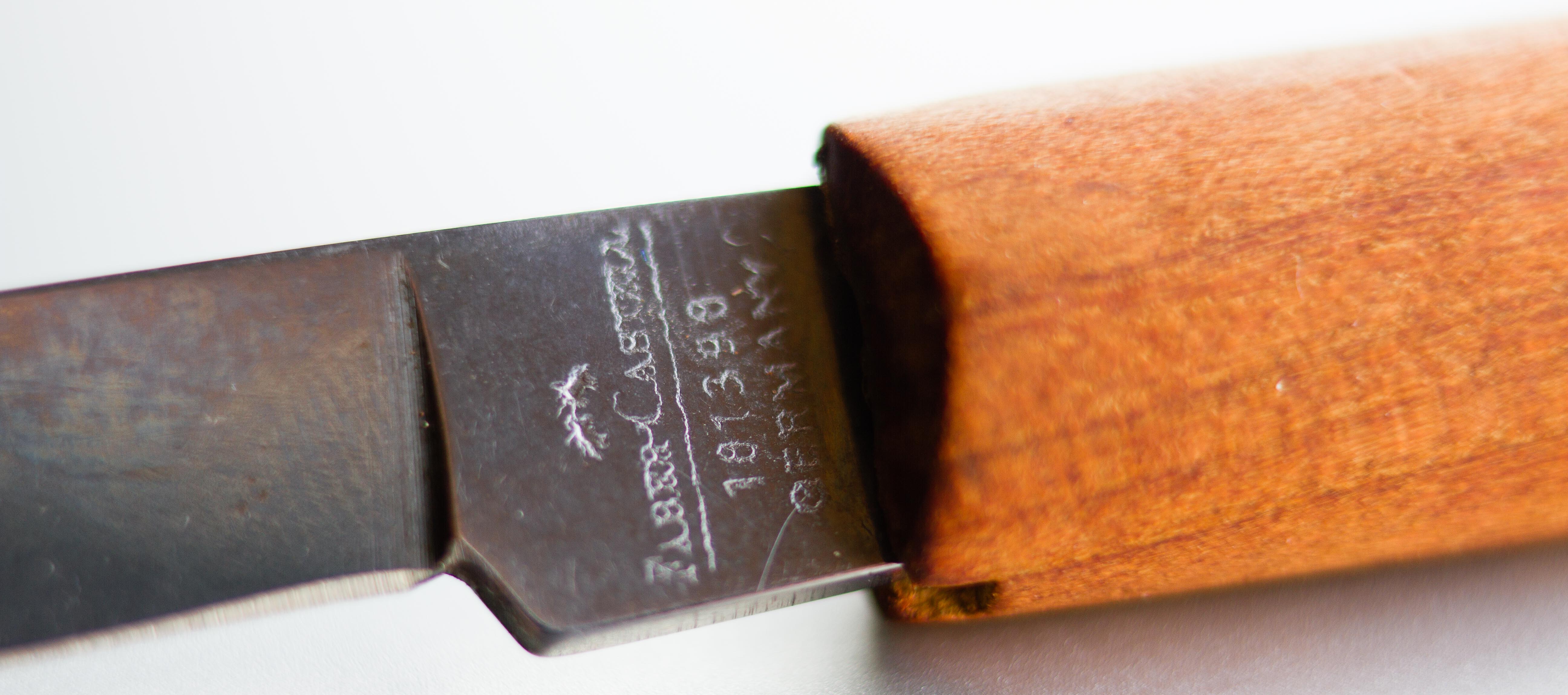
Today: another kind of eraser. This one has been quite useful on many occasions. One of the recent opportunities to use it was when I received dozens of printed cards that turned out to be printed with a mistake. Thanks to this ‘eraser’ I was able to ‘erase’ the mistakes from all the printed cards easily – by scratching them off the surface.
It’s Faber-Castell’s erasing knife 181398. One of its official purposes is to sharpen Faber-Castell’s charcoal sticks, but it can also be used on paper or to sharpen pencils, as demonstrated in one of Faber-Castell’s official videos (jump to 1:12).
Sharpening a Castell 9000 in F
This erasing knife has been around for 35 years. Gunther was kind enough to send me one in 2012 as I wasn’t able to get one in the UK at that time.
 I like a bargain. That means I do sometimes buy things if they are cheap, even if I don’t need them.